search expand

Melancholic States

Institute for Women’s Studies, Lancaster University 27-29 September 2007

This conference will explore the ways in which the idea of ‘melancholic states’ speaks to the complexity of the present. Melancholic States – with acclaimed speakers, artists, film makers and activists from across the world.

With a provenance in psychoanalysis, the concept of melancholia has proliferated across numerous fields. Sometimes it refers to a state of mind or an affective state: elsewhere it is used to speak of racialised, gendered or queer subjectivities. At other times it becomes a tool to analyse political states or to convene constituencies of solidarity.

Melancholia also founds collective memory and associated artefactual practices and describes the conditions of professional practice organised around a public service ethic. Positioned as a condition to be claimed, transcended, or negotiated, ‘melancholic states’ speaks to the contemporary zeitgeist: the post/neo-colonial era.

This international conference will bring together voices from women’s studies, postcolonial and critical race studies, critical psychology, politics, international relations, sociology, anthropology, geography, art and design and queer studies to address our melancholic states.

Confirmed plenary speakers include:

M. Jacqui Alexander (University of Toronto)

Gaye Chan (University of Hawai’i)

Veena Das (Johns Hopkins University)

David Eng (Rutgers University)

Ayse Gul Altinay (Sabinci University, Istanbul)

Yehudit Keshet (activist and writer, Jerusalem)

Ranjana Khanna (Duke University)

Roz Mortimer (filmmaker, London)

Kavita Panjabi (Jadavpur University, Calcutta)

Nandita Sharma (University of Hawai’i)

Cindy Weber (Lancaster University)

http://www.lancs.ac.uk/fass/events/melancholicstates/registration.htm

Registration is now underway for the Melancholic States conference – Early bird registration ends August 31st – click on link to register now and for further details http://www.lancs.ac.uk/fass/events/melancholicstates/registration.htm

Institute for Women's Studies, Lancaster University 27-29 September 2007

This conference will explore the ways in which the idea of 'melancholic states' speaks to the complexity of the present. Melancholic States - with acclaimed speakers, artists, film makers and activists from…

Read more

Ethnologin: “Schlagstöcke gegen Mönche ist für Burmesen zutiefst schockierend”

Wenn das burmesischen Militär auf Mönche einknueppelt, ist das eine in Burma extreme Vorgehensweise. Denn dass einem Mönch mit einem Stock über den Kopf geschlagen wird, sei eine Unvorstellbarkeit für Buddhisten, sagt die Berliner Ethnologin Miriam Kapp , lesen wir auf OÖNachrichten.

Mönche würden niemals infrage gestellt und schon ein Bild, das eine Schürfwunde auf dem Kopf eines Robenträgers zeige, löse Entsetzen in der Bevölkerung aus. “Es ist eine sehr symbiotische Beziehung zwischen den Familien und den Mönchen. Idealerweise sollte auch die Beziehung zum Staatsoberhaupt eine solche sein, aber sie wurde durch das Verhalten der Militärs zerstört”, sagte Kapp. Die Junta hätte alles versucht, die traditionell autonomen Klöster unter ihre Kontrolle zu bringen.

>> zum Bericht in den OÖNachrichten

Die Mönche halten demonstrativ Reisschüsseln halten – mit der Öffnung zu Boden gekehrt. Das ist in dem buddhistischen Land ein starkes Symbol: Die Mönche zeigen so, dass ihnen das (Seelen)Heil der Generäle nicht mehr wichtig ist. “Die Mönche aber zeigen, dass sie von der Regierung nichts mehr annehmen wollen. Und das gilt als eine harte Strafe.”, sagte die Ethnologin zwei Tage zuvor zur “Presse”. In der buddhistischen Tradition ist es nämlich alltäglich, Spenden, etwa Essen, in Schalen von Mönchen zu geben, wodurch sich der Spender Vorteile für sein Karma erhofft.

>> zum Bericht in der Presse

>> Burma-Spezial im Standard

Derzeit ist eine internationale Kampagne gestartet worden. Alle werden aufgefordert, sich am morgigen Freitag in Rot zu kleiden, siehe dazu mein Beitrag (auch mit mehr Info zu Burma) Wear red shirts on friday – Anthropologists on the protests in Burma?

Wenn das burmesischen Militär auf Mönche einknueppelt, ist das eine in Burma extreme Vorgehensweise. Denn dass einem Mönch mit einem Stock über den Kopf geschlagen wird, sei eine Unvorstellbarkeit für Buddhisten, sagt die Berliner Ethnologin Miriam Kapp , lesen wir…

Read more

Wear red shirts on friday – Anthropologists on the protests in Burma?

burma-demonstration

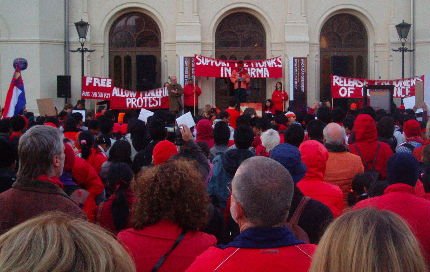
Wear red for Burma: Several thousand people at the demonstration in Oslo

“Wear a red t-shirt in solidarity this friday!” “Light candles in your windows on Friday night to honour the victims of the demostrations.” Pro-democracy protest marches in Burma have entered the tenth day. Burmese soldiers have detained about 200 Buddhist monks and fired shots as they attempt to disperse thousands of anti-government protesters in Rangoon.

Any comments by anthropologists on the situation in Burma? By now I’ve found two three four:

Monique Skidmore, medical anthropologist in The College of Arts & Social Sciences at the Australian National University (ANU) has been conducting research in Burma since 1994.

red shirt for burma

In the Australian online magazine Crikey she explains, that the the current protests stretch its roots stretch back to 1962 “when the Burmese armed forces, led by General Ne Win, usurped power from Burma’s democratically elected government of Prime Minister U Nu. General Ne Win ruled the country by fear, informers, propaganda and isolation. A civil war has waged since then, with estimates of the loss of life at up to 10,000 each year.”

Today’s street protests are furthermore “the culmination of a campaign for democracy being coordinated by the ’88 Student Generation, the activist movement in exile, the labor movement (embodied by Su Su Nway, now in hiding), monks, and the National League for Democracy.”

Coordination is difficult given that most mobile phones are illegal as well as use of the internet, she writes: “Burma’s first blog appeared last week showing the first day of the monk protest in Rangoon. It only took the military regime 24 hours to shut it down.”

>> Monique Skidmore: The Burmese people have had enough

Sometimes Burma is also called Myanmar. Myanmar is actually the official name, the BBC explains: The ruling military junta changed its name from Burma to Myanmar in 1989, a year after thousands were killed in the suppression of a popular uprising. Rangoon also became Yangon.

The name change is a form of censorship, says anthropologist and editor of Anthropology Today Gustaaf Houtman in the BBC article Should it be Burma or Myanmar?

Houtman has written a book that is available online (free) called Mental Culture in Burmese Crisis Politics. Aung San Suu Kyi and the National League for Democracy. It is also available on Google Books. Read also an interview with Houtman on The Culture of Burmese Politics.

update: In the New York Times story Karma Power: What Makes a Monk Mad anthropology professor Ingrid Jordt contributes with some orientalitic statements when she explains that the monks’ power comes from their role in bestowing legitimacy on the rulers:

“Legitimacy in Burma is not about regime performance, it’s not about human rights like the West. It is something that comes from the potency and karma bestowed by the monks. That’s why the sangha is so important to the government,” she said, referring to the Buddhist hierarchy and the spiritual status that its monks can convey. “They are actually the source of power.”

free burma

UPDATE: Anthropologist Gabriele Marranci tells a story that the mass media neglects to inform us: Muslims in Burma are persecuted, not only by the military, even by the ‘peaceful’ monks: >> Gabriele Marranci: The other, invisible suffering of Burma

FOR MORE INFORMATION ON THE SITUATION IN BURMA SEE:

BBC News Special Reports: Burma Protest

Wikipedia: 2007 Burmese anti-government protests

Global Voices: Burmese bloggers on Burma

BBC News also has a story about how Burma cyber-dissidents crack censorship and tell the world what is happening under the military junta’s veil of secrecy.

See also on Facebook Support the Monks’ protest in Burma and Red Shirt For Burma

For non facebook users more on the red shirt campaign see on these blogs at Livejournal, Dynamic Nonvilence, Sungame and in the Phuket Gazette: Red-shirt-Friday campaign sweeps Phuket and Norwegian trade union leader backs call to “wear red”

To those who think this might be a pointless or even stupid campaign I’ve found this comment in a facebook group:

Nobody thinks wearing a red shirt is gonna change the situation. Did you actually think so? Now THAT is really stupid.

Nobody really thought demonstrating against the Iraq war in Oslo, where I live, or any other place in the world would for that matter, would make Bush change his mind either. Point is, we still did it, it’s the biggest demonstration in Norwegian history.

What’s wrong with gathering the world? What’s wrong with trying to spread the word to everybody? What’s wrong with showing that you care, and that you are aware of the situation and have a statement, even though it doesn’t necessarily make a practical change? Negativity of that kind is what really is stupid.

UPDATE

Monks prosecute muslims? Free Burma International Bloggers’ Day 4.10.2007

burma-demonstration

Wear red for Burma: Several thousand people at the demonstration in Oslo

"Wear a red t-shirt in solidarity this friday!" "Light candles in your windows on Friday night to honour the victims of the demostrations." Pro-democracy protest marches in Burma…

Read more

Society for Ethnomusicology condemns use of music in torture

(via Savage Minds) Can a discussion about the use of music in torture shed new perspectives in our debates about the use of anthropological knowledge in torture, askes Kerim Friedman on Savage Minds. Jason Baird Jackson points in his comment to the Society for Ethnomusicology’s position statement on the use of music in torture:

The Society for Ethnomusicology condemns the use of torture in any form. An international scholarly society founded in 1955, the Society for Ethnomusicology (SEM) and its members are devoted to the research, study, and performance of music in all historical periods and cultural contexts. The SEM is committed to the ethical uses of music to further human understanding and to uphold the highest standards of human rights.

The Society is equally committed to drawing critical attention to the abuse of such standards through the unethical uses of music to harm individuals and the societies in which they live. The U.S. government and its military and diplomatic agencies has used music as an instrument of abuse since 2001, particularly through the implementation of programs of torture in both covert and overt detention centers as part of the war on terror.

The Society for Ethnomusicology

* calls for full disclosure of U.S. government-sanctioned and funded programs that design the means of delivering music as torture;
* condemns the use of music as an instrument of torture; and
* demands that the United States government and its agencies cease using music as an instrument of physical and psychological torture.

There’s also a link to the paper by by Suzanne Cusick: “Music as Torture, Music as Weapon”, published in Revista Transcultural de Música/Transcultural Music Review 10 (2006) that starts with these lines:

This paper is a first attempt to understand the military and cultural logics on which the contemporary use of music as a weapon in torture and war is based. After briefly tracing the development of acoustic weapons in the late 20th century, and their deployment at the second battle of Falluja in November, 2004, I summarize what can be known about the theory and practice of using music to torture detainees in Afghanistan, Iraq and Guantanamo. I contemplate some aspects of late 20th-century musical culture in the civilian US that resonate with the US security community’s conception of music as a weapon, and survey the way musical torture is discussed in the virtual world known as the blogosphere. Finally, I sketch some questions for further research and analysis.

>> Savage Minds: Rage against the machine and music in torture

>> The Society for Ethnomusicology’s position statement on the use of music in torture

>> Suzanne G. Cusick: Music as torture / Music as weapon

SEE ALSO:

American Anthropologists Stand Up Against Torture and the Occupation of Iraq

Anthropology and CIA: “We need more awareness of the political nature and uses of our work”

The dangerous militarisation of anthropology

(via Savage Minds) Can a discussion about the use of music in torture shed new perspectives in our debates about the use of anthropological knowledge in torture, askes Kerim Friedman on Savage Minds. Jason Baird Jackson points in his…

Read more

Antropologer: Militærets beste våpen?

I Weekendavisen får vi en grei oppsummering av en av de heteste debattene i antropologien: Er det greit å jobbe som spion for CIA og rådgiver for USAs Irakkrig og “terrorkamp”? Innledningen er slik:

Marcus Griffin er et våben, og han er et af den amerikanske hærs nyeste og bedste. Han er netop taget til Irak som fast mand på en af de første enheder med tilknyttet antropolog. Det er nemlig det, han er – specialist i menneskers samfunds- og kulturformer – og det er den slags viden, Pentagon blandt andet har besluttet sig for at satse på.

Journalisten Ina Kjøgx Pedersen som selv er antropolog har ikke bare saumfart diskusjonene på diverse antropologiblogger (også antropologi.info) og har lest mange fagartikler men har også snakket med flere sentrale aktører i debatten.

Konklusjonen høres naivt ut:

Tilbage står, at der måske fremfor alt er tale om en kløft mellem antropologi som videnskab og som værktøj – det har aldrig lydt kønt i et forskerselskab, når en praktiker argumenterede for at give nogen kulturkurser. Og så er der selvfølgelig lige det med krigen.

Men som den danske forsker Henrik Breitenbauch fra Dansk Institut for Militære Studier siger, så er det et stort skridt i den rigtige retning, at amerikanerne prøver at gå nye veje:

»Set over lang tid vil det samlede velfærdsniveau i verden vinde ved, at det amerikanske militær kommer til at forstå tingene mere holistisk.«

Det er en stor forskjell mellom å gi opplæring i antropologi være en direkt aktør og støttespiller for den ene parten i en uansett tvilsom krig.

>> les hele saken i Weekendavisen (link oppdatert)

Jeg har skrevet mye om temaet, se bl.a.

The dangerous militarisation of anthropology

Oppose participation in counter-insurgency! Network of Concerned Anthropologists launched

Anthropology and CIA: “We need more awareness of the political nature and uses of our work”

Forskere som spioner? CIA betaler antropologer for å “forske“ på muslimer. Militære fagtidsskrifter bruker uttrykk som “kulturbasert krig“ og “etnografisk etterretning“

Norske antropologer som spioner for E-tjenesten?

I Sverige: Antropologer utdanner soldater

Fredrik Barth underviste Hæren om Afghanistan

“Tribal Iraq Society” – Anthropologists engaged for US war in Iraq

Månedens antropolog: Tone Danielsen, rådgiver i Forsvaret

San Jose: American Anthropologists Stand Up Against Torture and the Occupation of Iraq and AAA Press Release: Anthropologists weigh in on Iraq, torture at annual meeting

I Weekendavisen får vi en grei oppsummering av en av de heteste debattene i antropologien: Er det greit å jobbe som spion for CIA og rådgiver for USAs Irakkrig og "terrorkamp"? Innledningen er slik:

Marcus Griffin er et våben, og han…

Read more