search expand

Utfordrer norskheten og hva det vil si å være muslim

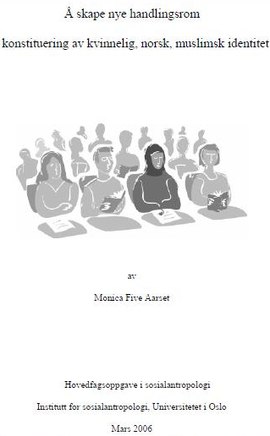
I sin hovedfagsoppgave i sosialantropologi har Monica Five Aarset undersøkt framveksten av en ung, kvinnelig, norsk, muslimsk identitet. Oppgaven som nå er blitt publisert på nett er basert på et 11 måneder langt feltarbeid blant kvinner som er tilknyttet Norges Muslimske Ungdom og Muslimsk Studentsamfunn.

Utviklingen av en norsk, muslimsk identitet innebærer både en etnifisering av den muslimske identiteten, og en deltakelse i og utviding av ”det norske”, skriver hun:

Informantene var aktive deltakere i det norske samfunnet gjennom studier, jobb og organisasjonsvirksomhet. Flere av informantene deltok i samfunnsdebatten gjennom organisasjoner, debatter, leserinnlegg og liknende. De utfordret etablerte forståelser av hva det vil si å være norsk og hva det vil si å være muslim.

(…)

De unge kvinnenes bruk av hijab, deltakelse i og utforming av de muslimske organisasjonene, og en begynnende tendens til ekteskap på tvers av etniske grupperinger er deler av konstitueringen av et norsk muslimsk kollektiv.

(…)

Å være muslim var en posisjon som gjorde det mulig å heve seg over og kritisere tradisjon, og bekjempe og utfordre stigmatisering. Gjennom referanser til islam skapte de unge muslimene handlingsrom hvor nye måter å være unge muslimske kvinner ble konstituert.

(…)

Vektlegging av en muslimsk identitet og referanser til en styrket kvinneidentitet i islam gjorde de unge muslimske kvinnene mindre utsatt for beskyldninger om ”fornorskning” og ga dem mulighet til å argumentere mot både ”vestlige” stereotypier og fordommer mot islam som en aggressiv og kvinnefiendtlig religion, og det de oppfattet som kvinneundertrykkende tradisjoner i sine/foreldrenes kulturelle bakgrunn.

Hun mener at beskrivelsene og analysen av de unge muslimenes erfaringer i studien “gir viktige innspill i forståelsen av hvordan det er å vokse opp som muslim i Norge i dag og i årene som kommer”.

>> last ned hele oppgaven: “Å skape nye handlingsrom – konstituering av kvinnelig, norsk, muslimsk identiet” (pdf)

>> Monica Five Aarsets blogg

PS: En etnifisering av ens identitet har antropolog Jan-Kåre Breivik observert blant døve, se Døve som etnisk gruppe?.

SE OGSÅ:

Doktorgrad på unge norske muslimer: På vei til en transnasjonal islam. antropologi.info-intervju med Christine M. Jacobsen

Når unge muslimer chatter med imamen – Internettets betydning for minoritetsungdom

Islam i Europa: Majoritetssamfunnet som premissleverandør

Muslimer i Göteborg berättar i ny rapport

Muslims in Calcutta: Towards a middle-class & moderation

Danske muslimer: Ja til ekteskap med ikke-muslimer

Å leve med hijab – to nye studier

Lila Abu-Lughod: It’s time to give up the Western obsession with veiled Muslim women

What does it mean to be Muslim in a secular society? Anthropologist thinks ahead

Islam: Embracing modernity while remaining true to their traditions and core beliefs

Unge muslimer vil ha “norsk islam”

Islam i Norge – Oddbjørn Lerivik sin oversikt

I sin hovedfagsoppgave i sosialantropologi har Monica Five Aarset undersøkt framveksten av en ung, kvinnelig, norsk, muslimsk identitet. Oppgaven som nå er blitt publisert på nett er basert på et 11 måneder langt feltarbeid blant kvinner som er tilknyttet Norges…

Read more

Why the French Don’t Like Headscarves

(LINKS UPDATED 11.1.2021) “Why the French Don’t Like Headscarves: Islam, the State and Public Space” is the title of a new book by American anthropologist John R. Bowen. For nearly three years ago, the French government banned headscarves and similar clothing that indicates religious affiliation from public schools.

Bowen writes in the introduction:

French public figures seemed to blame the headscarves for a surprising range of France’s problems including anti-Semitism, Islamic fundamentalism, growing ghettoization in the poor suburbs, and the breakdown of order in the classroom. A vote against headscarves would, we heard, support women battling for freedom in Afghanistan, schoolteachers trying to teach history in Lyon, and all those who wished to reinforce the principles of liberty, equality and fraternity.

He explains:

France has a long-standing tradition of state control and support of religious activity despite its modern laws concerning secularity. We often have the misconception that the state stays out of religious affairs. In fact, the French government pays the salaries of all teachers in private religious schools, it organized a national Islamic body, and it and city governments put a lot of money into building churches and mosques.

But because the Republican political tradition that developed out of the French Revolution of 1789 targeted the privileges of the Catholic Church, many French citizens developed a certain allergy to religions’ symbolism in public, and particularly in schools, a battleground between the Church and the Republic.

From that research, he’s working on another book, titled “Shaping Islam in France,” to be published in 2008, which will examine how French Muslims strive to build a base for their religious lives in a society that views these practices as incompatible with national values.

>> read the whole article on the website of Washington University in St.Louis

>> John R. Bowen: Muslims and Citizens. France’s headscarf controversy (Boston Review February/March 2004)

>> John R. Bowen: Pluralism and Normativity in French Islamic Reasoning (pdf)

>> John R. Bowen: Beyond Migration: Islam as a Transnational Public Space (pdf)

>> John R. Bowen: Does French Islam Have Borders? Dilemmas of Domestication in a Global Religious Field (pdf)

SEE ALSO:

Lila Abu-Lughod: It’s time to give up the Western obsession with veiled Muslim women

France: More and more muslims observe Ramadan

(LINKS UPDATED 11.1.2021) "Why the French Don't Like Headscarves: Islam, the State and Public Space" is the title of a new book by American anthropologist John R. Bowen. For nearly three years ago, the French government banned headscarves and similar…

Read more

Male circumcision prevents AIDS?

Two major studies have found that male circumcision reduces the risk of HIV infection by half, according to the San Francisco Chronicle. Dozens of studies conducted since the 1980s found similar results but lacked the scientific rigor of a randomized clinical trial.

“This is a landmark day in the history of fighting this epidemic”, said medical anthropologist Robert Bailey, who led one of the the two studies. Bailey first became interested in circumcision for AIDS prevention in 1985, when colleagues in the field began noticing that HIV rates were much higher in regions of Africa populated by non-circumcising communities.

Doctors theorize that circumcision might protect against HIV infection because the foreskin is rich in a type of white blood cell that is a favorite target of the AIDS virus. In addition, some studies suggest that circumcised males are less likely to have other sexually transmitted diseases, which cause sores that serve as gateways for HIV to enter the bloodstream.

Researchers stress that circumcision should not be considered a replacement for other measures such as the use of condoms. Male circumcision requires trained personnel, sterile instruments etc. In the developing world, these resources are often in short supply, and, in their absence, the procedure can lead to infections and even death.

Another study will attempt to determine whether women also benefit from the reduced HIV infection risk in a population of circumcised men.

>> read the whole story in the San Francisco Chronicle

SEE ALSO:

The emerging research field of medical ethnomusicology: How music fights AIDS

“There’s no AIDS here because men and women are equal”

Cultural values and the spreading of AIDS in Africa

“Ethnographic perspectives needed in discussion on public health care system”

AIDS and Anthropology – Papers by the AIDS and Anthropology Working Group

Two major studies have found that male circumcision reduces the risk of HIV infection by half, according to the San Francisco Chronicle. Dozens of studies conducted since the 1980s found similar results but lacked the scientific rigor of a randomized…

Read more

Wanted: Cultural anthropologist to sort out Seattle’s Christmas trees

Are public Christmas trees an “unconstitunal endorsement of one religion over another”? The debates about the removal of nine Christmas trees at the Seattle airport remind of the hijab-controversis and the display of (supposedly) religious symbols in the public. The Christmas trees at the airport had come down after a rabbi requested that a Hanukkah menorah also be displayed. “We decided to take the trees down because we didn’t want to be exclusive,” said airport spokeswoman Terri-Ann Betancourt.

Seattle Times:

Port of Seattle staff felt adding the menorah would have required adding symbols for other religions and cultures in the Northwest, said Terri-Ann Betancourt, the airport’s spokeswoman. The holidays are the busiest season at the airport, she said, and staff didn’t have time to play cultural anthropologists.

Andrew Gumbel comments in The Independent:

By Monday night, the trees were back, as if nothing had happened. Airport officials, frantically wiping egg off their collective faces, thanked Rabbi Bogomilsky for seeing the light and promised to rethink their seasonal decorations for next year. Cultural anthropologists across the US are no doubt busy honing their application letters already.

>> Wanted: cultural anthropologist to sort out Seattle’s ‘holiday trees’ (Andrew Gumbel, The Independent 13.12.06)

>> Airport puts away holiday trees rather than risk being “exclusive” (Seattle Times, 10.12.06)

>> Christmas trees going back up at Sea-Tac (Seattle Times, 12.12.06)

>> Treeless in Seattle? The port stumbles (Robert L. Jamieson Jr, Seattle Post Intelligencer, 12.12.06)

>> Christmas trees date back to ancient nature lovers (seattle Times, 12.12.06)

Are public Christmas trees an "unconstitunal endorsement of one religion over another"? The debates about the removal of nine Christmas trees at the Seattle airport remind of the hijab-controversis and the display of (supposedly) religious symbols in the public. The…

Read more

Nepal: Anthropologists, sociologists urged to build country

“Anthropologists should actively cooperate in the building of new Nepal”, Subash Chandra Nembang said at the three-day international seminar on ‘social science in a multi-cultural world’, organized by the Nepal Sociological and Anthropological Society (NSAS).

“It is sad that most of the projects run in Nepal do not have participation of sociologists and anthropologists”, he said. Secretary of the Society Bhanu Timsina said the sector has been under shadows as the planners have not realized the utility of the sociologists and anthropologists, according to the website The Rising Nepal.

Unfortunately, neither the conference nor the organisation seems to have a website. Digital Divide?

SEE ALSO:

Anthropology in a Time of Crisis. A Note from Nepal

Global identity politics and The Emergence of a Mongol Race in Nepal

Festivals and Cultural Change in Kathmandu, Nepal

“No Nepalese Can Dare To Challenge Centuries Old Religious Harmony”

Stefanie Lotter: Studying-up those who fell down: elite transformation in Nepal (Anthropology Matters 2/2004)

"Anthropologists should actively cooperate in the building of new Nepal", Subash Chandra Nembang said at the three-day international seminar on 'social science in a multi-cultural world', organized by the Nepal Sociological and Anthropological Society (NSAS).

"It is sad that most…

Read more