search expand

More Global Apartheid?

(LINKS UPDATED 6.4.2020) In my previous post, I’ve quoted anthropologist Owen Sichone about the concept of “Global apartheid”:

Whatever the advantages of apartness are (more economic than cultural), the South African system came to an end just as the rest of the world was reinventing it in new forms. Global apartheid policed by the regime of visas and passports in a manner that African migrant workers (…) would easily recognize as colonial still does the job of keeping wealth and poverty apart.

The French government is planning a new immigration law, furthering these developments towards more global apartheid, according to anthropologist Cicilie Fagerlid who writes:

According to this new law, immigration to France should be “chosen” (immigration choisie) rather than “suffered from” or “undergone” (subie). In practice, this means that people who are useful to the French economy are invited in, while the law will be more restrictive on the others – the asylum-seekers, the family reunions and the unregistered sans-papiers.

On yesterdays’ demonstration against the law, she writes, “quite a few demonstrators today had come to the conclusion that the interior minister obviously doesn’t love France as she is, so they suggested that he packs his bags and leave.”

>> read her whole post

Salih Booker and William Minter define Global Apartheid this way:

Global apartheid, stated briefly, is an international system of minority rule whose attributes include: differential access to basic human rights; wealth and power structured by race and place; structural racism, embedded in global economic processes, political institutions and cultural assumptions; and the international practice of double standards that assume inferior rights to be appropriate for certain “others,” defined by location, origin, race or gender.

>> read their whole article in The Nation

UPDATE (8.5.06):

Anthony Katombe from GlobalVoices reviews francophone blogs on African immigrants’ latest tribulations in France and Belgium. Blogger Le Pangolin belies Sarkozy’s assertions that France wants to start “choosing its immigrants” through new, tighter policies:

France has always chosen its immigrants. Remember the Senegalese janitors whom France imported from Senegal and Mali, the Renault and Peugeot auto factory workers they went to fetch in Maghreb to break the communist party and the CGT union’s strong influence between 1950 and 1970.

Le Pangolin ridicules a French government drowning under youth unemployment protests attempting desperately to redirect public attention towards a scapegoat, the African immigrant

>> read the whole post on GlobalVoices

SEE ALSO:

Yash Tandon: What is global apartheid and why do we fight it?

Charles Mutasa: Global Apartheid Continues to Haunt Global Democracy

Owen Sichone on Global Apartheid: Poor African migrants no less cosmopolitan than anthropologists

Proclaiming the birth of a new civil rights movement – demonstration against a tougher immigration policy in the US

Racism and The Five Major Challenges for Anthropology

(LINKS UPDATED 6.4.2020) In my previous post, I've quoted anthropologist Owen Sichone about the concept of "Global apartheid":

Whatever the advantages of apartness are (more economic than cultural), the South African system came to an end just as the…
Read more

Din masteroppgave på forsiden av avisa!

Den danske avisa Information har for ikke lenge siden startet et utmerket initiativ ang forskningsformidling: Information gir mulighet til å omtale og legge ut oppgaven i en egen blogg! Utrolig bra ide! Ikke minst fordi avisa først og fremst er interessert i oppgaver innen humaniora og samfunnsvitenskap. Jeg har allerede oppdaget flere oppgaver som jeg har tenkt å omtale her senere en gang. En norsk avis som føler seg kallet?

>> ta en titt på Informationens blogg om fakultets-specialer

Den danske avisa Information har for ikke lenge siden startet et utmerket initiativ ang forskningsformidling: Information gir mulighet til å omtale og legge ut oppgaven i en egen blogg! Utrolig bra ide! Ikke minst fordi avisa først og fremst er…

Read more

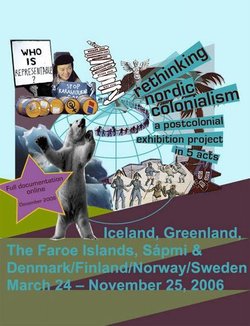
Rethinking Nordic Colonialism! Nordisk kolonialhistorie fram fra glemselen

plakat “Rethinking Nordic Colonialism” heter et interessant utstillingsprosjekt som tar for seg en glemt og mørk del av nordisk historie. For første gang blir den nordiske kolonialhistoria presentert i et globalt historisk og politisk perspektiv, skriver Dan Jönsson som skildrer sine første inntrykk etter at prosjektet startet i Reykjavik i mars:

Hur hänger Grönlands framtid ihop med situationen för tredje världens arbetarkvinnor och med kriget mot terrorismen? Hur påverkar den nordiska kolonialhistorien vår syn på dagens invandring? Borde vi be om ursäkt?
(…)
Här ställs frågor om historisk skuld och kulturella rättigheter, om det kollektiva och det individuella minnet, om konstens politisering kontra politikens estetisering, om historieskrivningen som marknadsföring & Vilket är viktigast? Var ska man börja?

>> les hele saken i Dagens Nyheter

I pressemeldingen (pdf) leser vi:

Selv om de nordiske koloniene er avviklet (nesten da), er ikke koloniseringen et overstått kapittel. Regionen kan i dag sies å befinne seg i en postkolonial tilstand med tydelige spor fra koloniseringen. I de tidligere koloniene vil man f.eks. kunne støte på frustrasjon over ikke å bli hørt,forstått og respektert, samtidig som man har splittede følelser i forhold til fortidens kolonisatorer.
(…)
Det Nordiske Institutt for Samtidskunst, NIFCA, står bak det visjonære prosjektet som kombinerer utstillinger med workshops, konferanser, høringer og happenings på Island, Grønland, Færøyene og det samiske området i Finland. 56 anerkjente kunstnere, teoretikere, politikere og
grasrotaktivister fra hele verden deltar i prosjektet som varer fra 24. mars til 25. november 2006.

>> prosjektets hjemmeside

Litt mer info om bakgrunnen gir teksten Exhibition Proposal. Vi finner et utdrag fra “What Is Danish Racism? av idehistorikern Kim Su Rasmussen som skriver:

“Another aspect, which is important in order to understand the complexity of the current racism in Denmark, concerns a pervasive historical repression of Denmark’s colonial history. In my opinion, there exists amongst the ordinary Dane a pervasive denial of the history of Danish slave trade and the Danish slave colonies in the West Indies.”

Teksten fortsetter slik:

According to Su Rasmussen, this denial is not accidental. Denmark’s imperial history (…) paints a picture of the Danes, which is in direct conflict, if not incompatible, with Danish self-perception today as a liberal, tolerant, progressive people.
(…)
It could be argued that this historical repression is characteristic of the other Scandinavian countries also. Sweden’s past colonial activities in the Baltic, the Caribbean, and the Cape Coast, and Norway’s present-day claim to possessions in the Arctic and Antarctica are toned down. The devastating effect that Swedish, Norwegian, and Finnish colonization has had, and continues to have, on the indigenous Sámi people living within their respective realms is also played down in favor of a massive exploitation of Sámi identity by the tourist industries of these countries.

>> les hele Exhibition Proposal (pdf)

SE OGSÅ:

Wikipedia om Danmarks kolonitid

Nett-Utstilling om slavehandelen (Liverpool Maritime Museum skriver bl.a. “The main European nations involved in slaving were Portugal, Spain, Britain, France, the Netherlands, Denmark and Sweden”)

Ny bok: “Kolonialismens svarta bok”

Menneskeutstillinger og myten om hvit overlegenhet

plakat

"Rethinking Nordic Colonialism" heter et interessant utstillingsprosjekt som tar for seg en glemt og mørk del av nordisk historie. For første gang blir den nordiske kolonialhistoria presentert i et globalt historisk og politisk perspektiv, skriver Dan Jönsson som skildrer sine…

Read more

Owen Sichone: Poor African migrants no less cosmopolitan than anthropologists

Anthropologists are citizens of the world because they are able to manoeuvre in and out of different cultures. African migrants display similar competencies when they are away from home. But you can even be cosmopolitan without ever having left your home, anthropologist Owen B. Sichone told at the conference Cosmopolitanism and Anthropology:

If we want to understand the cosmopolitanism of global justice we may find the answer not in liberal constitutions or UN conventions but in the real lives of the world’s a dollar a day multitudes.

(…)

In my view we would do better to look to remote Africa villages and congested urban slums to find the woman who greets the stranger with a tray of food and this woman who has never left home lives her cosmopolitanism by welcoming the world. One does not need to be well travelled to be a polyglot, polymath or cosmopolitan if one is plays host to the world as the women of Cape Town have done since the Mother City was constructed.

European capitalism on the other hand is uncosmopolitan:

In today’s globalising world the political philosophers have defined cosmopolitanism in various ways. Whether we see it as based on liberal notions of human dignity, (Appiah, 2005 ch6), ‘obligations of justice to non-nationals’ or merely being ‘marked by diverse cultural influences’ (Sypnowich: 56) the European capitalist who has long offered himself as the ideal type fails the test. It is not just failure to protect strangers in Europe but the whole imperial episode of colonial oppression, i.e uncosmopolitan cosmopolitanism.

Sichone points to tougher immigration laws, that are limiting the mobility of the less affluent people outside the rich countries. Modernisation has in his opinion meant sedentarisation rather than increasing mobility for most Africans. :

Whatever the advantages of apartness are (more economic than cultural), the South African system came to an end just as the rest of the world was reinventing it in new forms. Global apartheid policed by the regime of visas and passports in a manner that African migrant workers (…) would easily recognize as colonial still does the job of keeping wealth and poverty apart.

(…)

It is ironical that East Africans seem to have enjoyed greater freedom of movement during the colonial days than they do today. There was no real border at the time as East Africa was all-British territory, the same could be said for other parts of the continent.

Certain migrants, the sort that travel without passports or visas, challenge the system of global apartheid and make it possible for others who belong to the immobile 97 per cent of the global population that never leaves home, to connect with the world in ways that facilitate the transfer of resources between centres and peripheries. They sometimes impact upon the host population in dramatic and unpredictable ways that belies their small numbers, Sichone writes.

On the other hand, Cape Town (where his paper focuses on) is a quite xenophobic society. This may be the result of imperialism, colonialism and apartheid. Sichone found striking gender differences. Women are much more friendly to strangers than men. For the South African more strangers means less resources for everyone:

Xenophobia (…) is most pronounced in the world of the retrenched worker, the men who must blame their unemployability on foreigners and who see themselves in a zero sum battle for survival.
(…)
Many migrants in Cape Town would probably agree with the Congolese refugee who said, if it were not for the women, we would not make it. (…) My Tanzanian contact, Pascal referred to some of them as the ‘Xhosa mama’ who provide new arrivals with accommodation and counter the ill-treatment that makwerekwere suffer at the hands of South African men. The ‘Xhosa mama’ treats foreigners, strangers, aliens etc as fellow human beings from the beginning just as the xenophobic men are hostile to strangers even before they encounter them.

He concludes:

What we seek to do is not necessarily to denounce elite models of cosmopolitanism exemplified by the work of international scholars, global social movements or human rights activists but rather to demonstrate that for the dollar a day multitudes ultimate security lies in ubuntu.

His paper was for me one of the highlights of the conference. So I am glad that Owen Sichone gave me the permission to post his paper on antropologi.info. He welcomes comments. His email address: osichone AT humanities.uct.ac.za

>> read Xenophobia and xenophilia in South Africa. Africans migrants in Cape Town by Owen B. Sichone (90kb, pdf)

EARLIER POSTS ABOUT THE CONFERENCE:

What’s the point of anthropology conferences? (general summary)

David Graeber: There never was a West! Democracy as Interstitial Cosmopolitanism

Thomas Hylland Eriksen: Cosmopolitanism is like respecting the ban on smoking in the public

For an Anthropology of Cosmopolitanism

Anthropologists are citizens of the world because they are able to manoeuvre in and out of different cultures. African migrants display similar competencies when they are away from home. But you can even be cosmopolitan without ever having left…

Read more

“Lærer oss alternativer til vår måte å leve på”

Lena Thomsson i Gefle Dagblad er begeistret over boka På Barheidas tid – Familjekrönika från Savannen av antropologene Stig Holmqvist og Aud Talle. Den handler om nomader i Tanzania. Antropologene møtte nomadene allerede i 1971. Ifjor har de vært der for tredje gang:

Holmqvist och Talle har bott hos Barabaig, fotograferat och dokumenterat livet i byn, intervjuat medlemmarna av Barheidas familj och and­ra, böckerna blir fina som dyrbara smycken av elfenben. “På Barheidas tid” är mer av rapportbok än antropologi. Här finns inte det vetenskapliga och förklarande som så lätt blir nedlåtande. Författarna har få åsikter. Perspektivet är ofrånkomligt utifrån men det känns inte som en avigsida.

Anmelderen mener boka er så viktig fordi den viser oss at det fins andre måter å leve på og fordi den utfordrer mange gjengse forestillinger:

Den här boken är viktig att läsa för alla som vill veta hur det också går att organisera samhällen, att vårt sätt med representation och de valda så långt bort att de lika gärna kunde vara verksamma på månen, inte är enda sättet. Barabaigs rättssystem är direkt och handgripligt och demokratiskt.Polygamin är en försörjningsstruktur och inte en manlig sexuell utlevelse. Just detta gör böcker som “På Barheidas” tid oundgängliga. Vi får lära oss nya synsätt, alternativ till vårt sätt att leva, filosofera, att resonera existentiellt.

>> les hele anmeldelsen i Gefle Dagblad

Lena Thomsson i Gefle Dagblad er begeistret over boka På Barheidas tid - Familjekrönika från Savannen av antropologene Stig Holmqvist og Aud Talle. Den handler om nomader i Tanzania. Antropologene møtte nomadene allerede i 1971. Ifjor har de vært der…

Read more