search expand

Saba Mahmood: Democracy is not enough – Anthropologists on the Arab revolution part II


Voice of Freedom / Sout Al Horeya by Amir Eid ft. Hany Adel

(post in progress) While the revolutions in Northern Africa and the Middle East are spreading and the Libyan people managed are trying to get rid of another dictator, anthropologists continue to comment the recent events. Here is a short overview.

Much has been said about who or what is going to replace Mubarak after he had to step down two weeks ago. In her article The Architects of the Egyptian Revolution in The Nation, anthropologist Saba Mahmood directs our attention to a rather neclected topic: The economic unjustice in Egypt and its connections to “American driven reforms”. For since the 1970s, she writes, the Egyptian economy has been increasingly subject to neoliberal economic reforms by the World Bank, the IMF and USAID at the behest of the United States government. Egyptian elites have been beneficiaries of, and partners in, these American-driven reforms:

While there is no doubt that the new order in Egypt cannot do without the civil and political liberties characteristic of a liberal democracy, what is equally at issue in a country like Egypt is an economic system that serves only the rich of the country at the expense of the poor and the lower and middle classes.

The vast majority of public institutions and services in Egypt have been allowed to fall into a dismal state of disrepair. Countless Egyptians die in public hospitals for lack of medical care and staff; Egypt’s universities are no longer capable of delivering the education of which they once boasted. Lack of housing, jobs and basic social services make everyday life impossible to bear for most Egyptians, as do declines in real wages and escalating inflation.

It is these conditions that prompted the workers—from the industrial and service sector—to stage strikes and sit-ins over the past ten years. These workers were an integral part of the demonstrations over the past two weeks in Egypt; various unions formally joined the protests in the days immediately preceding Mubarak’s resignation, prompting some to suggest that this was a turning point in the evolution of the protest.

The role the US government plays will be “enormously consequential”:

While the Obama administration has reluctantly yielded to the demands for democratic reform, it is highly doubtful that this administration will tolerate any restructuring of US economic interests in Egypt and in the region more generally.

Egypt was governed as a private estate, explains political scientist Salwa Ismail in the Guardian. Under sweeping privatisation policies, Mubarak and the clique surrounding him appropriated profitable public enterprises and vast areas of state-owned lands.

“Egypt’s protests were a denunciation of neo-liberalism and the political suppression required to impose it”, concludes filmmaker Philip Rizk in Al-Jazeera. He has recently completed a documentary on the food price crisis in Egypt and blogs at tabulagaza.blogspot.com.

Protests were according to him the culmination of a wave of much smaller and more localised strikes and demonstrations that had been taking place across the country since 2006.

Saba Mahmood agrees. She goes in her account back to 2004. In The road to Tahir, another prominent anthropologist, Charles Hirschkind, gives us a comprehensive introduction in the history of the Egyptian revolution, starting with the Kifaya movement, that “brought together Islamists, Muslim Brothers, communists, liberals, and secular-leftists, joined on the basis of a common demand for an end to the Mubarak regime and a rejection of Gamal Mubarak’s succession of his father as president”. Many of the bloggers who helped promote the Kifaya movement have played key roles in the events of the past two weeks, he writes. (A longer version is available in the Open Access journal Revista de Dialectología y Tradiciones Populares.)

Political scientist Moataz A. Fattah lists in the Christian Science Monitor five reasons why Arab regimes are falling. Major societal and demographic factors are at play that in his view won’t go away with a new government, he argues.

Egypt: Rise to Freedom by Basha Beats and Natacha Atlas ناتاشا اطلس

Rise to Freedom by Basha Beats and Natacha Atlas

One of the best sources about the current Arab revolutions is the blog Closer. Anthropologist Martijn de Koning is regularily posting round-ups and recruites guest writers as for example Samuli Schielke, anthropologist at Zentrum Moderner Orient (ZMO), Berlin.

“If this revolution has taught me one thing is that the people of Egypt do not need to look up to Europe or America to imagine a better future”, he writes in his post “Now, it’s gonna be a long one” – some first conclusions from the Egyptian revolution:

“Compared to our governments with their lip service to democracy and appeasement of dictators, Egyptians have given the world an example in freedom and courage which we all should look up to as an example. This sense of admiration and respect is what has drawn so many foreigners to Tahrir Square in the past days, including myself.”

Samuli Schielke has maintained a diary of the protests at Tahrir Square at http://samuliegypt.blogspot.com/ . On his website, we find both photography (among others from Egypt) and several papers, among others Second thoughts about the anthropology of Islam, or how to make sense of grand schemes in everyday life, Ambivalent Commitments: Troubles of Morality, Religiosity and Aspiration among Young Egyptians and Boredom and despair in rural Egypt (what a title!).

The most recent post at Closer is Tunisia: from paradise to hell and back?, a personal account by Miriam Gazzah. She is currently working within the research project Islamic cultural practices and performances: The emergence of new youth cultures in Europe.

Riz Khan - Mother of the revolution

Several anthropologists commented on the rape story where CBS correspondent Lara Logan had been sexually assaulted while covering the Egyptian protests. “Two disturbing lines of commentary have emerged: one that cites irrelevant details about Logan’s beauty or her past sexual history, the other blaming Muslims or Egyptian culture for the assault”, anthropologist Racel Newcomb comments in the Huffington Post:

Rather than blaming religion, we should work to end underdevelopment, poverty, and a lack of education, problems whose eradication is crucial to a prosperous and healthy society anywhere, whether in Egypt or here at home.

In Empire and the Liberation of Veiled Women, anthropologist Maximilian Forte deconstructs the popular narrative of the West bringing freedom to the women of the non-West.

UPDATE: Fascinating developments. Egypt is inspring US protesters. Check From Cairo to Madison: Hope and Solidarity are Alive. Medea Benjamin writes:
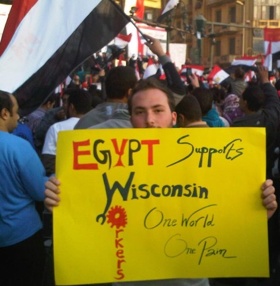
Local protesters were elated by the photo of an Egyptian engineer named Muhammad Saladin Nusair holding a sign in Tahrir Square saying “Egypt Supports Wisconsin Workers—One World, One Pain.” The signs by protesters in Madison include “Welcome to Wiscairo”, “From Egypt to Wisconsin: We Rise Up”, and “Government Walker: Our Mubarak.” The banner I brought directly from Tahrir Square saying “Solidarity with Egyptian Workers” has been hanging from the balcony of the Capitol alongside solidarity messages from around the country.

She quotes Muhammad Saladin Nusair who wrote these wonderful lines:

“If a human being doesn’t feel the pain of his fellow human beings, then everything we’ve created and established since the very beginning of existence is in great danger. We shouldn’t let borders and differences separate us. We were made different to complete each other, to integrate and live together. One world, one pain, one humanity, one hope.”

More texts:

John Postill: Egypt’s uprising: different media ensembles at different stages

Asef Bayat: Egypt, and the post-Islamist middle east: Why the portrayal of Egypt’s uprising in terms of its potential capture by Islamists is doubly misleading

Keith Hart: CLR James and the idea of an African revolution

Sami Hermez: Sacrifice and the Ripple Effect of Tunisian Self-immolation

Slavoj Žižek: For Egypt, this is the miracle of Tahrir Square

Gabriele Marranci: The Libyan massacre: or rather protesters killed for Italian and European interests?

SEE ALSO my first round up: “A wonderful development” – Anthropologists on the Egypt Uprising (updated 6.2.)

https://www.youtube.com/watch?v=CojujCER5Vw
Voice of Freedom / Sout Al Horeya by Amir Eid ft. Hany Adel

(post in progress) While the revolutions in Northern Africa and the Middle East are spreading and the Libyan people managed are trying to get rid of another dictator,…

Read more

Here they are: Open access anthropology books!

(LINKS UPDATED 22.4.2020)

More and more journals have gone open access, now it’s time for open access books!

OAPEN – Open Access Publishing in European Networks is an initiative in Open Access publishing for humanities and social sciences monographs. Several European university presses have joined the initiative that aims to improve the accessibility and dissemination of academic books. “The traditional book publishing model”, they state, “is no longer sustainable”.

OAPEN was launched last autumn at the Frankfurt Book Fair. Their first conference will be held at the end of this week in Berlin

Searching for anthropology gives 289 hits, among others these books. All books can be downloaded as pdf-files.

(Thanks, Marjut for the link!)

Meanwhile, Owen Wiltshire has published a draft of his thesis about making anthropology accessible online including a summary

SEE ALSO:

Democratic Publishing = Web + Paper

SSOAR – The first Social Science Open Access Repository is online

1st of May is Open Access Anthropology Day!

(updated) Danah Boyd on Open Access: “Boycott locked-down journals”

For Open Access: “The pay-for-content model has never been successful”

antropologi.info survey: Six anthropologists on Anthropology and Internet

Why Open Access?

(LINKS UPDATED 22.4.2020) More and more journals have gone open access, now it's time for open access books!

OAPEN - Open Access Publishing in European Networks is an initiative in Open Access publishing for humanities and social sciences monographs.…

Read more

Evaluering fastslår: Norsk antropologi stagnerer

Det er mye spennende som norske antropologer holder på med, men det er lite rom for nytenkning i faget. Antropologer er mer opptatt av å reprodusere etablert kunnskap enn å utfordre det, fastslår den første evalueringen av sosialantropologifaget i Norge.

Fem antropologer fra Danmark, Sverige, Finland, England og USA har på oppdrag av Forskningsrådet evaluert den norske antropologiens tilstand. De har lest publikasjonene til 88 antropologer og intervjuet mange av dem. Fokuset er årene 2004-2008.

Å si at dette fagpanelet “slakter” den norske antropologien ville være overdrevet. De har mye pent å si om faget. Likevel er det et problemtisk aspekt som trekker seg som rød tråd gjennom evalueringens 116 sider som bør vekke bekymring: Og det er fagets manglende evne til fornyelse.

Den norske antropologien ser ut til å stagnere.

Evalueringen påpeker blant annet følgende:

– “Much of the work seems to follow the logic of already-established theoretical trends, rather than necessarily developing theory of its own.

– “Little development is seen in terms of innovative fieldwork techniques and methodologies”.

– “With respect to originality, there were relatively few works that would potentially change the horizon of anthropology.”

Grunnen til denne stagnasjonen er blant annet manglende mobilitet og for mye intern rekruttering: Selv om det er tegn på bedring, så ansatter man stort sett folk man kjenner fra før, helst fra samme institutt:

A typical career path is to write your doctoral thesis at the same institution where you got your master’s degree. If a further academic career is pursued, it will be at the same university (or in a multidisciplinary unit geographically closely situated).
(…)
UiO is almost exclusively recruiting their own students to PhD positions, whereas half of the PhD students at UiB have their education from another institution. In total, 2/3 of all PhD students that completed their dissertation between 2003 and 2007, were recruited from the same university department where they gained their higher degree. (…) The recruitment of faculty staff from abroad is also very limited, albeit changing gradually in Oslo and Bergen.
(…)
Students and faculty seldom spend sustained time at other institutions abroad. The level of recruitment of international students is very low as a whole. Apart from the protracted fieldwork periods, the out-migration impulse is almost non-existent, even as shorter one or two semesters visiting stints.
(…)
The Panel believes that there may be a direct relationship between this long-lasting model of limited internationalization and the limited innovation and theoretical risk-taking, seen in the scholarly work.

Det finnes selvfølgelig unntak, dvs innovative og internasjonalt orienterte forskere, spesielt phd-studenter, men dette er altså det store bildet.

Panelet kommer også med interessante observasjoner i forhold til det regionale fokuset.

Hovedfokus er Melanesia/Polynesia, Afrika sør fra Sahara, Sør-og Sørøst-Asia, Midtøsten og Kina/Tibet. Det er lite forskning på Vest- eller Østeuropa, Latinamerika og arktiske områder.

Spesielt interessant er denne observasjonen om forskning i Norge:

There is plenty of work on Norway itself, although much of this concerns immigrant or refugee groups within Norway – and/or processes regarded as other. This signals a set of tacit assumptions about ‘proper Norway’ as a relatively undifferentiated social/moral unit. There is not much in the way of work, few of the works under review attempted to unpack this, or question its legitimacy. This is not unusual in European anthropology, but it is noteworthy.

Evalueringen inneholder også en interessant kvantitativ analyse av publikasjonene. Her kommer det fram at norske antropologer ikke er særlige synlige i internasjonale tidsskrifter. Det er påfallende få artikler som ble publisert i tidsskrifter som ble ansett som internasjonalt ledende. De fleste artikler havner i Norsk antropologisk tidsskrift. Med bøker forholder det seg annerledes. Her brukes det i større grad internasjonale forlag. Andel engelskspråklige bokbidrag har økt fra 53.7% i 2004 til 66% i 2008.

Kvalitetsmessig er monografier og bokartikler langt bedre enn tidsskrifter.

Monographs and edited volumes (often formed in an international collaboration, rather than across departments in Norway) are strongholds of quality and collaboration, while articles are more diverse.

Panelet ga karakter til de ulike publikasjoner fra 1 (verst) til 5 (best). Gjennomsnittet var 3.17, altså midt på treet. Interessant: Det var flere publikasjoner som fikk stryk-karakter. Også professorer fikk 1.

Panelet er dessuten bekymret over at nesten hver tredje antropolog er “uproduktiv”, dvs har ingen publikasjoner eller bare en eneste publikasjon mellom 2004 og 2008 å vise til som gir poeng. Men her er det ikke sikkert “who’s to blame”. Kritieriene for hva som gjelder som forskning, dvs gir publiseringspoeng, er snevre og går på tvers av antropologiske idealer. Filmer, utstillinger, kronikker teller ikke. Heller ikke publisering i open access tidsskrifter eller tidsskrifter som blir gitt ut i “ikke-vestlige land”:

A specific example, regarding collaboration with researchers in the Global South, provided by one of the institutions was: “We note, for example that choices must be made between publication in recognized journals and the opportunity to publish and encourage the production of textbooks, research results and policy-papers together with colleagues in Africa and Latin America. There is a serious imbalance in the accreditation given different types of publication”. This institution regarded the Western world orientation of the system strongly reprehensible, since the system mainly focuses on Northern American databases, thus representing a cultural discrimination of parts of the world that the Norwegian research institutions would like to collaborate with.

Det er store forskjeller mellom de enkelte instituttene i Norge:

The university departments fall into two sets; on the one hand the departments in Oslo and Bergen are high profile and well performing. On the other hand, the departments in Trondheim and Tromsø seem less well functioning. They lag behind in terms of original research and publication – not to speak of morale.

>> last ned evalueringen (pdf)

Se også dekningen i På Høyden, Universitetet i Bergens egen nettavis vinkler evalueringen annerledes: Skryt for antropologene.

OPPDATERINGER:

SE OGSÅ:

Norsk antropologi i forfall? Thomas Hylland Eriksen intervjuer Harald Eidheim

“For teoritung antropologi” – Espen Wæhle intervjuer Georg Henriksen

– Kvalitetsreformen truer antropologifaget

– Han moderniserte antropologien

Får ingen publiseringspoeng for å lage film

Betwixt & Between: Hvorfor skriver antropologer bare for hverandre?

– Antropologi må være maktkritikk

Marianne Gullestad – majoritetsforsker og annerledesantropolog

Det er mye spennende som norske antropologer holder på med, men det er lite rom for nytenkning i faget. Antropologer er mer opptatt av å reprodusere etablert kunnskap enn å utfordre det, fastslår den første evalueringen av sosialantropologifaget i Norge.

Fem…

Read more

Antropologi i tegneserieformat!

“Forskningsrapport stilles ut i tegneserieformat”, melder Høyskolen i Oslo.

To antropologer – Anne Leseth og Aleksandra Bartoszko har gått sammen med tegnserieskaperen Marcin Ponomarew og laget tegneserien Public Space, Information, Accessibility, Technology and Diversity at Oslo University College.

Antropologene undersøker tilgjengeligheten til lokaler og informasjonstjenester ved Høgskolen i Oslo. Rapporten er basert på antropologisk feltarbeid. Noen av tegningene viser situasjoner som forskerne selv har observert, andre viser situasjoner som informantene har erfart.

Ideen om å lage en tegneserie fikk Aleksandra Bartoszko under sitt feltarbeid, forteller hun til HiO-nytt:

– En internasjonal student spurte meg hvor studieadministrasjonen lå. Hele situasjonen var veldig “grafisk” og det var slik jeg kom på ideen om at dette kartleggingsprosjektet faktisk kunne tegnes.
 
– Vi hadde fra starten av tenkt på hvordan vi kunne formidle dette på en alternativ måte og denne situasjonen med studenten minnet meg litt om karikaturer og morsomme tegneserier der man avslører absurditeter i samfunnet.

Ved å presentere prosjektet i dette formatet, kan man nå ut til flere enn man ville gjort med en tradisjonell skriftlig rapport, understreker Anne Leseth.

>> les hele saken i HiO-nytt

Tegneserien har allerede fått mye positiv tilbakemelding i kommentarfeltet.

>> se tegneserien på nett

OPPDATERINGER:

Aleksandra Bartoszko har i flere bidrag her på antropologi.info vist nye måter å gjøre antropologi på, se bl.a. Pecha Kucha – the future of presenting papers? og serien Kan antropologi være kunst? Kan kunst være antropologi?.

SE OGSÅ:

Doktoravhandling ble teaterstykke

Manga instead of scientific paper: How art enriches anthropology

Formidling: – Bruk heller film enn skrift

Frode Storaas: Derfor trenger vi multimedia-antropologi på nett

Nigel Barley: “Fiction gives better answers than anthropology”

"Forskningsrapport stilles ut i tegneserieformat", melder Høyskolen i Oslo.

To antropologer - Anne Leseth og Aleksandra Bartoszko har gått sammen med tegnserieskaperen Marcin Ponomarew og laget tegneserien Public Space, Information, Accessibility, Technology and Diversity at Oslo University College.

Antropologene undersøker…

Read more

Doktorgrad: Dør av kreft fordi de unngår legebesøk

Utsatte legebesøk er årsaken til at mange dør av kreft. I sin doktoravhandling forklarer antropolog Rikke Sand Andersen hvorfor mange dansker nøler med å oppsøke legen, melder Kræftens Bekæmpelse og aviser som Information.

Hun har fulgt 30 kreftpasienter i alderen fra 32 til 82 år i region Midtjylland. Mange utsetter legebesøket av angst for en kreftdiagnose, andre av hensyn til omgivelsene sine eller fordi de ikke vil virke som hypokondrer.

Antropologen forteller:

– Jeg kan se et mønster i svarene, som ud over folks overvejelser om, hvorvidt de kan tillade sig at forstyrre deres egen læge, også afslører, at mange finder det svært at vurdere, om deres symptomer er de rene bagateller eller et reelt tegn på sygdom. Med andre ord: Er det blot kroppen der ”larmer” lidt, eller er det alvorlig sygdom. Derfor kan der let gå nogen tid, inden de reagerer på det.

– Ofte finder mange jo alle mulige gode forklaringer på de symptomer, de oplever. Hvornår er rumlen i maven et tegn på kræft, og hvornår skyldes det stress?

– Man kommer ikke uden om, at det er en ”social begivenhed” at blive syg. For nogle er det forbundet med et tab af status. For andre kan det forrykke nogle sociale strukturer og ændre på den rollefordeling, de har i deres familie. Mange trækker derfor tiden ud ved at ”stikke hovedet i busken”. De vil ikke pylres om. De vil lige på ferie, flytte eller skifte job, inden de går til lægen

En typisk forklaring lyder slik:

”Min rumlen og uro i maven startede nok for halvandet år siden, hvor jeg var sløj med influenza. Men der har været så meget andet at se til med bl.a. sygdom i familien, så jeg troede bare, at mavesmerterne skyldtes det stress og pres, jeg var under. Først da smerterne blev rigtig stærke, gik jeg til lægen. Man vil jo ikke være hypokonder, vel?” (63-årig kvinde med tyktarmskræft)

Antropologen mener det er viktig å undersøke hvordan helsesystemet påvirker folks beslutninger om å oppsøke legen.

>> les hele saken på cancer.dk

>> last ned hele avhandlingen Approaching Patient Delay and Cancer. Anthropological Perspectives on Concepts and Causes (pdf)

SE OGSÅ:

Redselen for HIV/AIDS: HIV-smittede holder sykdommen hemmelig

Hvordan studere og forstå lidelse?

Hvordan måle effekten av alternativ behandling?

Antropolog: Sykepleiere må kjenne pasientenes hverdag

Kulturens forakt for svakhet – eller: Hva er normalt?

“Ethnographic perspectives needed in discussion on public health care system”

Utsatte legebesøk er årsaken til at mange dør av kreft. I sin doktoravhandling forklarer antropolog Rikke Sand Andersen hvorfor mange dansker nøler med å oppsøke legen, melder Kræftens Bekæmpelse og aviser som Information.

Hun har fulgt 30 kreftpasienter i alderen fra…

Read more
