search expand

– Ikke kall dem for illegale

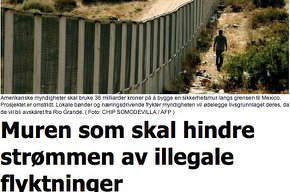
Muren som skal hindre strømmen av illegale flyktninger er overskriften av en Aftenposten-artikkel om muren mellom USA og Mexico. Er det ok å snakke om “illegale flyktninger”? Nei, mener sosialantropologen Shahram Khosravi ifølge Amnesty Nytt. Som forsker vil han ikke bruke “maktens språk” og kaller derfor ingen for illegal.

Språk er makt, derfor er det viktig å ha et reflektert forhold til ordene en bruker. Hvem som får merkelapp “illegal” er jo et politisk spørsmål. I Sverige fins det ett nettverk som heter Ingen människa är illegal (IMäI). Lignende organisasjoner fins flere steder i verden. På tysk er det vanlig å bruke begrepet “illegalisert” istedenfor “illegal” – nettopp for å framheve at det er noen som har gjort disse menneskene illegale.

Khosravi forsker på slike illegaliserte flyktninger (eller irregulære flyktninger som han kaller dem). I en artikkel på Yelah.net utdyper han synspunktene sine. Illegale invandrere er et uttrykk som gjenskaper maktrelasjioner og et skille mellom “oss” som hører hit og “dem” som ikke gjør det:

Genom att skilja (vita) medborgare från (icke-vita) icke-medborgare görs de irreguljära immigranterna inte bara till icke-medborgare utan till anti-medborgare. De beskrivs som amoraliska, lagbrytare, lögnare och en belastning för samhället. Genom att ha makt över problemförklaringar och handlingar går det att skapa opinion för en acceptans att utvisa människor, att sätta människor i förvar och att kriminalisera människor som inte begått något brott.
(…)
Irreguljära är uteslutna men samtidigt inneslutna i samhället. De utesluts från lagligt skydd men är objekt för lagens utövning. De har ingen representation i politiken men är objekt och instrument för politisk debatt. De får ingen röst i den offentliga debatten men används som sensationella figurer i massmedia.

>> les hele saken på Yelah.net

Shahram Khosravi kom i 1988 fra Iran via Pakistan til Sverige. At han tilhører minoriteten Bakhtiyari var en viktig årsak til at han valgte å studere sosialantropologi i Stockholm, sier han til Göteborgs Fria Tidning:

– Vi representerades alltid av andra, genom majoritetens bild. Det blev en drivkraft att själv få beskriva sin omvärld. Den inföddes revansch.

OPPDATERING (18.11.07): Aftenposten har nå tatt av seg saken og også intervjuet Shahram Khosravi men fortsetter å kalle disse menneskene for “illegale”.

SE OGSÅ:

Eliteinnvandring = Mer global apartheid

Katja Franko Aas: Flyktninger er blitt en sikkerhetsrisiko. De er ikke lenger mennesker som treger beskyttelse; de er blitt mennesker som majoritetssamfunnet må beskytte seg mot

– Åpne grenser er løsningen: Å åpne grensene for folk i fattige strøk er også det lureste som Vesten kan gjøre for å minske gapet mellom fattig og rik

Muren som skal hindre strømmen av illegale flyktninger er overskriften av en Aftenposten-artikkel om muren mellom USA og Mexico. Er det ok å snakke om "illegale flyktninger"? Nei, mener sosialantropologen Shahram Khosravi ifølge Amnesty Nytt. Som forsker vil han ikke…

Read more

New blog: “Open Anthropology” by Maximilian C. Forte

Another new blog: Anthropologist Maximilian C. Forte has recently launched the blog Open Anthropology – “a project of decolonization, growing out of a discipline with a long history and a deep epistemological connection to colonialism”:

OPEN ANTHROPOLOGY arises from a dissastisfaction with the state of knowledge in contemporary and classical anthropology, and is meant to significantly restructure and move anthropology beyond its current confines, beyond the constraints of professionalization and institutionalization, transcending the very “disciplinariness” of a discipline that has often foundered on its own shoals since its inception as “anthropology.”

Maximilian C. Forte is among others the editor of the open access journal KACIKE: The Journal of Caribbean Amerindian History and Anthropology, and writes also for the The CAC Review.

>> visit Open Anthropology

Another new blog: Anthropologist Maximilian C. Forte has recently launched the blog Open Anthropology - "a project of decolonization, growing out of a discipline with a long history and a deep epistemological connection to colonialism":

OPEN ANTHROPOLOGY arises from a dissastisfaction…

Read more

Art / anthropology: Practices of Difference and Translation (Oslo)

31 October – 1 November 2007 Kulturhistorisk Museum, University of Oslo, Norway

ART/ANTHROPOLOGY: PRACTICES OF DIFFERENCE AND TRANSLATION

convenor: Arnd Schneider, Institute of Social Anthropology, University of Oslo

A two-day international workshop to develop a framework for a research laboratory on contemporary art and anthropology in Oslo

The two-day workshop, the first in a number of consultation events, will explore ideas and future potentials in the establishment of a`laboratory’ in Norway which combines ethnographic and art practices across a number of institutions and fields (anthropology, art history/criticism, contemporary art practice and museums).

Thus the workshop conceived as an open discussion forum, with the intention to chart a preliminary matrix for a future art-ethnography laboratory in Oslo.

A number of invited national and international speakers(including Terje Brantenberg, Geir Tore Holm, George Marcus, Amanda Ravetz, Amiria Salmond, Sissel Tolaas, Chris Wright – full list available on request), from both the worlds of contemporary art and anthropology, will report on existing projects which incorporate ethnographic and art practices, or provide a counterpoint as respondents to reports from Norway or abroad.

Full programme available on request from Morten Kjeldseth Pettersen m.k.pettersen (AT) sai.uio.no

Participation is free, but places are limited. Please register your interest with: Morten Kjeldseth Pettersen m.k.pettersen (AT) sai.uio.no

31 October - 1 November 2007 Kulturhistorisk Museum, University of Oslo, Norway

ART/ANTHROPOLOGY: PRACTICES OF DIFFERENCE AND TRANSLATION

convenor: Arnd Schneider, Institute of Social Anthropology, University of Oslo

A two-day international workshop to develop a framework for a research laboratory on…

Read more

“Arabs and Muslims should be wary of anthropologists”

News of anthropologists in the US. military starts circulating on one of the largest Muslim websites, Culture Matters reports. Anthropologist Donald Abdallah Cole says to IslamOnline.net that “Arabs and Muslims should be wary of western anthropologists”:

‘We should be wary of everything that is written about us, whether by local people or by foreigners. To be wary does not mean to reject. We need to read what anthropologists say about people in the developing world and what they say about Islam and Muslims,’ he explained.

‘We can expect to trust the reliability of professional academic anthropologists who are subject to peer review and evaluation. But for others who are not fully professional, we need to be more careful.’”

>> read the whole story on Culture Matters

This reaction is no surprise, especially when we remember that Britian has recruited anthropologists for spying on muslims.

A few weeks ago anthropologist Maximilan Forte wrote that if anthropology’s role as an instrument of empire can come back into sharper focus it is no wonder that anthropology is banished from universities in the ‘decolonized’ world”.

Over at Savage Minds, a dscussion is going on if all this focus on anthropology in the Iraq war is primarily a PR game to bolster the image that the military is doing something novel to correct the errors of the Iraq occupation.

News of anthropologists in the US. military starts circulating on one of the largest Muslim websites, Culture Matters reports. Anthropologist Donald Abdallah Cole says to IslamOnline.net that "Arabs and Muslims should be wary of western anthropologists":

‘We should be wary…

Read more

New fieldwork blog: Struggling with antipathy for the field and “anthropology-fed-up-ness”

Norwegian anthropologist Jon Henrik Ziegler Remme has started blogging. He is currently on fieldwork in the Philippines among the Pentecostal Christians in Ifugao.

In his first two posts of his blog Jon Henrik in Ifugao, he describes parts of the fieldwork process that are familiar for most anthropologists but that rarely make it into papers or monograps: “anthropology-fed-up-ness” and antipathy for the field.

“Back in Ifugao, the first thing that struck me was that I was already tired of being here”, he writes in his first post Chasing Ifugao Christians with a lack of motivation….

“One of the main impressions I had of my previous fieldwork was that this type of research is very inefficient. (…) Today I had such an experience again”, he writes in his second post When the time is right…

>> visit Jon Henrik Ziegler Remme’s blog

For information on his first research project, see the project website.

SEE ALSO:

On fieldwork: “Blogging sharpens the attention”

Paper by Erkan Saka: Blogging as a Research Tool for Ethnographic Fieldwork

antropologi.info survey: Six anthropologists on Anthropology and Internet

Anthropology blogs

Norwegian anthropologist Jon Henrik Ziegler Remme has started blogging. He is currently on fieldwork in the Philippines among the Pentecostal Christians in Ifugao.

In his first two posts of his blog Jon Henrik in Ifugao, he describes parts of…

Read more