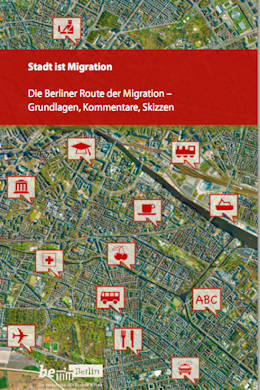
Das deutsch-türkische Anwerbeabkommen feiert 50. Geburtstag. Mitarbeiter des Instituts für europäische Ethnologie an der Humboldt-Universität in Berlin haben die Route der Migration nach Berlin in Ton- und Bilddokumenten nachgezeichnet, meldet das Deutschlandradio.
300.000 Negative haben Studentinnen und Studenten gesichtet, die eine Kreuzberger Fotografin über fünf Jahrzehnte gesammelt hatte. Sie machten sich dann auf die Suche nach den Menschen, die auf den Bildern zu sehen sind und interviewten sie.
Erstmals sei nun dokumentiert, wie Einwanderer die Stadtgeschichte geprägt und verändert haben, so das Deutschlandradio. Die Reise in den roten Containern entlang der “Route der Migration” spannt den Bogen von der Einwanderung der Hugenotten im 17. Jahrhundert bis zu heutigen Versuche, die Migration durch gesetzliche Vorgaben zu verhindern.
Um Aufmerksamkeit für die Berliner Migrationsgeschichte zu schaffen, hat das Ausstellungsteam rote Container gewählt, die an strategischen Orten in Berlin aufgestellt sind. Jeder der roten Container zeigt eine mit dem jeweiligen Ort verbundene Geschichte.
Manuela Bojadzijev leitet das Projekt. Sie hat ihre über die Migrationsgeschichte Deutschlands promoviert.Trotz jahrhunderlanger Einwanderung ist Migrationsgeschichte ein vernachlässigtes Thema, erklärt sie:
“Man muss sich ja auch im Klaren sein, das im Jahr 2000 überhaupt erst die erste Bundesregierung anerkannte, das Deutschland ein Einwanderungsland ist. Bis dahin gab es auch in den historischen Wissenschaften kaum Wissen über die Migrationsgeschichte in Deutschland. Das hat überhaupt erst in den letzten zehn Jahren wirklich stark zugenomen. ”
Die Container sind bis zum 3. November täglich von 10 bis 18 Uhr geöffnet. Ausserdem gibt es ein Rahmenprogramm mit u.a. postkolonialen Stadtführungen. Mehr Infos auf den Projektseiten
Auf berlin.de lässt die Ausstellungsbroschüre als pdf (2,7MB) herunterladen
Die Ausstellung hat bereits Aufsehen in den Medien erweckt, siehe u.a.
Das deutsch-türkische Anwerbeabkommen feiert 50. Geburtstag. Mitarbeiter des Instituts für europäische Ethnologie an der Humboldt-Universität in Berlin haben die Route der Migration nach Berlin in Ton- und Bilddokumenten nachgezeichnet, meldet das Deutschlandradio.
300.000 Negative haben Studentinnen und Studenten gesichtet, die eine…
Anthropologists should send a thank you to the Govenor of Florida, Rick Scott, who a few days ago in a radio show said “We don’t need anthropologists in the state”.
We don’t need a lot more anthropologists in the state. It’s a great degree if people want to get it, but we don’t need them here. I want to spend our dollars giving people science, technology, engineering, and math degrees. That’s what our kids need to focus all their time and attention on, those types of degrees, so when they get out of school, they can get a job.
What an unique opportunity to promote anthropology!
Anthropologists love talking about themselves and the importance of their discipline, so Lende’s list is long.
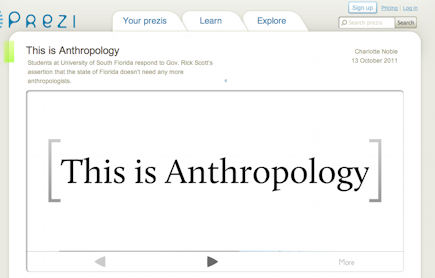
Personally, I think the students at the University of South Florida gave the most powerful response. They put a slide show together with short portraits of anthropologists and their work and put in online at prezi.
“This is absolutely a brilliant presentation. The American Anthropological Association should use it as a model for communication, education and lobbying”, commented Jonathan Hass, and it’s difficult to disagree with him.
Even anthropologists will be impressed and maybe also surprised about how diverse their discipline is – and how “relevant” and “useful” from the perspective of state bureaucrats.
Their presentation is still in the making, more and more slides are being added.
Two years ago, Canadian anthropology student Dai Cooper became a YouTube star with another innovative introduction to anthropology. She explained anthropology in her anthropology song
Anthropologists should send a thank you to the Govenor of Florida, Rick Scott, who a few days ago in a radio show said “We don’t need anthropologists in the state”.
We don’t need a lot more anthropologists in the state.…
(preliminary notes, still in progress, last updated 16.10., 00:30 ) As everybody else, I am trying to make sense of Sunday night’s outbreak of violence in Cairo. While I was – unsuspectingly – walking through the streets of Cairo, trying to find the pasta stand I stumbled upon a week ago, the military was massacring protesters less than ten minutes by foot away from me at the Maspero State-TV building. At least 27 people were killed, more than 300 were wounded during a protest against religious discrimination and a recent destruction of a church in Upper Egypt.
Army vehicles run over protesters
It is both interesting and disturbing to see how the event has been covered by international mainstream media in comparison to local and social media.
International media has framed the clashes mainly as a religious conflict while they also could have chosen a totally different perspective: instead of “Muslims against Christians”, they could have chosen “the army against the people”. They could have described the clashes as conflict between forces who support the pro-democracy revolution (the people) and those that rather oppose it (the ruling Supreme Council of the Armed Forces, SCAF), as a conflict more of power than of religion.
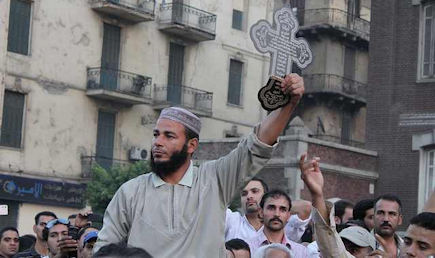
Many Muslims joined the clashes, and fought against the army and police. At one point a Muslim cleric carried a cross over the 6 October Bridge, leading Coptic protesters in marching on Maspero [the TV-building].
The demonstrators chanted repeatedly: “Muslims, Christians.. One hand!” and denounced Mubarak’s minister of defence, who is controlling the country now – Field Marshal Tantawi.
El-Hamalawy sees the current attacks on the Copts as an “attempt by the ruling military generals to split the ranks of the Egyptian poor and pit them against one another”. The presence of Muslim protesters alongside Copts are according to him “a hopeful sign”.
“There were people on the streets from all different sectors of society. Copts, Muslims, other Christians, secularists, even Salafists. ”What united them was not anything to do with sectarian issues or demands but actually a frustration directed at the army for what they feel is the army’s betrayel of the revolution."
Al Jazeera's Sherine Tadros reports from Cairo
Social justice for all, including religious minorities, was one of the demands of the january revolution.
Omar Tarek, an activist and journalist, was one of the Muslim protesters. Around 300 Muslim and Coptic protesters were gathered at state TV-building Maspero, holding candles, chanting and calling for unity according to Daily News Egypt .
Omar Tarek told the newspaper that the Coptic cause is the same as the Muslim cause.
You can’t demolish a house of worship. (…) I am here as an Egyptian, supporting an Egyptian cause.
Headlines like BBC’s Copts mourn victims of Cairo unrest suggest that Muslims or secularists don’t care which is not true. Many muslims joined the Copts at funerals.
I am here supporting the families of the martyrs and I was hoping that a lot of Muslims would make it to show the whole world that it is not sectarian strife, but an army against its people.
During their march from the Coptic Hospital to the largest Coptic cathedral in Cairo, protesters chant, “Muslims and Christians are one hand!”, reports newspaper Al-Masry Al-Youm. And: “Down with military rule!” “This is not a sectarian conflict, this is a military massacre.”
Ahram Online writes about the funeral for Mina Daniel, a young Christian revolutionary “who never forgot the importance of Muslim-Christian unity”:
Hundreds of Egyptians who had never met Mina Daniel – or, in many cases, had even heard of him before his death – attended the young man’s funeral, chanting, “We are all Mina Daniel.” (…)
Following the funeral, hundreds of mourners, including both Christians and Muslims, solemnly headed to Tahrir Square bearing Mina’s coffin.
A Muslim girl who came to support her Christian friend after her brother was killed during the battles Sunday night. Photo: Lilian Wagdy, flickr
There is no doubt that Reuters and others are right when they write that Copts are discriminated. Even tourists like me are realising that the Muslim-Christian relationship is a sensitive issue. But the news agencies neglect to mention that many conflicts have been initiated and provoked by the regimes in power (“Divide and rule”).
Tom Heneghan, Religion Editor at Reuters, for example went so far to claim the following:
The clashes, in which Christians say they were fired on and charged down by armored vehicles, highlighted an irony of the Arab Spring that the region’s dictatorships may have been better guardians of minorities than budding democracies.
But in Egypt, many believe the recent clashes are a result of ousted president Hosni Mubarak’s policies, which nurtured sectarian strife, writes Heba Fahmy in Daily News Egypt.
While many are quick to point out the marginalization of Egypt’s Copts, less are inclined to label the country as a sectarian state.
Many observers have said that these underlying issues are often manipulated by authorities seeking to cling to power, an accusation often leveled against the Mubarak regime. Incidents such as Sunday night’s events are usually followed by widespread calls for national unity and shows of solidarity between Muslims and Christians.
“We now know a previous massacre, the bombing of the Church of the Two Martyrs in Alexandria in December, in which 21 were killed, was the work of Mubarak’s ministry of the interior”, explains Egyptian short story writer Ahdaf Soueif in the Guardian.
It was beyond sickening that a government would kill its citizens in an attempt to turn them against each other – and Muslims flocked to stand with their Christian friends at Christmas mass.
The attack on Egyptian Christians last Sunday “was not sectarian”, she writes, “this was the army murdering citizens.”
Egypt's Copts vent their rage during funerals
So instead of accompanying their articles with background information about Christians in the Middle East (BBC) or Christians under siege in post-revolution Egypt (AP / ABC News), international media could have chosen to highlight the role of the military generals in Egypt as for example CBS’ 60 minutes did. As bonus track one could add a feature about the role of the West, especially the U.S. as sponsor.
Here, the media, especially state media, seems to play a crucial role.
A number of critics say that Egyptian state television not only failed to help resolve the crisis, but actually played a role in aggravating the already-tense situation.
In an unprecedented move, broadcasters on state television at one point called on the Egyptian public to head to Maspero en masse to defend Egyptian soldiers from angry Christian protesters, thereby further fuelling the sectarian flare-up.
On top of this, Issandr El Amrani writes at the Arabist, the military cut off the live TV feeds of several satellite TV stations, including Al Jazeera.
Some more observations at the end
Foreign media relied largely on accounts by the large international news agencies like Reuters and ap. Few journalists bothered to launche their web browser and do some research on their own. Egypt has an impressively large English language blogger og twitter scene, but only few of their accounts make it into mainstream news. One of them who took a look – Robert Mackey from the New York Times had to conclude “Social Media Accounts of Violence in Cairo Challenge Official Narrative“
International media treated Egyptian state and military officials as trustworthy sources. Manar Ammar from the Egyptian news site BikyaMasr had to conclude that "international media outlets largely reported on Sunday night Cairo what state television was reporting.
At the end of this already too long post, I’d especially like to recommend the analysis The Last Choice by Mahmoud Salem aka Sandmonkey, one of Egypts best English language bloggers I’ve read so far. He not only analyses the massacre but also discusses possible local and global consequences. Sandmonkey is ending optimistically with an account from the Sunday night clashes:
After engaging in a street brawl where not a single person could tell who is with who or against who, they stopped a started chanting. One team started chanting “The People and the Army are one hand” and the others started chanting “Muslims and Christians are one hand”, thus providing us with the choices that we as Egyptians were told to make yesterday.
And then, strangely, both sides at the same time changed their chants to “One hand”, and both sides started chanting that fiercely, stopped fighting each other, and joined each other into one big marsh chanting “One hand, One hand”, and thus showing us that they made the right choice. They were presented with the choice between the Army and National Unity, and they refused to make that choice and collectively and organically made the only correct choice: Each Other. Egypt.
In the midst of the battle, they realized on a very basic level that they can’t chose one over the other, and that, even if they have prejudices, they really do not want to fight each other. There is a lesson in that incident for all of us, and it may just hold the key to our salvation.
MORE UPDATES
“What was schemed as sectarian vandalism and a plot against the unity of Egyptians”, writes Nermeen Edrees on Global Voices, has turned out to be “a unifying force and a concrete wall to prove that what happened on the night of Black Sunday in Egypt is a Governor versus People clash rather than Christian versus Muslim one.”
She quotes Sandmonkey’s tweet: “Don’t say the army killed Christians. Say the army killed Egyptians.”
Anthropologist Samuli Schielke, who has just returned to Egypt, has written a less optimistic account called The Arab autumn? (also published on the blog Closer)
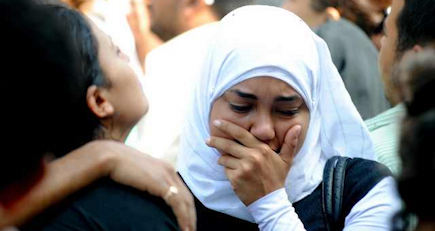
Hanna Yousef posted a picture with two grieving mothers, one Christian, the other Muslim, supporting each other and writes:
I am so angry. I can’t get over it. How dare they? I mean the shooting, the snipers, the crushing by tanks, the torture and the horrible ugly abject poverty are already too much to handle, and now I am supposed to hate Copts? Now, I am supposed to define them as the other. the other who is different than me, the other I should protect myself against? Well, I won’t. I refuse. (…) The God I believe in doesn’t like fascists.
“Muslims, Christians, One Hand”: A Salafi is leading chants at funeral march of murdered protestors. Photo: Omar Robert Hamilton, flickr (via Hossam el-Hamalawy, facebook)
(preliminary notes, still in progress, last updated 16.10., 00:30 ) As everybody else, I am trying…
Selv om det er lovpålagt, sjekker de ikke om pasientene forstår informasjonen tilstrekkelig. De vet heller ikke hvordan de skal forbedre en mangelfull kommunikasjonssituasjon.
I sin doktoravhandling, som hun skal forsvare imorgen, har antropolog Torunn Arntsen Sajjad sett på hvordan leger veileder pakistansk-norske familier om generell og fostermedisinsk genetikk, melder nettsidene til Universitetet i Oslo.
Her er det åpenbart mye som ikke er som det skal. Leger, mener Sajjad, trenger opplæring i å kommunisere bedre med pasientene. Hun foreslår blant annet regelmessig veiledning fra antropologer. Ansvaret for denne opplæringen skal ikke ligge hos legene, men må være forankret på instituttnivå.
Avhandlingens tittel er ”Hvis det fødes et sykt barn, hva tror du det skyldes? En medisinskantropologisk studie av genetisk veiledning blant pakistansknorske familier".
Hun er ikke den eneste antropologen som er opptatt av bedre kommunikasjon mellom helsepersonell og pasienter. For få uker siden har Aleksandra Bartoszko startet opp et prosjekt om helseradio på flere språk.
Selv om det er lovpålagt, sjekker de ikke om pasientene forstår informasjonen tilstrekkelig. De vet heller ikke hvordan de skal forbedre en mangelfull kommunikasjonssituasjon.
I sin doktoravhandling, som hun skal forsvare imorgen, har antropolog Torunn Arntsen Sajjad sett på hvordan…
Boka, som typisk nok ikke har fått mye medieoppmerksomhet, får veldig god omtale i den nyeste utgaven av Norsk antropologisk tidsskrift (ikke åpent tilgjengelig).
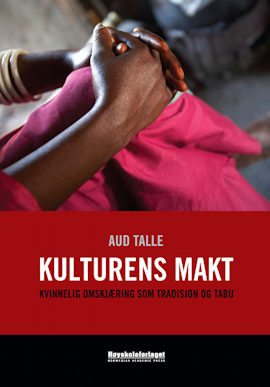
Med Kulturens makt har Aud Talle levert en nyttig og på mange måter klargjørende bok om kvinnelig omskjæring. En skikk som for det meste bare vekker forargelse, blir her gjort forståelig, men på slikt vis at det også blir mulig å tenke seg måter å avskaffe den på.
Boka handler om mer enn bare omskjæring. Den er “nærmest en lærebok i kulturoversettelse”, skriver han.
Det som her står på spill, er verdier forbundet med sterke affekter, grunnet på elementære kroppslige erfaringer av typen smerte og skade. Dermed er det et spesielt instruktivt eksempel på vanskene med å forholde seg til det som er fremmed.
For å kunne skrive innsiktsfullt om dette, må man praktisere relativisme som metode, om ikke som livssyn. Man må få sine lesere med på at forståelse ikke uten videre er det samme som forsvar, men ofte en betingelse for virkningsfull kritikk.
Vanskeligst er det kanskje å få dem til å innse at styrken i forpliktelsen til dem som blir utsatt for denne skikken, ikke kan måles med styrken i fordømmelsen av dem som forvalter den. Å holde hodet kaldt er ikke det samme som å svikte moralsk (…) Når hun skriver «omskjæring» framfor «kjønnslemlestelse», er det ikke for å glatte over, men for å komme i posisjon til å øve en kritikk som kan bli hørt og forstått. Slik er boken ikke bare en innføring i kvinneomskjæringens betydninger, men også i forutsetninger for tverrkulturell kommunikasjon.
Talle går ut mot massive overdrivelser i den journalistiske rapportering om saken:
«Tabuet» i bokens undertittel gjelder ytringer som behandler kvinnelig omskjæring «på annen måte enn med avsky». I Norge blir saken omtalt på systematisk villedende vis – og dét er ikke bare kulturfaglig uforsvarlig, men også kjønnspolitisk uhensiktsmessig: Demonisering av «overgriperne» bidrar til å skape en tillitskrise som vanskeliggjør åpen samtale med dem det angår, og fører dem inn i forsvarsposisjoner – og dermed skader den gode sak.
Det er en av de store fortjenestene til denne boken at den bidrar til å presisere problemets omfang og art, skriver Johansen:
Med henvisning til egen forskning, tegner Talle et mindre rystende, og mer overbevisende realistisk bilde. I de østafrikanske kjerneområdene er skikken i endring og delvis tilbakegang: Mindre operasjoner erstatter de større, særlig i byene; mange steder er det blitt akseptabelt å avstå helt. I Norge er omskjæring av jenter på det nærmeste avskaffet, om jeg forstår dette rett.
Selv har han lært av denne boken, at omskjæring av kvinner ikke er én enkelt ting:
Dette er en sammensatt sak, med flere lag av betydning og følelse, som også forekommer i flere varianter. For det første kan det oppfattes som meningsfullt å få fjernet en del av kroppen som anses fremmed (mannlig eller dyrisk), for på den måten endelig å bli en ren og hel kvinne. For det andre er samme inngrep et middel til kontroll over egen seksualitet som kvinnene utøver på vegne av mennene. For det tredje uttrykker det foreldrenes omsorg for døtre som ellers ikke ville kunne få barn og bli gift. I østafrikansk sammenheng er det flere typer hensyn som motiver den slags ritualer; til sammen forklarer de et stykke på vei hvordan de kan være så seiglivede. Men denne påpekningen av kompleksitet antyder også hvordan de er til å forandre på, eller til og med avskaffe, ganske fort.
Kulturens makt handler ikke bare om styrken i de kulturelle føringer, men også om deres begrensninger. Den omskårnes erfaring er ikke entydig: Gleden ved å bli voksen kvinne er blandet med minner om smerte og tvang som, under andre omstendigheter og med tilgang til andre begreper, kan vendes til motstand. Inngrepet er jo heller ikke det samme bestandig. «Omskjæring» viser til alt fra mer eller mindre drastisk beskjæring og gjensying til nokså skånsomme markeringer av overveiende symbolsk art. Hvis livssituasjonen forandrer seg, og tradisjonen kommer i et nytt lys, blir ikke spørsmålet nødvendigvis stilt som et enten–eller: Ved overgang fra én form til en annen kan det forekomme mange slags kompromisser mellom kontinuitet og forandring.
Boka har bare en svakhet, mener anmelderen, og det er at den “ikke er like nyansert i sin behandling av meningsdannelse i norsk offentlighet som i behandlingen av omskjæring som tradisjon”. Bare ett tilfelle av sensasjonsjournalistikk blir gjennomgått og på det grundigste tilbakevist. Dette er vel og bra, avslutter Johansen, men “ikke tilstrekkelig til å få oversikt over de ideologiske effekter av den samlede nyhetsproduksjon her til lands.”
For seks uker siden døde antropolog Aud Talle. Det var mindre enn ett år etter at hun hadde gitt ut sin siste bok: Kulturens makt. Kvinnelig omskjæring som tradisjon og tabu.
Boka, som typisk nok ikke har fått mye medieoppmerksomhet,…