search expand

“Minority cultures are automatically ‘different'”

The majority-minority discourse in Canada doesn’t seem to differ from the discourse here in Norway “Anglo culture is dominant and taken for granted; minority cultures are automatically ‘different'”, Yasmin Jiwani writes in the Vancouver Sun. There, recent media attention focusing on the murders of women from the South Asian-Canadian community has invoked a now-familiar refrain — “it’s the culture.”

But as Jiwani – associate professor in the department of communication studies at Concordia University in Montreal – stresses:

The interpretation of culture favoured by proponents of this view tends to dilute the complexity of the issues and presents a static, monolithic view of culture. Cultures are dynamic, as any self-respecting anthropologist will tell you.

She explains:

If we embrace the culturalist argument, we are adhering to a view that cultural groups are static relics isolated from the mainstream. More than this, we are positing that individuals within a particular cultural formation represent the entirety of that culture.

If this were indeed true, we would have to agree that someone like Willy Pickton, an alleged mass murderer, is representative of the dominant Anglo culture. Further, whatever crimes Pickton has been charged with, it follows that such crimes are endemic to and reflective of his whole culture. There are some who would agree with this viewpoint.

That aside, the Anglo culture is a dominant culture — its norms are often taken for granted and normalized, whereas minority cultures such as South Asian come under heavy scrutiny and their practices are often highlighted as markers of cultural difference, separating these groups from the mainstream.

For instance, each time a woman from an Anglo background is murdered, do we have reporters dwelling on her cultural background? We don’t, for example, get lengthy descriptions regaling the cultural facets of the burial, the wedding, or how they met despite or in spite of the fact that all of these practices and actions are undoubtedly culturally grounded.

These descriptions, if they are mentioned, are not culturalized but rather normalized as the dominant ways of doing things. Even which culture is categorized as a “culture” depends on who is doing the defining, the classifying and for what purpose.

(…)

The lesson in this is that if the cultural group you are critiquing is powerful, chances are your critique will be silenced. If however, the cultural group you are slamming or stereotyping is not so powerful, then there is little likelihood of the critique being challenged with the same force and with the same alliances from powerful political elites.

>> read the whole article in The Vancouver Sun

SEE ALSO:

Aboriginees in Australia: Why talking about culture?

The Culture Struggle: How cultures are instruments of social power

“Quit using the word ‘culture’ wherever possible”

Thomas Hylland Eriksen, Savage Minds: An old warhorse revisited: Do we need another book about culture?

On Savage Minds: Debate on the Construction of Indigenous Culture by Anthropologists

Culture and Race: The Five Major Challenges for Anthropology

The majority-minority discourse in Canada doesn't seem to differ from the discourse here in Norway "Anglo culture is dominant and taken for granted; minority cultures are automatically 'different'", Yasmin Jiwani writes in the Vancouver Sun. There, recent media attention…
Read more

"Voices": Anthropologist publishes e-book about Palestinian women

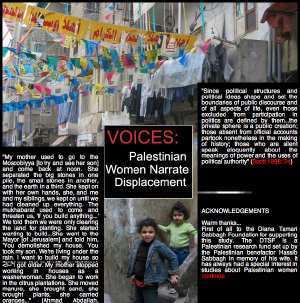
voices-cover

Voices: Palestinian Women Narrate Displacement is a collection of oral histories recorded by Beirut-based anthropologist and oral historian Rosemary Sayigh. It was published as e-book, devoted to men and women living in Gaza, the West Bank, Jerusalem and Israel. It allows readers to not only read the texts and see the pictures but also to hear the stories in the speakers’ own voices, The Daily Star Lebanon reports.

“Because “Voices” seizes on the advantages of technology, the book transcends precisely those borders so troublesome to the Palestinian condition”, Louisa Ajami writes in her review:

Sayigh became one of the few women to enter the Palestinian camps in Lebanon and she devoted her anthropological expertise to writing about the Palestinian diaspora. Much of her field work has centered on women and children, and she writes of the lives of rural peasant women and their more educated urban sisters with equal attention and flair.

Sayigh writes in the unobtrusive, objective style of an anthropologist, but she also interjects her personal impressions. She gives readers a sense of location, ambience and familiarity. (…) With her detached yet intense approach to recording their stories, Rosemary Sayigh renders her Palestinian subjects’ struggles less abstract and more human.

But there is one drawback for those who don’t speak Arabic:

Each narration is preceded by a short introduction in English. The opening lines of each interview are also transcribed in English, but the full interviews have been left in the original Arabic, as has the audio footage. For non-Arabic speakers, this leaves the bulk of the stories out of reach.

The review in The Daily Star Lebanon is no longer online.

>> read the e-book “Voices: Palestinian Women Narrate Displacement” (Link updated 24.7.2024)

More about / by Rosemary Sayigh

Interview with Rosemary Sayigh (The Jerusalem Times / palestine-family.net)

Rosemary Sayigh: No Work, No Space, No Future: Palestinian Refugees in Lebanon (Middle East International, 10 August 2001)

Rosemary Sayigh: Dis/Solving the “Refugee Problem” (Middle East Report 207 – Summer 1998)

SEE ALSO:

Anthropologists on the Israel-Lebanon conflict

The Future of Anthropology: “We ought to build our own mass media”

Open Source Anthropology : Are anthropologists serious about sharing knowledge?

2006 – The Year of Open Access Anthropology? 2005 was the year anthropology finally became visible on the internet. 2006 was the year of a more public, political and open access anthropology?

voices-cover

Voices: Palestinian Women Narrate Displacement is a collection of oral histories recorded by Beirut-based anthropologist and oral historian Rosemary Sayigh. It was published as e-book, devoted to men and women living in Gaza, the West Bank, Jerusalem and Israel. It…

Read more

– Modernitet betyr akselerasjon

Hvorfor har vi alle så dårlig tid selv om vi egentlig kan jobbe mer effektivt enn tidligere? Grunnen er at akselerasjon – kontinuerlig fartsøkning – er vår tids grunnprinsipp, mener sosiolog Hartmut Rosa. Hele modernitetens historie lar seg skrive som en historie om akselerasjon, mener han. Han bruker teorien også for å forklare innvandringsdebatten, økende fattigdom og populisme.

Rosa har vært innleder på seminaret Time and Modernity arrangert av forskningsprogrammet Kulturell kompleksitet i det nye Norge.

I et (epost-) intervju med meg sa han bl.a.

– I mange rådgivningsbøker leser vi kan komme oss ut av tidsklemma ved å ta det mer med ro. Jeg derimot sier: Akselerasjon hører til modernitetens vesen. Vi kan ikke leve eller jobbe saktere uten å melde oss ut av moderniteten. Moderniteten gir ikke rom for stillstand eller avkopling. Modernitetens grunnprinsipp er dynamisering. Og denne dynamiseringen består av tre former av akselerasjon som driver hverandre framover: teknisk akselerasjon, sosial akselerasjon og livstempoets akselerasjon. Akselerasjonsprinsippet har hersket over oss i omtrent 300 år. Derfor er det ikke bare å vedta et par lover eller å skape holdningsendringer og vips er tidsklemma borte.

(…)

– Men samtidig fins det både her i Europa og i andre verdensdeler store og kanskje økende befolkningsgrupper som er utestengt fra akselerasjonsspillet. De vil gjerne være med i akselerasjonen og oppfatter seg som frakoplet eller tvangs-deakselert. Dette gjelder for store deler av Afrika, men også for arbeidsledige i Europa. Slik oppstår det nye store forskjeller. Den ene delen lever på en måte fortere og fortere, den andre delen saktere og saktere. Men denne langsomheten er ikke noe kulturelt, det er heller en deprivasjonstilstand, ikke minst i vedkommendes egenoppfatning.

(…)

– Når vi har forstått akselerasjonens årsaker, kjennetegn og konsekvensene, er vi kanskje i stand til å dempe konsekvensene, forandre eller fjerne årsakene. Men hittil har vi ikke engang øynet, eller vi har til og med misforstått modernitetens akselerasjonskraft. De fleste sosiologiske moderniseringsteoriene ser differensiering (arbeidsdeling, spesialisering etc), rasjonalisering og individualisering, kanskje også kommodifisering, som moderniseringens grunnprinsipper. Sosiologien har glemt hvordan moderniteten har satt den materielle, sosiale og åndelige verden ustoppelig i bevegelse.

>> les hele intervjuet (lenker oppdatert 26.4.2021)

SE OGSÅ:

Modernitet: Sosiologen Ulrich Beck skisserer et nytt paradigme

Ny bok om Bauman og det postmoderne

Modernitet ødelegger antropologien: Er folk på Stillehavsøyene like moderne som vi i Europa? Er modernitet et nyttig begrep?

Hvorfor har vi alle så dårlig tid selv om vi egentlig kan jobbe mer effektivt enn tidligere? Grunnen er at akselerasjon - kontinuerlig fartsøkning - er vår tids grunnprinsipp, mener sosiolog Hartmut Rosa. Hele modernitetens historie lar seg skrive…

Read more

Likestilling og grådighet: “Endrede strukturer vil føre til annen adferd”

Finansministeren synes inntektsnivået til stjernemeglerne er “rene galskapen”, samtidig mener “rødstrømper” at rikmannsfruenes “likestillingsregressive” valg er et tilbakeslag: Det er liten grunn til å moralisere over andres valg: “Folk oppfører seg slik de gjør fordi både struktur og kultur legger til rette for det”, skriver antropolog Long Litt Woon i sin spalte i Aftenposten.

Hvis politikerne synes at meglerne velger å innrette seg skattemessig på måter som er moralsk tvilsomme og at fruene velger kjønnsroller som er forkastelige, bør de sette søkelyset på de rammebetingelsene som bidrar til at slike valg tas:

Istedenfor å moralisere, bør ansvarlige myndigheter heller gjøre noe med regelverket. Finansminister Kristin Halvorsen bør utrede hvordan lurifakshullene i skattereformen kan tettes slik at vanlige folks tillit til skattesystemet ikke uthules. På samme måte bør produktivitetsorienterte arbeidsgivere finne ut hvordan de best kan forebygge misbruk av fleksitid når vi nå har mangel på arbeidskraft i Norge.

Hvis “alle” gjør én ting, kommer man fort på defensiven hvis man gjør det motsatte av det de fleste gjør. Forsvarstaler gir oss med andre ord et godt tips om at vi er på sporet av et kulturtrekk. For eksempel har vi nylig kunnet lese i Dagens Næringsliv om hvor krevende det er å være hjemmeværende, sett fra rikmannsfruehold. Slike uttalelser om hjemmetilværelsens arbeidskrav skyldes blant annet den protestantiske arbeidsetikken som fortsatt lever i beste velgående: Det er gjennom (lønnet) arbeid at vi er noe.

>> les hele saken i Aftenposten

Jeg kan tenke meg at et slikt kulturelt og strukturelt perspektiv ville også vært nyttig for å analysere Opsjonsskandalen i Hydro

Finansministeren synes inntektsnivået til stjernemeglerne er "rene galskapen", samtidig mener "rødstrømper" at rikmannsfruenes "likestillingsregressive" valg er et tilbakeslag: Det er liten grunn til å moralisere over andres valg: "Folk oppfører seg slik de gjør fordi både struktur og kultur legger…

Read more

“Audio podcasting won’t take over the world”

Podcasting – publishing mp3-interviews on websites – has become more popular in the social sciences, including anthropology. But as Paul Ayres writes in an article for ALISS Quarterly, the journal of the Association of Librarians and Information professionals in the Social Sciences, content producers have already started to move on to video.

Audio podcasting won’t take over the world, he explains:

Audio as a format has a number of limitations. It can be inefficient, as it takes 10 minutes to listen to a 10 minute audio file, plus time to download it as well. Much of this information could be summed up in a short piece of text that is easier to scan and retain. Plus, some content does not lend itself to being read out loud, such as complex URLs or detailed instructions.

In the Higher Education context, providing only the audio of a lecture leaves out PowerPoint slides, data, charts or diagrams that may illustrate a point and it also limits the presenter to a chalk and talk approach, which excludes problem based learning techniques and active learning strategies, which require interaction in the lecture theatre or classroom.

Information Professionals may find audio only user education assets very limiting. With an increasing number of online services available, screencasts that offer commentary on a video walkthrough of a service, website or database, will give a visual cue and a more meaningful learning experience to students.

So users and content producers have already started to move on to video and it’s clear that audio podcasting won’t take over the world. Awareness of podcasts has only increased marginally in the last 18 months, and some say that it suffers from the “try me” virus effect, where something may be cool or interesting to sample, but not be engaging enough to return to.

>> read the whole article “Podcasting and Audio in the Social Sciences”

SEE ALSO:

Anthropology podcasts receive much attention

The Future of Anthropology: “We ought to build our own mass media”

Video by anthropologist Michael Wesch: How collaborative technologies change scholarship

Savage Minds: Visual anthropologist Jean Rouch on YouTube

Anthropological Films online

Podcasting - publishing mp3-interviews on websites - has become more popular in the social sciences, including anthropology. But as Paul Ayres writes in an article for ALISS Quarterly, the journal of the Association of Librarians and Information professionals in the…

Read more