search expand

Elections


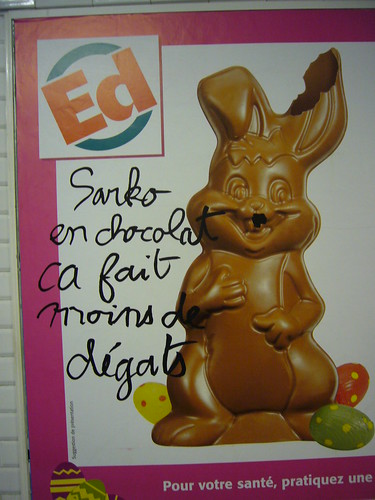
Sarkozy in chocolate makes less damage

Blogging is hard these days. I’m busy, I’ve had visitors and I’m experiencing a personal earthquake*. And when all this is going on in the fieldworker’s life, the presidential election is approaching.
[teaserbreak]
However, contrary to what I expected after the previous stormy spring in Paris, not much is actually going on. I have a pressing feeling of silence before the storm, while a more sinister friend of mine made up the metaphor of the silence of the tiptoeing of slippers before the reverberation of the boots…. His dark vision is that France will wake up and go to work just as normal when the catastrophe hits, – and it will hit, according to him. On a far more positive note, another acquaintance said that Sarkozy was too extreme to be voted president of France. He guessed that he wouldn’t even to through to the second round.

As I’ve mentioned before, the most frequent reproach against Sarkozy I hear, is that he divides the population (the worst faut pas in the indivisible republic) – between for instance “the good and the bad” (editorial in Libération 18/04).

The adversary candidates Royal (socialist) and Bayrou (centrist), said on their last meetings that France could not have a president with a mask of fear and who’s project is himself (Royal) and someone who loves power more than he loves France (Bayrou). Heavy criticism of this sort is coming up from various angles in the press at the moment. I just can’t imagine that he will go through, and if he does, I certainly can’t imagine what will happen…

The situation is tense everywhere and quite unlikely people are appealing to voter utile (“vote usefull” – thus gathering around the one candidate on the “left” who has a chance to go through to the second round, i.e. Ségolène Royal).
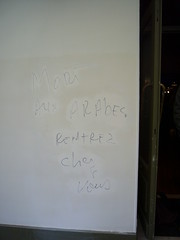
Racist slur on the wall outside the café Nuits Blanches
The slam scenes seem as much waiting and seeing as the rest of society. Some people claim that opportunists are turning up with political texts just to jump on the bandwagon (slam is highly hyped at the moment, and there are presumably agents from record companies and other possible sources of employment present on the soirées). Personally, I haven’t noticed that the texts are more political now than they were when I started seven months ago.

The climate of fear has however killed off one of my favourite slam venues, the weekly night at Les Nuits Blanches nearby Gare de Lyon. After complaints about noise from neighbours, which is one thing, and the shockingly plain racist threat – written with adult handwriting on their wall – mort aux Arabes rentez chez vous (death to the Arabs. go home), they decided to cancel the event. The owner immediately related the threat to the climate of the election campaign…

——–

*)
Oh, how could I be so stupid to put on Gainsbourg for writing at such a time? At the momen I hit the keyboard with this very sentence, his Chanson de Prévert (

) hit like an aftershock…

Å jeg vil at mens du minnes
Denne sange som var din
Jeg tror det var din favoirtt
At den er av Prévert og Kosma
Og at hver gang Dødt Løv [feuilles mortes]
Minner deg om meg
Slutter død kjærlighet [amours mortes]
Ikke å dø

[…]

Kan man aldri vite hvor den begynner
Og hvor den slutter, likegyldigheten
Høst går til vinter
Og når sangen til Prévert
Dødt Løv
Viskes ut av minnet mitt
Den dagen har de sluttet å dø
Mine døde kjærligheter

Sarkozy in chocolate makes less damage

Blogging is hard these days. I’m busy, I’ve had visitors and I’m experiencing a personal earthquake*. And when all this is going on in the fieldworker’s life, the presidential election is approaching.
[teaserbreak]
However, contrary to…

Read more

“But We Are Still Native People” – Tad McIlwraith’s dissertation is online

Our fellow anthro-blogger Tad McIlwraith has successfully defended his dissertation “But We Are Still Native People’: Talking about Hunting and History in a Northern Athapaskan Village” that now can be downloaded from his website (The graduates in his year are the first who are able to request open access publication)

His dissertation is a study of hunting in the northern Athapaskan village of Iskut, British Columbia, Canada. Iskut hunting is a source of pride for Iskut people. Yet, hunting is sometimes stigmatized by outsiders with interests in the lands and natural resources of northern British Columbia. For some outside observers, he writes, modernization and acculturation are one-way processes. Traditions are better left in the past. At times, he found out, Iskut talk about hunting conveys those sentiments too. At other times, Iskut people strongly reject the stigma of labels like ‘impoverished’ or ‘nomadic’ that resonate in the words that have been written about Iskut people.

Tad McIlwraith indicates that the ethnographic inquiry into an Iskut culture was a profitable way to identify the importance of hunting to Iskut people and, thus, to offset the racism and stereotypes that are frequently associated with native lives.

He also argues that ethnoecological research and the Ethnography of Speaking both contribute useful methodological alternatives to Traditional Use Studies particularly when the documentation and interpretation of the varied expressions of hunting in Iskut Village is of concern.

>> download the dissertation

>> visit his blog

Our fellow anthro-blogger Tad McIlwraith has successfully defended his dissertation "But We Are Still Native People’: Talking about Hunting and History in a Northern Athapaskan Village" that now can be downloaded from his website (The graduates in his year are…

Read more

The Dictionary of Man: Will Bob Geldof and the BBC reproduce racist anthropology?

Bob Geldof is to team up with the British Broadcasting Corporation (BBC) on a project to digitally catalogue all known human existence. They want to create the “largest ever living record” of films, photographs, anthropological histories, philosophies, theologies, economies, language and art, as well as people’s personal stories, according to afp

Might sound good but reading Geldofs statements (“In an age of globalisation, we face the growing homogenisation of cultures”) and their plans to “capture all 900 of the separate groups of people anthropologists believe exist in the world”, one begins to doubt: It seems that Geldof and the BBC are going to reproduce old fashioned racist anthropology (“Völkerkunde”). Although they call it an “anthropological project”, they can’t have read much anthropology.

>> BBC: Geldof unveils earth series plans

>> afp: BBC, Geldof join forces to draw up a map of mankind

>> Guardian: Geldof plans the definitive record of mankind

UPDATE: Over there at Culture Matters, Joana Breidenbach comments:

Here we see again the widely popular notion of “cultures” as distinct, static and unchanging entities threatened by Western-led globalization.

It seems a pity that this outdated view should be perpetuated by the BBC who in its reportages so often manages to portray a very different image of the cultural dynamics in globalization: i.e. in which a new diversity is created by the encounter between global consumer goods, media, ideas and institutions with local ways of doing and thinking.

>> read the whole comment

SEE ALSO:

Is this anthropology? African pygmies observe Britains in TV-show

In Detroit and London: More African Villages in the Zoo

Geldof’s Live8 and Western myths about Africa

Bob Geldof is to team up with the British Broadcasting Corporation (BBC) on a project to digitally catalogue all known human existence. They want to create the "largest ever living record" of films, photographs, anthropological histories, philosophies, theologies, economies, language…

Read more

Er Bob Geldof blitt gal?

Artisten Bob Geldof vil i samarbeid med BBC “dokumentere samtlige kulturer over hele verden, i form av lyd, bilder og tekst”, skriver Aftenposten euforisk.

Artikkelen gir inntrykk av at mannen ikke kan ha satt seg inn i faget vårt og at han sannsynligvis kommer til å reprodusere gammeldags smårasistisk “Völkerkunde” (beskrivelse av verden oppdelt i homogene etnisk baserte kulturer) som antropologer flest skammer seg over. I tillegg til et webbasert The Dictionary of Man er nemlig planen å lage 900 dokumentarfilmer om 900 folkegrupper (de mener dette er antallet på folkegrupper i verden….).

Nyheten er fersk, se også på engelsk meldingen av afp. Oppdatering: En kommentar på Culture Matters:

Here we see again the widely popular notion of “cultures” as distinct, static and unchanging entities threatened by Western-led globalization. It seems a pity that this outdated view should be perpetuated by the BBC.

Artisten Bob Geldof vil i samarbeid med BBC "dokumentere samtlige kulturer over hele verden, i form av lyd, bilder og tekst", skriver Aftenposten euforisk.

Artikkelen gir inntrykk av at mannen ikke kan ha satt seg inn i faget vårt og…

Read more