search expand

Doctoral thesis: Towards a transnational Islam

Young muslims are moving from an Islam based on the culture of their homeland to an increasingly transnationally embedded Islam of Muslims from many different countries and cultures. That’s one of the findings in the doctoral thesis by Norwegian anthropologist Christine M. Jacobsen that is now no longer available online. (UPDATE 26.3.2020)

Contributing to an emerging “anthropology of Islam in Europe”, she writes, her thesis is concerned with exploring continuities and discontinuities in religious identities and practices in a context of international migration and globalization. She has conducted fieldwork among youth and students who participate in two Islamic organizations in Oslo.

The situation of belonging to a minority group, she writes, means that young Muslims cannot take their religion for granted, and that they must engage in the redefinition of identity/difference and of Islamic traditions. And in this redefinition, young Muslims increasingly aspire to engage directly with Islamic texts in order to “choose” which position or interpretation to adhere to. They increasingly engage in discussion and debate on issues that were previously mainly an area of scholarly debate.

In order to make this thesis relevant to the broader comparative field of studies of Islam in Europe, Jacobsen draws on insights from studies of young Muslims elsewhere in Europe.

She criticizes the prevailing methodological nationalism in studies on immigrants and migration (the paradigm of the nation-state as the principle organizing unit of society). She writes:

Discussions about integration often ignore distinctions related to e.g. class, generation, gender, and urban processes, and tend to reify the distinction between “Us” (the Norwegian society representing Norwegian values) and “Them” (being the foreigners that must be integrated). Often, such discussions proceed without questioning the premises upon which our understanding of “integration” depends, and the way in which integration is part of a nation-making process.

In research that is based in political-administrative and methodological nationalist perspective, immigrants and the cultural and religious forms they represent tend to be constructed as “social problems” and “deviance” that need to be solved and brought into order through governing processes (Lithman 2004).

An example is the issue of arranged marriage:

Depending on the perspective adopted, arranged marriage might appear as an issue of deviancy among immigrants or as a part of how a majority of mankind organizes its social life. The consequences for anthropology as cultural critique are obviously important. When immigrants and the social and cultural forms they represent are constructed as “social problems” and “deviance”, they can neither allow worthwhile and interesting critiques of “our own society”, nor enlighten us about other human possibilities, to paraphrase Marcus and Fischer.

Within this nationalistic perspective, Islam is usually approached in terms of how it hinders or facilitates the “integration” of “Muslim immigrants” into “Norway” (or other European societies, “the West”). Studies of Muslims in Europe based on what Lithman calls “wonderment over society” seem to be less frequent, she writes:

When framed within the perspective of a nationalist methodology, this endeavour necessarily must result in ethnocentrism. Furthermore, this perspective has certain consequences not only for the description of the social and cultural aspects involved in migration, but also for its moral evaluation and as a basis for policy making.

She prefers “methodological relativism”:

Even though it is impossible to exclude all value-assumptions from research, I find striving towards considering different practices and traditions on their own terms worthwhile. If not, it is difficult to grasp the meaningfulness of social and cultural practices to the people that engage in them, or to see them as alternative ways of organizing human life, rather than just as deviance from a norm.

>> Download the thesis Staying on the straight path: Religious identities and practices among young muslims in Norway by Christine M. Jacobsen (BORA, Bergen Open Research Archive)

For those who read Norwegian: I’ve interviewed Christine M. Jacobsen a few weeks ago, see Doktorgrad på unge norske muslimer: På vei til en transnasjonal islam

LINKS UPDATED 26.3.2020

SEE ALSO:

Andreas Wimmer and Nina Glick Schiller: Methodological nationalism and beyond: Nation building, migration and the social sciences (pdf)

Why the French Don’t Like Headscarves

Muslims in Calcutta: Towards a middle-class & moderation

What does it mean to be Muslim in a secular society? Anthropologist thinks ahead

Islam in Morocco: TV and Internet more important than mosques

Lila Abu-Lughod: It’s time to give up the Western obsession with veiled Muslim women

Young muslims are moving from an Islam based on the culture of their homeland to an increasingly transnationally embedded Islam of Muslims from many different countries and cultures. That's one of the findings in the doctoral thesis by Norwegian…
Read more

2006 – The Year of Open Access Anthropology?

(post in progress) 2005 was the year anthropology finally became visible on the internet. 2006 was the year of a more public, political and open access anthropology?

Open Access

More and more anthropologists want to make their research available online. Two years ago, the open access movement was only known to some geeks. Now, more and more academics know of its existence and support its agenda. I’ve even read about Norwegian researchers who boycott publishers that don’t support Open Access (only in Norwegian). Recently, Norwegian libraries rejected Blackwell journals because of high prices and at the same time promoted their digital archives.

The bloggers at Savage Minds and Anthropology.net campaigned for more open access with New Open Access Anthropology Website, mailinglist, chat and t-shirts including a blog.

A new Open Access journal called After Culture – Emergent Anthropologies was announced and a few months ago, I’ve discovered Anpere – Anthropological Perspectives on Religion another new Open Access Anthropology Journal and shortly afterwards lots of new theses on indigenous research in MUNIN – the digital library of the University in Tromsø (Northern Norway).

Earlier, the American Anthropological Society was heavily criticized for its opposition to Open Access. Concerning their reluctance to use digital technology to disseminate knowledge, Jane Mejdahl from the new Danish Anthropology group blog Matters Out Of Place wondered if anthropologists were the last primitive tribe on earth. To promote anthropological blogging, anthropology.net established the first Anthropology Blog Carnival.

Politics and Public Anthropology

Last year, anthropology seemed to have become politicised. American anthropologists stood up against torture and the occupation of Iraq and used anthropology to show that the Bush administration is lying about the “war on terror” in the Sahara.

Furthermore, anthropologists criticized both the erosion of free academic speech in the USA, how censorship threatens anthropological fieldwork and the neoliberalism in academia, when Walmart’s management principles run an anthropology department.

In 2005, many debates arose on how CIA sponsers anthropologists to gather sensitive information. In 2006, we could read about anthropologists who are engaged for the US war in Iraq and “embedded anthropology” in the Canadian military.

It’s difficult to say if anthropologists have been more visible in mainstream media during the last year. We might remember that Didier Fassin criticized anthropologists for their silence during and after the riots in France. Maybe Indonesia can be an example. To link themselves to the non-academic world, anthropologists discuss politics and succeeded according anthropologist Fadjar I. Thufail. In Mexico, anthropologists who demonstrated against human rights abuses were beaten by the Mexican police.

Conferences and cosmopolitanism

Personally, I was engaged in discussions about conference culture. My post How To Present A Paper – or Can Anthropologists Talk? received more comments than any other post before. Shortly afterwards I went to the conference Anthropology and Cosmopolitanism at Keele University where I heard many weak presentations and wrote the post What’s the point of anthropology conferences?. My summary was later published in Anthropology Today and was commented by Don Moody. Concerning presentations, “the cure is a strong chairman and a system of lights”, he wrote.

I’ve written lots about cosmopolitanism, for example For an anthropology of cosmopolitanism or Thomas Hylland Eriksen: Cosmopolitanism is like respecting the ban on smoking in the public. Owen Sichone showed at the conference that poor African migrants are no less cosmopolitan than anthropologists and David Graeber argued that democracy is no ‘Western’ idea and questioned the terms “Western civilisation” or “Western values”.

There were of course lots more interesting news last year.

I especially enjoyed reading Jan Kåre Breivik’s book about deaf people as a forgotten cultural minority and Marianne Gullestads most recent book where she defines the five major challenges for anthropology

2006 is also the year when Clifford Geertz has passed away.

SEE ALSO:

Savage Minds: 2006 Highlights

The Anthropology Year 2005

(post in progress) 2005 was the year anthropology finally became visible on the internet. 2006 was the year of a more public, political and open access anthropology?

Open Access

More and more anthropologists want to make their research available online. Two years…

Read more

Some new anthropology blogs and websites (round-up part 1)

More and more anthropologists are blogging. Here a short overview over new websites and blogs that I’ve added recently to the “anthropology newspaper” sites http://www.antropologi.info/blog and http://www.antropologi.info/feeds/anthropology

Material World
Lots of longer articles (less “bloggy” than conventional blogs) in this group blog of scholars working in the anthropology departments of University College London and New York University. It “aims to create a new international community of academics, students, curators, artists and anyone else with particular interests in material and visual culture” (via announcement at Museum Anthropology).

Linguistic Anthropology
A (more “bloggy”) group blog from the members of the Linguistic Anthropology e-mail list (via announcement at Savage Minds).

Northern Waterways
Blog by cultural anthropologist Ed Labenski about northern Canadian anthropology, aboriginal rights and resource development and canoeing (via announcement at Fieldnotes).

Locating Ethnography
Blog by anthropologist Michaela Lord (University of Hull, UK). She’s finally started blogging about her research about British migrants in France.

Intute Social Sciences Blog
General university, education and social science news by Intute ( service created by a network of UK universities and partners)

warauduati
German anthropologist Marc Murschhauser has promised to blog more about his fieldwork, “taking interviews, observating culture, asking the right questions, writing notes, and living within difficult conditions”.

Culture Matters
Engaged blog by students and staff of applied anthropology at Macquarie University (Australia) about emergent trends in applied anthropology.

Critically Cultural
Blog by anthropologist Amelia Guimarin who is especially interested in visual media, for example body piercing.

Anthropology 2.0
Website by Marc K. Hebert from the University of South Florida, where he is pursuing a Ph.D. in Applied Anthropology. Focus on how new media can contribute to a more public anthropology.

Understanding Race
New website by the American Anthropological Association, including a blog, papers and presentations.

Two bloggers have moved their blogs.
Sarapen has moved from edublogs to anthroblogs. The new address of his blog about online anthropology on Filipino bloggers is http://www.anthroblogs.org/sarapen/ .
Anthronaut, currently on fieldwork in Peru has moved to wordpress.com and can now be found at http://anthronaut.wordpress.com/

Have i forgotten some new (social-) anthropology blogs?

UPDATE:

Student Anthropologists
Blog that was established during the 2006 AAA meeting. Now it also includes a forum, a wiki and bookmarks (del.icio.us)

SEE ALSO:

antropologi.info survey: Six anthropologists on Anthropology and Internet

On fieldwork: “Blogging sharpens the attention”

More and more blogging anthropologists – but the digital divide persists

New blog: The Anthropologists – Last primitive tribe on earth?

More and more anthropologists are blogging. Here a short overview over new websites and blogs that I've added recently to the "anthropology newspaper" sites http://www.antropologi.info/blog and http://www.antropologi.info/feeds/anthropology

Material World
Lots of longer articles (less "bloggy" than conventional blogs) in this group blog…

Read more

Rue du Faubourg du Temple

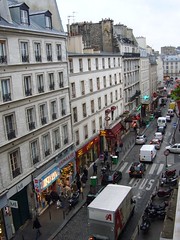
I’m not yet tired of Parisian street-life. That’s good, because it’s only four floors separating my bedroom-cum-office from a very noisy, or let’s rather say lively, street indeed.

Rue du Faubourg du Temple, view from my window.

Rue du Faubourg du Temple runs, as I’ve already mentioned, between the significant places Place de la République – where an enormous bronze Marianne La République resides with the three strong marble ladies La Liberté, L’Égalité and La Fraternité – and Belleville. Most demonstrations of whatever size start at Place de la République. When I lived next to the square for a fortnight in December, I stumbled upon a substantial number of police cars right outside my gate every third day or so. One day it was no less than 16 vans from the CRS, another day just 10 or so from La Gendarmerie, and yet another it was the Police Nationale. Only at one of the occasions did I see the demonstrators. The same happened actually a couple of days ago. I had read at Paris.Indymedia that the college students and the sans-papiers would demonstrate against the immigrations policies, so I went over to see what was happening. Maybe I was too late, because at the time I arrived there was very few lycéens to see. On the other hand, the forces of order were heavily represented; the CRS with at least 15 vans, a bus and some other equipment were creating a noisy traffic jam driving south-east down Avenue de la République (direction Père Lachaise and perhaps Place de la Nation). The demonstrations of national importance usually go between Place de la République to Place de la Nation, via Bastille – thus it’s not only the police who can stage a political struggle symbolically (however, with their Robocop uniforms they’re hard to beat when it comes to costumes).
[teaserbreak]
A few demonstrations start other places than at République. According to my flatmate, there is one passing down Faubourg du Temple about every second week. Judging from the slogans he mimicked, it usually concerns les sans-papiers, which is reasonable since it’s coming from Belleville/the East and going to Place de la République. I actually joined one of these demonstrations (described here), just a few weeks after arriving in Paris the previous autumn. Funnily, I took a photo of the building I’m now living in, because of the nice flowerpots and the Chinese restaurant at the ground floor. And that makes the transition to the next point in this post.

The restaurant in this building seems almost to be an outpost for the higher concentration of Chinese restaurants and shops a little up the street in Belleville. Down here, Pakistani shops are at least as numerous. For some strange reason, many Pakistanis in Paris run these cheap, thrashy plastic utensil etc. shops (I have no idea what to call this genre of shops in English). I’ve seen them everywhere in East working-class Paris, and most of them seem to be Pakistani owned. One can probably find some neat Fredrik Barthian explanation for why the Pakistanis have ended up in this particular ethnic niche in this city. Neither in London, nor in Oslo is that the case. Interestingly, it was in neither British hip-hop nor Norwegian, but French, that I was to hear the first sample of a Bollywood song (Rohff (Rohff on last.fm here): Bollywood style.)

The highest presence of Pakistanis is at the other side of Place de la République, in the direction of Gare de Nord. While I’ve just seen one not very conspicuous Bollywood video sale and rental around here, on the other side of République there are more, until you get some street which are almost exclusively Indian, Pakistani and Sri Lankan. (According to Le Monde à Paris – in the nicely titled guide series Paris est à nous (“Paris is ours”) – from 2004, there are 50 000 from the subcontinent in Paris. – One guesses that there is equally many Chinese clandestines here, in addition to the 450 000 who are registrered).

As usual when I start writing a post, I quickly lose focus of the initial idea and the post end up wandering about. I had no intention at all to write about the police again, for instance. This blog post was in fact inspired by a quick walk up the road and the no less than overwhelming amount of impressions it inspired – including the initial thought that opened this post; the Paris street life never stops intriguing me…. I’ve discussed the bad winter mood of the Parisians with a couple of people lately. – They rarely smile, many are arrogant or aloof and the level of aggression and nervousness is high. (For instance, often when I approach a young woman on the street to ask for a direction, she first looks visibly anxious before she notices that I’m just another young woman). – When a friend of mine explained this mood by referring to sheer dense materiality of this city – “packed as sardines on the metro, the person next to you just wished you weren’t there” – it echoed Dag Østerberg’s “socio-material interpretation of Oslo”, which I’d just been reading. Paris is far denser than Oslo, and people behave very differently on the street here. Whether it comes down to a material explanation, I don’t know. It can also have something to do with sexism and different gender relations, with revolutions and education for revolts, with a continuous construction of “living together” through talking to each other (a bit à la Cicero’s republic perhaps) etc… all of which I’ve touched upon here before and which I’ll undoubtedly return to. However not now, as this post has become long enough.

I’m not yet tired of Parisian street-life. That’s good, because it’s only four floors separating my bedroom-cum-office from a very noisy, or let’s rather say lively, street indeed.

Rue du Faubourg du Temple, view from my window.

Rue du Faubourg du…

Read more

Kvinner nekter å stille opp i media

Media (inkl blogging) og forskning er fortsatt manneting. Ifølge Morgenbladets kilder er det kvinnenes egen feil at de er nesten fraværende i media. – Kvinnelige akademikere sier ofte nei. Noen ganger kunne jeg ringe ti damer for hver mann, sier Roy Tore Jensen fra TV 2 til Morgenbladet. Cathrine Sandnes, redaktør i Samtiden og tidligere kulturredaktør i Dagsavisen er enig:

– Det er utrolig seig materie å få kvinner til å stille opp. De vegrer seg for å fremstå unyanserte, frykter reaksjoner fra fagmiljøet og vil ikke stemples som medienisser. Slik må kvinnelige akademikere selv ta en del av skylden for at de ikke er bedre representert. Når du har holdt på en halv dag med å ringe kvinnelige eksperter som sier nei er det lettere å ringe den kjente mannlige professoren med en gang.

Nå er det bare 15 kvinner på Morgenbladets liste over de 100 mest omtalte professorene i media. Samtidig er bare 17 prosent av professorene kvinner. Så ille er det vel ikke likevel? Og hvordan hadde kjønnsbalansen vært hvis en ikke bare hadde undersøkt professorenes plass i media?

Thomas Hylland Eriksen er forresten på plass 6, og Unni Wikan på plass 23.

>> les hele saken i Morgenbladet

Men at kvinner nekter å stå fram med sine meninger ser en også i bloggverdenen. Og hvis kvinner blogger, så ofte anonymt (mitt inntrykk, burde sjekkes nøyere). Antropologi er et jentefag (80% av studentene omtrent – og ikke bare i Norge), men antropologi-bloggene gir et motsatt inntrykk (dominert av menn). Kan også legge til at alle avisredaksjoner som jeg har jobbet i var dominert av menn.

SE OGSÅ:

Jantelov på Blindern? Ingen plass for sterke meninger?

More and more anthropologists, but they’re absent from public debates – Thomas Hylland Eriksen’s “Engaging Anthropology”

– Antropologer må bli flinkere til å bruke nettet

– UiO profesjonaliserer informasjonsformidling, bidrar til en svekket presse

Media (inkl blogging) og forskning er fortsatt manneting. Ifølge Morgenbladets kilder er det kvinnenes egen feil at de er nesten fraværende i media. - Kvinnelige akademikere sier ofte nei. Noen ganger kunne jeg ringe ti damer for hver mann, sier…

Read more