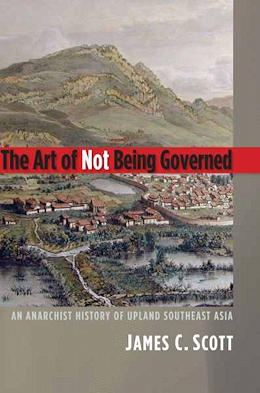
Phd-theses belong to the least accessible academic publications. Anthropologist Johannes Wilm chose to make his thesis available to the public – both online as a free download, as e-book and affordable paper book. In this email-interview he explains us how he did it and why he thinks students should set up their own publishing company.
Why is open access publishing important for you?
– Open access is the best way of ensuring that your material is available for anyone who cares to look. Writing this thesis, I realized that much of the background literature from just 25 years ago already is impossible to get at, even when printed with a top university press. While publishing this with for example Cambridge University Press may have had some advantages in the short-term in terms of marketing, in a perspective of some decades it would have had the opposite effect. Others have told me that the financial gain of publishing an academic book may be up to 700 USD. In comparison to current Scandinavian wages that really means very little, so I don’t think that earning another 700 USD should be a motive to restrict the access to one’s thoughts.
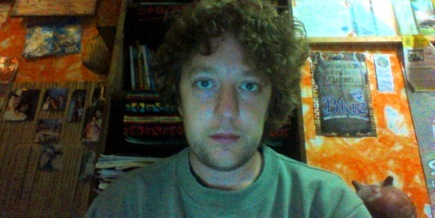
Johannes Wilm: Open access is the best way of ensuring that your material is available for anyone who cares to look. Photo: privat
What is your thesis about?
– The Sandinista movement in Nicaragua, and how I believe it has changed since the 1980s. There are elections in Nicaragua this fall, and while the Sandinistas have been in power since 2007, this may change a lot and interest in Nicaragua may grow around the elections, so I feel it’s necessary to have this out right now.
– I have been wondering whether I should wait with the free web version until real-life small-scale bookstores have had a chance, but what they have been telling me at the Revolutionary Grounds bookstore in Tucson, AZ is that people still buy the real paperback version even if things are online. So based on that the current plan is to put out everything at the same time.
– By the way, I should add that the text I will publish has a lot in common with my current thesis draft, but it is not the same. The book-version has a completely different conclusion than the thesis version. It is much less academic, aimed more at the general public, and looks more at the political outlook the country currently has. The requirements of what needs to go into a PhD thesis these days are unfortunately such that the text that comes out of it is not really interesting to read for anyone beyond the exam committee.
You chose to set up your own publishing entity instead of using well known publishers. Why?
– I thought about that. I found the handful of publishers that do open access publishing and contacted them. They all sent me encouraging comments, but said that my field was too strange or too specific. I also considered printing it with a traditional publishing house. With the exception of the top 10 university presses it seems like there is no real advantage of doing it that way. On the contrary, they impose their not-so-well founded ideas, then have someone edit it who has no knowledge of the field and end up hijacking the manuscript for at least a very long period of time – possibly forever. The publishing house should give some quality assurance, but given that many smaller presses just appear and disappear within very short time, that is not really given.
– Printing with a certain university press makes your work unavailable to almost anybody, with the exception to those few living close enough to a bookshop that sells it. People in the “Third world” are generally cut off from access to these books also due to the price, which oftentimes is upward of 35 USD. Using the techniques described below one should be able to offer a 300+ paged book in softcover for under 20 USD, while still being able to pay for returns and some more and offering the required discount to booksellers.
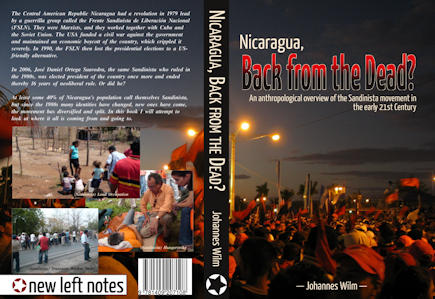
Johannes Wilm created the book cover with the Open Source software Scribus
I learnt that prestige is important for many researchers. Their argument against self publishing may be that it won’t give you much academic credit compared to publishing via f.ex. Columbia University Press?
– It is true that in the past there was some prestige connected to the label. Academia is currently changing massively and so is the publishing business. Nobody can quite know what things will be like in just a few years, so I think one should look at what makes sense technically. Who published Das Kapital? Does anybody know? Does anybody care? Not really.
– Great books should be able to stand on their own merit. That is also the case for the less famous books. When I was looking for books about Sandinismo in Nicaragua in the 1980s, the publishers were all over the place. Had I decided only to stick with books printed by the top university publishers, I would not have read any of the best books.
How did the faculty react? Did they support you?
– I think the faculty was mainly surprised. Everything about publishing is currently changing and so they didn’t quite know how to react. Unfortunately it seems to me that some felt the need to try to find some rule or other which would prevent me from being able to do this. Such a rule fortunately does not exist at the University of London, but other universities do make their students sign a note I which they specify that the work has not been published when they submit it. I am still a bit afraid that they may suddenly change the rules in order to prevent me from going ahead with my plan, so I decided to wait with publishing it until two hours after I hand the thesis in.
Now some more practical questions. Your aim was to make your phd thesis accessible to the public, both online as free download and offline as affordable paper book. How easy was this undertaking?
[teaserbreak]
– It took quit a bit of research to understand how book distribution is set up currently, including its pricing models. It involved some bureaucratic hurdles, such as registering a publishing company, and a lot of technical work setting up a work-flow that lets me edit the material in an program that shows the material similar to how it will end up in print (similar to Word) and then takes that material and converts it to the various output formats (PDF, HTML, Epub).
Is it required to be computer geek to do the technical stuff?
– If one is afraid of all that and doesn’t have a technical-genius spouse or brother or someone else close, I would recommend giving up on trying to make it look pixel-perfect and instead just write the whole thing in Libreoffice which is free. It shouldn’t be too hard to have it produce reasonably well-looking PDFs, HTML-files and Epubs out of that.
Do you have more advice to other master and phd students who’d like to publish an open access thesis?
– I would recommend to research first what the guidelines for publishing your manuscripts at your particular university are. Some universities seem to have set out to make this impossible as they feel threatened. Much work could be saved if several students were to go together to make a formal publishing company and register it. If PhD students could be convinced to lower themselves enough to talk to master-degree students, they could form the more permanent part of such a publishing company at one particular institute, that makes sure that knowledge about how to do these things is not lost every time a class graduates. This way they could built up links to particular bookstores in the university area and share technical knowledge about the process.
– Also, I would recommend to have several official sites of publishing. so if you have one in the US and one in a European country where ISBN-numbers are free, you can get your book listed bot with the US Library of Congress and enjoy the free ISBN-numbers. All you need to have in the US is “an office that can answer substantial cataloging questions” as I was informed. I take that as meaning some person with an address and a cell-phone which most likely never will be called up anyway. The site of publication is independent of the site of printing.
What is your advice to those who are not interested in setting up their own publishing company? So, first converting via LibreOffice, then…?
– Those who don’t want to start up their own publishing company can self-publish easily through Lulu.com and Createspace.com (Amazon’s self-publishing arm) for softcover books and Lulu.com, Kindle Direct Publishing (KDP) and Smashwords.com for the electronic versions for just about all devices. ISBN-numbers are given for free by Lulu and Smashwords and KDP publishes without one, but these companies will then be listed as the publisher. It simply means that it’s easier to spot these as being the product of self-publishing.
– The format you need to deliver it in is PDF for the printed version. Libreoffice has a built-in function to create PDFs. Just make sure that the margins are at least .5“ for the outer margins and .75” for the inner margin (gutter) and that you set the document size to be what it needs to be.
– For the electronic version you need some different formats. Lulu.com is good for Ipad-publishing and it accepts Epub, which is good, because that is also the output format. That means that you can fully control what it will look like. What works best is oftentimes first to convert the Libreoffice document to an HTML-page. You may want to change the contents to accommodate for the fact that page-numbering will not be available. Then use Calibre to convert it to an Epub for the required device. If the Epub doesn’t go through the input-checking mechanisms of Lulu.com, get Sigil and open the Epub in that program. Sigil checks for compliance with the standard and makes any necessary change automatically. Save te file again immeidately and now it should work.
– KDP accepts Epub-files, but will eventually convert it to the Mobipocket-format, so you are better of converting to Mobipocket to start with. Calibre can do that for you. KDP can also be used to publish to the Ipad.
– Smashwords is good for almost all other E-readers, such as Nook, Sony E-reader, etc. They only accept Word-files which they then convert to Epub-files for the different readers through an automatic script. This means that the quality will not be the best and you have few ways to control how it comes out. I would only recommend this as a backup solution and as a way of bringing the book to more obscure ereaders.
It selfpublishing expensive?
– The technical costs are not that high. The ISBNs are free if you register your publishing house in certain European countries. They only require you to send in a certain number of printed books once it’s done for them to put in their research libraries. In other countries you have to pay up to 100 USD for each number.
– Electronic distribution does not carry a start-up cost. The cost of setting up the printing and automatic distribution to all the main distribution channels is a bit higher. The only company that does this at a world scale is Lightningsource.com . If you pay in Euros, they charge 48 Euros for the uploading of cover and book interior as well as an 8 Euro cataloging fee a year. Additionally they make you buy a proof copy for 25 Euros (including delivery) and it’s probably a good idea to take advantage of their offer to list you in Ingram Advance Trade Advertising for one month for 50 Euro. Once your book is listed with Lightningsource, it is listed in all the main distribution channels in the UK and the US, which will also be available to the continental European market.
– Additionally you may want to list the book with Amazone’s Createspace.com. You can use the same ISBN, so that the books will be listed under the same heading on Amazon and it should always be listed as in-stock on Amazon.com .
– The real costs nowadays lie in the editing process. I count myself as very fortunate to have found volunteer editors who did this for free for me. Although in theory it is in exchange for other services – help with computers – that I provided them with, the value of what they did far exceeds the value of what I did. I do think that the final result comes out much better than what it would have with a traditional publishing company, precisely because I knew these editors and they had an interest in the material.
– Another cost may be marketing. Fortunately I have work experience as an IT professional and so making web pages and alike are not an issue for me. Nevertheless, I don’t have any illusions about massive sales. One aspect that was important to me was to make sure that the pricing would work out for small real-life bookstores so that hopefully with enough marketing efforts. I can convince the radical book stores around to have at least one copy out for people to flip through.
– Most self-publishing solutions offer to list your book so that it is available to all these, but it does so under conditions that are unattractive for the bookstore. What you need to offer is 55% discount on the recommended salesprice and the offer for them to return the books. Lightningsource will trow away those books, and it is generally said that 30% of books will end up like this. They will charge you for the whole-sale price of these books, so you need to make sure that your earnings on each book covers those extra costs. When you offer this through Ingram (one of the distribution channels of Lightningsource), it seems to end up as 40% discount to the bookstore if they order only one book. That is good enough for them. Some people have experimented with short discounts of only 20–25% and no returns. That is too little for any normal bookstores to carry it, but until very recently at least, Amazon still carried these books and profits for authors were accordingly high. This seems to have ended recently though.
– Another cost factor are photos. The photos that are commercially for sale are generally priced out of the general range. My solution has been to use United Nations image databases, as these explicitly allow for their photos to be used for free if accredited correctly. Also, you can filter for CC licensed photos on flickr and anything that is on Wikipedia has to carry a license that allows you to use it. I even obtained several pictures that were licensed under normal copyrights. A friendly email to the photographer, explaining what my project was and asking him to donate the license rights was oftentimes enough.
What were the main obstacles you faced?
– I was quite surprised to find that the tools for doing the conversion between one format and the other weren’t really evolved. Also the bibliography part of the Lyx editor I chose to use, were outdated and didn’t provide some of the things that people writing in the humanities rely on – such as providing a first-published date for a bibliographic item or converting graphs inside of the text to an image format that works in Epub and HTML.
– I ended up in long conversations on email lists with the developers of these programs and send in some patches to these programs for some of the things. I wrote a small program that takes care of all the bugs in all the programs that are involved. It can do the conversion as well as some other things (such as backup, calculating statistics, find common grammatical mistakes, etc.). I will be happy to share it with anyone who needs it.
– Another issue: Most ebook-readers out there so not implement the Epub-standard perfectly. That means that although one has an Epub that follows all the standards, one can be quite sure that it will not display properly on all the readers. Kovid Goyal, the creator of the Calibre ebook management software has done a good job in creating conversion scripts that create Epubs for all the different readers. Unfortunately they do this by breaking compatibility with the standard, and many distribution sites will only check whether your Epub complies to the standards and not whether the book will actually look good in the reader.
– Some of the other obstacles were things like that as a newly registered publishing company, the US Library of Congress will not prepare the Cataloging-in-Publication data (CIP) that needs to go on the Copyright page until you have published books by at least three different authors that are present in libraries somewhere. That means that until then one has to prepare the data oneself. Much of it is easy enough, but classifying the book according to the Dewey and the Library of Congress classification systems is challenging, because these numbers are not available freely online and no library nearby would let me take a look at their copies. These numbers are part of the CiP data so one somehow needs to find these.
Some last words?
– In many European countries there are extensive measures put in place to help small-scale authors. If one of these happens to help you – good luck! If they restrict you from putting the manuscript online, I would think twice about signing up for it.
Johannes Wilm has also self-published his master thesis back in 2006: On the Margins: US Americans in a bordertown to Mexico
SEE ALSO:
Democratic Publishing = Web + Paper
Anthropology and the challenges of sharing knowledge online: Interview with Owen Wiltshire
Here they are: Open access anthropology books!
Open Access anthropology journals
Open Access anthropology repositories and archives