search expand

“They still eat their fellow tribesmen”

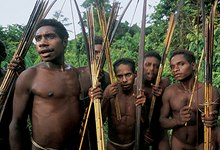
(via del.icio.us) If you miss “good old-style” stories about cannibals in far away places like Papua or New Guinea, read this story by Paul Raffaele in the Smithsonian Mag. It starts like this:

For days I’ve been slogging through a rain-soaked jungle in Indonesian New Guinea, on a quest to visit members of the Korowai tribe, among the last people on earth to practice cannibalism.

And about cannibalism: A local guide with “dark eyes” explains:

It’s because of the khakhua, which comes disguised as a relative or friend of a person he wants to kill. “The khakhua eats the victim’s insides while he sleeps,” Boas explains, “replacing them with fireplace ash so the victim does not know he’s being eaten. The khakhua finally kills the person by shooting a magical arrow into his heart.” When a clan member dies, his or her male relatives and friends seize and kill the khakhua. “Usually, the [dying] victim whispers to his relatives the name of the man he knows is the khakhua,” Boas says. “He may be from the same or another treehouse.”

I ask Boas whether the Korowai eat people for any other reason or eat the bodies of enemies they’ve killed in battle. “Of course not,” he replies, giving me a funny look. “We don’t eat humans, we only eat khakhua.”

The killing and eating of khakhua has reportedly declined among tribespeople in and near the settlements. Rupert Stasch, an anthropologist at Reed College in Portland, Oregon, who has lived among the Korowai for 16 months and studied their culture, writes in the journal Oceania that Korowai say they have “given up” killing witches partly because they were growing ambivalent about the practice and partly in reaction to several incidents with police.

(…)

Still, the eating of khakhua persists, according to my guide, Kembaren. “Many khakhua are murdered and eaten each year,” he says, citing information he says he has gained from talking to Korowai who still live in treehouses.

The travel writer even meets “true cannibals”:

Two men approach through the gloom, one in shorts, the other naked save for a necklace of prized pigs’ teeth and a leaf wrapped about the tip of his penis. “That’s Kilikili,” Kembaren whispers, “the most notorious khakhua killer.” Kilikili carries a bow and barbed arrows. His eyes are empty of expression, his lips are drawn in a grimace and he walks as soundlessly as a shadow.

The other man, who turns out to be Kilikili’s brother Bailom, pulls a human skull from a bag. A jagged hole mars the forehead. “It’s Bunop, the most recent khakhua he killed,” Kembaren says of the skull.

The story ends like this:

Three years earlier I had visited the Korubo, an isolated indigenous tribe in the Amazon, together with Sydney Possuelo, then director of Brazil’s Department for Isolated Indians [SMITHSONIAN, April 2005]. This question of what to do with such peoples—whether to yank them into the present or leave them untouched in their jungles and traditions—had troubled Possuelo for decades. “I believe we should let them live in their own special worlds,” he told me, “because once they go downriver to the settlements and see what is to them the wonders and magic of our lives, they never go back to live in a traditional way.”

So it is with the Korowai. They have at most a generation left in their traditional culture—one that includes practices that admittedly strike us as abhorrent.

>> read the whole story in The Smithsonian

>> BBC about the Kombai (Korowai)

>> Rupert Stasch: Giving up homicide: Korowai experience of witches and police (West Papua) (Oceania, Sep 2001)

On Papua Adventures we read:

Due to this very recent exposure to outside influences, the Korowai tribes are not as open and welcoming to tourists as the Yali, Dani and Lani for example. They remain on guard and suspicious of ways different to their own. This does of course make for an exciting and truly adventurous visit flying in by chartered Cessna from Jayapura to Yaniruma and trekking into Korowai country by foot and canoe.

UPDATE: Anthropologist Sarah Hewat comments: “Good story about cannibals. Pity it’s not even close to the truth”

SEE ALSO:

Disney-Film depicts indigenous people as involved in cannibalism

Inuit cannibalism?

Brief history of cannibal controversies

Our obsession with the notion of the primitive society

Is this anthropology? African pygmies observe Britains in TV-show

Ancient People: We are All Modern Now

Primitive Racism: Reuters about “the world’s most primitive tribes”

(via del.icio.us) If you miss "good old-style" stories about cannibals in far away places like Papua or New Guinea, read this story by Paul Raffaele in the Smithsonian Mag. It starts like this:

For days I've been slogging through a rain-soaked…

Read more

Back home part 2 – presenting my project so far (part 1)

Each time I tell about my fieldwork, I end up saying different things to different people, and usually I feel that it turns out quite messy, whatever I say. That was certainly the case when I tried to sum up the main points to my supervisor. So before my first seminar presentation (in front of a small multidisciplinary audience), the time had come to structure all I had experienced neatly into a comprehensible – and hopefully quite comprehensive – format.

My presentation was almost purely empirical, as I’ve not been reading much else than newspapers the last 9 months. The structuring principle I chose was to first give a socio-political overview of the bigger social events that took place during my fieldwork (October 05 to July 06), before I shifted to a more concrete micro focus on what and whom I’ll focus my research on (due to a need to anonymize at the web, I’ll be a little less concrete in this English version). I see the major socio-political events as forming a backdrop to my ethnographic micro focus, which – I hope – in turn can contribute to the understanding of these larger events. The first part of this post gives an English version of the first, events focuses, part of my presentation. The next part moves on to the micro focus, with a few words on my intended comparison with London as well as an attempt to sum up some of the comments I got after my presentation.

This is roughly what I said:
[teaserbreak]
I have not changed the fundamental focus of my project, thus I still focus on societal integration in two postcolonial European metropolises, particularly aspects of identity (formation) and belonging. However, my narrow focus on the so-called second generation (of one ethnic category; British Asians) in London, seemed – as predicted – of little relevance in Paris. [And coming to think of it, neither “identity” nor “belonging” is of that much importance to me anymore… We’ll see now, after summing up, if not “Communities in the making: Space, time and revolt” isn’t after all a more fitting title.]

During my 9-10 months of fieldwork, several large political events with huge relevance for my project took place. In the end of October, three weeks of rioting – car burning (which French youth are particularly keen on doing on a regular basis) and burning of schools and the like took place in deprived suburbs characterised by high unemployment and a large proportion of habitants of non-European decent.

In the spring, we had several weeks of massive protests against the new labour law, which had the intention of liberalising and increasing the flexibility of the labour market, but were seen as creating more insecurity (insécurité).

In addition, I would like to mention the abrogation, by President Chirac, of the less than a year old law paragraph saying that schools should teach the positive effects of colonisation. Until it’s abrogation, the paragraph and the protests it caused, never ceased to make it to the headlines. For instance, scheduled protests by the Martiniquais, including the poet Aimé Césaire, made Interior Minister Sarkozy to cancel his trip to the (French!) island.

The first day in commemoration of slavery (as a crime against humanity) took place the 10th of May. I had been looking forward to the day, anticipating it as a key event in my fieldwork. It was perhaps due to my great expectations that the day – for me – turned out to be almost a non-event.

The latter two events – the controversial paragraph about the teaching of history and the commemoration of slavery – give evidence to how important the struggle around the definition of (the correct and official version of) history is in France. I read into these events, as well as the last one I’ll mention – the active mobilisation against the new immigration law –, an increased demand for recognition of the transnational foundation of the French nation. [If this appears opaque at the moment, I’ll probably return to it in later posts, as I’m planning to work on what I’ll claim is a transnational appropriation of time and space this autumn…].

(Contrary to what was the case in the UK – and Norway! – the caricature affaire was no big event in France.)

I was struck by the constant focus on crisis and the feeling of anger and frustration present in the French society. The feeling of economic insecurity was present to a completely different degree there than what I was used to from Norway. In the beginning, the protests against the liberalisation of working conditions, seemed of little importance to my research (despite the fact that the law was part of Prime Minister de Villepin’s project on “égalité de chances”). However, as the protests gained ground, they pointed me in directions of important aspects of French social and political life:

*) Mobilising and protest: the belief that it’s possible, worthwhile and even correct and a good thing for proper citoyens to protest (i.e. it had already worked against the paragraph on colonialism).

*) Revolutions and riots as central aspects of the French national narrative, which is echoed on various levels in society, from the enthusiasm with which the pedestrians cross the street on red light – often dragging their children along, to the widespread (acceptance of) civil disobedience when “godfathering” and hiding sans-papiers children who are threatened by expulsion. For instance, many parents, teachers and other middle-aged people described the (sometimes quite violent) protests in the spring as a learning experience of democracy for the young. Apropos the riots in the banlieues: many commentators saw – utterly seriously, which surprised me – the riots as a positive sign: they riot against injustice, donc they are very French indeed!

*) Explicit and active scepticism against “(economic) liberalism”, partly as a so-called “Anglo-Saxon” phenomenon. (I.e. also “the republican model of integration” is also seen in contrast to the “Anglo-Saxon” multiculturalisms.

The two waves of protest and riot were easily interpreted within ideological discourses – not only by social scientists, but also not least in the public discourse. Both the two large events were frequently lifted up to a higher politico-philosophical level: For instance, one could readily hear that the riots in the banlieues were a proof that the French model of integration was destitute and France needed to turn in more in direction of multiculturalism. Equally, instead of the typically (so it went) French line of confrontation in politics – resulting with 1-3 millions in the streets against the CPE/first employment contract – needed to learn more from the “Scandinavian line of consensus”.

I find it interesting – particularly to my British/French comparison – that an excellent newspaper like the Guardian in my opinion not wholly grasps some particularities of French society in this respect. They wondered about the fact that 70% of French youth wished for something as boring and safe as a position as a public servant, and interpreted the protests as conserving and backward looking. My point is not whether their interpretation is right or not, but I find it quite ethnocentric and in lack of a native French point of view. (But that’s what we have anthropologists for ☺ )

My analysis is still at an embryonic or even less developed state, but it seems to me that these differing interpretations indicate a different relationship to the state, thus different state traditions, amongst British and French youth. I also have suspicion that one might read into the attitudes differences in visions of what constitutes a good life: perhaps in terms of more focus on career versus leisure, on consumption versus other forms of expressivity…. Well, probably I’m idealising the French context…

I hope to get a better grasp of these larger socio-political issues by looking at them though an ethnographic micro focus. However, it took me many months of fieldwork before I found such an ethnographic focus where I would be able to grasp what I saw as significant in the present situation. I went to loads of meetings and various gatherings and hung around in various places, but I found neither a suitable environment nor a suitable focus – until two months before I left the field.

I know this post can do with some links, but I’ll have to leave that for later… sorry

Each time I tell about my fieldwork, I end up saying different things to different people, and usually I feel that it turns out quite messy, whatever I say. That was certainly the case when I tried to sum up…

Read more

Back home part 1 – blogging continues

Since October 2005, I’ve been blogging from my fieldwork experiences right amongst the Parisians, but from now on this is – hélas – no longer the case. I’ve returned to Oslo with all my fieldnotes, photos, impressions and sentiments, and after living and working autonomously for 10 months, I’m now trying to reintegrate into the office environment (as well as my Oslo life). Since my intention with this blog has been to document not only how my fieldwork developed, but also the rest of the research process, I’ll try to keep on blogging from the office.
[teaserbreak]
From my (new) office at the University of Oslo, I’m looking down at one of Oslo’s more well-off neighbourhoods, with multicoloured wooden villas, all with neat gardens dotted with apple- and various other trees. (While (the lack of) mixité social seemed to be an ever-present matter of concern in Paris, I don’t find it to be that much of an issue here).

From one corner of my office window, I see the light blue Oslo tramway passes every fifth minute or so, and from the other I see a red brick church at a small tree-covered hill. When I lean a bit over my desk, I get a glimpse of the clear blue Oslo fjord with some blue hills on the other side. Far away, climbing up another hill, I see what must be a banlieue, with its high-rise buildings from the 1960s. The university campus itself is situated up-hill from the centre as well. All these hills I’m describing remind me of a funny incident when someone who knew my street in Paris described it as “the one that goes up”. I was struck by surprise for a second, when he said that. Yes, elle monte un peu, but what surprised me was that I had never even noticed the slight rise. Looking at the geography of Oslo – and even more so at the hilly city of Trondheim, where I lived the first twenty or so years of my life – one easily understands why.

So, from this office with this view, I hope to get on with stage two of my research project. From documenting research-in-progress during fieldwork, where theoretical and analytical discussions have been scarce or absent, I think the blog posts the next months will take two distinct but intertwined directions. On the one hand, I’ll write explicitly research-focused posts on how the project develops as I read, write and discuss my work. On the other hand, my mind keeps creating small (phenomenological) blog posts on my experiences in Oslo and how that contrasts with Paris. I think writing about such ethnographic contrasts can have several functions. As I experience them, they will probably take part in shaping my attention in the following stage of the research process. They can also perhaps be stepping-stones for a possible future fieldwork in Oslo. We’ll see we’ll see. I don’t know if I even can manage to experience, and write about, Oslo as I experienced and wrote about Paris.

The two following posts will be one in each direction: First a research centred post about the ethnographic status quo of my project, as I presented it at a multidisciplinary seminar last week, then a Norway/Paris contrast-focused post on techniques du corps (where cycling plays a part, of course).

Since October 2005, I’ve been blogging from my fieldwork experiences right amongst the Parisians, but from now on this is - hélas – no longer the case. I’ve returned to Oslo with all my fieldnotes, photos, impressions and sentiments, and…

Read more

Antropolog avslører kvinnenes flørteteknikker

Aha! Derfor! Godt at vi har antropologien! Den engelske sosialantropologen Kate Fox har forsket på flørting. Hun fant ut at tre av fire flørter startes av kvinner, og at menn ofte misoppfatter signalene, leser vi på Side2.no:

Kvinnene bruker flørteteknikker de første sekundene når de møter et nytt bekjentskap. Først og fremst for å finne ut om mannen er verdt å bli nærmere kjent med. Menn oppfatter derimot ofte dette som seksuell interesse. – Når kvinnene starter en flørt, manipulerer hun mannen til å ta frem kortene sine, sier Fox.

Hun kommer dessuten med en del (ganske generaliserende) uttallelser i teksten How to flirt: a European guide

SE OGSÅ:

Kate Fox om den engelske personligheten

Aha! Derfor! Godt at vi har antropologien! Den engelske sosialantropologen Kate Fox har forsket på flørting. Hun fant ut at tre av fire flørter startes av kvinner, og at menn ofte misoppfatter signalene, leser vi på Side2.no:

Kvinnene bruker flørteteknikker de…

Read more

Klær og kaffe – To antropologer om trender

Mange antropologer jobber med forbruksforskning. Charlotte Bik Bandlien forklarer i Aftenposten hvorfor espressomaskinen ikke vil bli allemannseie. Den er først og fremst et Oslo-fenomen. “Kaffedrikkingen vår”, sier hun, “er en kulturell institusjon som ikke lar seg bytte ut så lett.” Det harmonerer godt med Runar Døvings tidligere uttalelser om norske matvaner: Matvanene endrer seg ikke så mye som media gjerne ha det til. Grundstrukturen – grammatikken er den samme, mener han.

Næringslivsportalen n24.no har samtidig spurt antropologen Gunn-Helen Øye om hvorfor nordmenn er “ville etter den spanske klesgiganten” som nettopp åpnet en ny butikk i Oslo?

SE OGSÅ:

flere saker om antropologi og forbruk

Mange antropologer jobber med forbruksforskning. Charlotte Bik Bandlien forklarer i Aftenposten hvorfor espressomaskinen ikke vil bli allemannseie. Den er først og fremst et Oslo-fenomen. "Kaffedrikkingen vår", sier hun, "er en kulturell institusjon som ikke lar seg bytte ut så…

Read more