search expand

Monday

What a drama, and what a deception! People were so eager for a party and it seemed to be so much at stake…
[teaserbreak]
Yesterday afternoon while the preparations for the match was going out outside, I sat at home, absorbed in the excess of newspaper articles reporting and commenting on the political fallouts of the merits of the French national team. Will France be more tolerant and less discriminatory and racist due to its multicoloured team? Will its success lead to optimism and economic growth? I’d guess neither of the two, but the last couple of days have convinced me that there is much more than football at stake. Perhaps it is right that the French national team is the team of the real, but yet unrecognised, France? Here, in East Paris where I live, if you see someone in the national football shirt you should not be surprised if he (or she) has a skin colour in shades darker than white. And who have been fiercest celebrators of the victories so far if not the kids from the infamous banlieues?

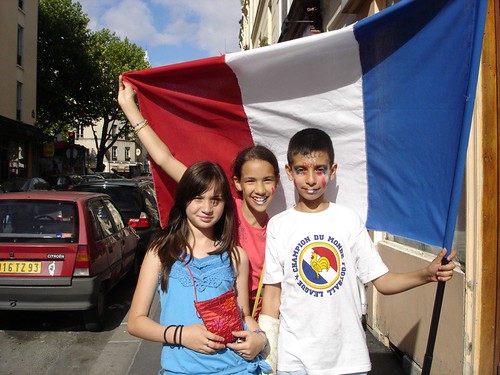
A couple of hours before the match, when I finally tore myself away from the media and got down on the street into the real world, I was met by three children singing and waving Le tricolore just outside my door. Le tricolore was waving from the local greengrocer’s and bistro too, as well as from numerous cafés, shops and flats along the boulevard. Flags were waving from cars and scooters, and the drivers were hooting at every possible and impossible opportunity. Amongst the tricolores, there were a couple of Algerian flags as well, apparently with at least one of the passengers wearing the French national jersey (which reminded me about a newspaper report I had just read from a bar in Marseille: after Zidane scored against Portugal someone had shouted “the ones who doesn’t jump now is not Kabyle” (Zidane’s parents were immigrants from Kabylia)…). From the fourth floor, a three year old (Chinese) was shouting Allez les Bleus! and a smiling father in a car was teaching his toddler the same chant.

All along the boulevard through eastern Paris the preparation for the match was well on its way. Two elderly ladies in a bistro at Place de Ménilmontant had – like so many others – drawn the flag on their cheeks. Some large blacks all in blue football shirts and with rastas, drunk on prematurely shared bottles of champagne, had painted their faces with red, white and blue stripes. A drunkard had put on an old blue jersey for tonight’s reunion with his drinking mates by Gare de Nord. The trip up the boulevard made me think that this was surely a team for everybody, even the most excluded, and I was probably smiling all the way.

We saw the match in a Kabylian bistro up north in the 18th arrondissement, behind Sacré Coeur. The atmosphere was tense. The manager, dressed in Thuram’s shirt, was among the anxious who went in and out, and who ended up seeing the penalty shootout from outside through the windows of the bar. The trickery and theatrics of the Italians didn’t go well with the French supporters: one called them “casseurs”, and another commented on how they where the ones who committed faults as well as falling afterwards and receiving the free kick. And today, the day after, quite a few here in France, as probably elsewhere in the world, ask themselves what Materazzi could have said that made Zidane entirely loose his temper and turn to such an unacceptably act as a headbutt to conclude his career. And in the media today, Zidane’s inexplicable exit undoubtedly adds an extra dimension to the huge disappointment people are expressing.

What a drama, and what a deception! People were so eager for a party and it seemed to be so much at stake…

[teaserbreak]
Yesterday afternoon while the preparations for the match was going out outside, I sat at home, absorbed…

Read more

Masteroppgave om “moderne menn i kvinneyrker”

Er menn som jobber i kvinneyrker mer entusiastiske? Sosiolog Ragnhild Røthing har skrevet masteroppgave om menn som jobber i barnehage og som sykepleiere. På nettstedet Kilden leser vi:

– Flere av mennene fremhever sitt eget forhold til jobben som mer dedikert og inderlig enn kvinnene på samme arbeidsplass, nettopp på grunn av at de ikke har gjort et “lettvint” valg ut fra tradisjon eller hva som forventes av dem, påpeker hun.

(…)

Der kvinnene inntar en rolle som barnepassere, er de mannlige barnehageansatte opptatt av å aktivisere barna, leke med dem og ha det artig. En av informantene forteller at han har inntrykk av at menn som velger førskolelæreryrket, er mer entusiastiske enn kvinnelige kolleger. Kvinnelige førskolelærere har valgt tradisjonelt og har kanskje ikke gjort et like reflektert valg som mennene i samme yrke, tror han.

>> les hele saken på Kilden

>> last ned hele oppgaven: Mann i kvinneland. En kvalitativ studie av kjønnsforming blant menn i kvinnedominerte yrker

SE OGSÅ:

Menn i kvinnedominerte yrker er redde for å bli latterliggjort og pynter på yrkestittelen for å få mer “cred” (Dagens Næringsliv, 9.3.06)

Tradisjonelle mannsidealer forsterkes – Doktorgrad på menn som sykepleier

Uten kjønn – intet menneske? Anmeldelsen av boka “Mann i ingenmannsland” av Runar Bakken (om menn som sykepleiere)

Den nye mannen – nytt nummer av nettmagasinet ALBA

Kan machismo likställas med manlighet i Mexico?

Er menn som jobber i kvinneyrker mer entusiastiske? Sosiolog Ragnhild Røthing har skrevet masteroppgave om menn som jobber i barnehage og som sykepleiere. På nettstedet Kilden leser vi:

– Flere av mennene fremhever sitt eget forhold til jobben som mer dedikert…

Read more

Fra akademia til menneskerettsarbeid: “Nesten glemt hvordan det er å brenne for noe”

Antropolog Kristina Lucumi Johansen har begynt å blogge. Hun jobber for Peacebrigades International i Colombia – der hun også har vært på feltarbeid for hovedoppgaven. Refleksjonene om overgangen fra universitet til arbeidet sitt i det voldelige Colombia er tankevekkende:

Etter altfor mange år på universitetet, har jeg funnet tilbake til engasjementet mitt, som nesten ble kvalt i alle de postmoderne teoriene og all drøftingen, det å alltid se ting fra ulike perspektiv, aldri ta standpunkt, aldri handle… Jeg hadde nesten glemt hvordan det er å brenne for noe, som da jeg gikk ut om nettene og skrev dikt på veggene, solgte KK [Klassekampen] i byen og diskuterte politikk med alle jeg møtte… Nå får engasjementet et mer diplomatisk uttrykk, men så skal det også mye mindre til for å bli definert som radikal i Colombia: Det er tilstrekkelig å arbeide med menneskerettigheter, fordi det innebærer å kritisere det bestående og kjempe for endringer.

I sitt arbeid møter hun “mennesker som virkelig står for noe”, skriver hun:

Advokater som kjemper en farlig kamp i rettsystemet for at de ansvarlige for massakrer og politiske drap skal bli dømt, for at sannheten skal komme fram i lyset og ofrene skal få erstatning. Tøffe kvinner som organiserer andre kvinner i fattige bydeler, som lærer dem å kjempe mot overgripere, som viser dem hvordan de kan håndtere frykten og de væpnede aktørene. ”Vi føder ikke barn til krigen”. Unge mennesker som reiser rundt til konfliktfylte områder og holder kurs i menneskerettigheter i avsidesliggende landsbyer. Alle vet at det innebærer en risiko å fortsette med dette arbeidet, men de tror på det de gjør, og sprer gløden sin over på oss, som får lov til å følge dem et stykke på veien.

>> les hele saken på Kristina Lucumí Johansens blogg

SE OGSÅ:

Kristina Lucumí Johansen: Vold, sikkerhetspolitikk og kamp om rom i Bogotá

For mer fokus på «anvendbar» antropologi – kronikk av Kristina Lucumí Johansen

Kristina Lucumi Johansen: Som i en boble : Velstående colombianere – vold, usikkerhet og kamp om rom (Hovedoppgave i sosialantropologi)

Antropolog Ingvild Solvang dro også tilbake til landet der hun hadde vært på feltarbeid tidligere. Hun jobber med flyktninger i Indonesia: >> les intervjuet med henne: – Føles bra å anvende antropologien i konfliktsituasjoner”

Antropolog Kristina Lucumi Johansen har begynt å blogge. Hun jobber for Peacebrigades International i Colombia - der hun også har vært på feltarbeid for hovedoppgaven. Refleksjonene om overgangen fra universitet til arbeidet sitt i det voldelige Colombia er tankevekkende:

Etter…

Read more

Ny månedens antropolog

En ny månedens antropolog er kåret av Norsk antropologisk forening. Fyren mener bl.a. at “samfunnsvitere (spesielt antropologer) utnytter internettets muligheter i altfor liten grad” og at “blogging demokratiserer akademia. >> les hele saken

SE OGSÅ:

Spesial: Open Access Anthropology – antropologisk kunnskapsdeling på internett

nyhetsarkiv: kunnskapsdeling på internett

En ny månedens antropolog er kåret av Norsk antropologisk forening. Fyren mener bl.a. at "samfunnsvitere (spesielt antropologer) utnytter internettets muligheter i altfor liten grad" og at "blogging demokratiserer akademia. >> les hele saken

SE OGSÅ:

Spesial: Open Access Anthropology - antropologisk…

Read more

Where women rule the world and don’t marry

She’s a young women from the Lake Lugu is the southwestern part of China and tells us in an article in The Standard (Hongkong):

“Mother thinks I’m being disrespectful to our heritage by having a steady boyfriend. She thinks I ought to follow the old ways, to take more than one lover. It’s a big problem between us. Actually,” she lowers her voice, “my boyfriend and I are thinking of leaving Lugu after the summer, and moving to Kunming [capital of Yunnan province]. We may get married.”

Journalist Joshua Samuel Brown explains that Lake Lugu is the home of the Mosuo – a matriarchal and matrilineal society: Women make most major decisions, control household finances, and pass their surnames on to their children:

But what makes the Mosuo truly unique is one particularly juicy facet of their familial relationships, their practice of zuo hun, or “walking marriage.” The Mosuo do not marry – rather, a woman chooses her lovers from among the men of the tribe, taking as many as she pleases over the course of her life. In Mosuo culture, having children with different men bears no social stigma. Children are raised more or less communally, and in most cases grow up in the mother’s home, surrounded by any number of sisters, brothers and “uncles.”

>> read the whole story in The Standard (Link updated 4.3.18)

MORE INFO:

Wikipedia: The Mosuo

Chinese men threaten ‘lake of free love’ where women rule (Telegraph, 25.3.01)

The Chinese region with women in charge (BBC, 18.9.05)

Lu Yuan: Land Of The Walking Marriage – Mosuo people of China (Natural History, 11/2000)

ON MATRILINEAL SOCIETIES SEE ALSO:

Eggi’s Village. Life Among the Minangkabau of Indonesia (another matrilineal society)

A Society Without Husbands or Fathers

Contemporary matriarchal societies: The Nagovisi, Khasi, Garo, and Machiguenga

Matriarchy: history or reality?

Anthropologists: U.S. Marriage Model Is Not Universal Norm

Links updated 28.2.2022

She's a young women from the Lake Lugu is the southwestern part of China and tells us in an article in The Standard (Hongkong):

"Mother thinks I'm being disrespectful to our heritage by having a steady boyfriend. She thinks I ought…

Read more