search expand

Indigenous? Non-Western? Primitive? The Paris Museum Controversy

Musee Quai Branly, a new major museum in Paris, dedicated entirely to well, how should it be called “non-Western arts”?, “indigenous arts?” has opened last Friday. Although the organizers named the new museum in Paris after the street it was built on after stirring criticism for floating the idea of a “primitive arts” or “first arts” museum, we read news headlines like “Paris unveils tribal art museum” (BBC), Paris welcomes new museum of indigenous art (Financial Times), and the Los Angeles Times informs: Parisians and tourists had their first chance Friday to visit Paris’ new primitive-art museum

Why do we need such a huge museum for non-European art?

“We want to show that this type of art is equivalent to European art. We want to place it on the same level”, said Patrice Januel, the museum’s director and curator.

But many people oppose the idea of categorising African, Asian and Pacific art as separate from Western art, according to the Telegraph:

Criticism ranges from claims that an institute dedicated to ethnic art is a patronising reinforcement of racist stereotypes to complaints that it relies heavily on items plundered in the ex-colonies. Some historians also suggest that the museum could “ghettoise” the works by isolating them from other art forms. (…) Among African observers, doubts persist. One Johannesburg critic said the museum would prompt bitter cries of “return the pillaged colonial loot”.

The museum is designed around a jungle theme. This design risked perpetuating colonial stereotypes, historian Gilles Manceron said according to The Guardian. It’s quite “natural” inside as well.

The New Zealand Harald describes the interior:

Inside, the sensation is of spirituality, with random shimmerings of light dappling the floor like sunbeams that pierce a rainforest canopy. The floor gently slopes, and the pillars are daubed in ochre coatings to make it look as if they have strangely taken root there.

Objects are arranged according to the continent of origin.

Patrick Lozes, president of an umbrella group of several hundred black associations called Cran, said he feared the new museum’s “archaic way of showing the past” would accentuate divisions rather than heal them, according to the New Zealand Harald:

“It’s an extension of a certain colonialist vision. Today we should emphasis migration and the mixing of people and not try to artificially separate the various strands of French society.”

The Courier Mail (Australia) on the otherhand writes about indigenous artists who are quite positive about the museum. The contribution to a wing of the Musee Quai Branly might be the largest and most significant permanent display of indigenous art outside Australia. Artist Gulumbu Yunupingu says:

“This place is a sacred place. I feel something here. It’s bringing us healing. These people recognised my hand, my work.”

Ap /Los Angeles Times reminds us:

Issues about France’s colonial past are still sensitive here — just last year, parliament passed a law requiring schoolbooks to highlight the “positive role” of French colonialism. The term was later stripped from the legislation, but the law was an embarrassment for France.

>> English homepage of the museum

Or rather start here:

>> Multimedia Presentations: Instruments and music of the world – draped garments – nomad settlements – it’s natural!

PS: Savage Minds has also blogged about it

UPDATE
A good summary: Al-Ahram Weekly: Museum of the oppressed

Musee Quai Branly, a new major museum in Paris, dedicated entirely to well, how should it be called "non-Western arts"?, "indigenous arts?" has opened last Friday. Although the organizers named the new museum in Paris after the street it was…
Read more

World Cup Enthusiasm: “Need for a collective ritual, not nationalism”


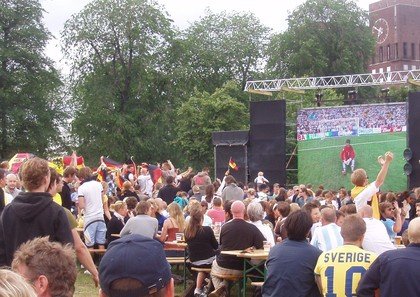
(Image: German and Swedish fans in Oslo)

Swissinfo interviews anthropologist Fabrizio Sabelli about the enthusiasm of Swiss fans during the World Cup. According to Sabelli, it’s driven by a need for a collective ritual and not nationalism:

We’re currently going through a pretty dull cultural period, which offers few gatherings like the World Cup, and people need them. They want to get together because they are increasingly lonely. And this solitude is not a uniquely Swiss malaise – it is found in all contemporary societies. Everyone needs rituals but there is a dearth of them in our globalised society.

I think it’s simply about rediscovering a sort of collective feeling shared at a celebration and above all the thought of a potential victory.

This Swiss team is made of different backgrounds, yet it doesn’t prevent members from presenting a united front under the Swiss flag. This, he says, is “an effect of the magic of sport “. Nevertheless, he doesn’t believe that football can have a determining influence on how we perceive others.

>> read the whole interview on Swissinfo

SEE ALSO:

Is the Football World Cup a peacemaker?

Rituals – mechanisms for both creating solidarity and for increasing conflict

Yoo Seung-gi: Sports Nationalism and World Cup. A look at the 2002 and 2006 football festivities (OhMyNews)

(Image: German and Swedish fans in Oslo)

Swissinfo interviews anthropologist Fabrizio Sabelli about the enthusiasm of Swiss fans during the World Cup. According to Sabelli, it's driven by a need for a collective ritual and not nationalism:

We're currently going through a…

Read more

“Welcome to an Engaged Anthropologist’s Blog”

Former professor of anthropology at Ben-Gurion University of the Negev and peace activist for over 30 years, Jeff Halper has started blogging. In his post “Welcome to an Engaged Anthropologist’s Blog” he explains:

My idea for this blog is to to bring you into the world of a peace activist in Israel-Palestine, an American-born Jew who became an Israeli some 35 years ago when he immigrated from Minnesota to Israel, who nevertheless believes in peace, justice, human rights, international law and critical thinking — thinking “out of the box” when it come to framing solutions to the world’s problems.

(…)

I’m not really conspiratorial or nutty as some of my words on the link among Israel, Jewish “leaders” and American Empire might imply (…). In fact, I’m a mild-mannered professor of Anthropology (used to teach at Ben Gurion University and elsewhere) who would love to do nothing more than go back to teaching and writing about the deconstruction of consciousness among the Nacirema or some other such stuff.

>> visit Jeff Halper’s blog (but why is there no RSS-feed??)

Halper has been nominated for the 2006 Nobel Peace Prize for his grass root peace activities, along with Professor Ghassan Andoni

>> ‘As Israelis, We Also Fight for Palestinians’ – Interview with Jeff Halper at OhMyNews

Former professor of anthropology at Ben-Gurion University of the Negev and peace activist for over 30 years, Jeff Halper has started blogging. In his post "Welcome to an Engaged Anthropologist's Blog" he explains:

My idea for this blog is to to…

Read more

Study: “Holders of social anthropology Ph.D.s are highly employable”

“Anthropologists escape into the wider world” is the title of a press release about a recent study that shows that “holders of social anthropology Ph.D.s are highly employable and successful in finding jobs that draw on their anthropological skills”.

The study tracked social anthropology doctoral students who completed their studies between 1992 and 2003 in Britain to see what they are doing now. The majority work outside academic anthropology, either in other disciplines within academia, or in various non-academic positions. Fifty-seven per cent currently hold academic positions, though one third of those are on fixed-term contracts with uncertain long-term prospects. Those who escape a conventional academic career can be found in international development organizations like the World Bank or in high-tech companies like Intel. Others remain in academia, teaching and researching.

What they bring to these settings are special skills of observation and critical analysis, born of Ph.D. projects based on long-term field research in challenging cultural locations, Professor Jonathan Spencer at the University of Edinburgh’s Anthropology Department says:

“We knew that social anthropologists have a real presence at all levels in the world of international development, but we were surprised by two discoveries. One was social anthropology’s success as an “exporter” of skilled researchers and teachers to other academic disciplines. The other was its growing role at the cutting edge of business and technology innovation. Employers seem to be especially interested in the close-focus research skills that are central to anthropological fieldwork. Our findings raise serious doubts about the received wisdom that employers are only interested in the most ‘generic’ social research skills.”

He adds:

In applying their skills in such diverse settings this generation of Ph.D.s is enriching the discipline in quite new ways. The challenge now is to explore ways to bring what they have learnt in their adventures back into academic training for the next generation of anthropologists.

>> read the whole article at EurekAlert

SEE ALSO:

INTEL is hiring more than 100 anthropologists

Popular IT-anthropologists: Observe families until they go to bed

“Anthropological customer research has become popular for a good reason”

Design Anthropology: Software development by participatory observation

"Anthropologists escape into the wider world" is the title of a press release about a recent study that shows that "holders of social anthropology Ph.D.s are highly employable and successful in finding jobs that draw on their anthropological skills".

The study…

Read more

The cultural nationalism of citizenship in Japan and other places

As in several European countries, Japanese citizenship is still defined by decent. Inspired by the recent immigration debates in the US, anthropologist Sawa Kurotani reflects about the “cultural nationalism” of Japanese citizenship and concludes: “As long as this biologically and culturally produced Japaneseness continues to be the basis of Japanese citizenship, the mobility between citizen and noncitizen categories will be minimal.”

He explains:

Japanese self-analysis of their national character is widely known as nihonjinron (literally, discussion or theory about the Japanese), which centers on the unique characteristics shared among the Japanese that are the product of both biology and culture. The essence of Japanese identity is passed down through the “blood,” and is nurtured through the early process of socialization to make one truly “Japanese,” so the theory goes. This is why so many Japanese stubbornly refuse to accept a non-Japanese who attains near-native fluency in Japanese or who are able to grasp subtle cultural nuances: How can a gaijin (foreigner) without blood ties or proper upbringing possibly understand anything Japanese?

(…)

When Japan began to admit a large number of foreign workers into the country in the 1980s, the overwhelming preference was given to descendants of Japanese who emigrated to Brazil and Peru. Japanese seemed to believe that their Japanese blood made them “Japanese,” despite their socialization as Brazilians and Peruvians, and they were truly surprised when they later found out otherwise. This instance gives us a sense of how powerful the belief in “Japanese blood” is.

(…)

Japan is now one of the few developed countries that do not allow dual citizenship. This is not a major problem in the world of “one citizenship per person per lifetime,” which is, perhaps, the world in which the majority of my compatriots still live. But, it is about time that we acknowledge that the myth of “homogeneous society” is just a myth, and that an increasing number of Japanese nationals are experiencing transnational/multicultural lives outside Japan, while more and more non-Japanese are choosing to live and work in Japan.

>> read the whole article in The Daily Yomiuri (updated with copy)

SEE ALSO:

Chris Burgess: Maintaining Identities. Discourses of Homogeneity in a Rapidly Globalizing Japan

Kenichi Mishima: Japan: Locked in the Self-assertive Discourse of National Uniqueness?

“Germans stick to the ethnic definition more than any other European nation”

“Germans&Japanese less sensitive about race”

“Anthropologists Should Participate in the Current Immigration Debate”

As in several European countries, Japanese citizenship is still defined by decent. Inspired by the recent immigration debates in the US, anthropologist Sawa Kurotani reflects about the "cultural nationalism" of Japanese citizenship and concludes: "As long as this biologically and…

Read more