search expand

Medicine as power: "Creates new categories of sick people"

(Links updated 28.1.2021) Antropython is the name of a blog by a student of anthropology at the University of Oslo. She has started to blog in English (previously only in Polish), so here is an excerpt from an interesting post by her on the power of medicine and how medicine changes our conceptions of the healthy body. Antropyton reviews the article “What do we mean by health?” by anthropologist Veena Das:

My reading of Das is that the emergence of discipline of geriatrics has brought about new definition of a healthy and “normal” body and has caused confusion between individual and social identities. It has also created a new category of sick people – the older ones. New definition of health has caused that aging has been reconceptualized as a disease and the ideology of the perfectly ordered body, which can be achieve through medicaments, as a sign of normalcy dominates the image of life cycle. Behaviour and health conditions, once normal and even noble (Kawagley, Turnbull), have been transformed to disability and this one to sickness that requires medical treatment.

>> read the whole post “Body redefinition & new social statuses”

Interesting reading also her thoughts before going on her first fieldwork

SEE ALSO:

Veena Das: Stigma, Contagion, Defect: Issues in the Anthropology of Public Health

“Ethnographic perspectives needed in discussion on public health care system”

Poverty and health policies: Listening to the poor in Bangladesh

medical anthropology – news archive

(Links updated 28.1.2021) Antropython is the name of a blog by a student of anthropology at the University of Oslo. She has started to blog in English (previously only in Polish), so here is an excerpt from an…

Read more

More Global Apartheid?

(LINKS UPDATED 6.4.2020) In my previous post, I’ve quoted anthropologist Owen Sichone about the concept of “Global apartheid”:

Whatever the advantages of apartness are (more economic than cultural), the South African system came to an end just as the rest of the world was reinventing it in new forms. Global apartheid policed by the regime of visas and passports in a manner that African migrant workers (…) would easily recognize as colonial still does the job of keeping wealth and poverty apart.

The French government is planning a new immigration law, furthering these developments towards more global apartheid, according to anthropologist Cicilie Fagerlid who writes:

According to this new law, immigration to France should be “chosen” (immigration choisie) rather than “suffered from” or “undergone” (subie). In practice, this means that people who are useful to the French economy are invited in, while the law will be more restrictive on the others – the asylum-seekers, the family reunions and the unregistered sans-papiers.

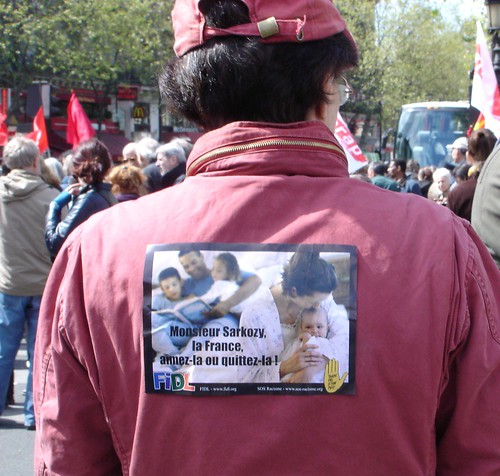
On yesterdays’ demonstration against the law, she writes, “quite a few demonstrators today had come to the conclusion that the interior minister obviously doesn’t love France as she is, so they suggested that he packs his bags and leave.”

>> read her whole post

Salih Booker and William Minter define Global Apartheid this way:

Global apartheid, stated briefly, is an international system of minority rule whose attributes include: differential access to basic human rights; wealth and power structured by race and place; structural racism, embedded in global economic processes, political institutions and cultural assumptions; and the international practice of double standards that assume inferior rights to be appropriate for certain “others,” defined by location, origin, race or gender.

>> read their whole article in The Nation

UPDATE (8.5.06):

Anthony Katombe from GlobalVoices reviews francophone blogs on African immigrants’ latest tribulations in France and Belgium. Blogger Le Pangolin belies Sarkozy’s assertions that France wants to start “choosing its immigrants” through new, tighter policies:

France has always chosen its immigrants. Remember the Senegalese janitors whom France imported from Senegal and Mali, the Renault and Peugeot auto factory workers they went to fetch in Maghreb to break the communist party and the CGT union’s strong influence between 1950 and 1970.

Le Pangolin ridicules a French government drowning under youth unemployment protests attempting desperately to redirect public attention towards a scapegoat, the African immigrant

>> read the whole post on GlobalVoices

SEE ALSO:

Yash Tandon: What is global apartheid and why do we fight it?

Charles Mutasa: Global Apartheid Continues to Haunt Global Democracy

Owen Sichone on Global Apartheid: Poor African migrants no less cosmopolitan than anthropologists

Proclaiming the birth of a new civil rights movement – demonstration against a tougher immigration policy in the US

Racism and The Five Major Challenges for Anthropology

(LINKS UPDATED 6.4.2020) In my previous post, I've quoted anthropologist Owen Sichone about the concept of "Global apartheid":

Whatever the advantages of apartness are (more economic than cultural), the South African system came to an end just as the…

Read more

Din masteroppgave på forsiden av avisa!

Den danske avisa Information har for ikke lenge siden startet et utmerket initiativ ang forskningsformidling: Information gir mulighet til å omtale og legge ut oppgaven i en egen blogg! Utrolig bra ide! Ikke minst fordi avisa først og fremst er interessert i oppgaver innen humaniora og samfunnsvitenskap. Jeg har allerede oppdaget flere oppgaver som jeg har tenkt å omtale her senere en gang. En norsk avis som føler seg kallet?

>> ta en titt på Informationens blogg om fakultets-specialer

Den danske avisa Information har for ikke lenge siden startet et utmerket initiativ ang forskningsformidling: Information gir mulighet til å omtale og legge ut oppgaven i en egen blogg! Utrolig bra ide! Ikke minst fordi avisa først og fremst er…

Read more

Rethinking Nordic Colonialism! Nordisk kolonialhistorie fram fra glemselen

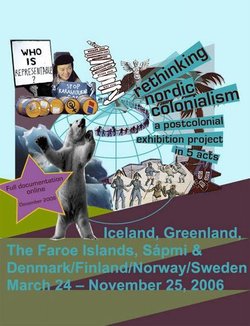
plakat “Rethinking Nordic Colonialism” heter et interessant utstillingsprosjekt som tar for seg en glemt og mørk del av nordisk historie. For første gang blir den nordiske kolonialhistoria presentert i et globalt historisk og politisk perspektiv, skriver Dan Jönsson som skildrer sine første inntrykk etter at prosjektet startet i Reykjavik i mars:

Hur hänger Grönlands framtid ihop med situationen för tredje världens arbetarkvinnor och med kriget mot terrorismen? Hur påverkar den nordiska kolonialhistorien vår syn på dagens invandring? Borde vi be om ursäkt?
(…)
Här ställs frågor om historisk skuld och kulturella rättigheter, om det kollektiva och det individuella minnet, om konstens politisering kontra politikens estetisering, om historieskrivningen som marknadsföring & Vilket är viktigast? Var ska man börja?

>> les hele saken i Dagens Nyheter

I pressemeldingen (pdf) leser vi:

Selv om de nordiske koloniene er avviklet (nesten da), er ikke koloniseringen et overstått kapittel. Regionen kan i dag sies å befinne seg i en postkolonial tilstand med tydelige spor fra koloniseringen. I de tidligere koloniene vil man f.eks. kunne støte på frustrasjon over ikke å bli hørt,forstått og respektert, samtidig som man har splittede følelser i forhold til fortidens kolonisatorer.
(…)
Det Nordiske Institutt for Samtidskunst, NIFCA, står bak det visjonære prosjektet som kombinerer utstillinger med workshops, konferanser, høringer og happenings på Island, Grønland, Færøyene og det samiske området i Finland. 56 anerkjente kunstnere, teoretikere, politikere og
grasrotaktivister fra hele verden deltar i prosjektet som varer fra 24. mars til 25. november 2006.

>> prosjektets hjemmeside

Litt mer info om bakgrunnen gir teksten Exhibition Proposal. Vi finner et utdrag fra “What Is Danish Racism? av idehistorikern Kim Su Rasmussen som skriver:

“Another aspect, which is important in order to understand the complexity of the current racism in Denmark, concerns a pervasive historical repression of Denmark’s colonial history. In my opinion, there exists amongst the ordinary Dane a pervasive denial of the history of Danish slave trade and the Danish slave colonies in the West Indies.”

Teksten fortsetter slik:

According to Su Rasmussen, this denial is not accidental. Denmark’s imperial history (…) paints a picture of the Danes, which is in direct conflict, if not incompatible, with Danish self-perception today as a liberal, tolerant, progressive people.
(…)
It could be argued that this historical repression is characteristic of the other Scandinavian countries also. Sweden’s past colonial activities in the Baltic, the Caribbean, and the Cape Coast, and Norway’s present-day claim to possessions in the Arctic and Antarctica are toned down. The devastating effect that Swedish, Norwegian, and Finnish colonization has had, and continues to have, on the indigenous Sámi people living within their respective realms is also played down in favor of a massive exploitation of Sámi identity by the tourist industries of these countries.

>> les hele Exhibition Proposal (pdf)

SE OGSÅ:

Wikipedia om Danmarks kolonitid

Nett-Utstilling om slavehandelen (Liverpool Maritime Museum skriver bl.a. “The main European nations involved in slaving were Portugal, Spain, Britain, France, the Netherlands, Denmark and Sweden”)

Ny bok: “Kolonialismens svarta bok”

Menneskeutstillinger og myten om hvit overlegenhet

plakat

"Rethinking Nordic Colonialism" heter et interessant utstillingsprosjekt som tar for seg en glemt og mørk del av nordisk historie. For første gang blir den nordiske kolonialhistoria presentert i et globalt historisk og politisk perspektiv, skriver Dan Jönsson som skildrer sine…

Read more

“Monsieur Sarkozy, if you don’t love France, leave her”

Today’s most important event is probably what I’m watching right now; the French cup final described as the dream final for the supporters and the nightmare for the forces of order. Since it’s between my two and only favourite French teams, it’s a dream final for me as well. After I’ve settled my little foldable bike import firm in Marseille my loyalties will probably settle for the Mediterraneans, but until then I’ve spent too much time in the capital to not have divided loyalties. There goes La Marseillaise… All the 80 000 (with tickets sold out weeks ago and reaching 400€ at the internet) are not singing, but quite a few are. The President arrives and shakes the hands with all the players…
[teaserbreak]
Well, not everyone will agree that this is the most important event today. Before going to what has been the most important event for me, I had a glance at an TV audience complaints programme, where I heard a TV spectator who was so angry, and found it surrealist that Zidane announcing his retirement had made it to the number one headline on the evening news the other day. (The spectator en colère was a religious man and in his opinion a news event in the Middle East was far more important). (PSG has already scored after 5 minutes! Luckily Olympic Marseille looks like they can equalise any moment). Zidane’s forthcoming retirement has not passed lightly in the public debate, but the last days the Clearstream affaire has of course out-shadowed other news. The question is; will really de Villepin have to go now after he somehow got through the CPE storm (though dropping to a an all time low for a Prime Minister on popularity ratings)? I can’t be bothered to go into this affair here (see The Guardian if interested), but the affair latches on to a question I saw on a funny poster today: On top of a drawing of the three leading politicians President Chirac, Prime Minister de Villepin and Interior Minister Sarkozy it was written Choisie? Subie? (“Chosen? Or suffering from?”)

In order to explain this drawing, I shall go on to what has been today’s most important event for me: The demonstration (of course encore une manif! It’s been more than three weeks since the last one…) against the new immigration policy which will be discussed in Parliament in three days.

According to this new law, immigration to France should be “chosen” (immigration choisie) rather than “suffered from” or “undergone” (subie). In practice, this means that people who are useful to the French economy are invited in, while the law will be more restrictive on the others – the asylum-seekers, the family reunions and the unregistered sans-papiers. The labour party (PS) politician Christiane Taubira said on the news today that she had too much respect for humanity to accept even the notion immigration choisie. Activists have in a similar humanist vein renamed the government term immigration subiedisposable immigration” (immigration jetable).

Either the political climate is hardening here, or I’ve just taken too long to grasp how far right the Interior Minister is willing to go. When the Votez Le Pen poster with Sarkozy’s photo appeared in January, I have to admit that I found it a too strong for my taste (on the other hand I could wholeheartedly appreciate the Sarkozy satire poster “When I hear the word banliue I reach for my Flash-ball (rubber bullet weapon)” and the Raspouteam stencil). But after Sarkozy’s two latest “love France or leave her” and the “If Le Pen says that the sun is orange, do I have to say that it is blue?”*) I must admit that the poster was far more updated on French politics than the newly arrived anthropologist.

Quite a few demonstrators today had come to the conclusion that the interior minister obviously doesn’t love France as she is, so they suggested that he packs his bags and leave.

The cup final is finished long time ago (Paris Saint-Germain led all the way from the 5th minute and won 2-1…).


*) The exact quotes are “s’il y en a que cela gêne d’être en France, qu’ils ne se gênent pas pour quitter un pays qu’ils n’aiment pas” (Le Nouvel Observateur 28/04)« Si certains n’aiment pas la France, qu’ils ne se gênent pas pour la quitter » (Le Figaro and Le Monde 29/04) Le Monde 27/04 has published a more extensive interview with the interiour minister on the subjet.

Today’s most important event is probably what I’m watching right now; the French cup final described as the dream final for the supporters and the nightmare for the forces of order. Since it’s between my two and only favourite French…

Read more