search expand

Marseille (communications)

I’ve spent Easter time in Marseille. In 3 hours and 10 minutes the TGV takes you more than 800 km south from Paris to the Mediterranean city, through the French countryside, past a few villages, a castle or two on top of a cliff, a viaduct, blooming apple orchards, the river Rhone and loads of white cows. “Quite why, you might wonder,” the Guardian wrote in the heat of the CPE-affaire, “is a country with wonderful infrastructure, beautiful towns and countryside, world-class companies and highly productive workers tearing itself apart again?” I do find that paradox intriguing, and the comfort of the Train Grande Vitesse was an apt opportunity to give the transportational part of it a thought. Most major train itineraries in France take around 3 hours, an infrastructural feat I – perhaps because I come from a country made of massive granite – find very fascinating. I wonder how people can bother to take domestic planes at all from the capital in this country, not to mention to London, when they can just jump on the efficient metro to one of the grandiose railway stations and get on a double-decker TGV, and get off at an equally grandiose station at their destination a few hours later. (Public transport in this country is one of the very few things that run on time – after 6 months here I still haven’t figured out exactly when the TV news starts, and I’m still not sure how delayed the conference, demo, meeting etc. will be – but public transport is reliable indeed, as long as there isn’t a strike or a manif blocking the way).
[teaserbreak]
Thinking of what I have planned writing about from Marseille I realise that this post could equally been titled “communication” (…which I add at this moment…). “Communication” can stand for all the three features that we noticed in particular on our weeklong holiday in Marseille. All the three of them are common in Paris as well, but in Marseille they’re somehow amplified:

First: I’ve got the impression that les Marsaillais are quite chatty. In Paris too people say things to strangers in public spaces. (This is perhaps normal in many countries in the world, but again, Norway is not only made of granite, it’s also very sparsely populated so we haven’t really discovered the finesse of human interaction yet ;-) ) I’ve written earlier that many people speak to themselves on meetings and conferences, apparently in order to get contact with their side-person so they have someone to share their opinions with (expressing opinions is undoubtedly very important in France). In public spaces people aren’t usually trying to enter into long term exchanges, they’re just saying a few words: In the supermarket today a boy around twenty commented that my nutritional intake today surely would be well-balances (I had some cartons of juice and a big bag of salad in my shopping basked, in order to fight of a threatening cold. He bought a packet of biscuits). And if people – kids, youth or adults – double you on a narrow pavement, chances are that they would say Pardon! or Excusez-moi! as they pass. If I carry flowers from the market, someone will possibly make a joke, usuallyare they for me? But particularly I appreciate all the passers-bys giving a Bon appétit! when they see someone eat in public. A couple of days ago, when we had lunch on the pavement outside a local bistrot someone even shouted bon appétit from a passing car.
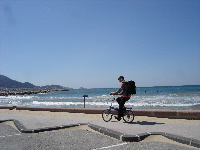
Foldable pocket bike at the beach in Marseille

These examples are from Paris, but my impression is that the Marseillais talk even more to strangers. When I stayed in France some years ago, I spoke more French in one week in Marseille than I had done the previous 4 months in Paris. This time, apart from all the ordinary bon appétit it was our small foldable pocket bikes that made quite a few Marseillais talk to us. Even a busdriver leaned out of the window at a red light and said he had always wanted such a bike and now he would like to know where we had got them. All the interest our bikes generated would probably have inspired someone a little more entrepreneurial than us to start a local import firm and live happily for the rest of our lives down there.

The second feature we noticed about Marseille is how calm people are in the traffic. It’s quite a Zen experience to cycle in Marseille, – but also in Paris, I should add, which I noticed when I unfolded my little green pocket bike and started cycling here as well. The contrast couldn’t have been bigger to cycling in London, which is almost an extreme sport experience (at least at the time I was there, which was just before Major Livingstone got to power). The bikes here are often older and of a more classical city bike posture than the typical off road or hybrid bikes in Oslo or London. That makes people sit more straight and almost backward leaning. In addition, many cycle really slow. And all kinds of people cycle; from elderly men and ladies to kids via businessmen. But this is Paris I’m talking about again. In Marseille there aren’t that many people on bikes, and the infrastructure for bikes are much worse than in the capital, with no bicycle lanes and at the moment the whole city centre is just a construction site for the new pride, the tramway. But despite all this, the drivers have surprisingly a lot of patience with us cyclists (perhaps they were just staring at our attractive foldable pocket bikes?).

I find it surprising that the city traffic in France give this Zen impression at the moment, because that was certainly not how I remember it from my first visits to Paris in the late 1980s.

Initially, I was thinking of writing a comparison between “multicultural” Belleville (social demographer Patrick Simon’s description) and cosmopolitan Marseille, but the only thing I’ll say about the cosmopolitan feature of the city for now is that les Marseillais apparently see it as some kind of public duty to make metissée babies. It wasn’t even the anthropologist, who is supposed to notice such things, but her companion who remarked the high number of people of mixed origins in the city of 2600 years of immigration.

I’ve spent Easter time in Marseille. In 3 hours and 10 minutes the TGV takes you more than 800 km south from Paris to the Mediterranean city, through the French countryside, past a few villages, a castle or two on…

Read more

Owen Sichone: Poor African migrants no less cosmopolitan than anthropologists

Anthropologists are citizens of the world because they are able to manoeuvre in and out of different cultures. African migrants display similar competencies when they are away from home. But you can even be cosmopolitan without ever having left your home, anthropologist Owen B. Sichone told at the conference Cosmopolitanism and Anthropology:

If we want to understand the cosmopolitanism of global justice we may find the answer not in liberal constitutions or UN conventions but in the real lives of the world’s a dollar a day multitudes.

(…)

In my view we would do better to look to remote Africa villages and congested urban slums to find the woman who greets the stranger with a tray of food and this woman who has never left home lives her cosmopolitanism by welcoming the world. One does not need to be well travelled to be a polyglot, polymath or cosmopolitan if one is plays host to the world as the women of Cape Town have done since the Mother City was constructed.

European capitalism on the other hand is uncosmopolitan:

In today’s globalising world the political philosophers have defined cosmopolitanism in various ways. Whether we see it as based on liberal notions of human dignity, (Appiah, 2005 ch6), ‘obligations of justice to non-nationals’ or merely being ‘marked by diverse cultural influences’ (Sypnowich: 56) the European capitalist who has long offered himself as the ideal type fails the test. It is not just failure to protect strangers in Europe but the whole imperial episode of colonial oppression, i.e uncosmopolitan cosmopolitanism.

Sichone points to tougher immigration laws, that are limiting the mobility of the less affluent people outside the rich countries. Modernisation has in his opinion meant sedentarisation rather than increasing mobility for most Africans. :

Whatever the advantages of apartness are (more economic than cultural), the South African system came to an end just as the rest of the world was reinventing it in new forms. Global apartheid policed by the regime of visas and passports in a manner that African migrant workers (…) would easily recognize as colonial still does the job of keeping wealth and poverty apart.

(…)

It is ironical that East Africans seem to have enjoyed greater freedom of movement during the colonial days than they do today. There was no real border at the time as East Africa was all-British territory, the same could be said for other parts of the continent.

Certain migrants, the sort that travel without passports or visas, challenge the system of global apartheid and make it possible for others who belong to the immobile 97 per cent of the global population that never leaves home, to connect with the world in ways that facilitate the transfer of resources between centres and peripheries. They sometimes impact upon the host population in dramatic and unpredictable ways that belies their small numbers, Sichone writes.

On the other hand, Cape Town (where his paper focuses on) is a quite xenophobic society. This may be the result of imperialism, colonialism and apartheid. Sichone found striking gender differences. Women are much more friendly to strangers than men. For the South African more strangers means less resources for everyone:

Xenophobia (…) is most pronounced in the world of the retrenched worker, the men who must blame their unemployability on foreigners and who see themselves in a zero sum battle for survival.
(…)
Many migrants in Cape Town would probably agree with the Congolese refugee who said, if it were not for the women, we would not make it. (…) My Tanzanian contact, Pascal referred to some of them as the ‘Xhosa mama’ who provide new arrivals with accommodation and counter the ill-treatment that makwerekwere suffer at the hands of South African men. The ‘Xhosa mama’ treats foreigners, strangers, aliens etc as fellow human beings from the beginning just as the xenophobic men are hostile to strangers even before they encounter them.

He concludes:

What we seek to do is not necessarily to denounce elite models of cosmopolitanism exemplified by the work of international scholars, global social movements or human rights activists but rather to demonstrate that for the dollar a day multitudes ultimate security lies in ubuntu.

His paper was for me one of the highlights of the conference. So I am glad that Owen Sichone gave me the permission to post his paper on antropologi.info. He welcomes comments. His email address: osichone AT humanities.uct.ac.za

>> read Xenophobia and xenophilia in South Africa. Africans migrants in Cape Town by Owen B. Sichone (90kb, pdf)

EARLIER POSTS ABOUT THE CONFERENCE:

What’s the point of anthropology conferences? (general summary)

David Graeber: There never was a West! Democracy as Interstitial Cosmopolitanism

Thomas Hylland Eriksen: Cosmopolitanism is like respecting the ban on smoking in the public

For an Anthropology of Cosmopolitanism

Anthropologists are citizens of the world because they are able to manoeuvre in and out of different cultures. African migrants display similar competencies when they are away from home. But you can even be cosmopolitan without ever having left…

Read more

“Lærer oss alternativer til vår måte å leve på”

Lena Thomsson i Gefle Dagblad er begeistret over boka På Barheidas tid – Familjekrönika från Savannen av antropologene Stig Holmqvist og Aud Talle. Den handler om nomader i Tanzania. Antropologene møtte nomadene allerede i 1971. Ifjor har de vært der for tredje gang:

Holmqvist och Talle har bott hos Barabaig, fotograferat och dokumenterat livet i byn, intervjuat medlemmarna av Barheidas familj och and­ra, böckerna blir fina som dyrbara smycken av elfenben. “På Barheidas tid” är mer av rapportbok än antropologi. Här finns inte det vetenskapliga och förklarande som så lätt blir nedlåtande. Författarna har få åsikter. Perspektivet är ofrånkomligt utifrån men det känns inte som en avigsida.

Anmelderen mener boka er så viktig fordi den viser oss at det fins andre måter å leve på og fordi den utfordrer mange gjengse forestillinger:

Den här boken är viktig att läsa för alla som vill veta hur det också går att organisera samhällen, att vårt sätt med representation och de valda så långt bort att de lika gärna kunde vara verksamma på månen, inte är enda sättet. Barabaigs rättssystem är direkt och handgripligt och demokratiskt.Polygamin är en försörjningsstruktur och inte en manlig sexuell utlevelse. Just detta gör böcker som “På Barheidas” tid oundgängliga. Vi får lära oss nya synsätt, alternativ till vårt sätt att leva, filosofera, att resonera existentiellt.

>> les hele anmeldelsen i Gefle Dagblad

Lena Thomsson i Gefle Dagblad er begeistret over boka På Barheidas tid - Familjekrönika från Savannen av antropologene Stig Holmqvist og Aud Talle. Den handler om nomader i Tanzania. Antropologene møtte nomadene allerede i 1971. Ifjor har de vært der…

Read more

– Uetiske business-antropologer

Det er en kjent sak at flere og flere antropologer jobber innen markedsføring og reklame. Dette medfører etiske dilemmaer. I Berlingske Tidende leser vi at danske reklamebyråer og leketøysfabrikanter bruker psykologer og antropologer for å markedsføre varer og kommunisere med barn og og unge. Barnepsykiater Gideon Zlotnik kritiserer antropologenes og psykologenes virke.

– Det er dypt uetisk å manipulere barn til å kjøpe noe de ikke har bruk for, mener han. Barn og unge bør beskyttes mot reklamepresset. Han viser til at barn innenfor visse varegrupper er den raskest voksende forbrukergruppe.

>> les hele saken i Berlingske Tidende.

Kritikken er ikke ny. Se også New book critizises ethnographic methods in market research on children

Det er en kjent sak at flere og flere antropologer jobber innen markedsføring og reklame. Dette medfører etiske dilemmaer. I Berlingske Tidende leser vi at danske reklamebyråer og leketøysfabrikanter bruker psykologer og antropologer for å markedsføre varer og kommunisere med…

Read more

“God faktabok om samepolitikk”

Norsk samepolitikk 1945–1990. Målsetting, virkemidler og resultater heter en ny bok av Bjørn Aarseth som har jobbet med samiske spørsmål i flere tiår. I dagens Klassekampen kan vi lese anmeldelsen av Svein Lund som skriver euforisk:

For den som vil vite kva som har skjedd i norsk samepolitikk, når det skjedde og kven som meinte kva, er denne boka vanskelig å komme utanom. (…) Om ho kanskje ikkje blir folkelesing i alle heimar, bør ho i alle fall finnast i alle bibliotek og skolar, og studerast av alle som deltar i offentlig debatt om samiske spørsmål.

>> les anmeldelsen på Svein Lunds hjemmeside (tidligere publisert i Finnmark Dagblad)

Norsk samepolitikk 1945–1990. Målsetting, virkemidler og resultater heter en ny bok av Bjørn Aarseth som har jobbet med samiske spørsmål i flere tiår. I dagens Klassekampen kan vi lese anmeldelsen av Svein Lund som skriver euforisk:

For den som vil vite…

Read more