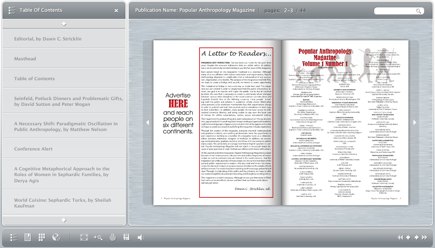
The first issue of the Popular Anthropology Magazine is out. It was meant to bridge the gap between academia and the public and between anthropologists and continents. Cool, we needed that. But the result is – in my opinion – disappointing. For it was made with outdated paper journals as ideal. The editors were thinking paper, not web. They do provide a downloadable version on their website but the flash animated paper-look-like version is a pain to navigate and read (the automatic scrolling is very irritating).
I finally tried to download the whole journal. It took ages and Firefox was about to crash. When the file finally was saved, it turned out to be 151 MB heavy. The pdf consisted of image files! Which means it is partly hard to read and you cannot copy and paste its content, and the links are not clickable. Fail! Can’t anthropologists do better? The articles deserve better. The table of contents looks promising, especially the sections on social science around the world.
The first issue of the Popular Anthropology Magazine is out. It was meant to bridge the gap between academia and the public and between anthropologists and continents. Cool, we needed that. But the result is - in my opinion…
Information har startet en interessant serie om hinduekstremister i Danmark. Det er bra at en holder et argusøye med ekstremister, men det er samtidig interessant å se hvor ulikt majoritetens og minoritetens ekstremisme blir behandlet – eller i det hele tatt lagt merke til.
For det er jo litt morsomt å lese kommentaren fra Birthe Skaarup i Dansk Folkeparti som sier “Vi vil ikke have ekstremister her i Danmark.” Hva annet enn ekstremister er de selv? Det er heller ikke umulig å argumentere for at hele det danske regimet er høyreekstremt.
Manu Sareen, integrationskonsulent og politiker fra Det Radikale Venstre ytrer seg på lignende måte overfor minoriteter. Han sier:
“Der sker en kulturel radikalisering i hele Europa, hvor minoriteter bliver mere og mere bevidste om deres egen kultur. Det synes jeg er et problem uanset, hvem pokker man er.”
Anledningen for serien er et europeisk møte i den hindunationalistiske bevægelse Hindu Swayamsevak Sangh (HSS) i danske Brønshøj. Ifølge Information har HSS “stærke bånd” til den hindunationale bevegelsen Rashtriya Swayamsevak Sangh (RSS) som i India blir satt i sammenheng med “terrorlignende aktiviteter” og drap av tusenvis av muslimer og kristne. HSS avviser dette.
Information snakker også med antropologerne Stig Toft Madsen og Kenneth Bo Nielsen som blant annet forteller at hindunasjonalister forsøkte å mobilisere i Danmark siden 1980-tallet.
“De skal ikke nødvendigvis forbydes, men den her forening har forbindelser til den hindunationale bevægelse, og man bør være kritisk overfor, om deres arbejde har konsekvenser andre steder i verden”, sier Kenneth Bo Nielsen.
Information har startet en interessant serie om hinduekstremister i Danmark. Det er bra at en holder et argusøye med ekstremister, men det er samtidig interessant å se hvor ulikt majoritetens og minoritetens ekstremisme blir behandlet - eller i det hele…
Das Institut ist sich der Brisanz des Themas bewusst. Werbung für die Kriege der Bundeswehr im Ethnologie-Seminar? Die Marxistische Aktion Tübingen hat in einem offenen Brief an das Rektorat der Uni die Veranstaltung bereits kritisiert und in Zusammenhang einer generellen Militarisierung gestellt:
Frau Dr. Monika Lanik (…) bietet übrigens im kommenden Semester ein Hauptseminar zum Thema an. Ein Schelm, wer hier Böses denkt. Sie wird doch nicht etwa, wie ihr am rechten Rand agierender Kollege Thomas Bargatzky an der Uni Bayreuth, bei dem sie bereits mehrmals Gastvorträge hielt, Studierende dazu anhalten wollen sich bei der Bundeswehr zu engagieren? Bei dem regelmäßigen Autor der rechtsextremen Zeitschrift „Junge Freiheit“ Thomas Bargatzky kann der/die Interessierte direkt auf seiner Institutshomepage Formulare für Praktika bei der Bundeswehr downloaden.
So wenig subtil wird Monika Lanik wohl nicht agieren. Dass Laniks Afghanistan-„Forschungen“ nichts desto trotz im Dienste des militärischen Engagements der Bundeswehr stehen, davon kann sich jedeR leicht in dem Buch „Afghanistan- Land ohne Zukunft?“ (download unter: www.streitkraeftebasis.de) überzeugen.
Frau Dr. Lanik arbeitet als Ethnologin im Amt für Geoinformationswesen der Bundeswehr. Dies hat die Themenwahl der Lehrveranstaltung bestimmt, keinesfalls aber die Inhalte, die persönlich Dr. Lanik zuzuschreiben sind und keinesfalls im Namen der Bundeswehr stehen.
Ziel ist es, gemeinsam mit Studierenden der Ethnologie die Argumentationsstränge zu sortieren, den Stand der Informationen zu bewerten und aus wissenschaftlicher Sicht eine Bewertung der Ethik-Diskussion vorzunehmen.
Inhaltlich wird es darum gehen, auf der Grundlage der neueren Geschichte von Ethnologie und Militär im deutschsprachigen Raum ein informiertes Bild über die Methoden- und Ethikdiskussion des aktuellen Einsatzes von Ethnologen im Militär zu erarbeiten. Die Ethnologie steht hier exponiert in einem Anwendungsfeld, das de facto längst von der Psychologie, der Kommunikationswissenschaft, der Geographie, der Islamwissenschaft und anderen Disziplinen besetzt ist. Am Ende des Seminares soll die Frage beantwortet werden, ob überhaupt ein speziell ethnologischer Beitrag gefragt ist in der militärischen Anwendung und in welchem Passungsverhältnis dieser zum ethischen Forschungskanon der Ethnologie stehen kann.
Sehr interessant ist die Seite http://www.streitkraeftebasis.de/ worauf im Offenen Brief hingewiesen wird. Da gibt es u.a. Infos über die modische sogenannte “Interkulturelle Einsatzberatung” Das Buch, in dem Lanik einen Text beigesteuert hat, heisst übrigens nicht Afghanistan – Land ohne Zukunft, sondern Afghanistan – Land ohne Hoffnung? und ist in der Tat als pdf erhältlich. Einen weiteren Artikel von ihr ist in einem weiteren Buch über Afghanistan – für Soldaten geschrieben – zu lesen.
Monika Lanik hat bei der Diskussionsveranstaltung Ethnologen in Krisen- und Kriegsgebieten: Ethische Aspekte eines neuen Berufsfeldes auf der Tagung der Deutschen Gesellschaft für Völkerkunde im Herbst letzten Jahres teilgenommen. Im Referat (pdf) ist zu lesen dass es laut Monika Lanik keine Möglichkeiten gebe, als Ethnologin innerhalb der Bundeswehr eigene Feldforschung zu betreiben. Die Strukturen seien zu starr. Sie verteidigte jedoch ihren Job: Wenn sich Ethnologen nicht selbst dieser Fragen annehmen, bestünde die Gefahr, dass das Wissen um kulturelle Gegebenheiten von Fachfremden ohne entsprechende Expertise abgedeckt werde, so Lanik.
Man kann jedoch nur Laniks Logik folgen, wenn man die Bundeswehr und ihre Kriege unterstützt. Unabhängig davon bleiben ethische und fachliche Fragen. Es wäre spannend, wenn Teilnehmende des Seminares von den Diskussionen berichten könnten.
(AKTUALISIERUNG 16.4.10 / 29.4.10: Friedensbewegung protestiert gegen "Ethnologie und Militär" Seminar und Ethnologie und Militär: Der Protest hat genutzt) Am 23.April gehts los. Dann wird Bundeswehr-Ethnologin Monika Lanik die Studierenden mit dem Hauptseminar "Angewandte Ethnologie und Militär" im Ethnologie-Institut…
Anthropological engagement with media was long rare and discouraged – and in some quarters still is, Bird criticizes. The main focus has in her view been on topics like the role of television in family life, or the maintenance of diaspora connections through digital media but not on news production or reception.
This neglect is according to her important because “news is the one popular genre that claims to describe reality for the public”. Most of what people know about the world is mediated in one way or another:
Throughout the world, people argue, fight and die for stories in which they believe. So it is important to dissect and interpret them: the use of language, the choice of words, the images, the entire frame of the news coverage.
She suggests following research questions:
Which stories are being told and which are not?
Whose stories are being told, whose are not, and why?
How do journalistic routines and values vary across cultural contexts, and how does that produce different kinds of news?
How does the choice of images take the story in one direction or another?
How does the story then become part of the common-sense reality in specific cultural contexts?
High profile issues like war, she continues, illustrate these questions dramatically:
We all know, for instance, that the story of the Iraq war is deeply contested. If we have a lot of time, we can scour the Internet, sift through multiple accounts, and reach a conclusion. Most people have neither the time nor the resources to do that; they have little choice but to attend to the stories that predominate.
If we understand better how journalism works, she concludes, not only will we better understand our mediated global cultures, but we will also become more adept at working with journalists to tell anthropology’s stories more effectively.
I have to admit I’m a bit surprised about her analysis. Is the study of news really so much neglected? But that’s maybe because I tend to read more anthropology blogs than journals? It’s in blogs this kind of media anthropology is happening?
“Merging book reviewing with journalism”, she writes, “opens up a space in which we may fling our fierce book-engagement out into the wider world, and see what comes back to us:
When reviewing, the single greatest joy for me is the oppor- tunity to showcase our colleagues’ brilliance. I look for books that bring alive people’s patterns of meaning-making as they flourish and struggle in their daily lives, books that make us see with new eyes behaviors familiar and strange to our own society or at times even to our own species.
The contemporary market and labor conditions pressure anthropologists to adopt faster modes of research and writing than ever before:
Even doctoral candidates report feeling enormous pressure to publish their research findings well in advance of receiving their PhDs. Not unlike the desk journalists of old, we find ourselves increasingly concerned with “getting the story” (Peterson in Anthropological Quarterly 74[4]), that is, with chasing the next publication opportunity to keep up with market expectations and the demands of institutional audit cultures.
The best source on media anthropology might be the website http://media-anthropology.net with mailing list and a long list of working papers and the blog media/anthropology by John Postill
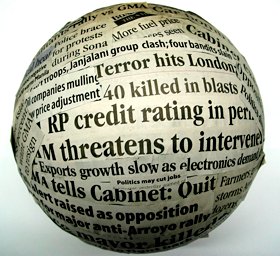
Bad News. Photo: Stitch, flickr The time is right for more anthropologists to engage with news media - with their creation, reception and content, writes S Elizabeth Bird in the recent issue of Anthropology News that was published today.
Janine Wedel has done something that far too few anthropolologists do: She studied powerful people. Those who rule the world.
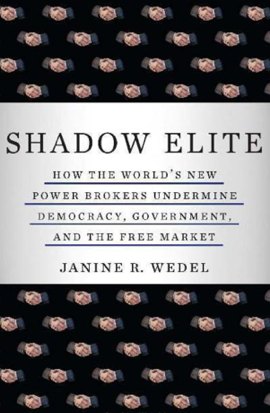
In her book “Shadow Elite“, she shows how a new system of power and influence has taken hold globally, one that undermines democracy, government, and the free market.
Why went America to war against Iraq? More and more “government work” is performed by “shadow elites”: consulting firms, companies, nongovernmental organizations, think tanks etc, rather small circles of powerful people (she calls them “flexians”) who use their interlocking relationships to control public policy without public input. “Flexians” work often for private interests, academia and government at the same time.
The flexians form “Flex nets”. They cannot be reduced to lobbyists or interest groups. They are according to a review in the Financial Times defined by four features:
1) personalizing bureaucracy, or using personal connections and loyalties to realize goals;
2) privatizing information while branding conviction, or branding the information available only to insiders in this game;
3) juggling roles and representations, or changing spots frequently, wearing the pelt of military leader one day, analyst the next, and concerned citizen the next;
4) relaxing rules at the interstices of official and private institutions, or adjusting accountability and rules that apply to one or more of their pelts from the safety of a seemingly non-aligned position.
One of those flexians is the retired US general Barry McCaffrey, who has been simultaneously a commentator for the media, a consultant to the defence industry and professor. According to a 2008 exposé in the New York Times, he was one of several former military men who helped to shape public opinion on the Iraq war, while simultaneously having undisclosed ties to the Pentagon.
Wedel’s book has received quite a lot of media attention since it was released earlier this year. It was book of the month at Huffington Post (where she has started writing a weekly column) and was also reviewed in mainstream media. She was interviewed both by BBC, Russia Today, MSNBC and Al Jazeera.
Riz Khan - Shadow Elite - 15 dec 09 - Pt 1
Riz Khan - Shadow Elite - 15 dec 09 - Pt 2
It would be interesting to know how she studied the “shadow elites”. Has she been on fieldwork? I haven’t read all her texts. But in her newest article in Huffington Post, she explains how she came to understand the game: through her experience studying the mechanisms of power and influence in post-Cold War eastern Europe for about 30 years:
(E)xamining eastern Europe up close–through its transformations away from communism over the last quarter century–has been excellent preparation for making sense of how a small group of power brokers helped engineer the invasion of Iraq, and more broadly, how a new system of power and influence has taken hold globally, one that, as I write in my book Shadow Elite, undermines democracy, government, and the free market.
In communist Poland, the necessity of getting around the state-controlled system created a society whose lifeblood–just beneath the surface–was vital information, circulated only among friends and trusted colleagues, information that was not publicly available. Under-the-radar dealings that often played on the margins of legality – this was the norm, not the exception.
(…)
I began to recognize a familiar (to me) architecture of power and influence. I started to follow the networks and overlapping connections in government, foundations, think tanks, and business of a tiny set of neoconservatives – just a dozen or so players I call the “Neocon core”.
(…)
The playbook of the Neocon core seemed to come straight from that of the top players of transitional eastern Europe. In both cases, players who already knew each other set up a host of organizations–organizations that seemed more like an extended family franchise than think tank, populated by the same set of individuals. (…) And despite a new administration in Washington, not to mention the damage done to their credibility since the Iraq invasion, the Neocon core lives on, because networks like it are self-propelling, multipurpose, and enduring.
And she adds that as a social anthropologist, her “focus is not on whether the U.S. should have invaded Iraq, but rather how that decision was made, who made it, and what mechanisms of power and influence were used to make it”.
I have concluded that an ethnographic focus is indispensable to sorting out power and influence amid transforming federal governance in the United States, not only under change-of-system conditions such as those found in transitional eastern Europe.
The ethnographic sensibility that enabled scholars of communist and post-communist societies to deal with the complexity, ambiguity and messiness of political and policy processes is ideally suited to examine the interactions between public policy and private interests and the mixing of state, nongovernmental, and business forms that are increasingly preva- lent in the United States and around the world.
By focusing on players and their networks as drivers of governing and policy decisions, these ethnographers have laid the groundwork for badly needed critiques of social science categories such as “state” versus “private,” “top-down versus bottom-up,” and “centralized” versus “decentralized.” They have provided a basis for reexamining conventional models that guide so much thinking about politics, policy and power, and yet obfuscate, rather than illuminate, the real system of power and influence.