
search expand

AIDS:”Traditional healers are an untapped resource of great potential”

In a recently published doctoral dissertation at the University of Helsinki, anthropologist Perpetual Crentsil provides 13 recommendations on how to fight AIDS. Crentsil has been on fieldwork among the Akan in the coastal south and forest zone of Ghana:

It seems reasonable to expect that where deaths from AIDS are common, people would be worried and would attempt to prevent infection by abstinence or protecting themselves. However, new infections indicate that campaigns to educate and create more awareness are not having the optimal effect.

The ill effects of the disease necessitate a radical approach, Crentsil writes and suggests among other the following measures:

– Campaign strategies need radical changes in order to portray their urgency in sending strong messages about the seriousness of the disease. Alternative modes of educating people could be adopted, such as the use of traditional or supernatural concepts — ‘bad’ death and non-creation of ancestors.

– There should be more posters and billboards about the disease. Owing to the high level of non-Western education in the rural areas, the posters should be more pictorial than textual. Again, as this study found, the posters seem to be concentrated in the cities and major towns. More need to go to the rural areas too.

– It is important that pharmaceuticals make the medication for HIV/AIDS cheap enough for poor countries; in this way biomedicine would claim more control over other medical systems.

– Traditional healers are an untapped resource of great potential, as I have suggested elsewhere (Crentsil 2002). They could be integrated into the country’s medical system, properly regulated and redefined to provide important outlets for networks dedicated to the campaign against HIV/AIDS in remote areas. After all, the model of the ‘health care system’ is meant to be universally applicable.

(…)

– The role of the media is important. (…) My observations in the field were that even in the urban areas where many people have television sets, the majority choose to watch music and drama instead of HIV/AIDS programmes. Although not statistically proven, it is believed that people find HIV/AIDS programmes too boring. Soap operas on HIV/AIDS could be encouraged by the media houses. (…)

– The family needs to reform itself as a socialising unit. Parents should be able to speak against their children’s questionable lifestyles. In this period of risks of infection, the lineage needs to assume its role as what I call an informal ‘health promotion agency’ by conducting thorough investigations of prospective partners for their young members. This, in my opinion, could be a major deterrent to many young people who may be engaging in unhealthy lifestyles.

(…)

– I support the churches’ insistence on HIV test before they conduct marriage between couples, if that will make people sit up. I suggest that churches (the spiritualist ones and others) should make issues about the disease a major part of their preaching in worship sessions. (…) I support abstinence by those who are not married (not merely because I am a Catholic). For married couples, being faithful should be a strong message to them. It is only when abstinence and fidelity cannot be practised that people would need to adopt the condom culture.
(…)

>> download the thesis

SEE ALSO:

Male circumcision prevents AIDS?

The emerging research field of medical ethnomusicology: How music fights AIDS

“There’s no AIDS here because men and women are equal”

Cultural values and the spreading of AIDS in Africa

In a recently published doctoral dissertation at the University of Helsinki, anthropologist Perpetual Crentsil provides 13 recommendations on how to fight AIDS. Crentsil has been on fieldwork among the Akan in the coastal south and forest zone of Ghana:

It…
Read more

Mahmood Mamdani: “Peace cannot be built on humanitarian intervention”

While Iraq is seen as a place with messy politics, the Sudan is seen as a place without history and politics, and the Darfur-conflict as a case of “ethnic cleansing” and “genocide”: “Arabs” are trying to eliminate “Africans”. Why is the violence in Iraq and Darfur named differently? Who does the naming? What difference does it make? These questions are asked by anthropologist Mahmood Mamdani in his commentary The Politics of Naming: Genocide, Civil War, Insurgency in The London Review of Books:

The similarities between Iraq and Darfur are remarkable. The estimate of the number of civilians killed over the past three years is roughly similar. The killers are mostly paramilitaries, closely linked to the official military, which is said to be their main source of arms. The victims too are by and large identified as members of groups, rather than targeted as individuals. But the violence in the two places is named differently.

The most powerful mobilisation in New York City is in relation to Darfur, not Iraq, he writes. One would expect the reverse. Even some of those who are calling for an end to intervention in Iraq are demanding an intervention in Darfur; as one of the slogans of the campaigners go: ‘Out of Iraq and into Darfur.’

Mamdani criticizes the de-politisation of the Darfur-conflict, especially by New York Times op-ed columnist Nicholas Kristof:

To peruse Kristof’s Darfur columns over the past three years is to see the reduction of a complex political context to a morality tale unfolding in a world populated by villains and victims who never trade places and so can always and easily be told apart. It is a world where atrocities mount geometrically, the perpetrators so evil and the victims so helpless that the only possibility of relief is a rescue mission from the outside, preferably in the form of a military intervention.
(….)
Kristof made six highly publicised trips to Darfur, the first in March 2004 and the sixth two years later. He began by writing of it as a case of ‘ethnic cleansing’: ‘Sudan’s Arab rulers’ had ‘forced 700,000 black African Sudanese to flee their villages’ (24 March 2004). Only three days later, he upped the ante: this was no longer ethnic cleansing, but genocide.
(…)
Newspaper writing on Darfur has sketched a pornography of violence. It seems fascinated by and fixated on the gory details, describing the worst of the atrocities in gruesome detail and chronicling the rise in the number of them. The implication is that the motivation of the perpetrators lies in biology (‘race’) and, if not that, certainly in ‘culture’. This voyeuristic approach accompanies a moralistic discourse whose effect is both to obscure the politics of the violence and position the reader as a virtuous, not just a concerned observer.

The depoliticisation of the conflict gave campaigners several advantages. Among others, they were able to occupy the moral high ground. The campaign presented itself as apolitical but moral, its concern limited only to saving lives, Mamdani argues and concludes that the camp of peace needs to realise that peace cannot be built on humanitarian intervention:

The history of colonialism should teach us that every major intervention has been justified as humanitarian, a ‘civilising mission’. Nor was it mere idiosyncrasy that inspired the devotion with which many colonial officers and archivists recorded the details of barbarity among the colonised – sati, the ban on widow marriage or the practice of child marriage in India, or slavery and female genital mutilation in Africa.

I am not suggesting that this was all invention. I mean only to point out that the chronicling of atrocities had a practical purpose: it provided the moral pretext for intervention. Now, as then, imperial interventions claim to have a dual purpose: on the one hand, to rescue minority victims of ongoing barbarities and, on the other, to quarantine majority perpetrators with the stated aim of civilising them.

Iraq should act as a warning on this score. The worst thing in Darfur would be an Iraq-style intervention. That would almost certainly spread the civil war to other parts of Sudan, unravelling the peace process in the east and south and dragging the whole country into the global War on Terror.

>> read the whole article in The London Review of Books

SEE ALSO:

Book review: Mahmood Mamdani: “Good Muslim, Bad Muslim”

Challenges of Providing Anthropological Expertise: On the conflict in Sudan

Anthropology and Sudan: “We have a huge responsibility to give back to the places we study from”

Cameroon: “Ethnic conflicts are social conflicts”

Anthropologists on the Israel-Lebanon conflict

Fieldwork reveals: Bush administration is lying about the “war on terror” in the Sahara

American Anthropologists Stand Up Against Torture and the Occupation of Iraq

While Iraq is seen as a place with messy politics, the Sudan is seen as a place without history and politics, and the Darfur-conflict as a case of "ethnic cleansing" and "genocide": "Arabs" are trying to eliminate "Africans". Why is…

Read more

Anthropologists condemn the use of terms of "stone age" and "primitive"

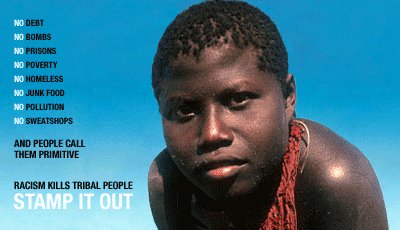
Good news: British anthropologists take part in public debates. The ASA (Association of Social Anthropologists) issued a statement where they “condemn the use of terms like ‘stone age’ and ‘primitive’ to describe tribal and indigenous peoples alive today”.

We anthropology bloggers have often criticized the use of these terms.

The official condemnation comes in the wake of controversial comments made on the BBC (not online!) by Baroness Jenny Tonge, the Liberal Democrat peer, who called the Bushmen of the Kalahari Desert ‘stone age’ and ‘primitive.’

The ASA statement reads:

‘All anthropologists would agree that the negative use of the terms ‘primitive’ and ‘Stone Age’ to describe [tribal peoples] has serious implications for their welfare. Governments and other social groups. . . have long used these ideas as a pretext for depriving such peoples of land and other resources.’

The ASA has become the latest supporter of Survival International’s campaign against racism in the media which challenges the use of terms like ‘stone age’, ‘primitive’ and ‘savage’ to describe tribal and indigenous peoples.

Survival International writes:

Terms like ‘stone age’ and ‘primitive’ have been used to describe tribal people since the colonial era, reinforcing the idea that they have not changed over time and that they are backward. This idea is both incorrect and very dangerous. It is incorrect because all societies adapt and change, and it is dangerous because it is often used to justify the persecution or forced ‘development’ of tribal peoples. The results are almost always catastrophic: poverty, alcoholism, prostitution, disease and death.

Other supporters of this campaign include prominent journalists such as John Simpson, John Pilger and George Monbiot.

According the Washington Times, the American Anthropological Association did not return calls for comment.

But why do they still use the term tribe in their campaign? Why not use society or community? Doesn’t the term tribe imply something similar as “primitive”?

As I’ve mentioned earlier, several African scholars argue that the idea of tribe promotes misleading stereotypes and that “anyone concerned with truth and accuracy should avoid the term “tribe” in characterizing African ethnic groups or cultures”.

In their paper Talking about “Tribe” Moving from Stereotypes to Analysis, they argue that:

  • Tribe has no coherent meaning.
  • Tribe promotes a myth of primitive African timelessness, obscuring history and change.
  • In the modern West, tribe often implies primitive savagery.
  • Images of timelessness and savagery hide the modern character of African ethnicity, including ethnic conflict.
  • Tribe reflects once widespread but outdated 19th century social theory
  • Tribe became a cornerstone idea for European colonial rule in Africa.

Black Britain sheds more light on the use of this term. Several scholars, among others sociologist and cultural historian Lez Henry say that Survival and the ASA should also examine their use of the terms ‘tribe’ and ‘tribal.’ Henry says, people in Africa who live simple agrarian lifestyles are often seen as ‘primitive.’ Such notions served as justification for the colonisation of countries designated as ‘third world’. For Ekwe Ekwe, the term ‘tribe’ conjures up images of being unsophisticated and away from technological advancement.

According to Survival, they are guided by the United Nations in their definition of the term ‘tribe.’:

“Survival uses the term ‘tribal’ peoples, partly because we need a way to describe the type of people that we are working with. The term ‘indigenous’ can be used as well and often is.”

Following publication of the Black Britain article, the ASA contacted Black Britain to clarify its position and said:

“The ASA does not support the use of the term ‘tribal’ to describe people…We share your concerns about the use of the word in perjorative ways in the same vein as primitive, etc.

“However, we do support the overall aim of the campaign which is to change perceptions and work against racism and outdated ideas of social evolution. Hence we wish to support Survival International’s aims even if the wording is difficult.”

>> read the whole article on Black Britain

SEE ALSO:

Our obsession with the notion of the primitive society

Primitive Racism: Reuters about “the world’s most primitive tribes”

“Stone Age Tribes”, tsunami and racist evolutionism

“Good story about cannibals. Pity it’s not even close to the truth”

Ancient People: We are All Modern Now – Debate on Savage Minds

Good news: British anthropologists take part in public debates. The ASA (Association of Social Anthropologists) issued a statement where they "condemn the use of terms like 'stone age' and 'primitive' to describe tribal and indigenous peoples alive today".

We anthropology…

Read more

On African Island: Only women are allowed to propose marriage

“Now the world is upside down,” complaines 90-year-old Cesar Okrane. “Men are running after women, instead of waiting for them to come to them.” Christian missionaries challenge a unique tradition on Orango Island (Guinea-Bissau). Here it’s women who choose their spouses and men are not allowed to propose marriage, according to AP-writer Rukmini Callimachi.

Women make their proposals public by offering their grooms-to-be a dish of distinctively prepared fish, marinated in red palm oil. Once they have asked, men are powerless to say no, we read.

Okrane explains:

“The choice of a woman is much more stable. “Rarely were there divorces before. Now, with men choosing, divorce has become common.”

65-year-old Carvadju Jose Nananghe says:

“Love comes first into the heart of the woman. Once it’s in the woman, only then can it jump into the man.”

He was married when he was 14. A girl entered his grass-covered hut and placed a plate of steaming fish in front of him. “I had no feelings for her”, he says. “Then when I ate this meal, it was like lightning. I wanted only her.”

There are matrilineal cultures in numerous pockets of the world. But according to anthropologist Christine Henry the unquestioned authority given to women in matters of the heart on Orango island is unique. “I don’t know of it happening anywhere else”, she says.

Christian missionaries, who have established churches on this island, have started to challenge this tradition. 19-year-old Marisa de Pina says the Protestant church has taught her that it is men, not women, who should make the first move and so she plans to wait for a man to approach her.

>> read the whole story in USA Today

ON MATRILINEAL SOCIETIES SEE ALSO:

SW China: Where women rule the world and don’t marry (antropologi.info 9.7.2006)

What are matriarchies, and where are they now? (The Independent 8.3.2018)

Matriarchal societies ( a padlet by Hailey Norman)

Peggy Reeves Sanday: Matriarchy as a Sociocultural Form: An Old Debate in a New Light (Department of Anthropology at the University of Pennsylvania)

LINKS UPDATED 8.8.2020

"Now the world is upside down," complaines 90-year-old Cesar Okrane. "Men are running after women, instead of waiting for them to come to them." Christian missionaries challenge a unique tradition on Orango Island (Guinea-Bissau). Here it's women who choose their…

Read more

Male circumcision prevents AIDS?

Two major studies have found that male circumcision reduces the risk of HIV infection by half, according to the San Francisco Chronicle. Dozens of studies conducted since the 1980s found similar results but lacked the scientific rigor of a randomized clinical trial.

“This is a landmark day in the history of fighting this epidemic”, said medical anthropologist Robert Bailey, who led one of the the two studies. Bailey first became interested in circumcision for AIDS prevention in 1985, when colleagues in the field began noticing that HIV rates were much higher in regions of Africa populated by non-circumcising communities.

Doctors theorize that circumcision might protect against HIV infection because the foreskin is rich in a type of white blood cell that is a favorite target of the AIDS virus. In addition, some studies suggest that circumcised males are less likely to have other sexually transmitted diseases, which cause sores that serve as gateways for HIV to enter the bloodstream.

Researchers stress that circumcision should not be considered a replacement for other measures such as the use of condoms. Male circumcision requires trained personnel, sterile instruments etc. In the developing world, these resources are often in short supply, and, in their absence, the procedure can lead to infections and even death.

Another study will attempt to determine whether women also benefit from the reduced HIV infection risk in a population of circumcised men.

>> read the whole story in the San Francisco Chronicle

SEE ALSO:

The emerging research field of medical ethnomusicology: How music fights AIDS

“There’s no AIDS here because men and women are equal”

Cultural values and the spreading of AIDS in Africa

“Ethnographic perspectives needed in discussion on public health care system”

AIDS and Anthropology – Papers by the AIDS and Anthropology Working Group

Two major studies have found that male circumcision reduces the risk of HIV infection by half, according to the San Francisco Chronicle. Dozens of studies conducted since the 1980s found similar results but lacked the scientific rigor of a randomized…

Read more