

search expand

What’s the point of anthropology conferences?

panel

I’m back from the conference Anthropology and Cosmopolitanism at Keele University (1h from Manchester, UK). As I’ve learned from entries on Savage Minds, job hunting and networking are a main point of anthropology conferences arranged by the AAA (American Anthropological Association). Luckily, this wasn’t the case with the conference I’ve attended last week: The main purpose seemed to be socialising – without ulterior motives: The participants were very friendly and open people. It seemed to be that I’ve talked at least to the half of all participants.

The topic – cosmopolitanism – seemed to have attracted a certain kind of people. “There are nearly no Americans here”, one delegate wondered. Usually, lots of Americans attended conferences arranged by the Association of Social Anthropologists of the UK and Commonwealth. What I found most striking: The largest part of all delegates were migrants!

Nearly none of them is working at a University in the country they were born. I met an anthropologist from Sri Lanka who’s working in the USA, another anthropologist working in Canada, originally from Turkey but – as she said – “a product from Norway”. There were quite a lot of German anthropology migrants living in the UK, and from Switzerland and Italy. A woman wore a badge with “Aberdeen University” on it. Of course, she told me that she’s from Malta!

colson

Many participants appreciated the social events. In contrast to other conferences, nobody left the venue after the day’s final lecture. There was nowhere to go as the University of Keele is a kind of academic ghetto, located far away from the nearest village. And the lectures actually lasted until 11 o’clock at night! I especially enjoyed these less formal after-dinner lectures – held by Elizabeth Colson (see picture to the right), by Andre Beteille and a debate on Robert Hayden’s ‘Shared Shrines, Syncretism and Tolerance’ in the old library (see image below), published in Current Anthropology.
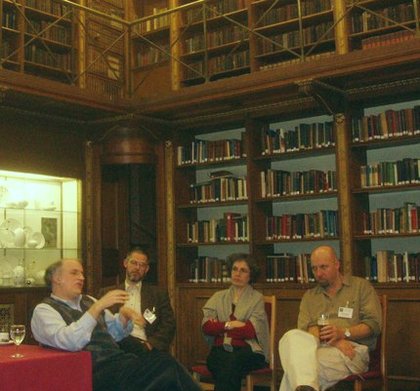
old library

But concerning the topic of the conference, I wonder if I might have learned more if I had stayed at home and read the papers on my own. There were many very weak presentations: Most paper-givers read their papers monotonously and went over time. There was never enough time for discussion. Furthermore, generally three or four papers were read one after another without any breaks in between! It reminded me of the worst seminars during my first year at university.

Several participants left these panels before they ended. After a short walk in the sun, I met a young PhD-student. He was as frustrated as me: “It’s my first and probably my last conference”, he told me.

I wondered: Is the main purpose of a conference to deliver a paper in order to get it listed on one’s CV as John McCreery supposes while we discussed the topic How To Present A Paper?

“If you want to be considered a serious academic you have to read your paper. That’s standard and just the way it is”, one of the elder anthropologists informed me.

Some papers haven’t even had much to do with the topic of the conference (a few paper-givers admitted it openly!).

On the last day of the conference, Keith Hart said (maybe too harshly?): “Anthropologists don’t care for cosmopolitanism. It’s just an excuse to come together. We’re not engaging in the world. We don’t talk about Iraq and Iran. Our detached discourse lacks wider relevance.”

As I’ve found out afterwards, Keith Hart had said something that many delegates agreed with. The organisers had asked great questions about cosmopolitanism, but we haven’t heard many concrete answers. I missed debates about moral and ethical issues: Recently, several magazines and newspapers have discussed cosmopolitanism as an answer to the growing polarisation between socalled Western values and the socalled Islamic world. After the controversy around the Mohammed-cartoons, mainstream-media loved talking about culture and religion wars and Huntingtons clash of civilisation. But maybe we should have talked more about cosmopolitanism? Is this correct? Is cosmopolitanism a better alternative than multiculturalism? If yes, how could anthropologists contribute to a more peaceful, just, cosmopolitan world?

Nobody addressed these questions. Rather, extreme relativism prevailed. French anthropologist Benoît de L’Estoile for example, argued, we shouldn’t define the term cosmopolitanism by its moral qualities (openness to the world, empathy etc). graeber It is in his view problematic to define some people as good (cosmopolitans) or bad (non-cosmopolitans).
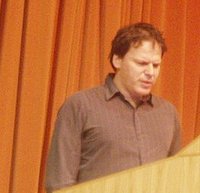
Nevertheless, there were many interesting papers (among others by David Graeber, see image to the left). I’ll have a look at them during the following days and weeks, (I hope) and will try to summarize some of the discussions.

See also my earlier post For an Anthropology of Cosmopolitanism.

UPDATE 2: A heavily edited version of this text was published in Anthropology Today august 2006. You can read the text here on my personal homepage

UPDATES

Summary of David Graeber: There never was a West! Democracy as Interstitial Cosmopolitanism

Owen Sichone: Poor African migrants no less cosmopolitan than anthropologists

Thomas Hylland Eriksen: Cosmopolitanism is like respecting the ban on smoking in the public

panel

I'm back from the conference Anthropology and Cosmopolitanism at Keele University (1h from Manchester, UK). As I've learned from entries on Savage Minds, job hunting and networking are a main point of anthropology conferences arranged by the AAA (American Anthropological…

Read more

Do anthropologists have anything relevant to say about human rights?

Anthropology News April focuses on the topic anthropology and human rights. Both anthropologists and non-anthropologists have been asked to answer the question: Do anthropologists have anything useful or relevant to say about human rights?

In Gerald F Hyman’s view (Director, USAID Office of Democracy and Governance), anthropologists contribute little to the development of human rights themselves or a human rights regime because anthropologists are skeptical of normative claims.

Sheila Dauer from amnesty international makes a similar point, criticizing the idea that human rights are a Western idea and than introducing them might even be a neocolonial act:

When anthropologists support the idea that the changes the changes people are working for on the ground that are based on human rights standards are “Western” or “neocolonial,” they are using the same argument used by governments and others in power to repress less powerful sectors of society—ethnic and racial minorities, women and other groups. Within the human rights movement, conceptualizing human rights standards as universal is now thought of as bringing local meanings into dialogue with human rights standards to mutually reinterpret them and to find ways they can apply locally—a kind of cultural negotiation.

(related see Democracy Isn’t ‘Western’ by Amartya Sen that also was debated on Savage Minds)

Victoria Sanford calls for “activist scholarship”:

It is not uncommon within the academy for lived experience to be dismissed as unscientific or not relevant to real, objective scholarship. This is completely backwards because it is the academy that needs to be relevant to the reality of lived experience.

Advocacy and activism do not diminish one’s scholarly research. On the contrary, activist scholarship reminds us that all research is inherently political—even, and perhaps especially, that scholarship presented under the guise of “objectivity” is often little more than a veiled defense of the status quo. Anthropologists can do better than that. We can and should use our expertise to support rights claims in the communities where we work.

She has a nice homepage with lots of pictures and several articles about her conflict and peace research in Guatemala and Colombia.

Veena Das is sceptical. Institutional transformations in the universities in the US and elsewhere are threatening the kind of free inquiry on which critical understanding rests:

I see a far greater threat to anthropology’s capabilities for engaging politically difficult questions based upon good evidence from everyday practices that govern research in universities than from direct censorship.

>> read the whole article in Anthropology News (removed, no longer available)

UPDATE (9.10.06):
The October 06 issue of Anthropology News asks the question Do Anthropologists Have an Ethical Obligation to Promote Human Rights? (removed)

SEE ALSO:

Declaration on Anthropology and Human Rights Committee for Human Rights by the American Anthropological Association

“We have a huge responsibility to give back to the places we study from”

Annelise Riles: Anthropology, Human Rights, and Legal Knowledge: Culture in the Iron Cage

Sally Engle Merry: Human Rights Law and the Demonization of Culture (And Anthropology Along the Way)

Links updated 12.5.2018

Anthropology News April focuses on the topic anthropology and human rights. Both anthropologists and non-anthropologists have been asked to answer the question: Do anthropologists have anything useful or relevant to say about human rights?

In Gerald F Hyman's view (Director,…

Read more

Conference blogging: “Quit using the word ‘culture’ wherever possible”

On the recent conference by the Society for Applied Anthropology, Mary Odell Butler from Battelle suggested that anthropologists ought to quit using the word ‘culture’ wherever possible, according to Judd Antin at Technotaste who writes:

“The larger and more interesting point she made, is that talking about culture instead of more specific perceptions or processes, is a scapegoat. It relieves us of the burden of talking about specific ideas, habits, and histories. She gave an example that I remember well. Contrast these two statements:

Many African-American women have developed a culturally-based perception that they will be disrespected in community healthcare clinics.

vs.

Many African-American women have learned through their experience and that of their friends and family that they will be disrespected in community healthcare clinics.

Culture, in other words, is too often a gloss for actual perception and practice. Why not call a rose a rose?”

>> read the whole post on TechnoTaste

Judd Antin has written two more posts about the conference: Wednesday Morning at SfAA and SfAA 2006: To Start. There was no press coverage (no surprise). Jen Cardew at anthroblogs did some conference blogging, but the notes aren’t especially reader-friendly.

Jen made an interesting remark about getting in touch with people at conferences. It’s an advantage to be a smoker:

I would like to note that the only people who have approached me, or that I have approached at the conference thus far have been smokers outside on a smoke break. I am actually thankful that I am a smoker right now, what a wonderful social tool! I’m kind of shy, so it is not too often that I approach people to chat.

Jen has also written about Smokers as a Subculture

SEE ALSO:

Emphasis on ‘culture’ in psychology fuels stereotypes, scholar says

The Culture Struggle: How cultures are instruments of social power

Thomas Hylland Eriksen, Savage Minds: An old warhorse revisited: Do we need another book about culture?

Thomas Hylland Eriksen: Why culture should be brought back in

The Secret Society of Anthropologists

On the recent conference by the Society for Applied Anthropology, Mary Odell Butler from Battelle suggested that anthropologists ought to quit using the word ‘culture’ wherever possible, according to Judd Antin at Technotaste who writes:

"The larger and more interesting point…

Read more

Riots in France and silent anthropologists

What anthropologists failed to do, a few thousand burned cars made possible: Public debates on inequality, discrimination and post-colonialism. In the recent volume of Anthropology Today (subscription required), Didier Fassin criticizes anthropologists for their silence during and after the november 2005 riots in France. Anthropologist Keith Hart reminds us in a comment to this article on the marginality of French anthropology and a recent letter to oppose anthropology’s apparent demotion within the administrative structures of the CNRS (Centre national de la recherche scientifique).

Didier Fassin writes:

During and after the events historians, sociologists, demographers, writers and intellectuals intervened in the public sphere, expressing comprehension if not of the rioters’ actions then at least of the problems they experienced. (…)
Anthropologists remained peculiarly silent. Just as we had done during the impassioned debate on the prohibition of the Islamic veil, we kept quiet when the historian Hélène Carrère d’Encausse, permanent secretary of the Académie Française, suggested that the main cause of the riots was polygamy in African families – a proposal subsequently reiterated by right-wing political leaders. The academically marginal but professionally dynamic Association Française des Anthropologues organized two meetings a few weeks after the events, but significantly invited sociologists to speak.

In Didier Fassins view, anthropologists could have foreseen these events. After having done fieldwork on relations between police and youth in the suburbs of Paris, the explosion and spread of violence was no surprise to him, he writes.

The riots gave French society the opportunity for a public confession of the long-denied policies of economic inequality, residential segregation and racial discrimination. France was beginning to admit that its integration paradigm had become a cover for the denial of its institutional racism. For the first time the French started to consider theirs a post-colonial society. Though long evident to many foreign scholars working on France, French anthropologists were the last to realize what was happening according to Fassin. He explains:

Suddenly, a previously unacknowledged colour bar was discovered. The word ‘ghetto’, previously banned from French vocabulary on the grounds that it reflected a specifically American reality, became common in editorials. Newspaper articles and television reports revealed how difficult it was for Arabs or Black people to get a job or a flat, how they were stigmatized at school and humiliated by the police. What thousands of pages of academic and administrative literature failed to do, a few thousand burned cars made possible.

Anthropologists had little to say on these subjects for two reasons in Fassins view:

(1) Very few anthropologists were working on the banlieues, on immigration or inequality: This relates to the history of the discipline in France and its predominant epistemological position. Anthropology in France is above all the study of the present of remote societies. Even when French anthropologists became interested in their own society, they tended to analyse its traditional aspects:

When a few of us turned to the study of politics, most described it in terms of rituals and institutions, comparing them with the display and organization of power in African societies. Scientific analyses have certainly been rich and sometimes innovative, but seldom related to the issues that we face in our own societies today.

(2) Many anthropologists found their beliefs and the ideals of the French society uncomfortably challenged: Isn’t France a secular and colorblind society?

The reluctance of anthropologists to recognize the existence of racial and religious discrimination in France is thus as problematic as the paradigms they do engage with. (…) Many still resist acknowledging this reality and prefer to ironize about what they see as an excessive display of victimhood. (…) Racial and religious issues remain difficult for many of us to raise when it comes to actual practices because they confront our values with a reality we would rather avoid.

Keith Hart comments Fassins article. He explains French anthropology’s weak engagement with ethnic / social inequality among others by “general divisions and elitism characteristic of higher education there”.

He compares different national traditions in anthropology:

If French anthropology seems to be beleaguered these days, Brazilian anthropology, having once been confined largely to Amazonia, is now booming as a source of investigation and commentary on mainstream urban society. Scandinavian anthropology offers a flourishing model of public engagement. Anthropology is a major operation in India and Nigeria today, being mainly concerned with ‘tribal’ populations and internal cultural diversity. Anthropologists in the USA and Britain have organized themselves quite effectively as professional guilds, but there is little public knowledge there of what they do (try using ‘anthropology’ as a keyword for email alerts from the New York Times); and the discipline’s relationship to the universities is precarious.

>> read Keith Hart’s comment (updated link)

SEE ALSO:

Who Are the Rioters in France? Anthropology News January incl comments by Thomas Hylland Eriksen and Cicilie Fagerlid

More and more anthropologists, but they’re absent from public debates – “Engaging Anthropology” (1)

Racism: Five Major Challenges for Anthropology

What anthropologists failed to do, a few thousand burned cars made possible: Public debates on inequality, discrimination and post-colonialism. In the recent volume of Anthropology Today (subscription required), Didier Fassin criticizes anthropologists for their silence during and after the…

Read more

Proclaiming the birth of a new civil rights movement

Lots of demonstrations recently – not only in Paris, but also in the USA. According to anthropologist Roberto J. Gonzalez the recent mass demonstration against a tougher immigration policy (bill HR 4437) is proclaiming “the birth of a new civil rights movement”:

For many other young people — those without documents — the proposed legislation threatened to shatter their American dreams of a better future.
(…)
The walkouts are part of a larger wave of mass demonstrations in which immigrants and those sympathetic to their cause have been led by Latino activists. They have been turning out in the hundreds of thousands — a quarter of a million in Chicago, half a million in Los Angeles, and many thousands more in Phoenix, Milwaukee, Dallas and other cities.

Those participating in the marches are expressing much more than opposition to the xenophobic proposals of a Midwest congressman. They are proclaiming the birth of a new civil rights movement — a movement seeking to reclaim the dignity of all people living within our country’s borders, regardless of color, creed or nationality.

(…)

Mass marches, rallies and demonstrations are deeply rooted American traditions in our country, a land of immigrants seeking new opportunities. Howard Zinn‘s groundbreaking book, “A People’s History of the United States,” recounts hundreds of cases in which ordinary people — women, slaves, students, working people, immigrants — have transformed our country against incredible odds by doing extraordinary things.

>> read the whole story at Mercury News

Roberto J. Gonzalez has among others written the book Anthropologists in the Public Sphere : Speaking Out on War, Peace, and American Power. For Anthropology News 2003 (AAA) he wrote the text Speaking Out on War, Peace and Power. Towards a Preventative Diplomacy.

SEE ALSO:

Students stage new immigration protests; demonstrations peaceful (OhMyNews, 1.4.06)

Thousands stage second day of demonstrations in California for immigrants’ rights (OhMyNews, 26.3.06)

Lots of demonstrations recently - not only in Paris, but also in the USA. According to anthropologist Roberto J. Gonzalez the recent mass demonstration against a tougher immigration policy (bill HR 4437) is proclaiming "the birth of a new civil…

Read more