
search expand

New media and anthropology – AAA meeting part III

While new media can foster participatory ethnography and enhance access, one also has to reflect on the implications of the Internet’s openness and availability. This was one of the lessons of a session at the annual meeting of the American Anthropological Association about new media and anthropology according to Inside Higher Education.

Kate Hennessy, a graduate student at the University of British Columbia, described an online exhibit on the indigenous culture of the Doig River First Nation that she helped to develop for the Virtual Museum of Canada. It makes songs, photographs and video of the Dane-zaa people freely available to the general public, in what Hennessy described as “a form of repatriation” — the term for returning objects and artifacts to the cultures from which they came, although here the term was used in a virtual sense.

(…)

Over the course of several meetings with community elders, the team came to realize that, according to the Web site, “it is not appropriate to show Dane-zaa Dreamers’ drawings to a worldwide audience on the Internet. Even though the drum is central to this website, in order to ensure that the Dreamers drawings are treated properly and with respect, no images of Dreamers’ drawings or the drum that we describe here are shown.”

(…)

(T)he online exhibit project extended discussions about when the display of cultural heritage crosses the line into appropriation, and how giving communities access to digital tools can provide a means for self-representation.

>> read the whole article in Inside Higher Ed “Downloading Cultures”

SEE ALSO:

Interview with Michael Wesch: How collaborative technologies change scholarship

How to save Tibetan folk songs? Put them online!

New website helps save Kenai Peoples language (Alaska)

“A new approach to the collection of traditional Aboriginal music”

Multimedia Music Ethnography of Yodelling and Alphorn Blowing

How Media and Digital Technology Empower Indigenous Survival

Book review: Claiming the Stones, Naming the Bones: Cultural Property and the Negotiation of Identity

Book review: Who owns native culture – A book with an excellent website

For more news on the AAA meeting see Circumcision: “Harmful practice claim has been exaggerated” – AAA meeting part IV, “The insecure American needs help by anthropologists” – AAA-meeting part II, and Final report launched: AAA no longer opposes collaboration with CIA and the military – AAA meeting part I

While new media can foster participatory ethnography and enhance access, one also has to reflect on the implications of the Internet’s openness and availability. This was one of the lessons of a session at the annual meeting of the American…

Read more

Now open access to 39 years of the journal Folklore Forum

cover

Folklore Forum, a journal that is produced by graduate students at the Folklore and Ethnomusicology Department of Indiana University, has gone Open Access. From now on, 39 years of scholarship, debate, and exchange of ideas are freely accessible for everybody in the freshly digitized archives of Folklore Forum.

Their most recent volum focuses on Folklore and the Internet and includes articles on urban legends that circulate in chain letter-form as anonymous emails, and on icons and avatars as cyberart and examples of the development of folkloric art forms online.

Folklore has has always had an ambivalent relationship with mass media, Editor-in-Chief Curtis Ashton writes in the editorial:

Salvage ethnography to recover oral texts would be unnecessary if print were not invading 19th century Europe and America and depriving the Folk of their lore. (…) Though the trend has been shifting in professional meetings and journal publications, folklorists do tend to avoid the world of computers as a field for enquiry, either because of a lack of technical training or just a lack of general interest.

But as this volume demonstrates, the web has much to offer for folklorists:

I encourage our readers to consider how we use the Internet in our work as folklorists, as a object of study in an of itself, with its own discourse of traditional motifs; as a field for ethnographic research into the virtual, networked community; as a means for scholarly communication and publication; as a storage facility for the digitally compressed knowledge of the past; as a presentation space for the mutual benefit of both ethnographer and informant; as a means for reflection, rethinking how we do our work, what draws us to it, and why.

>> visit Folklore Forum

As a sidenote: In the most recent entry here on antropologi.info I wrote about how folkore can enrich anthropology, see “Take care of the different national traditions of anthropology”

SEE ALSO:

Now online: Up to 100 year old anthropology papers

2006 – The Year of Open Access Anthropology?

antropologi.info survey: Six anthropologists on Anthropology and Internet

cover

Folklore Forum, a journal that is produced by graduate students at the Folklore and Ethnomusicology Department of Indiana University, has gone Open Access. From now on, 39 years of scholarship, debate, and exchange of ideas are freely accessible for everybody…

Read more

Why were they doing this work just to give it away for free? Thesis on Ubuntu Linux hackers

thesis-cover

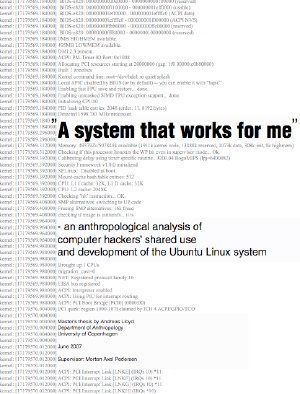
It all started when anthropologist Andreas Lloyd (University of Copenhagen) was browsing on the Internet looking for a new laptop computer and ended up installing the free Windows alternative Linux. Two years later, he finished his master thesis “A system that works for me” – an anthropological analysis of computer hackers’ shared use and development of the Ubuntu Linux system.

The thesis is a study of the Internet Gift Economy. Linux is developped by computer geeks saround the world, collaborating over the Internet, building a computer operating system in their spare time, which can be downloaded, installed, used and modified completely for free. It is among the biggest and most complex engineering projects ever conceived and built:

Based on more than 2 years of daily use of the Ubuntu Linux system and 6 months of online and in-person fieldwork among the developers working to develop and maintain it, this thesis examines the individual and collaborative day-to-day practices of these developers as they relate to the computer operating system that is the result of their labour.
(…)
A group of Spanish computer scientists measured the size of a Linux system similar to Ubuntu, and found that it contained around 230 million lines of source code. When they translated this into the effort spent on writing this code using a standard software industry cost estimate model, they found that it would correspond to almost 60.000 man-years of work (Amor-Iglesias et. al. 2005). By comparison, it took an estimated 3.500 man-years to build the Empire State Building in New York, and 10.000 man-years to build the Panama Canal. This immense effort makes modern operating systems such as Ubuntu among the biggest and most complex engineering projects ever conceived and built.

So the anthropologist was curious to learn more about how the hackers collaborate to build such an intricate system, and to learn why they were doing all of this work just to give it away for free.

How do you do fieldwork among hackers around the world? He explains:

I joined the Ubuntu on-line community on the same terms as the Ubuntu hackers, contributing to and using the same system, sharing their experiences with the system, and meeting them in-person on the same terms as they do at the conferences at which they gather, experiencing the same social and technical means and limitations through which they develop the system.
(…)
In order to do participant observation in this on-line space, I began contributing to the system by writing the system help and documentation, rather than the system itself due to my lack of technical understanding. In this way, I could take part in shaping Ubuntu alongside other community members while slowly developing a feel for the everyday exchanges and work in the community.

His thesis is by the way neither dedicated to any girl friend nor his parents:

In the true digital spirit of this work, I dedicate this thesis to Rosinante, the laptop on which I first experienced the Ubuntu system, and which was my faithful companion during my fieldwork and the writing of this thesis, only to bow out a week before tsafe for so long.

>> download the thesis

(Links updated 11.1.17)

SEE ALSO:

The Internet Gift Culture

Open source movement is like things anthropologists have studied for a long time

Open Source Fieldwork! Show how you work!

Gift economies and open source software: Anthropological reflections

Why you always get a present you don’t want – Social Sciences and Gift-Giving

Mobile phone company Vodafone gets inspired by traditional Kula exchange system

Open Source Anthropology : Are anthropologists serious about sharing knowledge?

2006 – The Year of Open Access Anthropology?

thesis-cover

It all started when anthropologist Andreas Lloyd (University of Copenhagen) was browsing on the Internet looking for a new laptop computer and ended up installing the free Windows alternative Linux. Two years later, he finished his master thesis "A…

Read more

New website helps save Kenai Peoples language (Alaska)

Their language is nearly dead. Maybe a new website can revitalize Kahtnuht’ana Qenaga: The Kenai Peoples Language in Alaska? For more than two years, the two anthropologists Alan Boraas and Michael Christian have taken pictures, navigated through HTML and digitized old audio recordings of Native writer Peter Kalifornsky in order to present vocabulary, grammar, stories and place names in an interactive Web site that went live last month, the Peninsula Clarion reports.

“I hope people of all ages go to it and gain insights into both the language and the culture,” Boraas says. This project is the latest in the Kenaitze Indian Tribe‘s endeavor to revitalize their Native language. Finding people who actively speak the Dena’ina language is one of the most difficult parts of revitalizing it. The credit for much of the Dena’ina revitalization goes to James Kari, who spent 30 years working on a dictionary.

>> read the whole story in the Peninsula Clarion

>> visit the website Kahtnuht’ana Qenaga: The Kenai Peoples Language

SEE ALSO:

How to save Tibetan folk songs? Put them online!

Knowledge Fades As Africa Languages Die

Modern technology revives traditional languages

Saving native languages

Inuit language thrives in Greenland

Book review: Empires of the Word: A Language History of the World

Their language is nearly dead. Maybe a new website can revitalize Kahtnuht'ana Qenaga: The Kenai Peoples Language in Alaska? For more than two years, the two anthropologists Alan Boraas and Michael Christian have taken pictures, navigated through HTML and digitized…

Read more

John Postill on media anthropology and internet activism in Malaysia

Is Internet making any significant difference to the governance of an multiethnic middle-income suburb of Kuala Lumpur? Anthropologist John Postill has been on fieldwork there and sent me a working paper about his research Field theory and the political process black box: analysing Internet activism in a Kuala Lumpur suburb.

The suburb is renowned in Malaysian ICT policy circles for its rich diversity of ‘e-community’ initiatives – and it was the vibrant Internet scene that attracted Postill to the locality. In his paper he discusses several approaches within media anthropology:

In recent years Pierre Bourdieu’s field theory has received increased attention from sociologists, anthropologists, media scholars and others (Benson and Neveu 2005). (…) Yet instead of adopting Bourdieu’s field theory wholesale I concentrate on an area of field theory that is underdeveloped in Bourdieu but has an earlier history within political anthropology, namely the field-theoretical study of political processes such as social dramas undertaken by Victor Turner and other Manchester scholars.

>> read the whole paper

On his website, Postill has published lots of related papers.

SEE ALSO:

Now online: EASA-conference papers on media anthropology

How Media and Digital Technology Empower Indigenous Survival

Is Internet making any significant difference to the governance of an multiethnic middle-income suburb of Kuala Lumpur? Anthropologist John Postill has been on fieldwork there and sent me a working paper about his research Field theory and the political process…

Read more