search expand

Doing fieldwork in Eastern Europe – New issue of Anthropology Matters

The new issue of Anthropology Matters – one of the few online anthropology journals – is out! The nine articles on “Doing Fieldwork in Eastern Europe” try to explore post-communism in Eastern Europe in new ways. They are based on ethnographic case studies of communities in Poland, Romania, Hungary, Georgia, Serbia and Croatia, among others among vendors in the market square, waste gatherers, Greek migrants, Transylvanian Saxons etc.

From the editorial by Michaela Schäuble, Tomasz Rakowski and Wlodzimierz Pessel:

Ethnographic micro-societal fieldwork creates new insight into the contemporary dilemmas and everyday practices of ordinary people dealing with the heritage of socialist ideology while simultaneously trying to obtain a sense of security and continuity in their identity.

(…)

Tackling everyday realities seems to be the most emblematic feature of anthropological research in post-socialist scenarios, insofar as it provides a valuable counterpart to ‘apparent history’ as featured in legal acts, political programmes, and changes of economic and monetary systems. In his influential Anthropology, Michael Herzfeld notes that anthropology and history ‘have danced a flirtatious pas de deux throughout the past century’ (Herzfeld 2001:55). In Central and Eastern Europe this flirtation has turned into a productive intellectual relationship, in that the authors’ anthropological micro-scale fieldwork brings hitherto unseen or neglected levels, ‘paces’, and cultural narratives (back) into sight.

>> visit Anthropology Matters Journal, 2006, Vol 8 (1): Doing Fieldwork in Eastern Europe

The new issue of Anthropology Matters - one of the few online anthropology journals - is out! The nine articles on "Doing Fieldwork in Eastern Europe" try to explore post-communism in Eastern Europe in new ways. They are based on…
Read more

24 minutes visual anthropology about (trans)nationalism on the Danish-German border

Anthropologist and blogger Johannes Wilm has published a fascinating video about the annual meeting of the Danish minority in a small village in Northern Germany called Ascheffel. Is it possible to be both German and Danish? Why are there so many Germans who send their kids to the Danish school? As he shows, there is both nationalism and much transnational history among the participants of the annual meeting.

>> watch the video

SEE ALSO:

On Sylt, Germany’s northernmost island, the Danish minority cultivates its language and culture

Anthropologist and blogger Johannes Wilm has published a fascinating video about the annual meeting of the Danish minority in a small village in Northern Germany called Ascheffel. Is it possible to be both German and Danish? Why are there so…

Read more

Indigenous? Non-Western? Primitive? The Paris Museum Controversy

Musee Quai Branly, a new major museum in Paris, dedicated entirely to well, how should it be called “non-Western arts”?, “indigenous arts?” has opened last Friday. Although the organizers named the new museum in Paris after the street it was built on after stirring criticism for floating the idea of a “primitive arts” or “first arts” museum, we read news headlines like “Paris unveils tribal art museum” (BBC), Paris welcomes new museum of indigenous art (Financial Times), and the Los Angeles Times informs: Parisians and tourists had their first chance Friday to visit Paris’ new primitive-art museum

Why do we need such a huge museum for non-European art?

“We want to show that this type of art is equivalent to European art. We want to place it on the same level”, said Patrice Januel, the museum’s director and curator.

But many people oppose the idea of categorising African, Asian and Pacific art as separate from Western art, according to the Telegraph:

Criticism ranges from claims that an institute dedicated to ethnic art is a patronising reinforcement of racist stereotypes to complaints that it relies heavily on items plundered in the ex-colonies. Some historians also suggest that the museum could “ghettoise” the works by isolating them from other art forms. (…) Among African observers, doubts persist. One Johannesburg critic said the museum would prompt bitter cries of “return the pillaged colonial loot”.

The museum is designed around a jungle theme. This design risked perpetuating colonial stereotypes, historian Gilles Manceron said according to The Guardian. It’s quite “natural” inside as well.

The New Zealand Harald describes the interior:

Inside, the sensation is of spirituality, with random shimmerings of light dappling the floor like sunbeams that pierce a rainforest canopy. The floor gently slopes, and the pillars are daubed in ochre coatings to make it look as if they have strangely taken root there.

Objects are arranged according to the continent of origin.

Patrick Lozes, president of an umbrella group of several hundred black associations called Cran, said he feared the new museum’s “archaic way of showing the past” would accentuate divisions rather than heal them, according to the New Zealand Harald:

“It’s an extension of a certain colonialist vision. Today we should emphasis migration and the mixing of people and not try to artificially separate the various strands of French society.”

The Courier Mail (Australia) on the otherhand writes about indigenous artists who are quite positive about the museum. The contribution to a wing of the Musee Quai Branly might be the largest and most significant permanent display of indigenous art outside Australia. Artist Gulumbu Yunupingu says:

“This place is a sacred place. I feel something here. It’s bringing us healing. These people recognised my hand, my work.”

Ap /Los Angeles Times reminds us:

Issues about France’s colonial past are still sensitive here — just last year, parliament passed a law requiring schoolbooks to highlight the “positive role” of French colonialism. The term was later stripped from the legislation, but the law was an embarrassment for France.

>> English homepage of the museum

Or rather start here:

>> Multimedia Presentations: Instruments and music of the world – draped garments – nomad settlements – it’s natural!

PS: Savage Minds has also blogged about it

UPDATE
A good summary: Al-Ahram Weekly: Museum of the oppressed

Musee Quai Branly, a new major museum in Paris, dedicated entirely to well, how should it be called "non-Western arts"?, "indigenous arts?" has opened last Friday. Although the organizers named the new museum in Paris after the street it was…

Read more

World Cup Enthusiasm: “Need for a collective ritual, not nationalism”


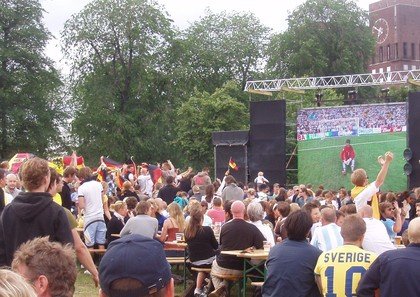
(Image: German and Swedish fans in Oslo)

Swissinfo interviews anthropologist Fabrizio Sabelli about the enthusiasm of Swiss fans during the World Cup. According to Sabelli, it’s driven by a need for a collective ritual and not nationalism:

We’re currently going through a pretty dull cultural period, which offers few gatherings like the World Cup, and people need them. They want to get together because they are increasingly lonely. And this solitude is not a uniquely Swiss malaise – it is found in all contemporary societies. Everyone needs rituals but there is a dearth of them in our globalised society.

I think it’s simply about rediscovering a sort of collective feeling shared at a celebration and above all the thought of a potential victory.

This Swiss team is made of different backgrounds, yet it doesn’t prevent members from presenting a united front under the Swiss flag. This, he says, is “an effect of the magic of sport “. Nevertheless, he doesn’t believe that football can have a determining influence on how we perceive others.

>> read the whole interview on Swissinfo

SEE ALSO:

Is the Football World Cup a peacemaker?

Rituals – mechanisms for both creating solidarity and for increasing conflict

Yoo Seung-gi: Sports Nationalism and World Cup. A look at the 2002 and 2006 football festivities (OhMyNews)

(Image: German and Swedish fans in Oslo)

Swissinfo interviews anthropologist Fabrizio Sabelli about the enthusiasm of Swiss fans during the World Cup. According to Sabelli, it's driven by a need for a collective ritual and not nationalism:

We're currently going through a…

Read more

“Welcome to an Engaged Anthropologist’s Blog”

Former professor of anthropology at Ben-Gurion University of the Negev and peace activist for over 30 years, Jeff Halper has started blogging. In his post “Welcome to an Engaged Anthropologist’s Blog” he explains:

My idea for this blog is to to bring you into the world of a peace activist in Israel-Palestine, an American-born Jew who became an Israeli some 35 years ago when he immigrated from Minnesota to Israel, who nevertheless believes in peace, justice, human rights, international law and critical thinking — thinking “out of the box” when it come to framing solutions to the world’s problems.

(…)

I’m not really conspiratorial or nutty as some of my words on the link among Israel, Jewish “leaders” and American Empire might imply (…). In fact, I’m a mild-mannered professor of Anthropology (used to teach at Ben Gurion University and elsewhere) who would love to do nothing more than go back to teaching and writing about the deconstruction of consciousness among the Nacirema or some other such stuff.

>> visit Jeff Halper’s blog (but why is there no RSS-feed??)

Halper has been nominated for the 2006 Nobel Peace Prize for his grass root peace activities, along with Professor Ghassan Andoni

>> ‘As Israelis, We Also Fight for Palestinians’ – Interview with Jeff Halper at OhMyNews

Former professor of anthropology at Ben-Gurion University of the Negev and peace activist for over 30 years, Jeff Halper has started blogging. In his post "Welcome to an Engaged Anthropologist's Blog" he explains:

My idea for this blog is to to…

Read more