search expand

Thesis: That’s why there is peace


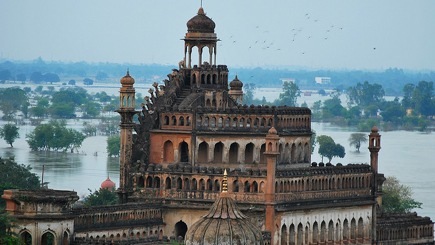
The Rumi Darwaza (“the Turkish Gate”) in Lucknow. Foto: Himalayan Trails / Rajesh, flickr

Why are some areas of this world more peaceful than others? In her master’s thesis Networks That Make A Difference, anthropologist Tereza Kuldova explains why the Indian city of Lucknow has remained peaceful throughout its history, even throughout such events as the Partition of India in 1947, and the demolition of Babri mosque in 1992 by Hindu nationalists in Ayodhya, less than 100 km from Lucknow.

“In contrast to the vast majority of studies concerned with communal violence in general and the Hindu-Muslim violence in India in particular, I opt the opposite point of departure, the one of communal peace”, Kuldova writes who is currently PhD fellow at the Museum of Cultural History in Oslo and author of several book reviews here at antropologi.info.

The heart of the peaceful nature of Lucknow is according to her “a particular blend of local history and networks of economic dependency which cut across the boundaries of class, caste, religion and locality. These networks are produced by the local embroidery industry, known under the name Chikan. Chikan is a traditional Muslim craft, and traded mostly by Hindu businessmen. In the last two decades there were more and more Muslims among the traders and Hindus among the embroiderers.

Chikan embroidery. Foto: Joey Berzowska, flickr

The Chikan industry gives employment to about 20 percent of the city’s population. It integrates people of different origins – rural, urban, lower class, middle class, men, women, Hindus, Muslims and creates according to her “an incredible network of mutual dependency, obligations and expectations”.

Religion is often used by political leaders to polarize people. It is rarely the main source of conflicts. These economic networks of interdependency, writes Tereza Kuldova, neutralize the polarizing strategies of the political leaders and lessen the chances of the occurrence of the communal tension. They lead to the “priority of the processes of togethering” as opposed to the “processes of othering”:

The growth of the industry and these networks, especially after 1990s, that is noticeably connected to the emergence and the ideology of the Hindu nationalism, has at the same time prevented the negative effects of this ideology, which have been violently felt in Lucknow’s neighbouring areas. This happened by expanding the cross-cutting networks and by turning a craft, which could have possibly been labelled as a “Muslim” craft, into a “traditionally Indian” craft. Chikan has been turned into embroidery which is worn by both Muslims and Hindus to express their Indianness, sense for tradition and fashion.

Additionally, Lucknow is by its inhabitants imagined as a peaceful and tolerant city, as the city of the Nawabs, rulers who bridged faiths:

Almost all accounts of the oral history that I gathered began like this: “In the times of Nawabs, the arts and architecture flourished, it was the time when a Muslim king danced as Lord Krishna…now where you can see that”. The Nawabs thus became associated with secularism; it is them who made Lucknow a “peaceful, clean and a neat city”

You don’t have to be born in Lucknow to be a Lakhnavi:

This imagination of anything or anyone as “Lakhnavi” goes in result beyond the dichotomy of Muslim vs. Hindu; it is rather about belonging to a particular place, which is populated by “Lakhnavis”, first and foremost.

The most persistent logic of the reasoning of why Lucknow is a peaceful city thus goes (tautologically enough) in the field as follows: “Lucknow is a peaceful city, because it is Lucknow, Lakhnavis do not fight, it has always been like that here and anyone who comes here just has to adopt that culture” (From a conversation with a Hindu businessman, 25.3.08.)
(…)
The discourse of the mythical past seems to work hand in hand with the economic structures and the social and economic networks in the city, creating both economic and discursive basis for the establishment of “relaxed” communal relationships.

As consequence of her findings, Tereza Kuldova encourages anthropologists to think rather and in terms of identifications than identities and in terms of networks than dichotomies:

Through the Chikan industry and through Chikan as a commodity, we can learn something about the fluidity of the social systems, about change and continuity, about the importance of the cross-cutting networks, about the discourses which govern the market and people’s choices and last but not least about the experience of modernity in India.

(…)

We have even seen that what is usually considered as unchangeable identities, particularly in the Indian context, namely the religious identities, are as mutable as any other. They are identifications, that might be at times stronger, at times weaker and at other times they might be replaced by new ones. People play with these identifications in a similar way as the popular Bollywood cinema does. (…) The concept of identification thus, being much richer, gives us more space to acknowledge the discursive shifts, which occur when the identifications are played out. At the same time as it acknowledges the situational and relational character of identity.

(…)
The network approach reminds us of the complexity of the social life and its situations, as well as of the impossibility to divide and classify the flow of social and economic interactions into clear-cut categories. (…)
Anthropology in general and I believe this study in particular, “has the authority and the ability to collapse a number of counterproductive dichotomies: the local and the global, the virtual and the real, the place-bound and the “non-place”, the universal and the particular. In real-life settings such contrasts evaporate” (Eriksen 2003: 15). “The “India”, where the past is inserted into the present and then projected into the future, questions the colonial dichotomies of “India” vs. “West”, “modernity” vs. “tradition”” (Favero 2005:24).

>> download the thesis

SEE ALSO:

Why more scholarship on war than peace?

– Highlight the connections between people!

How to challenge Us-and-Them thinking? Interview with Thomas Hylland Eriksen

Mahmood Mamdani: “Peace cannot be built on humanitarian intervention”

An Anthropological Challenge to Assumptions about War and Violence

Applied anthropology: A wedding ceremony in support of durable solutions in West Timor

Presenting 2nd generation Multi-Sited Ethnography

The Rumi Darwaza ("the Turkish Gate") in Lucknow. Foto: Himalayan Trails / Rajesh, flickr

Why are some areas of this world more peaceful than others? In her master’s thesis Networks That Make A Difference, anthropologist Tereza Kuldova explains why…
Read more

For more anthropology of climate change


Photo: The World Wants a Real Deal, flickr

In the recent issue of Imponderabilia Heid Jerstad criticizes the lack of anthropological research on climate change. Climate change is only present on the margins of anthropological research, Jerstad claims. A similar critique was formulated by Simon Batterbury in his article Anthropology and global warming: the need for environmental engagement.

But several climate anthropologists have been in the news recently. In an interview with the Borneo Post, anthropologist Bob Pokrant addresses climate change in Borneo. To tackle the climate change issue, he proposed using the ‘adaption approach’ instead of the ‘mitigation approach’:

By mitigation, we mean reducing the sources of greenhouse effect. By adaption, we mean recognising that climate change is happening and then work out a programme to reduce the social vulnerability of those affected. We have to empower the people to take the future in their own hands. In countries affected by climate change most, their people’s capacity to adapt must be built up.

Fight global warming ‘with traditional methods’, urged Pietro Laureano. architect, town planer and anthropologist. Traditional water management methods from the Sahara and Ethiopia and Iraq’s Babylon area could be used alongside newer technologies such as solar power to prevent desertification and energy wastage. See also interview with Laureano and his paper Traditional Techniques of Water Management a New Model for a Sustainable Town and Landscape. From the First Water Harvesting Surfaces to Paleolithic Hydraulic Labyrinths.

Environmental anthropologist Kenny Broad was interviewed by Hawaii 24/7. As an anthropologist “his focus is bridging the physical and social aspects of science, specifically the human-environment relationship along coastlines and the impacts of climate change.”

For as Linda Connor says, climate change is a cultural crisis, – an aspect that in her opinion is ignored in much of the technical, economic and political talk of policies and solutions.

A few weeks ago, Susan Crate’s research on climate change in Siberia was presented. On her website lots of papers can be downloaded, for example the most recent one Bull of Winter? Grappling with the Cultural Implications of and Anthropology’s Role(s) in Global Climate Change (pdf). Together with Marc Nuttall, she edited the book Anthropology and Climate Change. From Encounters to Actions. See also interview with Nuttall on CBC News “Human face of climate change: Weather out of its mind”.

At the University of Copenhagen, anthropologist Kirsten Hastrup is the leader of the interdisciplinary climate change research project Waterworlds. In an interview, she explains the relevance of historical anthropology for today’s climate change.

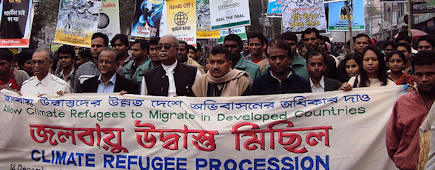
See also Climate Change and Small Island Developing States: A Critical Review by Ilan Kelman and Jennifer J. West (Ecological and Environmental Anthropology, Vol 5, No 1 (2009)) and Waterworld1: the heritage dimensions of ‘climate change’ in the Pacific by Rosita Henry and William Jeffery as well as information about climate refugees and my earlier post Why Siberian nomads cope so well with climate change. For even more literature see Bibliography for the anthropology of climate change.

Photo: The World Wants a Real Deal, flickr

In the recent issue of Imponderabilia Heid Jerstad criticizes the lack of anthropological research on climate change. Climate change is only present on the margins of anthropological research, Jerstad claims. A similar critique…

Read more

Football World Cup = an arena of everyday cosmopolitanism?

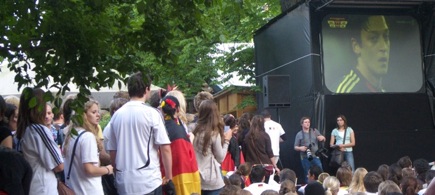
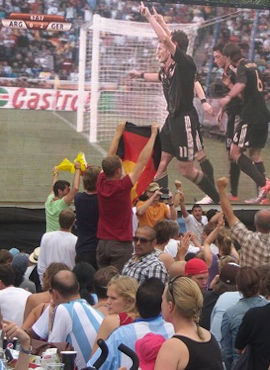
Oslo, Saturday afternoon. Several thousands people are watching Germany-Argentina on the big screen. The man opposite to me is wearing the German jersey. He is not German, but Norwegian. He is not the only one who identified with the”others” during the World Cup. Not only teams from the rich “West” are popular. A few days ago, people from all nationalities cheered on Ghana. Norwegian TV2 interviewed fans of the Ivory Coast team in South Africa. Ivory Coast fans came from all over the world, and many of them were neither black nor from the Ivory Coast.

The Football World Cup is often associated with primitive nationalism. Watching the matches in different public viewing places made me wonder: What about seeing the event as an arena of everyday cosmopolitanism, where people engage with the world, identify with teams, people and nations from far away places?

Even German fans of the German team cheer on players with names like Mesut Özil and Sami Khedira. In the German team, 11 of the 23 players were eligible to play for a different country. What effect does this have on notions of Germanness and identifications in general?


Mesut Özil and his fans in a beer garden in Stuttgart, Germany.

But a quick google search revealed that the cosmopolitan aspects of the football world cup do not seem to be a popular research topic. I haven’t found papers that address this topic explicitly – but maybe a closer look at the 90 journal articles that Routledge Journals made free to access until the end of July will nuance the picture?

Or maybe rather not?

“Academic treatments of football have tended to focus either on the game’s capacity to inspire xenophobic hooliganism amongst its followers or how it has been exploited by politicians for nationalistic purposes”, writes Peter Hough in one of them called “Make Goals Not War“. There he highlights the mostly ignored positive contributions of international football to international relations. But he is not addressing cosmopolitanism either.

Anthropologist Hans Hognestad shares his view.

“Despite the apparent existence of transnational football fandom there seems to be a reluctance in academe to view this as generative of new identities contesting more traditional ones related to the nation as a privileged frame for structuring and reproducing identities”, he writes in the paper Transglobal Scandinavian? Globalization and the contestation of identities in football that is not freely accessible (mostly about club football, though).

Why is this so?

“The lack of understanding of the popular and cultural appeal of sport seems to me linked to the incomprehension about and instinctive dislike of patriotism”, argues Sunder Katwala. In a comment to The football world cup is not xenophobic by Robert Sharp, he criticizes the view “that we will (only) have a better world when people do not identity with national identities, but instead only with the brother-and-sisterhood of humanity.” Instead, cosmopolitanism can in his opinion be achieved “through supporting positive and outward-looking national identities which see the value as internationalism as important to “who we are”.

Maybe the World Cup constitutes such an arena for creating these identities?

For more commentary about the World Cup see the posts by Matthew Durington at Savage Minds, among others Parallels of Ethnicity Inc. at the World Cup and Initial Thoughts on the World Cup.

Khaled Hroub has written a wonderful text about watching the World Cup in Palestinia and Palestinans identifications with other teams

For more texts see the overviews by Erkan Saka, among others http://erkansaka.net/archives/4233 and http://erkansaka.net/archives/4132

There is also a comprehensive overview at GlobalVoices

Or take a look at Steps to an ecology of transnational sports by Thomas Hylland Eriksen and Ambivalent Football. An Ethnographic Approach to Postcolonial Player Migration by Kristian Dyrkorn

UPDATE: Interesting post by anthropologist Martijn de Koning: Orange Fever: Notes on the Worldcup, football, nationalism and Deep Play in the Netherlands

SEE ALSO:

”Eurovision produces a new form of unity”

World Cup Enthusiasm: “Need for a collective ritual, not nationalism”

Is the Football World Cup a peacemaker?

World Cup: Cultural representations and why patriotism is not healthy

Identity politics: Have anthropologists gone too far?

– Highlight the connections between people!

For an Anthropology of Cosmopolitanism

Interview with Benedict Anderson: Being a cosmopolitan without needing to travel

Oslo, Saturday afternoon. Several thousands people are watching Germany-Argentina on the big screen. The man opposite to me is wearing the German jersey. He is not German, but Norwegian. He is not the only one who identified with the"others" during…

Read more

– Highlight the connections between people!

It happened already around 200 years ago: Aboriginal Australians marry Indians. Afghan cameleers open up the interior of Australia for transport and development. Indian seamen fight for Indonesian independence. And long before Australia was colonised by white settlers in 1788, Aboriginees have had longstanding relations with the Indonesian archipelago.

A few weeks ago I met Devleena Ghosh. She is conducting interesting research about the movements of people and ideas in the Indian ocean. We often link transnationalism to today’s world, but Ghosh shows that people have lived globalised lives already several hundred years ago. Australias history consists of more than white settler history.

– It is important to highlight the connections between people, she told me. It is important to challenge the popular belief that migration is something new, that people lived seperated from each other, hating each other. Because that’s not true.

I totally agree with her.

Relationships between South Asians and Australians during the colonial period and earlier have been little investigated. The same can be said of Norwegian history. It was not more than seven years ago, that the first history of immigration was written.

Because of this lack of transnational history writing, the incorrect view of the world as consisting of isolated and self-sustaining societies has been able to dominate the public and scientific discourse. This view has been a fruitful breeding ground for ethnic chauvinism, racism and – in social science – methodological nationalism (pdf).

Devleena Ghosh and her colleagues have published some open access papers:

Devleena Ghosh, Heather Goodall, Lindi Renier Todd: Jumping Ship: Indians, Aborigines and Australians Across the Indian Ocean (Transforming Cultures eJournal, Vol 3, No 1 (2008)

Devleena Ghosh, Stephen Muecke: Cultures of Trade: Indian Ocean Exchanges (Introduction) (pdf)

Goodall Heather: Port Politics: Indian Seamen, Australian unionists and Indonesian independence 1945-1947 (Labour History 94, 2008)

SEE ALSO:

How to challenge Us-and-Them thinking? Interview with Thomas Hylland Eriksen

For an Anthropology of Cosmopolitanism

Owen Sichone: Poor African migrants no less cosmopolitan than anthropologists

Beyond Ethnic Boundaries? Anthropological study on British Asian Cosmopolitans

The Double Standards of the “Uncontacted Tribes” Circus

Doctoral thesis: Towards a transnational Islam

It happened already around 200 years ago: Aboriginal Australians marry Indians. Afghan cameleers open up the interior of Australia for transport and development. Indian seamen fight for Indonesian independence. And long before Australia was colonised by white settlers in 1788,…

Read more

More posts next week

I thought I would have some time left for writing a blog post before I’ll go on a short holiday… but anyway there will be more posts next week! By the way, recently I updated the anthropology blog news feeds at http://www.antropologi.info/feeds/anthropology – it gives you an overview over the most recent posts by anthropology bloggers in English – an alternative to the overview at http://www.antropologi.info/blog/ See you next week!

I thought I would have some time left for writing a blog post before I'll go on a short holiday... but anyway there will be more posts next week! By the way, recently I updated the anthropology blog news feeds…

Read more