
search expand

Fieldwork among homeless heroin and crack users – new book by Philippe Bourgois

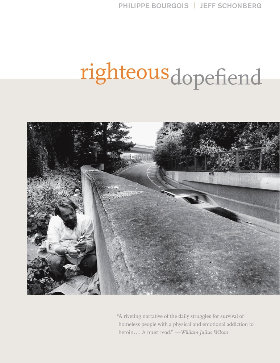
cover

In Search of Respect. Selling Crack in El Barrio” is one of my favorite ethnographies. Now, Philippe Bourgois, is out with a new book. In “Righteous Dopefiend“, he looks at the clients of the dealers, the University paper Penn Current reports.

The paper published a interesting interview with him that also touches the popular topic “anthropology at home”. Bourgois conducted his fieldwork among homeless heroin and crack users a mere six blocks away from his San Francisco home. He spent lots of time with them, and even slept outside in homeless encampments to gain a true sense of what life is like for the addicts.

What happened? People in the neighborhood began to think that the anthropologist must be one of the addicts as well:

During the intense years, when I’d be hanging out on the corner, people in the neighborhood just took for granted that I was either a drug addict or someone about to fall into drug addiction.

I remember being embarrassed in front of my son’s friends, because my son at this time was about seven years old when I started the project, and so all of his friends lived in the neighborhood and would say, ‘I saw your father hanging out on the corner where all the drug addicts are.’ I was worried about my son’s friends’ parents, because they were seeing me.

But although the addicts lived so close to the neighborhood, they were invisible. It was “mind-boggling”, he says, that he literally had to walk not more than six meters through a little thicket in order to enter a totally separate universe:

You can hear all these people, I mean, literally, hundreds of people at rush hour, walking to the bus stop, and you’re in this separate universe, and the two don’t touch. You can spend several hours in this separate universe listening to people go by and they don’t look through the bushes and notice these people. You almost feel falsely protected in this cocoon. 
People don’t want to see it, either, and the point of my book is to make it visible.

Bourgois connects the daily life in the thicket with larger structures in the society:

(W)hat is terrifying is seeing – and this is in a sense what the book is about – how structural forces beyond our control, historical forces, shifts in the economy, shifts in the political organization of public policy, come crashing down on vulnerable sectors of the population and basically shove them around in very unpleasant ways.

These are the people who weren’t able to recover from the downsizing of the industrial sector in the United States. A bunch of other types of industries arose in place of that, but those people who aren’t able to make that adjustment, those people who don’t have the education to shift from being a factory worker to being an information technology processor, are people who fall into indigent poverty.

The guys that we studied – their parents were the people who lost their jobs working on the docks of San Francisco, working in the steel mills, working in the warehouses that were serving the active factory sector of San Francisco as a port industrial city. 
These are forces that are much larger than the will of any individual or the moral ability of any individual to act in a way that’s going to make them a productive member of society. The book is trying to show those dynamics and when you dig deeper you then see these other patterns, that whites are affected by this very differently than African Americans.

Over half of his informants have passed away during the study and in the two years since the end of the actual field work.

>> read the interview in the Penn Current

>> download the first chapter of the book

On his website, he has published lots of papers!

UPDATE Long article about the book in The Chronicle Review: An Anthropologist Bridges Two Worlds. See also the comment by Eugene Raikhel at Somatosphere

SEE ALSO:

The most compelling ethnographies

Is the anthropologist a spy? New Anthropology Matters about fieldwork identities

Study: Drug smuggling as vehicle for female empowerment?

cover

"In Search of Respect. Selling Crack in El Barrio" is one of my favorite ethnographies. Now, Philippe Bourgois, is out with a new book. In “Righteous Dopefiend", he looks at the clients of the dealers, the University paper Penn Current…
Read more

Is the anthropologist a spy? New Anthropology Matters is out

When anthropologist Michael Madison Walker did research in rural Mozambique, he – as a white man – was variously assumed to be a priest, a development worker, a U.S. Peace Corps volunteer, and even a spy. Fieldwork identities is the topic of the new issue of Anthropology Matters.

11 authors reflect on perceived inequalities, differences or power relations, e.g. related to race or wealth, gender or age. As Ingie Hovland writes in her introduction, “the identities that are attributed to us and the roles we are placed in during fieldwork matter – to the people we study, to us, and to the research process.”

But as Nigerian anthropologist and blogger Olumide Abimbola shows, “being similar” is not necessarily less challenging. On his fieldwork among mostly Nigerian traders in Benin, some thought his questions, his glasses and backpack made him a suspicious character or a spy. As he is based at an academic institution in Germany, others thought he must be a German citizen (who could aid others in acquiring German visas). It was precisely the shared similarities (Nigerian background) between himself and the traders, that brought out the differences between them all the more sharply, Olumide Abimbola argues.

>> visit Anthropology Matters 1/2009

SEE ALSO:

Panic, joy and tears during fieldwork: Anthropology Matters 1/2007 about emotions

When anthropologist Michael Madison Walker did research in rural Mozambique, he - as a white man - was variously assumed to be a priest, a development worker, a U.S. Peace Corps volunteer, and even a spy. Fieldwork identities is the…

Read more

Interview with Benedict Anderson: Being a cosmopolitan without needing to travel

During my research for the new overview over open access anthropology journals, I made many great discoveries. I’ll try to present some of them.

One of the discoveries was Invisible Culture. An electronic journal for visual culture. The most recent issue includes an interview with famous Benedict Anderson about colonial cosmopolitism or cosmopolitism from below.

Cosmopolitism does not mean that you have to spend more time in airports than in your own bed. You don’t need to travel at all, Anderson, the author of “Imagined Communities. Reflections on the Origin and Spread of Nationalism” says.

In this interview he takes a different take on this term than in 2005 when I interviewed him. “I haven’t met many cosmopolitans in my life, perhaps no more than five”, he said.

In the interview in Invisible Culture, he tells us the story of Kwee Thiam Tjing, a poor Chinese-Indonesian journalist, in order to explore the role of cosmopolitanism in the life of the “colonial subject”. Kwee lived in Indonesia.

Anderson says:

In terms of colonial cosmopolitanism, I thought it was interesting because this guy was absolutely a cosmopolitan, but he almost never went anywhere—not even to China, as many of his Chinese acquaintances did. So I had to think about cosmopolitanism to talk about Kwee.

Interviewer Cynthia Foo asks Anderson how he would describe Keew as a cosmopolitan.

Anderson answers:

His family had been in Indonesia for 300 years, but Dutch colonial policy had been always, as much as possible, to segregate the Chinese and not let them assimilate with the natives (a policy which was of course quietly resisted). So Kwee was very aware of the fact that he wasn’t a native of the country, although he was extremely patriotic about the country.

He spoke Hokkien, which nobody except the Chinese spoke, as well as Indonesian and Javanese. He started out, really, with 4 languages: he had a home or “in-the-house” language of Hokkien; he spoke Javanese, which is a street language; Dutch he got in school; and Indonesian he learned in his teens, I think, maybe early 20s, because that was the popular medium for writing in newspapers and magazines.

 So you start off with a guy who at 20 is a master of 4 languages, and you’ve got something right there.

The second thing to add was that this was a very rich colony, yet little Holland didn’t have the power to say “only for us,” so all kinds of people came to seek their fortunes: Indians came, Yemenese came, Europeans of different kinds—Germans, Austrians, English, Americans—and so forth. This is why the population was very mixed; there was also a huge migration of natives, mainly Javanese, from the interior where people were looking for better ways to live. The Chinese ghetto system broke down in the 1910s, so, wherever you went, you were running into all kinds of people.


>> read the whole interview

SEE ALSO:

Owen Sichone: Poor African migrants no less cosmopolitan than anthropologists

David Graeber: There never was a West! Democracy as Interstitial Cosmopolitanism

Thomas Hylland Eriksen: Cosmopolitanism is like respecting the ban on smoking in the public

For an Anthropology of Cosmopolitanism

During my research for the new overview over open access anthropology journals, I made many great discoveries. I'll try to present some of them.

One of the discoveries was Invisible Culture. An electronic journal for visual culture. The most recent issue…

Read more

The Open Anthropology Cooperative – A Worldwide Anthro-Community in the Making

(updated)What about creating A worldwide community for anthropological discussion and collaboration away from the restrictions of formal academic structures has been created at http://openanthcoop.ning.com/ (already more than 140 members Thursdag night!) It started as a twitter-conversation, now the debate also takes place on Keith Hart’s website.

In some way, this community already exists – in the anthropological blogosphere. But also non-bloggers shall be included, and The Open Anthropology Cooperative – that’s what it is supposed to called – is actually much more. Maybe we can call it the web 2.0 version of the conventional (mostly national) anthropological associations.

More than 30 comments have been posted so far. They include following ideas and suggestions about the new community:

* A place to share ideas

* A place to find like-minded anthropologists

* A place to collaborate

* A place to hold virtual conferences

* A place to host podcasts

* A place to ask questions

* A place to learn about new tools for anthropology (online tools, field tools, etc.)

* a place to find resources (e.g. databases, good grad programs, upcoming colloquia, software, field opportunities)

* A place to publish
* The idea of an engaged anthropology for the 21st century in relation to the digital revolution
* Group blog with posts from both Keith and others
* Forum for discussion
* Online press to publish longer pieces
* The incorporation of Twitter, social bookmarking, wiki, etc

>> read the whole discussion

>> follow the debate on twitter

Anthropologist “Fran” at http://ethblography.blogspot.com likes to see the Open Anthropology Cooperative “become a comfortable channel for discussion which does not intimidate amateurs or first-year undergraduates, yet remains useful for doctoral students, fieldworkers, lecturers and specialists in all fields”. She also hopes “that it will become truly international (and multilingual)”.

She continues:

In my opinion, there is no reason for an invented divide that reduces web-based academic content to a second-rate substitute for formal (read: expensive, elaborate, bureaucratic) channels. Why not overlap “open” and “official” academia until they are one and the same? If the technology and demand can sustain it – which I believe they can – making anthropological and ethnographic knowledge freely available should be a priority. This can reflect back heavily upon the academic method itself, both in theory and in practice.

>> read the whole post

SEE ALSO:

How can we create a more plural anthropological community?

World Anthropologies Network – Working towards a global community of anthropologists

The Future of Anthropology: “We ought to build our own mass media”

Keith Hart and Thomas Hylland Eriksen: This is 21st century anthropology

(updated)What about creating A worldwide community for anthropological discussion and collaboration away from the restrictions of formal academic structures has been created at http://openanthcoop.ning.com/ (already more than 140 members Thursdag night!) It started as a twitter-conversation, now the debate also…

Read more

Journal of European Ethnology is going (a little bit) Open Access

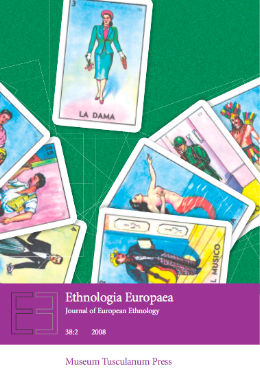
cover

Is Open Access the new buzz-word? Do we see some change in the world of anthropology journals? Angels Trias i Valls recently announced the birth of a new open access journal, Anthropology Reviews: Dissent and Cultural Politics.

And last week, I received an email by Thomas Mogensen, the editor of Ethnologia Europaea. Journal of European Ethnology. He promoted his journal among other things by informing that they support open access publishing. Back issues (older than three volumes) are open access.

And he wrote:

As part of our policy in support of open access publishing, we also would like to offer you a free copy of one of the articles from the latest issue (vol. 38:2). You can access and distribute the article free of charge by using this link: http://www.mtp.dk/pdf/Is_East_Going_West-Or_is_the_West_Moving_East

If we take a look at the previously published volumes, we’ll find out that only back issues from 2004 and newer are freely available. Marketing Manager Niels Stern explains that they only had funds to digitize volumes published since 2001 (they were digitized in 2004). “But of course we would like to go further back”, he writes in an email to me. Being a non-profit publisher, they are still looking for funding initiatives that could aid in this respect.

At the same time, one of the larger commercial publishers is involved in a scandal. Elsevier has been lobbying against the open access movement for a long time on the grounds that open access journals can’t be trusted. Now they confirm that they have put out six fake journals. They look like peer reviewed but were sponsored by unnamed pharmaceutical companies. >> more info at Open Access News

Is East Going West – Or Is The West Moving East is the title of the open access article in the most recent issue og the Journal of European Ethnology.

For her doctoral thesis on (East) German identity-formation in today’s unified Germany, Sofi Gerber has conducted biographic interviews with persons who were born and grew up in the GDR and who now live in unified Germany.

She writes:

The most striking thing in the interviewees’ picture of the Eastern parts of Germany is their general de- scription of a society falling into decay. Contradictory to the hopes invested in the program Aufbau Ost (Re-Build the East), which has invested enormous amounts in the New Federal Republics’ infrastructure and buildings, the interviewees seem, rather, to describe an Abbau Ost (Dismantling the East). My interviewees’ narrations include an othering of big parts of Eastern Germany, as a place in which it is impossible or undesirable to live.

But the East–West boundary is not only reified, but also transcended by the interviewees:

This is articulated both implicitly, in that the interviewees stress other identifications, and explicitly, in that the dichotomisation is described as irrelevant or outdated. (…)
The identification with a region or a town can be described as superior to the East–West identification (…).
Most of the interviewees now living in Berlin identify themselves with the city, mostly because of what they describe as its openness, rawness and charm. Berlin is then not only a geographical place, but also a way of living, which is contrasted with the narrow-minded life in the countryside or the superficial life in other cities.
As described earlier, both of these contrasts can be associated with the East and the West respectively, but the special aura of Berlin can also be described as something extraordinary, transcending this dichotomisation. Even when the interviewees identify themselves with one district, this identification is often described as independent of the former border.

>> visit Ethnologia Europaea. Journal of European Ethnology

SEE ALSO:

New overview over open access anthropology journals

Open Access Anthropology in Africa – an introduction

Open access to all doctoral dissertations at Temple University

Why Open Access?

cover

Is Open Access the new buzz-word? Do we see some change in the world of anthropology journals? Angels Trias i Valls recently announced the birth of a new open access journal, Anthropology Reviews: Dissent and Cultural Politics.

And last week, I…

Read more