
search expand

How scholars in the Middle East developed anthropology more than 1000 years ago

Anthropology emerged in a relatively high scientific level in the wider Middle East before it existed as a discipline in the West. Therefore, the label of colonialism often coupled to its emergence must be removed.

This is the main point of an article by Hassen Chaabani in the recent issue of the International Journal of Modern Anthropology.

Although the beginning of the development of anthropology as a discipline is originated in colonial encounter between Western people and colonized peoples and, therefore, coupled to its use in favor of extremist ideologies such as racism, this must not diminish the scientific value of anthropology, he writes.

You won't find many anthropology departments at universities in the Middle East, and its reputation might not be the best. So therefore this article mind be a timely reminder that anthropology has not been a dubious invention by the West. Chaabani sees "the prestige and hegemony of some editors and publishers in some powerful countries" as "one of the factors that could inhibit the development of a real global anthropology".

Hassen Chaabani, who is is president of the Tunisian Anthropological Association, draws our attention to two scholars: Abu Rayhan al- Biruni, a Persian scholar (973-1048) and Ibn Khaldoun, a Tunisian scholar (1332-1406).

Abu Rayhan al-Biruni, he writes, "is considered as one of the greatest scientists not only of the 11th century but of all times". He is most commonly known as a mathematician, astrologer, and historian. But he has also been an anthropologist:

He founded the science of anthropology before anthropology existed as a discipline, and therefore he is considered as the first anthropologist. He was an impartial writer on custom and creeds of various nations and was the first Muslim scholar to study Indian populations and their traditions. In addition he wrote detailed comparative studies on the anthropology of religions and cultures in the Middle East, Mediterranean and especially South Asia. (…)

Living during the high period of Islamic cultural and scientific achievements, Al-Biruni placed a focus on modern anthropological interests including caste, the class system, rites and customs, cultural practice, and women’s issues (Akbar, 2009). Through this modern practice, Al-Biruni used the concepts of cross cultural comparison, inter-cultural dialogue and phenomenological observation which have become commonplace within anthropology today (Ataman K., 2005).

Biruni's tradition of comparative cross-cultural study continued in the "Muslim world" through to Ibn Khaldoun’s work in the 14th century, Chaabani writes:

Some of his books cover the history of mankind up to his time and others cover the history of Berber peoples, natives of North Africa, which remain invaluable to present day historians, as they are based on Ibn Khaldūn's personal knowledge of the Berbers. In fact, he presented a deep anthropological study of Berbers before anthropology existed as a discipline.

Chaabani also writes that the general idea of biological evolution was advanced more than 1,000 years before Darwin by the Iraqi thinker Amr ibn Bahr Al Jahis (800-868) in his book "Book of Animals".

> > read the whole article (pdf)

Who was the first anthropologist? Really al-Biruni? A tricky question. Others might point to Classical Greece and Classical Rome, see more in Wikipedia: History of Anthropology (where al-Biruni is mentoned as well). The main point as I see it is that anthropology was developed in many parts of the world, and not only in the so-called West.

SEE ALSO:

How can we create a more plural anthropological community?

"Take care of the different national traditions of anthropology"

The resurgence of African anthropology

The dubious behaviour of Western researchers sightseeing the “Arab Spring”

“No wonder that anthropology is banished from universities in the ‘decolonized’ world”

How racist is American anthropology?

Minority scholars treated as second class academics: Still a racial bias in anthropology

Jack Goody: "The West has never been superior"

The Five Major Challenges for Anthropology

Anthropology emerged in a relatively high scientific level in the wider Middle East before it existed as a discipline in the West. Therefore, the label of colonialism often coupled to its emergence must be removed.

This is the main point of…
Read more

Now I am a truly engaged anthropologist!

I wanted to write this post long time ago. As you might have noticed, there haven’t been any new posts on this blog since the 24th of October last year.

So what has happened?

Well, at about the same time I wrote my last blog post, the most wonderful woman entered my life. Two months later we already got engaged. And in a few months, I hope, we will get married.

So yes, now I am a truly engaged anthropologist! !

Getting married in Egypt is for me a wonderful, but not actually a cheap endeavour. My economic situation forces me therefore to focus on my paid job at the University in Oslo. Nevertheless, I hope there will be some time for blogging and developing the website soon. I really miss it and I’d like to start up again!

In the meantime you can have a look at the website of the new research project by anthropologist Thomas Hylland Eriksen that I am currently working for. It’s called Overheating. The three crises of globalisation.

Here is some of the stuff I’ve written there:

I wanted to write this post long time ago. As you might have noticed, there haven’t been any new posts on this blog since the 24th of October last year.

So what has happened?

Well, at about the same time I wrote…

Read more

When anthropology is begging for attention: PopAnth website launched

Regularily, new initiatives are launched to make anthropological knowledge more accessible to the general public. A few weeks ago, PopAnth was launched – a highly ambitious project that “translates anthropological discoveries for popular consumption” as they explain:

We take anthropology’s collective knowledge and translate it for mainstream audiences, much in the way that popular science books, tv shows and trivia quizzes make even the hardest of sciences accessible. We strive to provide you with the best of anthropology in a format that makes you go, ‘Wow! I didn’t know that!’ Our cross-cultural stories aim to help you discover things about yourself and the world you live in.

That sounds – apart from the corporate PR-language – good and is exactly what we need more of in the social sciences. And already after a few weeks, there are a lot of articles about a wide range of topics about everything from backpacking, human emotions and Japanese consumers. And yes, they are all written in an easily understandable language. Yeah!

This also applies to the book reviews, where they also chose to focus on books that might be able to attract a wider non-specialized readership like Watching the English by Kate Fox or Haiti After the Earthquake by Paul Farmer.

And they’ve also set up a discussion forum.

But as a look at their first articles also reveals, this project suffers from similar shortcomings as many others we find online. It is a rather Western / US-centric endavour in the sense that the “we” that is invoked and articulated in many articles means “We Americans” or “We in the metropolitan West”. Most of the authors have an US- or Britain-based background.

I’m still waiting for the globalisation of anthropology.

In my opinion a thematic focus and stronger connections to current issues and bigger questions would benefit the site and attract more readers. The content of the articles seems to be somehow arbitrary, and their focus sometimes too narrow.

Maybe more articles are needed who ask such big questions as Edward F Fischer does in his interesting piece Can reducing our choices increase our happiness?


“Share me, like me, look here!” Maybe a bit too messy?

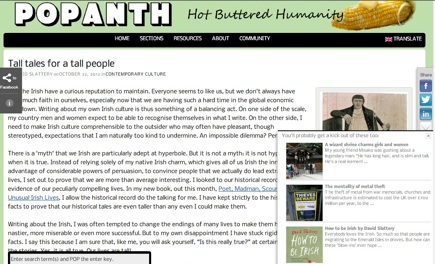
Another thing that struck me as typical for our time is the cry for attention, the cry for being shared and liked. Big sharing buttons everywhere, one of them even covers parts of the text, and makes it unreadable. And when we are approaching the end of the article, we get attacked by a huge popup with the message “You’ll probably get a kick of these too”.

The PopAnth project started by the way after a discussion on newly formed PopAnth group, founded by Erin Taylor at the Open Anthropology Cooperative.

Two years ago I looked at a similar initiative with a very similar name, and as the title of the post I chose Popular Anthropology Magazine = fail. This journal does not seem to exist anymore. All we see is a post called Welcome to Popular Anthropology Relaunched, but all the articles are gone. But there are ads for firewood and business intelligence software… …

Regularily, new initiatives are launched to make anthropological knowledge more accessible to the general public. A few weeks ago, PopAnth was launched - a highly ambitious project that “translates anthropological discoveries for popular consumption” as they explain:

We take…

Read more

Minority scholars treated as second class academics: Still a racial bias in anthropology

In a blog post at AnthroNow, Manissa McCleave Maharawal draws our attention to an important article in the American Anthropologist that was already published in november 2011: Anthropology as White Public Space?

Here, Karen Brodkin, Sandra Morgen, and Janis Hutchinson show that there is still a racial bias in American anthropology. Their online survey among anthropologists of color in the US reveals that anthropology has “not done well when it comes to decolonizing their own practices around race”. A racial division of labor within departments, as well as a range of everyday practices recreate white public spaces. Works by minority scholars and their role in theory building are not reflected in the canon.

>> read Manissa McCleave Maharawal’s post Anthropology’s Persistent Race Problem

(Check also some of her articles on AlterNet)

Inspired by her post, I downloaded and read the paper. Here we find several examples for that anthropologists of color (graduate students and faculty) often are treated as second class academics:

In sum, taken-for-granted practices of racially dividing labor mark anthropology departments as white institutional spaces. They include assigning diversity work to faculty of color, while giving it little value for tenure and promotion, and freeing white faculty from responsibility for it. Informal practices that train students of color for a paraprofessional track reinforce long traditions of treating members of subordinated communities as study subjects and native informants rather than as professional colleagues. The message is that minority anthropologists are not full professionals.

Here are some more quotes from the paper:

  • Several respondents experienced being actively sought after, only to discover that their most valued attribute was their appearance—so that their university or department could have the look of diversity. One who was so courted discovered that her appointment was tied “to a diversity-related administrative function with little budget or power.”

  • Those who are held institutionally responsible for the work of creating a more racially diverse faculty and student body are disproportionately minority faculty. As respondents described the amount of time they spent on this work and the consensus of their colleagues that it was their job, we came to think of it as “diversity duty.” –

  • A racial division of expectations also applies to teaching and advising. Departments often value faculty of color for their ability to teach students of color but not necessarily white students.

  • Students and faculty of color are often hypervisible as tokens of institutional political correctness but invisible as scholars in their work settings. More specific were reports of white faculty who treated students of color as research assistants and cultural brokers rather than scholars-in-training.

  • An important conceptual foundation of a secondary track for anthropologists of color is a common assumption that outsider status is the desired norm for anthropological research. This marks insider researchers negatively, most notably marking their knowledge as “folk” or “local” but not“scholarly . ”

  • Some respondents reported being “valued for my language and cultural insight, not for my intellect”. (…) Another [respondent] described a professor who “wished me to accompany him to Africa to be his go-between with the natives although this would have yielded no advantage to me and would greatly have delayed my ability to complete my program of study… . He wished to exploit me for his gain because of my minority ethnic status.”

  • (M)any respondents were told that the subject matter of their work, especially studies of U.S. communities of color and patterns of racism, do not belong in anthropology. Several were encouraged to leaveanthropology and move to ethnic studies.

  • Many departments remain attitudinally white in ownership and decision making about the discipline, undermining what Daryl Smith (2009) calls institutional “mattering and belonging . ” This happens through the continuing pattern of marginalizing the work and theoretical perspectives generated by scholars of color, as well as by seeing proper anthropology and ethnic studies as mutually exclusive. Both practices constitute anthropologists of color as less than full anthropologists. White ownership also happens when a predominantly white department collectively enacts mainstream U.S. forms of race avoidance in dealing with racial issues in departmental practice.

  • Respondents to our survey encountered resistance similar to that reported in 1973 to scholars of color actively shaping the directions of anthropological thought—and, notably , they mentioned hostility toward critical theoretical perspectives on taken-for-granted aspects of mainstream culture. One faculty respondent reflected, “Neither myself nor my grad school peers of color expected the extreme resistance for paradigm changes … we have all been pushed out of these colleges simply because of this resistance.”

  • Another [respondent] implicated class bias: “ Tenure requires having no life but [an] academic [one] and a class background that gives you a level of financial support to work.” (…) Class and race bias interact. Students of color are disproportionately from working-class backgrounds, and institutional blindness to the concomitants of class works against them.

  • Perhaps the biggest attitudinal barrier to ethnic diversification is a belief that being an anthropologist inoculates one against racism (as well as other varieties of social stereotyping). Many respondents urged developing a departmental discourse about race that includes reflexivity. Intersectional thinking is at the heart of reflexivity: for example, recognizing that not all minorities are male (or straight or working class) nor are all women white (or straight or middle class) opens up possibilities for making racial diversity the cutting edge of broader diversification. The lesson is to make critical discourses part of departmental discourse. (…) (D)epartments must hold white faculty equally responsible for improving racial diversity for it to be highly valued.

  • (T)he heart of our conclusion is embarrassingly obvious. It is this: the defamiliarizing insights and analyses generated from vantage points developed by anthropologists of color are better tools for diversifying departmental organization and culture (among other things) than hegemonic ones, and anthropology departments should embrace them instead of marginalizing them. Alternatively put, anthropology has made its mark on understanding cultures by taking seriously the points of view of those it studies. We suggest it needs to take seriously the points of view of those who are internal others to better understand and diversify itself as well as enhance its theoretical robustness.

Source: Brodkin, K, S Morgen and J Hutchinson (2011) Anthropology as White Public Space? (behind paywall, only available for subscribers)

Some of their findings are also reflected in an ethnography of American anthropology that I blogged about nearly two years ago: Reversed Gaze. An African Ethnography of American Anthropology by Mwenda Ntarangwi – see my post How racist is American anthropology?. I see now that I announced a second post about this book, but it never appeared, I hope I’ll have the opportunity to do that soon!

See also a post from 2005: How can we create a more plural anthropological community? and a more recent post The dubious behaviour of Western researchers sightseeing the “Arab Spring”

There has been some discussion on these issues (including the paper) in a post by Jason Antrosio at Savage Minds: Taking Anthropology, Introduction

In a blog post at AnthroNow, Manissa McCleave Maharawal draws our attention to an important article in the American Anthropologist that was already published in november 2011: Anthropology as White Public Space?

Here, Karen Brodkin, Sandra Morgen, and Janis Hutchinson show…

Read more

What the burial of a 4 year old boy says about daily life more than 24 000 years ago

Antropologi.info is mainly about social anthropology. So, maybe now it’s time to get inspired by a paper from a neighbouring discipline – archaeology. Lukas Loeb has sent me this paper that he’d like to share with others: The Human Burial of the Abrigo Lagar Velho Child. An analysis of human burial and the understanding of social relations and ancient society.

Loeb is currently a student in the Social Science and Economy Department at the University of Agder, Norway. The paper was written as a part of an anthropology course he took at the University of British Columbia, Canada, in 2009/2010. The course, an Introduction to World Archaeology, provided a survey of world archeology from the emergence of humankind to the beginning of state societies.

What is your essay about, Lukas Loeb?

– My essay is about the human burial of the Abrigo Lagar Velho Child, and the introduction of modern humans in Europe. How we can use a single burial to discover ancient cultures and study their social life by the burial itself and the tools and vegetation surrounding it?

In your email to me, you wrote this is an important topic that you’d like to share with others. Why?

– Many say that the Neanderthals disappeared from Europe because the continent were overtaken by modern humans. My essay discusses the important topic of the modern humans and Neanderthals interacted and that there were some sort of gene flow between these two human species.

Is this discussion also relevant for cultural-  and social anthropologists?

– I would say that this discussion is both important and relevant for both cultural- and social anthropologists, this essay discusses and analyzes the burial itself and how it reflects to the religion, social life, hierarchy and status that was present 24,500 BP.
 
As a bonus: Some links for those who want to know more about your topic?

João Zilhão: Fate of the Neandertals (archaeology.org)

Lagar Velho – the Hybrid Child from Portugal (donsmaps.org)

João Zilhão and Erik Trinkaus (ed): Portrait of the Artist as a Child. The Gravettian Human Skeleton from the Abrigo do Lagar Velho and its Archeological Context (scribd.com)

Thanks for this short interview!

Download the paper (pdf, 421kb)

Antropologi.info is mainly about social anthropology. So, maybe now it's time to get inspired by a paper from a neighbouring discipline - archaeology. Lukas Loeb has sent me this paper that he'd like to share with others: The Human…

Read more