
search expand

Ainu in Japan: Cool to be indigenous

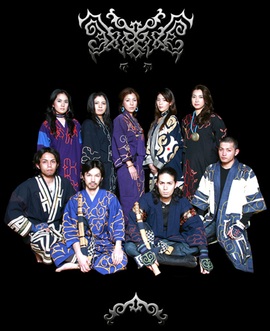
ainu rebels screenshot

Better times for the Ainu in Japan? There is an “revival of ethnic pride” going on in Japan according to ap.

At the forefront are the Ainu Rebels (image). They use music and dance to rebel against a history of institutionalized discrimination. They celebrate being an Ainu by mixing traditional dress, dance and language with hip-hop and rap.

And they’re getting an enthusiastic response from young Japanese. T-shirts, vests and handbags adorned with Ainu motifs are selling well, and Ainu rock musician Oki Kano is making it big with a band featuring the tonkori, a sort of Ainu guitar, ap journalist Malcolm Foster writes. Ethnicity is hip in Japan according to linguist John Maher.

When I visited the indigenous music festival Riddu Riddu in Northern Norway a few years ago, I noticed the strong ties between the Saami and other indigenous people around the world. Riddu Riddu started as a Saami festival but developped into an international festival with guests from Papua New Guinea, Botswana, New Zealand, Nunavut and Greenland.

Contact with other indigenous people was also critical to the Ainu revival. Mina Sakai from the Ainu Rebels tells that her awareness came at age 16 when, on a cultural exchange trip to Canada, she was struck by the passionate way Canadian indigenous people danced and sang:

“I was shocked. They were so cool and so proud of being native Canadians. I realized that I have a beautiful culture and strong roots. I decided that I should be a proud Ainu and express that in my life.”

In June, Japan’s parliament recognized the Ainu as an indigenous people – a major shift from the mid-1980s when Yasuhiro Nakasone, the then prime minister, declared that Japan was a homogenous nation with no minorities.

>> read the whole ap-story “Ainu rise up from the margins of society in Japan, celebrate long-hidden culture”

The article also mentions Ann-Elise Lewallen, an American cultural anthropologist at Hokkaido University who has worked closely with the Ainu community for 10 years. But I could not find info about her online.

LINKS UPDATED 18.7.2024

SEE ALSO:

Inuit language thrives in Greenland

“Pop culture is a powerful tool to promote national integration”

The cultural nationalism of citizenship in Japan and other places

How Media and Digital Technology Empower Indigenous Survival

“But We Are Still Native People” – Tad McIlwraith’s dissertation is online

Indigenous people no victims of globalisation: Alex Golubs dissertation on mining and indigenous people

Open Access to Indigenous Research in Norway

How filmmaking is reviving shamanism

Thomas Hylland Eriksen on Cosmoculture: Preferably more art than books!

ainu rebels screenshot

Better times for the Ainu in Japan? There is an "revival of ethnic pride" going on in Japan according to ap.

At the forefront are the Ainu Rebels (image). They use music and dance to rebel against a history of…

Read more

Anthropologist explores heavy metal in Asia, South America and the Middle East

In 2005 his movie Metal – A Headbanger’s journey took the world with storm. Now anthropologist and metal musician Sam Dunn has released “Global Metal” – a film about the global expansion of heavy metal music.

Together with his co-director Scot McFayden, Dunn visited metal fans in Brazil, Japan, China, Indonesia, Israel and Iranian metal fans in Dubai.

The film seems to be especially relevant for theories on globalisation, cosmopolitanism, and social movements. As we read on the film’s homepage:

GLOBAL METAL reveals a worldwide community of metalheads who aren’t just absorbing metal from the West – they’re transforming it. Creating a new form of cultural expression in societies dominated by conflict, corruption and mass-consumerism.

Reviewer Liz Braun notes in the Winnipeg Sun:

In every country, metal has been bent and remade to reflect the culture. In India, metal fans talk about Bollywood music. In China, kids learn metal licks at a music school devoted to rock. Kaiser Kuo of the band Tang Dynasty talks about the underground metal scene in Beijing. In the Middle East, a Muslim says, “I got caught by the religious police for wearing a Slayer T-shirt and having long hair.”

(…)

Global Metal confirms that music is an international language. Particularly in countries where war and oppression are the norm, metal seems to represent a crucial outlet for emotional expression.

Unlike many facets of so-called “Western culture”, metal has not been spread by mass media, but rather by word of mouth and the internet. After the success of their first film, Dunn began receiving emails from places he didn’t even know had a metal culture, he tells to The Age:

There were a lot of countries that didn’t get proper distribution of the film, and we started to get emails from India and Iran, from people saying, “We’ve heard about the film or downloaded it, but come and check out metal in our country.”

We knew about metal in places like Brazil and Japan; we didn’t know the full extent of how metal is spread around the world.

In an interview with twitchfilm.net, Scot McFayden says that they even hired researchers for their movie.

Sam Dunn tells that he was especially surprised about heavy metal in Israel:

I was really struck by our experience in Israel actually and the degree to which the Metal that the Israeli kids listen to and perform has such a strong personal relevance for them.

When I was growing up as a Metalhead, the lyrics were never necessarily reflecting something I was going through as a person. (…) But to go to Israel and talk with people that are living through a day to day reality of conflict and war. It was quite eye-opening for me and I realized that Metal can mean something very different to people depending on where you come from.

In an interview with Victoria Times Colonist he says learning about metal communities in other countries changed his views on Heavy Metal:

Being a fan of metal in Iran means you’re putting, at some extent, your personal safety at risk. Kids have had their hair cut [off], their T-shirts taken away, rehearsal rooms raided and gear confiscated, so we realized being a metal-head is a far greater statement [there] than being a snotty-nosed teenager with a Slayer shirt who wants to piss off your parents.

According to the SeeMagazine, “Dunn is a major reason the film is so charming”:

He’s tall and lanky, forever wearing the same Mastodon t-shirt and awkwardly tucking his shoulder-length blond hair behind his ears. That earnest, unassuming quality makes him a likable character, but it also makes him an extremely effective interviewer: everyone seems to want to talk to the guy—not just Chinese record store owners and struggling metal bands from Iran, but ex-Megadeth guitarist Marty Friedman (who now makes his career appearing on Japanese variety television) and even Lars Ulrich, the notoriously prickly drummer for Metallica.

SEE ALSO:

The Rediff Interview/Nandini Chattopadhyay: Music and Protest

Socially conscious hip-hop is worldwide phenomenon

Cultures of Music Piracy: An Ethnographic Comparison of the US and Japan

How does music create community? Interview with Jan Sverre Knudsen and Stan Hawkins

filmtrailer

In 2005 his movie Metal - A Headbanger's journey took the world with storm. Now anthropologist and metal musician Sam Dunn has released "Global Metal" - a film about the global expansion of heavy metal music.

Together with his co-director Scot…

Read more

“Prostitution is not sex for money”

(via CultureMatters) Prostitution is a fascinating topic and means different things in different parts of the world. In the American Sexuality Magazine, anthropologist Lisa Wynn writes about her difficulties to understand what Egyptians meant when they said “prostitute”.

The article explains why we always have to think out of the box and leave our own preconceptions behind. She writes:

Eventually I realized that the reason I was struggling to understand the concept of a prostitute had everything to do with my own preconceptions about sex and money. I thought of prostitutes as women who had sex for money.

It was not the injection of money into a sexual relationship that defined it as prostitution:

What is involved in defining a prostitute in Egypt, then, is a complex moral judgment about a woman’s social behavior, the number of her sexual partners, the extent to which she submits to familial controls over her social life, and her loyalty to her current romantic partner.

>> read the whole story

Similar points have been made by anthropologist Bjarke Oxlund who conducted research among students at the University of Limpopo in South Africa, see my earlier post An anthropologist on sex, love and AIDS in a university campus in South Africa. Earlier this year, anthropologist Patty Kelly argued for a decriminalization of prostitution.

(via CultureMatters) Prostitution is a fascinating topic and means different things in different parts of the world. In the American Sexuality Magazine, anthropologist Lisa Wynn writes about her difficulties to understand what Egyptians meant when they said “prostitute”.

The…

Read more

New e-zine: American Ethnography

cover

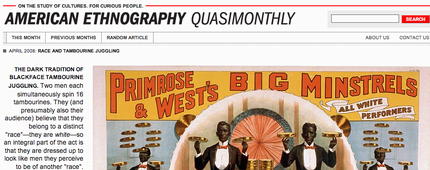
Anthropologist Martin Høyem has launched the e-zine “American Ethnography”, an “internet glossy on the study of cultures”:

We cover ethnography that relates to anything we would call America. We aim to present the tradition and practice of ethnography to people who didn’t know they could be intrigued by ethnography. The goal is to help increase the interest in how we all try to understand unfamiliar cultures. This, we think, could do the world good.

As he writes to me in an email, “it’s pretty new, so there isn’t a lot of material there yet, and most of what is there is old public domain texts (previously not freely available to the general public).” Most of the texts were previously published in the journal American Anthropologist.

Around twelve articles are online already, including portraits of some famous anthropologists and texts about the peyote-cult – a cactus that was eaten in rituals of native Indians. The most recent issue contains articles about race and tambourine juggling. Looks interesting!

>> visit American Ethnography

Høyem has previously written a thesis about American Lowrider Culture called I want my car to look like a whore. Lowriding and poetics of outlaw aesthetics, see also my post about the thesis: When Norwegians do business in Brazil, Lowrider Culture and 9 more anthropology theses.

Høyem is currently working at Pacific Ethnography – anthropology and design

UPDATE: The discussion about American Ethnography and copyright issues is continuing over at Savage Minds, see American Ethnography, the AAA, and the Public Domain

cover

Anthropologist Martin Høyem has launched the e-zine "American Ethnography", an "internet glossy on the study of cultures":

We cover ethnography that relates to anything we would call America. We aim to present the tradition and practice of ethnography to people…

Read more

Anthropologist: “Decriminalize prostitution! It’s part of our culture”

cover

After her fieldwork in a brothel in Mexico, anthropologist Patty Kelly is convinced: Legalizing and regulating prostitution has its problems. But criminalization is worse. It’s time to decriminalize prostitution, she writes in The Los Angeles Times.

One reason: Prostitution is not terribly uncommon. It’s a part of “our” culture, and it’s not going away any time soon, she explains. I’m not sure if she means “American culture” or “human culture”. Her statistics are related to America: More than one in every 10 American adult males have paid for sex at some point in their lives. In 2005, about 84,000 people were arrested across the USA for prostitution-related offenses.

But it was during her one year fieldwork in a legal, state-regulated brothel in Mexico where she learned why legalizing is the way the way to go. She spent days and nights in close contact with the women who sold sexual services, with their clients and with government bureaucrats who ran the brothel. In Mexico, commercial sex is common, visible and, in one-third of the states, legal.

Saying that all sex workers are victims and all clients are demons is the easy way out, she writes:

Here’s what I learned: Most of the workers made some rational choice to be there, sometimes after a divorce, a bad breakup or an economic crisis, acute or chronic. Of the 140 women who worked at the Galactic Zone, as the brothel was called, only five had a pimp (and in each of those cases, they insisted the man was their boyfriend).

The women made their own hours, set their own rates and decided for themselves what sex acts they would perform. Some were happy with the job. (As Gabriela once told me: “You should have seen me before I started working here. I was so depressed.”) Others would’ve preferred to be doing other work, though the employment available to these women in Mexico (servants, factory workers) pays far less for longer hours.

At the Galactic Zone, good-looking clients were appreciated and sometimes resulted in boyfriends; the cheap, miserly and miserable ones were avoided, if possible.

To be sure, the brothel had its dangers: Sexually transmitted diseases and violence were occasionally a part of the picture. But overall, it was safer than the streets, due in part to police protection and condom distribution by government authorities.

Sweden’s 1998 criminalization of commercial sex has according to Kelly not protected the women at all. Prostitution continued, prices for sexual services dropped, clients were fewer but more often violent.

Kelly prefers New Zealand’s 2003 Prostitution Reform Act. The act, she writes, not only decriminalizes the practice but seeks to “safeguard the human rights of sex workers and protects them from exploitation, promotes the welfare and occupational health and safety of sex workers, is conducive to public health, [and] prohibits the use in prostitution of persons under 18 years of age.”

>> read the whole article in The Los Angeles Times

Patty Kelly is also the author of the book Lydia’s Open Door: Inside Mexico’s Most Modern Brothel

SEE ALSO:

An anthropologist on sex, love, AIDS and prostitution in a university campus in South Africa

cover

After her fieldwork in a brothel in Mexico, anthropologist Patty Kelly is convinced: Legalizing and regulating prostitution has its problems. But criminalization is worse. It's time to decriminalize prostitution, she writes in The Los Angeles Times.

One reason: Prostitution is…

Read more