search expand

Interview with Benedict Anderson: Being a cosmopolitan without needing to travel

During my research for the new overview over open access anthropology journals, I made many great discoveries. I’ll try to present some of them.

One of the discoveries was Invisible Culture. An electronic journal for visual culture. The most recent issue includes an interview with famous Benedict Anderson about colonial cosmopolitism or cosmopolitism from below.

Cosmopolitism does not mean that you have to spend more time in airports than in your own bed. You don’t need to travel at all, Anderson, the author of “Imagined Communities. Reflections on the Origin and Spread of Nationalism” says.

In this interview he takes a different take on this term than in 2005 when I interviewed him. “I haven’t met many cosmopolitans in my life, perhaps no more than five”, he said.

In the interview in Invisible Culture, he tells us the story of Kwee Thiam Tjing, a poor Chinese-Indonesian journalist, in order to explore the role of cosmopolitanism in the life of the “colonial subject”. Kwee lived in Indonesia.

Anderson says:

In terms of colonial cosmopolitanism, I thought it was interesting because this guy was absolutely a cosmopolitan, but he almost never went anywhere—not even to China, as many of his Chinese acquaintances did. So I had to think about cosmopolitanism to talk about Kwee.

Interviewer Cynthia Foo asks Anderson how he would describe Keew as a cosmopolitan.

Anderson answers:

His family had been in Indonesia for 300 years, but Dutch colonial policy had been always, as much as possible, to segregate the Chinese and not let them assimilate with the natives (a policy which was of course quietly resisted). So Kwee was very aware of the fact that he wasn’t a native of the country, although he was extremely patriotic about the country.

He spoke Hokkien, which nobody except the Chinese spoke, as well as Indonesian and Javanese. He started out, really, with 4 languages: he had a home or “in-the-house” language of Hokkien; he spoke Javanese, which is a street language; Dutch he got in school; and Indonesian he learned in his teens, I think, maybe early 20s, because that was the popular medium for writing in newspapers and magazines.

 So you start off with a guy who at 20 is a master of 4 languages, and you’ve got something right there.

The second thing to add was that this was a very rich colony, yet little Holland didn’t have the power to say “only for us,” so all kinds of people came to seek their fortunes: Indians came, Yemenese came, Europeans of different kinds—Germans, Austrians, English, Americans—and so forth. This is why the population was very mixed; there was also a huge migration of natives, mainly Javanese, from the interior where people were looking for better ways to live. The Chinese ghetto system broke down in the 1910s, so, wherever you went, you were running into all kinds of people.


>> read the whole interview

SEE ALSO:

Owen Sichone: Poor African migrants no less cosmopolitan than anthropologists

David Graeber: There never was a West! Democracy as Interstitial Cosmopolitanism

Thomas Hylland Eriksen: Cosmopolitanism is like respecting the ban on smoking in the public

For an Anthropology of Cosmopolitanism

During my research for the new overview over open access anthropology journals, I made many great discoveries. I'll try to present some of them.

One of the discoveries was Invisible Culture. An electronic journal for visual culture. The most recent issue…

Read more

Anthropology, islam and homosexuality

Anthropology student Lykke Bjørnøy sent me an article on homosexuality and islam that she wrote as part of her studies at the University of Cairo. She tries to understand why homosexuality often is demonized. Not only in Islam, but also in Christianity (and other religions I suppose), homosexuality is a touchy subject.

It is (as always) work in progress and Lykke Bjørnøy is interested in getting feedback and comments:

Are homosexuals impure according to Sunni Islam?

Written by Lykke V. Bjørnøy

Last year I lived in the noisy metropolitan city of Cairo. Living there as a western, blond girl, my thoughts about discrimination and womens’ rights was flourishing in my head. I have never been so visible in my life and I wondered: Are there other groups that are invisible, but feel even more visible than I did? I looked different than all the others. However, I didn’t feel different.

Almost every religion has an opinion about homosexuals, or at least a view on sodomy. In Christianity sodomy is considered as “a sin against nature” and it’s the same in Judaism where it’s written in Leviticus: “[A man] shall not lie with another man as with a woman” Leviticus 18:22), both Christians and Jews are referring to this particular verse when the issue about homosexuality is questioned.

Islam doesn’t have the same clear restrictions on this subject, like other religions, but there are several hadiths and views on the topic. Islam contains much more written and boundary filled sexuality than Christianity. The Qur’an for instance is filled with restrictions according to sex, how it’s done, who it’s ought to perform and what time it should be done. One of the reasons for this can be the prophet Muhammad behavior, he was a sexual man in a contrast to Jesus. For the Prophet to cope with all the difficulties that could appear concerning sexual actions and the interaction with all his wives, he made restrictions and rules that would help the participants to deal with the conflicts that could emerge.

However, rules that are related to the control and restrictions against sodomy and sex in general is not just special for Islam, but all the religions, there is a set of laws in most holy texts, especially about the outsiders and the un-traditional actions that can take place in a society. The religion creates boundaries for the participants hence; it’s a way to deal with elements that need restriction or are considered unusual. Homosexuals have a different position and status than the mainstream in a society, and sometimes they are not even acknowledged. The president of Iran, Ahmadinejad, said on Fox News that they didn’t have a problem with homosexuals because they didn’t exist. Even though Ahmadinejad is seen as a Shi’a, his point still stands, his impression of homosexuality is just another act of sodomy which is not prohibited.

In order to understand the reasons why homosexuals often are considered as heathens, and why they are frequently demonized, it is therefore necessary to examine the basis of the condemnation. Demonization is often related to sickness and disturbances and these themes will be discussed further as we go along.

Homosexuality as a sickness
If you ask any religious scholar about homosexuals you get many different answers. One of the issues that are frequently discussed is the linkage between homosexuality as a disease. And if it is a sickness is it curable? There are scientists who do research on this matter right now; the internet is loaded with organizations and pages that discuss this issue (www.narth.com). So why do some people have the cravings to solve the “un-normalities” in the society and why is it so frowned upon?

What is it about the homosexuals that are so obviously wrong that needs to be solved? One argument that has been questioned is the fact that homosexuals have no function in the society and in the world in general, hence there has to be something wrong with them. The lion eats the zebra, the zebra eats grass; the circle of life. With homosexuals the circle of life is not being fulfilled.

Mary Douglas argues in her book “Purity and danger” that every human has a certain feeling of order. That objects or people are seen as impure if they don’t fit in a specific system. If homosexuals don’t fit in circle of life, they cannot reproduce, for this reason they are seen as impure according to Douglas. Several imams states that “if everyone was a homosexual, the world would go under”, which is true in the long term, because there would be no reproduction. Or as I see it a perfect solution to solve the global problem of constant increasing world population.

Levi-Strauss’ argument about impurity builds around the imam’s statement. For him, impurity is often linked to progress and logic. He proves this by looking at why incest is prohibited in most societies. He claims that one of the reasons that incest is prohibited is because it only reproduces defected human beings, which in the long term would lead to the extinction of human kind. If homosexuality is seen as impure because of their lack of reproducing skills, then why would God created them?

Most religious scholars reject the fact that it’s biological, by that I mean that homosexuality is something one is born with or can inherit. This is often stated because God doesn’t differentiate between people, we are all children of Adam according to the Sunni tradition. The hollowness in our stomachs, the lack of control, these are all factors that make us all similar (Katz, 2002:177.) In spite the fact that we all are made from the same foundation, Adam lost his purity in the Garden of Eden because apparently – no man is perfect. Since humans are not faultless there are stories in the Qur’an and in the Bible about what happens to people that don’t behave themselves, commit sins or disobey God.

The most famous one is the story about “The People of Lot” that exist both in the Quran and in the Bible. “The people of Lot” commits sins, like sodomy. The word homosexuality is of course not mentioned in the Qur’an or the Bible because it’s a modern expression. We can’t find an expression that is even comparable with the English term that was first used in the early 19th century, but the closest we get to homosexuality in is the act of sodomy (Qur’an:302).

The People of Lot got punished by God for their behavior and their towns were “turned upside down, and rained on them stones of backed clay, in a well arranged manner one after another” (Quran: 82) Apparently, these cities were in Palestine which today is the Dead Sea. This is the only punishment mentioned towards sodomy, however it’s pretty brutal. There are discussions about how sodomy ought to be punished today in some countries especially the Arab world, some scholars say that they should be stoned to death and get the same treatment as those who commit adultery, on the other hand this interpretation of the Qur’an has been created after the time of the Prophet Mohammed and has its origins from the hadiths and not the Holy script itself.

In the legal sources there has been differentiated between a grand and a petty sodomy. The grand sodomy is the action that takes place between two men and requires death of both participants (Wright & Rawson 1997:116) according to legal sources. A petty sodomy is anal sex between a man and a woman, although sexual intercourse with the opposite sex is” legal” this action is also forbidden by the Sunni tradition (Ibid). Since the Qur’an doesn’t differentiate between peoples’ feelings for the same sex and the actions of sodomy, means that the acts of sexual intercourse is the factor that makes sodomy impure and forbidden, not the homosexuals themselves.

As I mentioned in the introduction, sexuality has been an important part of literature and has played a much bigger part in Islam rather than it has in Christian societies. The grand example of this sort of literature is “One Thousand and One Nights” that were written in the early 1900’s and is filled with stories which all have elements of sexual actions, including sodomy. The simplicity of the sexual actions that were taken place in these stories say that sexual actions were not frowned upon, but rather appreciated. Why sodomy has the status of being “The Sin” contains an arsenal of meanings. The sexual act of sodomy is seen as animalistic, and naturally the sexual image of dog sex may have it’s similarities to sodomy, since the modern term of anal sex is called “doggy-style” is not taken out of the blue.

Islam has its restrictions and guidelines toward sexual actions and distinguishes between minor and major ahdaths. One example of a major ahdath can be regular sexual intercourse. Reinhart argues in is article “Impurity no Danger” that there is no danger in being in an impure state as an answer to Douglas’ article. He argues that there is a lack of control that makes something impure, not that an object is out of place. Reinhart says that Douglas’s argument don’t stand because semen, tears and mothers milk is not seen as impure objects in Islam. So it’s the action of ejaculation that is seen as a lack of control and therefore gains the same status a laughter break-out during prayer.

On the other hand another anthropologist named Julie Marcus agrees with Douglas and says that the fluid of sexual liquid across the body boundaries is seen as crucial (Marcus 1992:78). In other words the only solution to prevent oneself from getting in a position of impurity, is control. Therefore, if one compares adultery with sodomy as comparable sizes the only way the actor cannot become impure, is restriction. And in fact if you resist your desires you get paid in heaven according to the Qur’an (Qur’an:200).

The social sexual hierarchy in Islam
One of the foundations in Islam are that women and men are ought to be treated equally since they are both made from the same soul (Qur’an:7.189). Men and women are different biologically and Islam has rules on how the sexes cooperate with their biologically differences towards Islam. There are restrictions on menstruation, childbirth, sexual actions etc. and these are all considered major ahdath so they require major ablution before entering a mosque or pray.

Marcus argues in is article “Islam, Gender and hierarchy” that there do exist a basic social hierarchy in Islam. She says that women are naturally under men in the social hierarchy. She claims that since women menstruate and give birth they are considered below men in the social hierarchy. The lack of control concerning menstruation places women in an impure position regularly, without the possibility to change her status. She continues in her article “hierarchy is achieved at the point at which women are constructed as uncontrolled (…)”(Marcus 1992: 88.). By this statement she says implicit that men have a way to control their impurity, hence achieve then the higher rank in the hierarchy.

I will take Marcus’ theory a little bit further and make the comparison with homosexuals. Where do they fit in Marcus’s theory? If we state Marcus theory as a fact, man to man sex doesn’t fit into the system. If the regular dichotomy doesn’t hold its normal position, the factor is then according to Douglas’s theory impure, because it’s a matter out of place, in other words it’s un-placeable. If the natural order in the sexual hierarchy is not maintained and when the inferior is changed with the superior we end up with two sizes that are exactly the same.

This theory still stands if one just discusses sodomy which could happen between the same sex and the opposite sex. It is honorable to be the penetrator and it’s a disgrace to be the one’s being penetrated (Wright & Rowson 1997:199). The ones who is the penetrator has the power and the ones receiving are the inferior and when the action is between two men the action itself creates a hierarchy not the actors themselves.

Conclusion
The concept of same-sex sexual interactions has a tendency to disgust religious scholars and an attempt of legalizing homosexuals’ rights is seen as another “Western influence”. One of the reasons why religious scholars don’t acknowledge homosexuals is that it is not written implicit in the Qur’an how to handle them, just the actions of sodomy. Homosexuality is “The Sin” in Islam; the causes are that the well-known and “normal” social hierarchy that is presented in the holy scripts and in nature as we know it, is being tampered with.

A meddled system always creates chaos, and at the same time destructs the natural order as well as creating impurity. Since the impurity is characterized by actions that are located in social hierarchies, the status of a homosexual is not seen as impure.

The fact that there are two masculine human beings having sexual intercourse Marcus’ hierarchy is not being fulfilled, where there ought to be one superior and one being the inferior. When the sexual hierarchy is in chaos, who is then there to help us get the system back on track, when religion is the one factor, according to Durkheim that creates a system in chaos. Since the sexual actions between two men create an unbalance, will there ever be a system that accepts the interactions between homosexuals?

Bibliography
Douglas, Mary “Purity and Danger” 1966
Marcus, Julie, “A world of difference. Islam and gender hierarchy in Turkey”, Sydney 1992
Katz, Marion Holmes, “Body of Text: The Emergence of the Sunni Law of Ritual Purity”
Ithaca, New York, U.S.A.: State Univ of New York Pr 2002,
Reinhart, Kevin “Impurity / No Danger” University of Chicago;1990
Wright, W Jr. & Everett K. Rowsen “Homoeroticism in Classical Arabic Litterature” Colombia University Press: 1997
Dr. Muhammad Taqi-ud-Din Al-Hilali & Dr. Muhammad Muhsin Khan “Al-Quran” Islamic University, al-Medinah al-Munawwarah

SEE ALSO:

Native American Tribe Allows Gay Marriage

A subculture of hefty, hirsute gay men is attracting the attention of academics

An anthropologist on sex, love and AIDS in a university campus in South Africa

Researched the sexual revolution in Iran

Anthropology student Lykke Bjørnøy sent me an article on homosexuality and islam that she wrote as part of her studies at the University of Cairo. She tries to understand why homosexuality often is demonized. Not only in Islam, but also…

Read more

Mahmood Mamdani: “Western concern for Darfur = Neocolonialism”

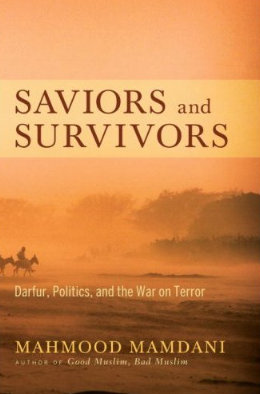
300 000 people have been killed and 2.5 million been made refugees in the war in Darfur. In his new book, anthropologist Mahmood Mamdani describes the Save Darfur campaign as representing a refracted version of the moral logic of the “War on Terror” with the Arabs in both cases branded as evil, Alex de Waal writes in The Monthly Review.

Mamdani writes:

The Save Darfur lobby demands, above all else, justice, the right of the international community — really the big powers in the Security Council — to punish “failed” or “rogue” states, even if it be at the cost of more bloodshed and a diminished possibility of reconciliation. More than anything else, “the responsibility to protect” is a right to punish without being held accountable — a clarion call for the recolonization of “failed” states in Africa. In its present form, the call for justice is really a slogan that masks a big power agenda to recolonize Africa.

Mamdani criticizes Save Darfur as mobilizing “child soldiers,” by which he means naive American students, in a campaign that diminishes Africans as part of an argument to “save” them, G. Pascal Zachary notes in his review.

Zachary is one of several scholars who discuss Mamdanis book Saviors and Survivors. Darfur, Politics, and the War on Terror on their group blog Making Sense of Darfur.

Zachary is a huge fan of Mamdani but feels that “like almost everyone else who speaks on Darfur, Mamdani too has another agenda”:

Like all those he complains about who use Darfur to score points on matters of greater importance to them – repressive Islamic regimes, Christian tolerance, the value of military intervention, etc – Mamdani too subordinates Darfur to a broader set of stories he wants to tell about dysfunctional American power in the world, about misunderstood Muslims, about an Africa violated by Westerners from every point of the political spectrum. Mamdani may be right about all of these larger stories, but just he is wrong to exploit Darfur – as wrong as those he finds guilty of doing the same.

>> read the whole text “Mamdani and the Uses of Darfur”

>> Saviors and Survivors (Monthly Review 13.4.09)

>> What Does Darfur Have To Do With The “War On Terror”? Kevin Funk, Making Sense of Darfur, 19.4.09)

>> The Darfur the West Isn’t Recognizing as It Moralizes About the Region (New York Times, 30.3.09)

>> Mahmood Mamdani: You (and I) got Darfur Wrong (Radio Open Source 3.4.09)

In an interview with the Boston Globe, the anthropologist explains his interest for the Darfur case:

In a context where African tragedies seem never to be noticed, I wondered why Darfur was an obsession with the global media. The reason, I realized, was that Darfur had become a domestic issue here, thanks to the Save Darfur movement. So I thought it important to examine the movement’s history, organization, and message.

(…)

I’m struck by the contrast between the mobilization around Darfur and the lack of mobilization around Iraq. The explanation, I believe, lies in the fact that Save Darfur presented the conflict as a tragedy, stripped of politics and context. There were simply “African” victims and “Arab” perpetrators motivated by race-intoxicated hatred. Unlike Iraq, about which Americans felt guilty or impotent, Darfur presented an opportunity to feel good.

(…)

The language of human rights was once used primarily by the victims of repression. Now it has become the language of power and of interventionists who turn victims not into agents but into proxies. It has been subverted from a language that empowers victims to a language that serves the designs of an interventionist power on an international scale.

>> read the whole interview

I wrote about Mamdani and Darfur earlier, see Mahmood Mamdani: “Peace cannot be built on humanitarian intervention” and about earlier books Book review: Mahmood Mamdani: “Good Muslim, Bad Muslim”

300 000 people have been killed and 2.5 million been made refugees in the war in Darfur. In his new book, anthropologist Mahmood Mamdani describes the Save Darfur campaign as representing a refracted version of the moral logic of the…

Read more

Earth Hour – The first globalized ritual?

Candlelight Dinner
Earth Hour in Perth
Earth Hour Warrior

I have to confess I have an ambivalent relation to initiatives like the Earth Hour. But anthropologist Stephen Bede Scharper casts an interesting perspective on this new way to save our planet.

He describes Earth Hour as “the first globalized ritual”, a `liminal space’ and therefore “a potent opportunity for change”:

Earth Hour combines a spiritual quest, a moral mandate and a communal practice into a unique and truly global event. It can thus be considered a transcultural action of moral responsibility for the planet, a statement that “another world is possible.” It is not driven by brands, consumerism or corporate logos. Earth Hour is not Coca-Cola teaching “the world to sing in perfect harmony,” nor Nike telling us to “Just Do It.” It is, rather, approximately one billion people entering the threshold of a different relationship with both the planet and the cosmos.

(…)
Earth Hour has arisen, almost organically, outside of established religious and secular institutions. The fact that churches and municipal governments are now participating is a testament not only to its popularity, but also possibly to its motivational power and persistence, something that places the event in the category of “ritual.”

>> read the whole story in The Toronto Star

UPDATE: Antarctica to Pyramids: Lights dim for Earth Hour (ap, 28.3.09)

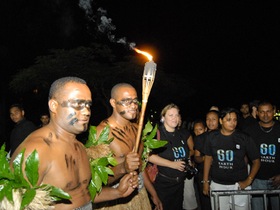
The pictures are from Melbourne (by avlxyz), Perth (by earthhour_global) and Fiji (by earthhour_global) – found via a flickr search for Earth Hour.

SEE ALSO:

The Value of Rituals

World Cup Enthusiasm: “Need for a collective ritual, not nationalism”

For an Anthropology of Cosmopolitanism

The last days of cheap oil and what anthropologists can do about it

Candlelight Dinner

I have to confess I have an ambivalent relation to initiatives like the Earth Hour. But anthropologist Stephen Bede Scharper casts an interesting perspective on this new way to save our planet.

He describes Earth Hour as "the first globalized…

Read more

Boycott Israel? – More anthropologists on Gaza (II)

LINKS UPDATED 26.10.2023 (text changed, name removed, see comments below) Four anthropologists are among a long list of scholars who in The Guardian call for a boycott of Israel:

We must do what we can to stop Israel from winning its war. Israel must accept that its security depends on justice and peaceful coexistence with its neighbours, and not upon the criminal use of force.

We believe Israel should immediately and unconditionally end its assault on Gaza, end the occupation of the West Bank, and abandon all claims to possess or control territory beyond its 1967 borders. We call on the British government and the British people to take all feasible steps to oblige Israel to comply with these demands, starting with a programme of boycott, divestment and sanctions.

Sarah at Once Upon a Time an Anthropologist Wrote reports about more protests at British Universities in her post How Academic World Reacted Toward the War on Gaza

Maximilian Forte at Open Anthropology has posted more info on boycott activities in Canada and university protests in Britain.

In the US on the other hand 3 students, who protested against Israel’s attacks, were arrested (one of them an anthropologist).

The question of academic boycott was also discussed at a seminar that Thomas Hylland Eriksen organized with his colleages at the research project Culcom. Personally, I am not sure if boycott is the way to go, but I liked the “smart boycott” that political scientist Nils Butenschøn suggested. If you collaborate with Israel you should be sure that the Israeli institution does not discriminate or support acts that breache international law.

What role should academics play in situations like these in Gaza? Theologian Anne Hege Grung said that the conflict is held up by myths. Our job is to deconstruct these myths.

Israeli anthropologist Jeff Halper is one of those intellectuals who does exactly that, she said. Last year he arranged a boat trip to Gaza in order to break the Israeli blockade. There, he formulated a message to his fellow Israelis:

(1) Despite what our political leaders say, there is a political solution to the conflict and there are partners for peace. If anything, we of the peace movement must not allow the powers-that-be to mystify the conflict, to present it as a “clash of civilizations.” The Israeli-Palestinian conflict is political and as such it has a political solution;

(2) The Palestinians are not our enemies. In fact, I urge my fellow Israeli Jews to disassociate from the dead-end politics of our failed political leaders by declaring, in concert with Israeli and Palestinian peace-makers: We refuse to be enemies. And

(3) As the infinitely stronger party in the conflict and the only Occupying Power, we Israelis must accept responsibility for our failed and oppressive policies. Only we can end the conflict.

His report of the trip can be read on the blog by Ted Swedenburg, another blogging anthropologist. Swedenburg is professor at the University of Arkansas and editorial committee member of the Middle East Report. He has blogged a lot about the Gaza-conflict.

In an earlier post I’ve mentioned several antropologists who try to do something similar. In a more recent post, Maximilian Forte analyzes and criticizes the myths spread by American media:

So THE WORLD trembles with love at the mere mention of “Obama,” while all those who oppose Israeli genocide and demonstrated against it were “Muslims.” In the meantime, the only real threat to peace is Hamas, and its bottle rockets.

Palestinians, not being white, European, privileged allies of the U.S., unlike Israelis, are less than human, and less than important, except as “obstacles.” All that Israel ever does is respond and get provoked, it never initiates — a pristine white victim of irrational brown people, you can almost hear its maiden-like screams across the white Atlantic.

With “reporting” like this, the media will keep anthropologists in business for a long time to come, as we try to clean up the damage they cause in creating a deranged culture of war and hatred. And it is hatred, a subtle, insidious, and racist hatred that motivates and encourages AP to write the kind of articles about Gaza as it has.

Then, I found a post by Palestinian anthropologist Khalil Nakhleh who concludes:

The only future for us, as an indigenous national minority that can exercise our inherited basic human rights on our land and that can achieve true justice and equality, is to reclaim and re-assert our narrative. (…) Our repossessed narrative cannot be a reinterpretation of our history as a dull shadow of Jewish-Zionist narrative. Our repossessed narrative must be based on the deconstruction of the racist Zionist-Ashkenazi system, which itself is a precondition for such a just solution. The existing Israeli system is, by definition, racist and exclusivist, and it is inherently and structurally incapable of providing justice and genuine equality to my Palestinian people.

Today, Anthropologist Smadar Lavie emailed me a link to her text Sacrificing Gaza to revive Israel’s Labor party. She reminds us of the different groups within the Israeli society and writes that it was mostly was the Mizrahim (Jews with origin in the Arab and Muslim World) who have been hit by the Hamas missiles. The Israeli European elite “imported” them “as a demographic shield against the Arab enemy”.

Smadar Lavie has put lots of papers online.

Finally, the anthropologists Kerim Friedman and Kiven Strohm have set up the wikipage “Understanding Gaza”

For more comments by anthropologists see my first posts: Anthropologists on the war on Gaza

LINKS UPDATED 26.10.2023 (text changed, name removed, see comments below) Four anthropologists are among a long list of scholars who in The Guardian call for a boycott of Israel:

We must do what we can to stop Israel from winning its…

Read more