search expand

David Graeber: There never was a West! Democracy as Interstitial Cosmopolitanism

(LINKS UPDATED 20.8.2020) Recently, the terms “Western civilisation” or “Western values” have been used in opposition to regimes mainly in the Middle East. But how fruitful is this notion of “the West”? In his keynote speech at the conference Cosmopolitanism and Anthropology, David Graeber showed that this idea is a kind of Othering: It makes artificial gaps between people that have more in common than supposed.

His deconstruction of the West resembels earlier deconstructions of the National (what traditionally has been considered as “typical Norwegian” is rather the result of migration and influences from other countries).

In his paper that he presented on the conference, Graeber writes:

If you examine these terms more closely, however, it becomes obvious that all these “Western” objects are the products of endless entanglements. “Western science” was patched together out of discoveries made on many continents, and is now largely produced by non- Westerners. “Western consumer goods” were always drawn from materials taken from all over the world, many explicitly imitated Asian products, and nowadays, most are produced in China.
(…)
As European states expanded and the Atlantic system came to encompass the world, all sorts of global influences appear to have coalesced in European capitals, and to have been reabsorbed within the tradition that eventually came to be known as “Western”.
(…)
Can we say the same of “Western freedoms”? The reader can probably guess what my answer is likely to be.

The idea of a superior “Western civilisation” is a product of colonialism. But as he says:

Opposition to European expansion in much of the world, even quite early on, appears to have been carried out in the name of “Western values” that the Europeans in question did not yet even have.

Graeber mainly used the notion of democracy as a Western concept as an example:

Almost everyone who writes on the subject assumes “democracy” is a “Western” concept begins its history in ancient Athens, and that what 18th and 19th century politicians began reviving in Western Europe and North America was essentially the same thing.

(…)

Democratic practices-processes of egalitarian decision-making-however occur pretty much anywhere, and are not peculiar to any one given
“civilization”, culture, or tradition.

We should according to Graeber treat the history of “democracy” as more than just the history of the word “democracy”:

If democracy is simply a matter of communities managing their own affairs through an open and relatively egalitarian process of public discussion, there is no reason why egalitarian forms of decision-making in rural communities in Africa or Brazil should not be at least as worthy of the name as the constitutional systems that govern most nation-states today-and in many cases, probably a good deal more so.

(…)

Rather than seeing Indian, or Malagasy, or Tswana, or Maya claims to being part of an inherently democratic tradition as an attempt to ape the West, it seems to me, we are looking at different aspects of the same planetary process: a crystallization of longstanding democratic practices in the formation of a global system, in which ideas were flying back and forth in all directions, and the gradual, usually grudging adoption of some by ruling elites.

Yet why have these procedures not been considered as “democratic.” The main reason in Graebers view: In these assemblies, things never actually came to a vote! Rather, they preferred “the apparently much more difficult task” of coming to decisions “that no one finds so violently objectionable that they are not willing at least assent”. It is this form of participatory democracy that social movements around the world are trying to revive!

Graeber also discusses the “coercive nature of the state” and the contradictions that democratic constitutions are founded on. He refers to Walter Benjamin (1978) who pointed out “that any legal order that claims a monopoly of the use of violence has to be founded by some power other than itself, which inevitably means, by acts that were illegal according to whatever system of law came before it”.

And about Ancient Greece and democracy:

It is of obvious relevance that Ancient Greece was one of the most competitive societies known to history. It was a society that tended to make everything into a public contest, from athletics to philosophy or tragic drama or just about anything else. So it might not seem entirely surprising they made political decision-making into a public contest as well. Even more crucial though was the fact that decisions were made by a populace in arms.

UPDATE: The whole text is now available in The Anarchist Library: There Never Was a West Or, Democracy Emerges From the Spaces In Between

SEE ALSO:

Amartya Sen: Democracy Isn’t ‘Western’ this text was also debated on Savage Minds

Amartya Sen: Democracy as a Universal Value (pdf) (Journal of Democracy 10.3 (1999) 3-17)

David Graeber: Reinventing Democracy

Review of Graeber’s book: Fragments of an Anarchist Anthropology

Cosmopolitanism and Anthropology – What’s the point of anthropology conferences?

(LINKS UPDATED 20.8.2020) Recently, the terms "Western civilisation" or "Western values" have been used in opposition to regimes mainly in the Middle East. But how fruitful is this notion of "the West"? In his keynote speech at the conference Cosmopolitanism…


Read more

What’s the point of anthropology conferences?

panel

I’m back from the conference Anthropology and Cosmopolitanism at Keele University (1h from Manchester, UK). As I’ve learned from entries on Savage Minds, job hunting and networking are a main point of anthropology conferences arranged by the AAA (American Anthropological Association). Luckily, this wasn’t the case with the conference I’ve attended last week: The main purpose seemed to be socialising – without ulterior motives: The participants were very friendly and open people. It seemed to be that I’ve talked at least to the half of all participants.

The topic – cosmopolitanism – seemed to have attracted a certain kind of people. “There are nearly no Americans here”, one delegate wondered. Usually, lots of Americans attended conferences arranged by the Association of Social Anthropologists of the UK and Commonwealth. What I found most striking: The largest part of all delegates were migrants!

Nearly none of them is working at a University in the country they were born. I met an anthropologist from Sri Lanka who’s working in the USA, another anthropologist working in Canada, originally from Turkey but – as she said – “a product from Norway”. There were quite a lot of German anthropology migrants living in the UK, and from Switzerland and Italy. A woman wore a badge with “Aberdeen University” on it. Of course, she told me that she’s from Malta!

colson

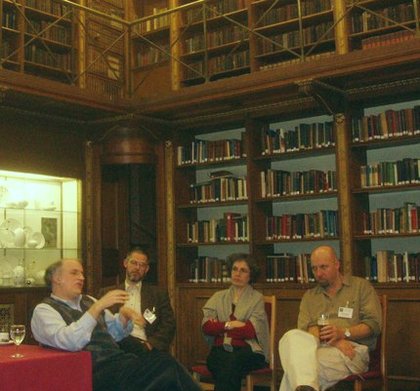
Many participants appreciated the social events. In contrast to other conferences, nobody left the venue after the day’s final lecture. There was nowhere to go as the University of Keele is a kind of academic ghetto, located far away from the nearest village. And the lectures actually lasted until 11 o’clock at night! I especially enjoyed these less formal after-dinner lectures – held by Elizabeth Colson (see picture to the right), by Andre Beteille and a debate on Robert Hayden’s ‘Shared Shrines, Syncretism and Tolerance’ in the old library (see image below), published in Current Anthropology.

old library

But concerning the topic of the conference, I wonder if I might have learned more if I had stayed at home and read the papers on my own. There were many very weak presentations: Most paper-givers read their papers monotonously and went over time. There was never enough time for discussion. Furthermore, generally three or four papers were read one after another without any breaks in between! It reminded me of the worst seminars during my first year at university.

Several participants left these panels before they ended. After a short walk in the sun, I met a young PhD-student. He was as frustrated as me: “It’s my first and probably my last conference”, he told me.

I wondered: Is the main purpose of a conference to deliver a paper in order to get it listed on one’s CV as John McCreery supposes while we discussed the topic How To Present A Paper?

“If you want to be considered a serious academic you have to read your paper. That’s standard and just the way it is”, one of the elder anthropologists informed me.

Some papers haven’t even had much to do with the topic of the conference (a few paper-givers admitted it openly!).

On the last day of the conference, Keith Hart said (maybe too harshly?): “Anthropologists don’t care for cosmopolitanism. It’s just an excuse to come together. We’re not engaging in the world. We don’t talk about Iraq and Iran. Our detached discourse lacks wider relevance.”

As I’ve found out afterwards, Keith Hart had said something that many delegates agreed with. The organisers had asked great questions about cosmopolitanism, but we haven’t heard many concrete answers. I missed debates about moral and ethical issues: Recently, several magazines and newspapers have discussed cosmopolitanism as an answer to the growing polarisation between socalled Western values and the socalled Islamic world. After the controversy around the Mohammed-cartoons, mainstream-media loved talking about culture and religion wars and Huntingtons clash of civilisation. But maybe we should have talked more about cosmopolitanism? Is this correct? Is cosmopolitanism a better alternative than multiculturalism? If yes, how could anthropologists contribute to a more peaceful, just, cosmopolitan world?

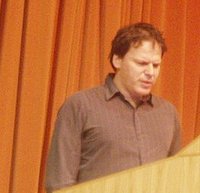
Nobody addressed these questions. Rather, extreme relativism prevailed. French anthropologist Benoît de L’Estoile for example, argued, we shouldn’t define the term cosmopolitanism by its moral qualities (openness to the world, empathy etc). graeber It is in his view problematic to define some people as good (cosmopolitans) or bad (non-cosmopolitans).

Nevertheless, there were many interesting papers (among others by David Graeber, see image to the left). I’ll have a look at them during the following days and weeks, (I hope) and will try to summarize some of the discussions.

See also my earlier post For an Anthropology of Cosmopolitanism.

UPDATE 2: A heavily edited version of this text was published in Anthropology Today august 2006. You can read the text here on my personal homepage

UPDATES

Summary of David Graeber: There never was a West! Democracy as Interstitial Cosmopolitanism

Owen Sichone: Poor African migrants no less cosmopolitan than anthropologists

Thomas Hylland Eriksen: Cosmopolitanism is like respecting the ban on smoking in the public

panel

I'm back from the conference Anthropology and Cosmopolitanism at Keele University (1h from Manchester, UK). As I've learned from entries on Savage Minds, job hunting and networking are a main point of anthropology conferences arranged by the AAA (American Anthropological…

Read more

Interviews on Christians and Muslims, Class, Immigration History and Black Feminism

Four interviews that I’ve conducted for the research program “Cultural Complexity in the new Norway” have been translated into English:

The sacred space between Christians and Muslims – Interview with Oddbjørn Leirvik
Leirvik has been involved in inter-religious dialogue since the middle of the 1980s: “I want to investigate the space in between. The space between Christians and Muslims. I wonder whether there is an open landscape which we share and which nobody has control over.”

– Class, equally as important as ethnicity – Interview with Ivar Morken
For special needs educationalist Ivar Morken cultural complexity is just as much about class differences in a Norwegian valley as it is about immigration from distant lands.

Collecting immigrants’ life histories – before it’s too late – Interview with Knut Kjeldstadli
In the three volume “Norsk innvandringshistorie” ( A History of Immigration in Norway) the historian Knut Kjedstadli, showed that it is wrong to believe that Norway was a homogeneous society before the arrival of Pakistanis and Somalis.

In pursuit of “black feminism” in Norway – Interview with Beatrice Halsaa
What is the relationship between ethnic Norwegian and non-ethnic Norwegian feminists or immigrant women? This is one of the big questions that Beatrice Halsaa, leader of the Centre for Women’s Studies and Gender Research (SKK) is interested in.

Four interviews that I've conducted for the research program "Cultural Complexity in the new Norway" have been translated into English:

The sacred space between Christians and Muslims - Interview with Oddbjørn Leirvik
Leirvik has been involved in inter-religious dialogue since the middle…

Read more

Riots in France and silent anthropologists

What anthropologists failed to do, a few thousand burned cars made possible: Public debates on inequality, discrimination and post-colonialism. In the recent volume of Anthropology Today (subscription required), Didier Fassin criticizes anthropologists for their silence during and after the november 2005 riots in France. Anthropologist Keith Hart reminds us in a comment to this article on the marginality of French anthropology and a recent letter to oppose anthropology’s apparent demotion within the administrative structures of the CNRS (Centre national de la recherche scientifique).

Didier Fassin writes:

During and after the events historians, sociologists, demographers, writers and intellectuals intervened in the public sphere, expressing comprehension if not of the rioters’ actions then at least of the problems they experienced. (…)
Anthropologists remained peculiarly silent. Just as we had done during the impassioned debate on the prohibition of the Islamic veil, we kept quiet when the historian Hélène Carrère d’Encausse, permanent secretary of the Académie Française, suggested that the main cause of the riots was polygamy in African families – a proposal subsequently reiterated by right-wing political leaders. The academically marginal but professionally dynamic Association Française des Anthropologues organized two meetings a few weeks after the events, but significantly invited sociologists to speak.

In Didier Fassins view, anthropologists could have foreseen these events. After having done fieldwork on relations between police and youth in the suburbs of Paris, the explosion and spread of violence was no surprise to him, he writes.

The riots gave French society the opportunity for a public confession of the long-denied policies of economic inequality, residential segregation and racial discrimination. France was beginning to admit that its integration paradigm had become a cover for the denial of its institutional racism. For the first time the French started to consider theirs a post-colonial society. Though long evident to many foreign scholars working on France, French anthropologists were the last to realize what was happening according to Fassin. He explains:

Suddenly, a previously unacknowledged colour bar was discovered. The word ‘ghetto’, previously banned from French vocabulary on the grounds that it reflected a specifically American reality, became common in editorials. Newspaper articles and television reports revealed how difficult it was for Arabs or Black people to get a job or a flat, how they were stigmatized at school and humiliated by the police. What thousands of pages of academic and administrative literature failed to do, a few thousand burned cars made possible.

Anthropologists had little to say on these subjects for two reasons in Fassins view:

(1) Very few anthropologists were working on the banlieues, on immigration or inequality: This relates to the history of the discipline in France and its predominant epistemological position. Anthropology in France is above all the study of the present of remote societies. Even when French anthropologists became interested in their own society, they tended to analyse its traditional aspects:

When a few of us turned to the study of politics, most described it in terms of rituals and institutions, comparing them with the display and organization of power in African societies. Scientific analyses have certainly been rich and sometimes innovative, but seldom related to the issues that we face in our own societies today.

(2) Many anthropologists found their beliefs and the ideals of the French society uncomfortably challenged: Isn’t France a secular and colorblind society?

The reluctance of anthropologists to recognize the existence of racial and religious discrimination in France is thus as problematic as the paradigms they do engage with. (…) Many still resist acknowledging this reality and prefer to ironize about what they see as an excessive display of victimhood. (…) Racial and religious issues remain difficult for many of us to raise when it comes to actual practices because they confront our values with a reality we would rather avoid.

Keith Hart comments Fassins article. He explains French anthropology’s weak engagement with ethnic / social inequality among others by “general divisions and elitism characteristic of higher education there”.

He compares different national traditions in anthropology:

If French anthropology seems to be beleaguered these days, Brazilian anthropology, having once been confined largely to Amazonia, is now booming as a source of investigation and commentary on mainstream urban society. Scandinavian anthropology offers a flourishing model of public engagement. Anthropology is a major operation in India and Nigeria today, being mainly concerned with ‘tribal’ populations and internal cultural diversity. Anthropologists in the USA and Britain have organized themselves quite effectively as professional guilds, but there is little public knowledge there of what they do (try using ‘anthropology’ as a keyword for email alerts from the New York Times); and the discipline’s relationship to the universities is precarious.

>> read Keith Hart’s comment (updated link)

SEE ALSO:

Who Are the Rioters in France? Anthropology News January incl comments by Thomas Hylland Eriksen and Cicilie Fagerlid

More and more anthropologists, but they’re absent from public debates – “Engaging Anthropology” (1)

Racism: Five Major Challenges for Anthropology

What anthropologists failed to do, a few thousand burned cars made possible: Public debates on inequality, discrimination and post-colonialism. In the recent volume of Anthropology Today (subscription required), Didier Fassin criticizes anthropologists for their silence during and after the…

Read more

New Ethnography: The Deaf People – A Forgotten Cultural Minority

It is insufficient to understand deaf people as disabled. Most deaf people rather see themselves as members of a cultural and linguistic minority. They are proud of their culture. And they face identity obstacles similar to those faced by many other minority members. Therefore is it important to change the attitudes from the medical definitions and into an understanding of the deaf as a linguistic cultural group. These are some of the main findings in a new book by Norwegian anthropologist Jan-Kåre Breivik called Deaf Identities in the Making. Local Lives, Transnational Connections.

As deaf-activist Asbjørn puts it:

“Why fix healthy deaf children through CI surgery? We do not need that. What we need are more hearing people that want to play on our team – as we are – as Deaf people. we need more people willing to use the key to our culture – the sign language.”

See among others this quote by one of Breiviks informants – it might have been told by Native Indians, black people, Saami people etc:

“I did not accept myself as deaf. My family and the local environment did not give me the means to appreciate that side of my self. I was the only local deaf person and what I head about deaf persons was almost exclusively negative. The “deaf and dumb” stereotype was around me and became part of my own experience. I was constantly trying to be part of my hearing environment, but of course I couldn’t pass as a hearing person. I was constantly frustrated, never getting access to what the others were speaking about.
(…)
At the age of eighteen, (…) I stated to visit the deaf club. Here I also found a new friend. I began to accept my deafness, and gradually I aquired a sense of pride for being deaf.
(…)
I felt as if I had been given a new life, when I began accepting myself as deaf. I got more out of life and the companionship with other deaf persons. We shared the same identity, the same culture, that we were facing the same problems of communication and language in society.

Deaf people’s identity politics also resemble those of other minority groups. To create a collective identity, borders have to be drawn. But where? This is of course an widely debated issue. There is some kind of hierarchy: Some people are regarded as “more deaf” than others according to Breivik:

Within the Deaf signing community, deafened people are often viewed as suspect figures. This is because they are not accepted as being really deaf, and they are often accused of being too willing to pass as hearing people.

An informant says:

“In the United States, there are extremely deaf conscious, and where you must be second- or third-generation deaf to be counted as a real deaf person.”

Many informants fear for sharper boundaries between the deaf and the hearing world. One of them says:

“Deaf Power can be compared to being proud to be from Norway, and be extremely conscious of that. Such self-consciousness can turn into nationalism. This scares me, and I experience this constantly. At each youth camp, there are always some extreme types. Their messages do not differ from other extreme nationalists. It is always us vs. them.”

Many deaf people live transnational lives: They travel a lot in order to meet other deaf people. In contrast to many hearing people, deaf people don’t link equality and sameness, Breivik found out:

One of the key lessons I have learned, as a hearing person who has been immersed in deaf life through my anthropological research, is that the phrase “being at home among strangers” (Schein 1989) goes to the heart of the identity question. This is about deaf people’s frequent departure from biological roots and the hearing, settled world, and their search for “equals” in distant places.

Their language – the sign language is of great help. It is much more suitable for transnational lives than spoken languages. It’s quite easy to learn foreign sign languages. Albertine from Norway tells about her time in the USA:

“I was present one month before school started up, and by that time I was able to make myself understood and I could capture most of what they told me. After three months, I was almost fluent in American Sign Language.”

Japanese, she tells, is totally incomprehensible. Nevertheless she’s convinced that she would have managed Japanese “after a few weeks.”

Deaf people embrace the new communication technologies like internet and email. For many of them, the Net is a window toward the world, several informants met their husbands/wives there. On the internet, they are able to communicate with strangers freely without any consideration of hearing status.

I’m halfway-through the book that actually qualifies to become one of my favorite anthropology books. It describes a – for hearing people – totally unknown world and turns some of our assumptions upside down. The book is also an example for good anthropological writing!

>> more information on the book by the publisher

>> read the first chapter of the book

SEE ALSO:

Jan-Kåre Breivik: Global Connections in Deaf Worlds through technology (Working paper)

‘I hoped our baby would be deaf’ Most parents would be distressed to learn that their child had been born unable to hear. But for Paula Garfield and Tomato Lichy, it means daughter Molly can share their special culture (The Guardian, 21.3.06)

UPDATE:

Anthropologist Karen Nakamura is going to publish a new book called Deaf in Japan. It will be out in August 2006.

Grace Keyes: “Hearing has been neglected in studies of enculturation and personality development”

It is insufficient to understand deaf people as disabled. Most deaf people rather see themselves as members of a cultural and linguistic minority. They are proud of their culture. And they face identity obstacles similar to those faced by many…

Read more