
search expand

Five more interviews on cultural complexity!

One of my jobs consists in interviewing researchers in the research program Cultural Complexity in the new Norway. Five of these interviews have been translated into English, I’ve just put them online:

Traveling to Turkey to Understand Norway
Anthropologist Therese Sandrup is interested on focusing on the strong emotional connection the second generation in Norway has to their parents’ native country: “It is important to look at the migration process in its entirety. Certain actions and decisions are the result of a dialogue between the past and the present, the country of origin and the Norwegian context,” she says.

Doing Fieldwork Among Poets and Rebels in Paris
Anthropologist Cicilie Fagerlid had actually intended to study peaceful cosmopolitan existence in Paris. But a month after she had relocated there, riots broke out in the suburbs. This research fellow now wants to find out why France ended up in this situation – in large part by studying the poetry slam scene.

Does the Labor Movement Tackle Cultural Complexity?
In the 1970s, The Norwegian Confederation of Trade Unions (LO) struggled with integrating women and new occupational groups. Margrethe Daae-Qvale believes the same is now happening with immigrants. In connection with her Master’s thesis, she has interviewed immigrants who have been active in the trade union, together with central participants within LO’s forum for ethnic equality.

Gender Roles Among Christians and Muslims: Shared Problems and Shared Solutions?
Do Christians and Muslims face common challenges, or are they so distant from each other that communication becomes impossible? In order to answer these questions, the theologian Anne-Hege Grung has formed a dialogue group with Christian and Muslim women. They are meeting to discuss texts from the Bible, the Koran and Hadith.

Revealing Media Habits Among Norwegian-Iranians
In studying media habits among Norwegian-Iranian people, sociologist Sharam Alghasi wants to comment on the relationship between Norwegians and Iranians. “You cannot consider yourself to be Norwegian if you feel you are excluded from Norwegian society through the media”, he says.

One of my jobs consists in interviewing researchers in the research program Cultural Complexity in the new Norway. Five of these interviews have been translated into English, I've just put them online:

Traveling to Turkey to Understand Norway
Anthropologist Therese Sandrup is…
Read more

Mahmood Mamdani: “Peace cannot be built on humanitarian intervention”

While Iraq is seen as a place with messy politics, the Sudan is seen as a place without history and politics, and the Darfur-conflict as a case of “ethnic cleansing” and “genocide”: “Arabs” are trying to eliminate “Africans”. Why is the violence in Iraq and Darfur named differently? Who does the naming? What difference does it make? These questions are asked by anthropologist Mahmood Mamdani in his commentary The Politics of Naming: Genocide, Civil War, Insurgency in The London Review of Books:

The similarities between Iraq and Darfur are remarkable. The estimate of the number of civilians killed over the past three years is roughly similar. The killers are mostly paramilitaries, closely linked to the official military, which is said to be their main source of arms. The victims too are by and large identified as members of groups, rather than targeted as individuals. But the violence in the two places is named differently.

The most powerful mobilisation in New York City is in relation to Darfur, not Iraq, he writes. One would expect the reverse. Even some of those who are calling for an end to intervention in Iraq are demanding an intervention in Darfur; as one of the slogans of the campaigners go: ‘Out of Iraq and into Darfur.’

Mamdani criticizes the de-politisation of the Darfur-conflict, especially by New York Times op-ed columnist Nicholas Kristof:

To peruse Kristof’s Darfur columns over the past three years is to see the reduction of a complex political context to a morality tale unfolding in a world populated by villains and victims who never trade places and so can always and easily be told apart. It is a world where atrocities mount geometrically, the perpetrators so evil and the victims so helpless that the only possibility of relief is a rescue mission from the outside, preferably in the form of a military intervention.
(….)
Kristof made six highly publicised trips to Darfur, the first in March 2004 and the sixth two years later. He began by writing of it as a case of ‘ethnic cleansing’: ‘Sudan’s Arab rulers’ had ‘forced 700,000 black African Sudanese to flee their villages’ (24 March 2004). Only three days later, he upped the ante: this was no longer ethnic cleansing, but genocide.
(…)
Newspaper writing on Darfur has sketched a pornography of violence. It seems fascinated by and fixated on the gory details, describing the worst of the atrocities in gruesome detail and chronicling the rise in the number of them. The implication is that the motivation of the perpetrators lies in biology (‘race’) and, if not that, certainly in ‘culture’. This voyeuristic approach accompanies a moralistic discourse whose effect is both to obscure the politics of the violence and position the reader as a virtuous, not just a concerned observer.

The depoliticisation of the conflict gave campaigners several advantages. Among others, they were able to occupy the moral high ground. The campaign presented itself as apolitical but moral, its concern limited only to saving lives, Mamdani argues and concludes that the camp of peace needs to realise that peace cannot be built on humanitarian intervention:

The history of colonialism should teach us that every major intervention has been justified as humanitarian, a ‘civilising mission’. Nor was it mere idiosyncrasy that inspired the devotion with which many colonial officers and archivists recorded the details of barbarity among the colonised – sati, the ban on widow marriage or the practice of child marriage in India, or slavery and female genital mutilation in Africa.

I am not suggesting that this was all invention. I mean only to point out that the chronicling of atrocities had a practical purpose: it provided the moral pretext for intervention. Now, as then, imperial interventions claim to have a dual purpose: on the one hand, to rescue minority victims of ongoing barbarities and, on the other, to quarantine majority perpetrators with the stated aim of civilising them.

Iraq should act as a warning on this score. The worst thing in Darfur would be an Iraq-style intervention. That would almost certainly spread the civil war to other parts of Sudan, unravelling the peace process in the east and south and dragging the whole country into the global War on Terror.

>> read the whole article in The London Review of Books

SEE ALSO:

Book review: Mahmood Mamdani: “Good Muslim, Bad Muslim”

Challenges of Providing Anthropological Expertise: On the conflict in Sudan

Anthropology and Sudan: “We have a huge responsibility to give back to the places we study from”

Cameroon: “Ethnic conflicts are social conflicts”

Anthropologists on the Israel-Lebanon conflict

Fieldwork reveals: Bush administration is lying about the “war on terror” in the Sahara

American Anthropologists Stand Up Against Torture and the Occupation of Iraq

While Iraq is seen as a place with messy politics, the Sudan is seen as a place without history and politics, and the Darfur-conflict as a case of "ethnic cleansing" and "genocide": "Arabs" are trying to eliminate "Africans". Why is…

Read more

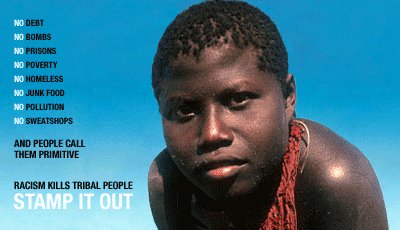
Anthropologists condemn the use of terms of "stone age" and "primitive"

Good news: British anthropologists take part in public debates. The ASA (Association of Social Anthropologists) issued a statement where they “condemn the use of terms like ‘stone age’ and ‘primitive’ to describe tribal and indigenous peoples alive today”.

We anthropology bloggers have often criticized the use of these terms.

The official condemnation comes in the wake of controversial comments made on the BBC (not online!) by Baroness Jenny Tonge, the Liberal Democrat peer, who called the Bushmen of the Kalahari Desert ‘stone age’ and ‘primitive.’

The ASA statement reads:

‘All anthropologists would agree that the negative use of the terms ‘primitive’ and ‘Stone Age’ to describe [tribal peoples] has serious implications for their welfare. Governments and other social groups. . . have long used these ideas as a pretext for depriving such peoples of land and other resources.’

The ASA has become the latest supporter of Survival International’s campaign against racism in the media which challenges the use of terms like ‘stone age’, ‘primitive’ and ‘savage’ to describe tribal and indigenous peoples.

Survival International writes:

Terms like ‘stone age’ and ‘primitive’ have been used to describe tribal people since the colonial era, reinforcing the idea that they have not changed over time and that they are backward. This idea is both incorrect and very dangerous. It is incorrect because all societies adapt and change, and it is dangerous because it is often used to justify the persecution or forced ‘development’ of tribal peoples. The results are almost always catastrophic: poverty, alcoholism, prostitution, disease and death.

Other supporters of this campaign include prominent journalists such as John Simpson, John Pilger and George Monbiot.

According the Washington Times, the American Anthropological Association did not return calls for comment.

But why do they still use the term tribe in their campaign? Why not use society or community? Doesn’t the term tribe imply something similar as “primitive”?

As I’ve mentioned earlier, several African scholars argue that the idea of tribe promotes misleading stereotypes and that “anyone concerned with truth and accuracy should avoid the term “tribe” in characterizing African ethnic groups or cultures”.

In their paper Talking about “Tribe” Moving from Stereotypes to Analysis, they argue that:

  • Tribe has no coherent meaning.
  • Tribe promotes a myth of primitive African timelessness, obscuring history and change.
  • In the modern West, tribe often implies primitive savagery.
  • Images of timelessness and savagery hide the modern character of African ethnicity, including ethnic conflict.
  • Tribe reflects once widespread but outdated 19th century social theory
  • Tribe became a cornerstone idea for European colonial rule in Africa.

Black Britain sheds more light on the use of this term. Several scholars, among others sociologist and cultural historian Lez Henry say that Survival and the ASA should also examine their use of the terms ‘tribe’ and ‘tribal.’ Henry says, people in Africa who live simple agrarian lifestyles are often seen as ‘primitive.’ Such notions served as justification for the colonisation of countries designated as ‘third world’. For Ekwe Ekwe, the term ‘tribe’ conjures up images of being unsophisticated and away from technological advancement.

According to Survival, they are guided by the United Nations in their definition of the term ‘tribe.’:

“Survival uses the term ‘tribal’ peoples, partly because we need a way to describe the type of people that we are working with. The term ‘indigenous’ can be used as well and often is.”

Following publication of the Black Britain article, the ASA contacted Black Britain to clarify its position and said:

“The ASA does not support the use of the term ‘tribal’ to describe people…We share your concerns about the use of the word in perjorative ways in the same vein as primitive, etc.

“However, we do support the overall aim of the campaign which is to change perceptions and work against racism and outdated ideas of social evolution. Hence we wish to support Survival International’s aims even if the wording is difficult.”

>> read the whole article on Black Britain

SEE ALSO:

Our obsession with the notion of the primitive society

Primitive Racism: Reuters about “the world’s most primitive tribes”

“Stone Age Tribes”, tsunami and racist evolutionism

“Good story about cannibals. Pity it’s not even close to the truth”

Ancient People: We are All Modern Now – Debate on Savage Minds

Good news: British anthropologists take part in public debates. The ASA (Association of Social Anthropologists) issued a statement where they "condemn the use of terms like 'stone age' and 'primitive' to describe tribal and indigenous peoples alive today".

We anthropology…

Read more

Interview with Michael Wesch: How collaborative technologies change scholarship

(via del.icio.us) After his video about collaborative tools on the web (like blogs, wikis etc), Michael Wesch has become the most talked about anthropologist on the internet. In an interview with John Battelle’s Searchblog, Wesch explains his interest in what geeks call web 2.0:

For me, cultural anthropology is a continuous exercise in expanding my mind and my empathy, building primarily from one simple principle: everything is connected.

(…)

For me, the ultimate promise of digital technology is that it might enable us to truly see one another once again and all the ways we are interconnected. It might help us create a truly global view that can spark the kind of empathy we need to create a better world for all of humankind.

He made his first website in 1998 and saw “a tremendous potential for transforming the way we present our research”. Since then, he tells us, he has had a passion for exploring the latest technologies and how they an be used to communicate ideas in more effective ways.

Farther down in the comment field he explains:

The radically collaborative technologies emerging on the Web create the possibility for doing scholarship in the mode of conversation rather than argument, or to transform the argument as war metaphor into something that suggests collaboration rather than combat.

Personally, I prefer the metaphor of the dance and that we are all here in this webscape dancing and playing around with ideas. The best dancers are those that find a way to “lose themselves” in the music – pushing the limits of the dance without fear of tripping or falling because they know that it is all part of the dance.

>> read the whole interview on John Battelle’s Searchblog

>> watch the video

As said, his video was widely debated, for anthropological comments see among others: mike wesch rocks the video essay (Savage Minds), Mike Wesch’s Web 2.0 video makes waves, expands our understanding of this digital phenomenon (Anthropology.net), Anthropologists on Web 2.0 (TechnoTaste) and Internet 6 or Web 2.0: Video Edition (Disparate, Alexandre Enkerli)

His video is part of his work at the Digital Ethnography working group at Kansas State University.

Last year, Wesch was guestblogger at Savage Minds and blogged about new teaching methods.

SEE ALSO:

antropologi.info survey: Six anthropologists on Anthropology and Internet

Paper by Erkan Saka: Blogging as a Research Tool for Ethnographic Fieldwork

Ethnomusicologist uses website as an extension of the book

“YouTube clips = everyday ethnography”

Ethnographic Skype

Ethnographic Flickr

Ethnographic research on Friendster’s online communities

Ethnographic Study on “Digital Kids”

2006 – The Year of Open Access Anthropology?

The Internet Gift Culture

(via del.icio.us) After his video about collaborative tools on the web (like blogs, wikis etc), Michael Wesch has become the most talked about anthropologist on the internet. In an interview with John Battelle's Searchblog, Wesch explains his interest in what…

Read more

Panic, joy and tears during fieldwork: Anthropology Matters 1/2007 about emotions

How to understand religious experiences when you have not ‘experienced’ the experiences? What is the function of emotions in the anthropological research process? Do emotions operate as ‘anthropology’s taboo’? Or are they key tools in our understanding and openings to our ‘informants’? And what are the effects of the emotional appeal of human rights activism on the resulting work?

The new issue of Anthropology Matters – one of the few online journals in anthropology – focuses an very interesting topic: Emotions – both as a state or research method during fieldwork and object of study. Editor Ingie Hovland writes in her introduction:

Emotions are inextricably tied up in our anthropological research and writing-in our apprehensive anticipation of the field, our feelings of helplessness once there, our anger at ‘informants’, our moments of panic, exuberance or exhaustion, our joy over the development of meaningful relationships and our excitement when we are ‘struck’ by something, and the despair, resignation or satisfaction that accompany writing up.

Yet these emotions are often dismissed in a number of curious ways: frequently left out of anthropological research methods courses, frequently edited out of ethnographic texts, admonished when they slip into PhD seminars, in general confined to personal fieldnotes, at times turned into jokes or asides, and at other times treated with uncertainty, embarrassment or silence.

How has this state of affairs come about? Is it only due to anthropology’s over-reliance on the Western academy and its Enlightenment split between knowing and feeling, turning emotions into the dangerous ‘other’ of knowledge? Or does it go beyond the question of hierarchies of knowledge and probe into the regulatory regimes of the anthropological community itself, turning emotions into an object of discipline?

>> overview over all articles in Anthropology Matters 1/2007

As we remember, blogger Antropyton, currently on fieldwork in Nicaragua has been very open concerning her emotions recently.

How to understand religious experiences when you have not 'experienced' the experiences? What is the function of emotions in the anthropological research process? Do emotions operate as 'anthropology's taboo'? Or are they key tools in our understanding and openings…

Read more