search expand

Book review: The deep footprints of colonial Bombay


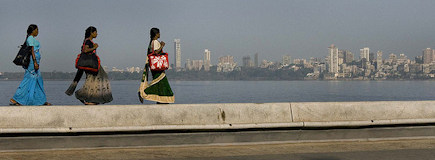
Three Women of Mumbai. Photo: Steve Evans, flickr

Antropologi.info book reviewer Tereza Kuldova has read another book for us.

“One wonders how little has changed”, she writes in her review of The Making of an Indian Metropolis: Colonial Governance and Public Culture in Bombay, 1890-1920 by historian Prashant Kidambi. The book is in her opinion “a great read also for any urban anthropologist, not only for historians who are the main target group”.

—-

The deep footprints of colonial Bombay

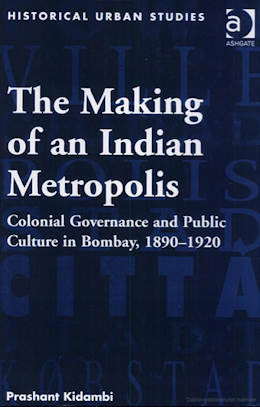
Review: Kidambi, Prashant. 2007. The Making of an Indian Metropolis: Colonial Governance and Public Culture in Bombay, 1890-1920. Ashgate

Tereza Kuldova, Ph.D. student in social anthropology, University of Oslo
At times, when you read about old Bombay, about the ‘lost’ times when ‘Bombay’ was not ‘Mumbai’, you are faced with idealized narratives of a golden era, now long gone and mourned. A picture of Bombay is painted in which people of diverse religions, classes, castes and live harmoniously together; it is a picture of a conflict-free era, where rules and obligations are followed and mutual respect prevails.

It is then only refreshing to read an account of colonial Bombay (1890-1920) that confronts us with a much more realistic picture. A picture of Bombay struck by two global pandemics, as well as by episodes of collective violence. A picture of Bombay, where the ruling elites try to handle the ‘unintended city’ – a result of industrialization and intense immigration – and its issues of sanitation, slums, famine, plague, riots, order and criminality.

Divided by caste, class and religion

Reading Kidambi’s account, it becomes obvious that, as he himself says, the imagined ‘ideal’ Bombay is “essentially an exercise in ‘historical fantasy’ that elides over the extent to which the city has always been divided by caste, class and religion” (236). If one has some knowledge of contemporary Mumbai, reading this book makes one realize how little has changed and how deep footprints have the colonial rule left in today’s Mumbai.

Prashant Kidambi’s inquiry into the urban history of Bombay manages to grasp the dynamics of urban change at the same time as it catches the reader’s attention – and that even though the wealth of historical detail can be overwhelming. 

He focuses on three decades in which, in his own words, “the city was restructured in accordance with the dictates of modern urban planning and intrusive modes of governance were deployed in response to the challenges posed by rapid industrialization and massive labor migration” and in which “the city became the site of a vigorous associational culture and ‘modernizing’ social activism that infused its civil society with new dynamism” (p. 9). 

Prashant Kidambi argues, that the city was a ‘contested terrain’, shaped as much by acts of resistance as by the operations of power (p. 12).  Contrary to the “widely entrenched perception that the norms and practices of civil society were solely internalized by the Anglophone intelligentsia and were more or less alien to the cultural worldview and dispositions of the lower orders” (p. 14), the lower strata of society actually took part in the associational civility, the civil society of the emerging Bombay (pp. 157-202).

An interesting part of the book, particularly for an anthropologist such as me, is the discussion of the urban middle class formation in colonial India in relation to the concepts of ‘social reform’ and ‘social service’ and the way in which middle class became formed by these practices.

The distinction between ‘social reform’ and ‘social service’ is I believe useful in this respect.  Kidambi argues that “while ‘social reform’ during the late nineteenth century had largely denoted the internal attempts at ‘self-improvement’ within particular castes and communities, the emergent discourse and practice of ‘social service’ articulated by members of the high-status Anglophone intelligentsia was directed at the destitute, the downtrodden and the disadvantaged” (p. 15).

A leading cosmopolitan commercial center

Kidambi’s account of the colonial Bombay is centered around several topics. Firstly he introduces the reader to the rising city of Bombay, a city that had by 1860 “become, after New York and Liverpool, the largest cotton market in the world” (p. 18) and that “by the last decade of the nineteenth century (…) could justifiably lay claim to being a leading commercial and financial center” (p. 23), where a “highly cosmopolitan culture amongst the business elites” (p. 24) developed. At that time “Bombay was also home to a nascent, but dynamic, English-educated Indian middle class comprising lawyers, doctors, engineers, businessmen, journalists, teachers and clerks employed in mercantile and government offices. This middle class was a product of colonial policies that dated back to the second quarter of the nineteenth century” (p. 26). 

The growth of Bombay as a business and industrial center also “attracted a large, predominantly male, proletarian population”, which “found employment in the cotton-textile industry” (p. 29). However, the “city’s modernization had resulted in ‘two Bombays’, the one inhabited by a cosmopolitan elite that nestled in the fashionable enclaves of the city, the other full of chawls, crowded, insanitary, ill-ventilated slums and filthy lanes, stables and godowns” (p. 36). (One wonders here, how little has changed, when in today’s Mumbai 95% of its population lives on 5% of its space and the richest 5% occupies 95% of the land).

Diseases and segregation: Urban poor as threat

Overcrowding, slums, sanitary issues, disease, increased criminality, all these were the issues that increasingly kept the colonial administration preoccupied. And in 1896 this was only to get more intense as the plague epidemic attacked Bombay. 

The plague and its handling by the administration becomes another interesting topic. Kidambi argues that “for nearly a decade after the initial outbreak in the city, long-standing assumptions that viewed epidemic diseases as a product of locality-specific conditions of filth and squalor exercised significant influence over the colonial state’s war against plague” (p. 50).

These localist perceptions meant that the policies were aimed at sanitary regeneration of the city, cleaning of the infected areas, their evacuation or eventual demolition. Furthermore a notion that Kidambi labels as “contingent contagionism” has developed, which could be summarized as follows: “If plague was a disease either generated by, or nurtured in, filth and squalor, many officials argued, it followed that Bombay’s poor who resided in ill-ventilated, overcrowded tenements would be more susceptible to its ravages. This, in turn, buttressed the belief that it was the poor, rather than the ‘respectable’ classes, who were the ‘natural’ bearers of contagion” (p. 64). “Consequently, the colonial state’s antiplague offensive was in large measure directed at segregating the urban poor, who were perceived as posing threat to the physical well-being of Bombay’s elites” (p. 70). 
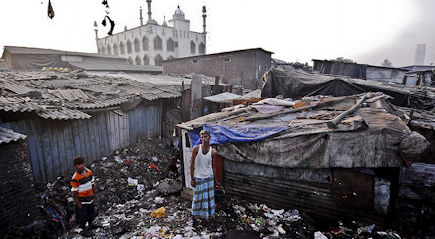

Shadow City – Dharavi, Mumbai. Photo: Akshay Mahajan, flickr

The next chapter deals with the Bombay Improvement Trust (1898), which was meant as a solution to the sanitary problems of the city; it dealt with the issues of town-planning, slum clearance, tried to expand the city’s residential area and provide sanitary housing for the poor.

Kidambi concludes that “(b)y the end of the First World War, it was widely acknowledged that the Bombay Improvement Trust failed to redress the civic problems that had led to its creation. On the contrary, most contemporary observers agreed that the Trust’s activities had worsened Bombay’s housing and sanitary problems” (p. 112).  However, “notwithstanding the Trust’s failure to carry out the tasks for which it had been established, its policies has profound, albeit unintended, consequences for the development of Bombay’s spatial organization and social geography” (p. 113).

The emerging importance of the ‘street’

Kidambi goes on to discuss colonial policing strategies and control and regulation of the urban spaces and the perceived threats to urban ‘order’, particularly after the experience of two major riots in the 1890s. He presents an interesting discussion of the emerging importance of the ‘street’ and the life of and on the street and in neighborhoods.

“The street was the principal locus of working-class social life and recreational activities ranging from akharas (gymnasia) and tamashas (street theatre) to the liquor shops where many workers congregated after work” (p. 121). 

He concludes that in the 1890s “the traditional colonial strategy of ‘indirect’ control began to give way to a more intrusive approach vis-à-vis the urban neighborhoods and the emergent plebeian public sphere. The 1902 Police Act vastly enhanced the discretionary powers of the police over a range of ‘public’ activities and urban spaces that had hitherto been unregulated. Their newly consolidated powers, in turn, increased the scale and dimension of conflict between the colonial police and the populace. Consequently, the relationship between the colonial administration and plebeian society in Bombay grew markedly fractious in the years leading up to the end of the Great War” (p. 155). 
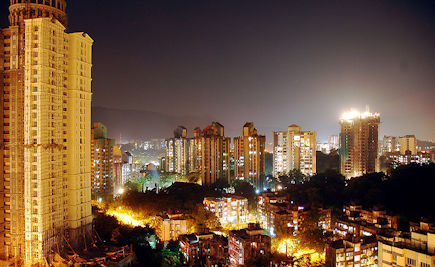

Mumbai at night. Photo: Premshree Pillai, flickr

Towards the end of the book, Kidambi takes on topics such as the emergence of the civil society in Bombay and the involvement of particularly the English-educated elite and middle class in various educational, scientific, religious and social reform oriented associations.

He concludes that “the rich diversity of associational activity within Indian civil society rendered its public sphere a ‘segmented’ domain in which the fashioning of the ‘autonomous, reason-bearing individual’ was offset by a countervailing process ‘through which community identities were reworked and reaffirmed’. It also invested urban public culture in colonial India with an intrinsic plurality and polyphony that has continued to inflect its post-colonial career” (p. 201). 

The last chapter of the book is devoted to the question of social reform and social service and the social activism of Bombay’s intelligentsia directed at the uplifting of the depressed classes. These efforts of the educated middle and upper classes were both integral to the process of nation building and also had the effect of strengthening “the claims to public leadership of the educated middle class during the first two decades of the twentieth century. By the end of the First World War, educated men were able to tout their credentials as the ‘real’ leaders of the citizenry far more confidently than during the late nineteenth century” (p. 231).

Relevance for today?

There are several things that I have been missing in the book (but that may be likewise a general problem with the genre of historical accounts).

The book deals with a period of three decades (1890-1920). Except for a brief note in the conclusion there is no reflection on the effects of these three decades on the later developments. One is simply left to conclude on one’s own. It feels as if relating to present days or even decades following the three decades under thorough investigation, would not be rigorous enough.  I would prefer at least some reflections, that would give the reader a sense of continuity and change and put things into a broader context of events that followed and issues that Mumbai is faced with now. This would turn a historical narrative, largely of interest only to specialists, into a reading of relevance for a much broader audience. 

Another thing that at times bothered me was what I experienced as a continual struggle of the author to give the account an appearance of factuality, of presenting matters ‘as they were’ and the very little space left to polemics with one’s own material and the works of others. This appearance of an authoritative account is greatly supported by the referencing system that uses footnotes at the bottom of each page (and not references directly in the text) and by the use of single quotes for both quotations from other’s works and archival materials and author’s own expressions in ‘quotes’. This is not very lucky as the reader very often looses track of who says what. 

Nevertheless, reading this book was enjoyable and would be definitely a great read also for any urban anthropologist, not only for historians who are the main target group. 

>> information about the book by the publisher (Ashgate)

>> read the first chapter of the book (pdf)

>> read another review: Bombay on the brink of modernity (Hans Schenk)

>> Article by Prashant Kidambi: ‘The Ultimate Masters of the City’: Police, Public Order and the Poor in Colonial Bombay (Crime, Histories and Societies 2004)

SEE ALSO:

Tereza Kuldova: Networks that make a difference. The production of social cohesion in Lucknow, North India

Colonialism, racism and visual anthropology in Japan: Photography, Anthropology and History part II

How the Ganges boatmen resist upper-caste and state domination

Sheds light on the collaboration between science and colonial administration in Naga ethnography

Three Women of Mumbai. Photo: Steve Evans, flickr

Antropologi.info book reviewer Tereza Kuldova has read another book for us.

“One wonders how little has changed”, she writes in her review of The Making of an Indian Metropolis: Colonial Governance and Public Culture…

Read more

The return of colonial anthropology?

“A dysfunctional ethnic and tribal brawl has been the norm in Afghanistan for centuries. Afghanistan is a mess. ” Who said that? A frustrated U.S. military officer? No, a professor of anthropology, Robert L. Moore.

In his article Tribes, Corruption Ail Afghanistan in The Ledger he shares his concerns about the difficulties for “us” (=the U.S. military) to “push this contentious country into the 21st century” and turn it into a “normal, stable country” that will be “governable in the way that most nations are”.

His main point: Afghanistan is an ethnic and religious mess:

Afghanistan is a mess. It is populated by a multitude of ethnic groups, the dominant ones being Pashtun, Tajik, Hazara and Turkic. Many of these groups are further subdivided into traditional tribes whose members regard loyalty to their tribe or clan as more vital than loyalty to any nation or government. Alongside these tribal and ethnic divisions are religious differences that separate Shi’a from Sunni Muslims. The upshot of all this is that Afghanistan is not governable in the way that most nations are.

“In this harsh landscape”, he continues, “our efforts to “stabilize” Afghanistan cannot bring about rapid dramatic change”:

There are areas of Afghanistan, mainly non-Pashtun regions, where the Taliban are deeply distrusted and in these areas our troops might be welcomed. But would our fighting on behalf of, say, Tajiks (who, by the way, are ethnic cousins of Iran’s Persians) help solve Afghanistan’s long-standing problem of ethnic conflict? It is more likely to simply add another dimension to the dysfunctional ethnic and tribal brawl that has been the norm in Afghanistan for centuries.

Ethnic mess – apartheid as ideal? U.S-military=”us”. “Anthropology= serve those in power” – Sounds like 19th century colonial anthropology!

Over at Zero Anthropology, Maximilian Forte gives an overview over European press coverage of U.S. Army’s Human Terrain System and its embedding of civilian social scientists in Afghanistan and Iraq.

SEE ALSO:

Sheds light on the collaboration between science and colonial administration in Naga ethnography

Army-Anthropologists call Afghans “Savages”?

“No wonder that anthropology is banished from universities in the ‘decolonized’ world”

The dangerous militarisation of anthropology

The Five Major Challenges for Anthropology

“A dysfunctional ethnic and tribal brawl has been the norm in Afghanistan for centuries. Afghanistan is a mess. ” Who said that? A frustrated U.S. military officer? No, a professor of anthropology, Robert L. Moore.

In his article Tribes, Corruption Ail…

Read more

Thesis: That’s why there is peace


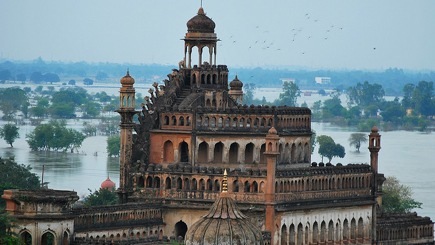
The Rumi Darwaza (“the Turkish Gate”) in Lucknow. Foto: Himalayan Trails / Rajesh, flickr

Why are some areas of this world more peaceful than others? In her master’s thesis Networks That Make A Difference, anthropologist Tereza Kuldova explains why the Indian city of Lucknow has remained peaceful throughout its history, even throughout such events as the Partition of India in 1947, and the demolition of Babri mosque in 1992 by Hindu nationalists in Ayodhya, less than 100 km from Lucknow.

“In contrast to the vast majority of studies concerned with communal violence in general and the Hindu-Muslim violence in India in particular, I opt the opposite point of departure, the one of communal peace”, Kuldova writes who is currently PhD fellow at the Museum of Cultural History in Oslo and author of several book reviews here at antropologi.info.

The heart of the peaceful nature of Lucknow is according to her “a particular blend of local history and networks of economic dependency which cut across the boundaries of class, caste, religion and locality. These networks are produced by the local embroidery industry, known under the name Chikan. Chikan is a traditional Muslim craft, and traded mostly by Hindu businessmen. In the last two decades there were more and more Muslims among the traders and Hindus among the embroiderers.

Chikan embroidery. Foto: Joey Berzowska, flickr

The Chikan industry gives employment to about 20 percent of the city’s population. It integrates people of different origins – rural, urban, lower class, middle class, men, women, Hindus, Muslims and creates according to her “an incredible network of mutual dependency, obligations and expectations”.

Religion is often used by political leaders to polarize people. It is rarely the main source of conflicts. These economic networks of interdependency, writes Tereza Kuldova, neutralize the polarizing strategies of the political leaders and lessen the chances of the occurrence of the communal tension. They lead to the “priority of the processes of togethering” as opposed to the “processes of othering”:

The growth of the industry and these networks, especially after 1990s, that is noticeably connected to the emergence and the ideology of the Hindu nationalism, has at the same time prevented the negative effects of this ideology, which have been violently felt in Lucknow’s neighbouring areas. This happened by expanding the cross-cutting networks and by turning a craft, which could have possibly been labelled as a “Muslim” craft, into a “traditionally Indian” craft. Chikan has been turned into embroidery which is worn by both Muslims and Hindus to express their Indianness, sense for tradition and fashion.

Additionally, Lucknow is by its inhabitants imagined as a peaceful and tolerant city, as the city of the Nawabs, rulers who bridged faiths:

Almost all accounts of the oral history that I gathered began like this: “In the times of Nawabs, the arts and architecture flourished, it was the time when a Muslim king danced as Lord Krishna…now where you can see that”. The Nawabs thus became associated with secularism; it is them who made Lucknow a “peaceful, clean and a neat city”

You don’t have to be born in Lucknow to be a Lakhnavi:

This imagination of anything or anyone as “Lakhnavi” goes in result beyond the dichotomy of Muslim vs. Hindu; it is rather about belonging to a particular place, which is populated by “Lakhnavis”, first and foremost.

The most persistent logic of the reasoning of why Lucknow is a peaceful city thus goes (tautologically enough) in the field as follows: “Lucknow is a peaceful city, because it is Lucknow, Lakhnavis do not fight, it has always been like that here and anyone who comes here just has to adopt that culture” (From a conversation with a Hindu businessman, 25.3.08.)
(…)
The discourse of the mythical past seems to work hand in hand with the economic structures and the social and economic networks in the city, creating both economic and discursive basis for the establishment of “relaxed” communal relationships.

As consequence of her findings, Tereza Kuldova encourages anthropologists to think rather and in terms of identifications than identities and in terms of networks than dichotomies:

Through the Chikan industry and through Chikan as a commodity, we can learn something about the fluidity of the social systems, about change and continuity, about the importance of the cross-cutting networks, about the discourses which govern the market and people’s choices and last but not least about the experience of modernity in India.

(…)

We have even seen that what is usually considered as unchangeable identities, particularly in the Indian context, namely the religious identities, are as mutable as any other. They are identifications, that might be at times stronger, at times weaker and at other times they might be replaced by new ones. People play with these identifications in a similar way as the popular Bollywood cinema does. (…) The concept of identification thus, being much richer, gives us more space to acknowledge the discursive shifts, which occur when the identifications are played out. At the same time as it acknowledges the situational and relational character of identity.

(…)
The network approach reminds us of the complexity of the social life and its situations, as well as of the impossibility to divide and classify the flow of social and economic interactions into clear-cut categories. (…)
Anthropology in general and I believe this study in particular, “has the authority and the ability to collapse a number of counterproductive dichotomies: the local and the global, the virtual and the real, the place-bound and the “non-place”, the universal and the particular. In real-life settings such contrasts evaporate” (Eriksen 2003: 15). “The “India”, where the past is inserted into the present and then projected into the future, questions the colonial dichotomies of “India” vs. “West”, “modernity” vs. “tradition”” (Favero 2005:24).

>> download the thesis

SEE ALSO:

Why more scholarship on war than peace?

– Highlight the connections between people!

How to challenge Us-and-Them thinking? Interview with Thomas Hylland Eriksen

Mahmood Mamdani: “Peace cannot be built on humanitarian intervention”

An Anthropological Challenge to Assumptions about War and Violence

Applied anthropology: A wedding ceremony in support of durable solutions in West Timor

Presenting 2nd generation Multi-Sited Ethnography

The Rumi Darwaza ("the Turkish Gate") in Lucknow. Foto: Himalayan Trails / Rajesh, flickr

Why are some areas of this world more peaceful than others? In her master’s thesis Networks That Make A Difference, anthropologist Tereza Kuldova explains why…

Read more

Football World Cup = an arena of everyday cosmopolitanism?

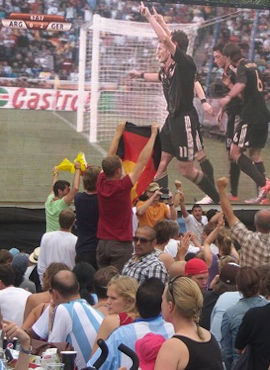
Oslo, Saturday afternoon. Several thousands people are watching Germany-Argentina on the big screen. The man opposite to me is wearing the German jersey. He is not German, but Norwegian. He is not the only one who identified with the”others” during the World Cup. Not only teams from the rich “West” are popular. A few days ago, people from all nationalities cheered on Ghana. Norwegian TV2 interviewed fans of the Ivory Coast team in South Africa. Ivory Coast fans came from all over the world, and many of them were neither black nor from the Ivory Coast.

The Football World Cup is often associated with primitive nationalism. Watching the matches in different public viewing places made me wonder: What about seeing the event as an arena of everyday cosmopolitanism, where people engage with the world, identify with teams, people and nations from far away places?

Even German fans of the German team cheer on players with names like Mesut Özil and Sami Khedira. In the German team, 11 of the 23 players were eligible to play for a different country. What effect does this have on notions of Germanness and identifications in general?


Mesut Özil and his fans in a beer garden in Stuttgart, Germany.

But a quick google search revealed that the cosmopolitan aspects of the football world cup do not seem to be a popular research topic. I haven’t found papers that address this topic explicitly – but maybe a closer look at the 90 journal articles that Routledge Journals made free to access until the end of July will nuance the picture?

Or maybe rather not?

“Academic treatments of football have tended to focus either on the game’s capacity to inspire xenophobic hooliganism amongst its followers or how it has been exploited by politicians for nationalistic purposes”, writes Peter Hough in one of them called “Make Goals Not War“. There he highlights the mostly ignored positive contributions of international football to international relations. But he is not addressing cosmopolitanism either.

Anthropologist Hans Hognestad shares his view.

“Despite the apparent existence of transnational football fandom there seems to be a reluctance in academe to view this as generative of new identities contesting more traditional ones related to the nation as a privileged frame for structuring and reproducing identities”, he writes in the paper Transglobal Scandinavian? Globalization and the contestation of identities in football that is not freely accessible (mostly about club football, though).

Why is this so?

“The lack of understanding of the popular and cultural appeal of sport seems to me linked to the incomprehension about and instinctive dislike of patriotism”, argues Sunder Katwala. In a comment to The football world cup is not xenophobic by Robert Sharp, he criticizes the view “that we will (only) have a better world when people do not identity with national identities, but instead only with the brother-and-sisterhood of humanity.” Instead, cosmopolitanism can in his opinion be achieved “through supporting positive and outward-looking national identities which see the value as internationalism as important to “who we are”.

Maybe the World Cup constitutes such an arena for creating these identities?

For more commentary about the World Cup see the posts by Matthew Durington at Savage Minds, among others Parallels of Ethnicity Inc. at the World Cup and Initial Thoughts on the World Cup.

Khaled Hroub has written a wonderful text about watching the World Cup in Palestinia and Palestinans identifications with other teams

For more texts see the overviews by Erkan Saka, among others http://erkansaka.net/archives/4233 and http://erkansaka.net/archives/4132

There is also a comprehensive overview at GlobalVoices

Or take a look at Steps to an ecology of transnational sports by Thomas Hylland Eriksen and Ambivalent Football. An Ethnographic Approach to Postcolonial Player Migration by Kristian Dyrkorn

UPDATE: Interesting post by anthropologist Martijn de Koning: Orange Fever: Notes on the Worldcup, football, nationalism and Deep Play in the Netherlands

SEE ALSO:

”Eurovision produces a new form of unity”

World Cup Enthusiasm: “Need for a collective ritual, not nationalism”

Is the Football World Cup a peacemaker?

World Cup: Cultural representations and why patriotism is not healthy

Identity politics: Have anthropologists gone too far?

– Highlight the connections between people!

For an Anthropology of Cosmopolitanism

Interview with Benedict Anderson: Being a cosmopolitan without needing to travel

Oslo, Saturday afternoon. Several thousands people are watching Germany-Argentina on the big screen. The man opposite to me is wearing the German jersey. He is not German, but Norwegian. He is not the only one who identified with the"others" during…

Read more

– Highlight the connections between people!

It happened already around 200 years ago: Aboriginal Australians marry Indians. Afghan cameleers open up the interior of Australia for transport and development. Indian seamen fight for Indonesian independence. And long before Australia was colonised by white settlers in 1788, Aboriginees have had longstanding relations with the Indonesian archipelago.

A few weeks ago I met Devleena Ghosh. She is conducting interesting research about the movements of people and ideas in the Indian ocean. We often link transnationalism to today’s world, but Ghosh shows that people have lived globalised lives already several hundred years ago. Australias history consists of more than white settler history.

– It is important to highlight the connections between people, she told me. It is important to challenge the popular belief that migration is something new, that people lived seperated from each other, hating each other. Because that’s not true.

I totally agree with her.

Relationships between South Asians and Australians during the colonial period and earlier have been little investigated. The same can be said of Norwegian history. It was not more than seven years ago, that the first history of immigration was written.

Because of this lack of transnational history writing, the incorrect view of the world as consisting of isolated and self-sustaining societies has been able to dominate the public and scientific discourse. This view has been a fruitful breeding ground for ethnic chauvinism, racism and – in social science – methodological nationalism (pdf).

Devleena Ghosh and her colleagues have published some open access papers:

Devleena Ghosh, Heather Goodall, Lindi Renier Todd: Jumping Ship: Indians, Aborigines and Australians Across the Indian Ocean (Transforming Cultures eJournal, Vol 3, No 1 (2008)

Devleena Ghosh, Stephen Muecke: Cultures of Trade: Indian Ocean Exchanges (Introduction) (pdf)

Goodall Heather: Port Politics: Indian Seamen, Australian unionists and Indonesian independence 1945-1947 (Labour History 94, 2008)

SEE ALSO:

How to challenge Us-and-Them thinking? Interview with Thomas Hylland Eriksen

For an Anthropology of Cosmopolitanism

Owen Sichone: Poor African migrants no less cosmopolitan than anthropologists

Beyond Ethnic Boundaries? Anthropological study on British Asian Cosmopolitans

The Double Standards of the “Uncontacted Tribes” Circus

Doctoral thesis: Towards a transnational Islam

It happened already around 200 years ago: Aboriginal Australians marry Indians. Afghan cameleers open up the interior of Australia for transport and development. Indian seamen fight for Indonesian independence. And long before Australia was colonised by white settlers in 1788,…

Read more