search expand

Antropolog for mer Gud i bistanden

“Sekulær bistand har formidlet et arrogant og nedsettende budskap til tross for festtalene om respekt for mottakerne”, skriver antropolog Asle Jøssang i et innlegg i Vårt Land. Saken er ikke på nett.

De aller fleste steder hvor det drives bistand i dag, er det religiøse en integrert del av kultur og samfunnsliv, påpeker han. Likevel har mye av bistanden tatt utgangspunkt i “vår” (=Norges) kontekst, hvor det religiøse ikke ligger til grunn for offentlige tiltak.

Dette er ikke bra. Det er på høy tid at religion blir tatt på alvor, sier Bistandsnemnda (BN), som organiserer bistandsinnsatsen til 17 kristne organisasjoner. For religionen kan være en viktig motor for utvikling. “Lokale kirkelige partnerorganisasjoner har gang på gang klaget på det som oppleves som kunstige og kulturfiendtlige skiller, som ikke løser ut det fulle potensialet for helhetlig utvikling”, skriver antropologen fra Mediehøgskolen Gimlekollen. 


Miljø- og bistandsminister Erik Solheim har tatt BN på ordet. Ta Gud alvorlig, skrev han for fire uker siden i Aftenposten.

Men hvis religion er så viktig, hvordan skal den integreres? Vil Norad godta at -eksplisitt religiøst begrunnede målsetninger for -utvikling og ditto metoder figurerer i søknader og plandokumenter, lurer antropologen på.

Han nevner et interessant eksempel. På en alternativ klimakonferanse i Cochabamba som Bolivia organiserte, ble miljøødeleggelsene satt i sammenheng med det sekulære verdensbildet. Nå akter Bolivia gå til FN og fremme en alternativ økofilosofi.

Jøssang stiller følgende spørsmål:

Vil Norad godta at eksplisitt religiøst begrunnede målsetninger for utvikling og ditto metoder figurerer i søknader og plandokumenter? Hva hvis religiøse verdier og praksiser oppleves å stride mot norsk politikk? Blir det bryske oppgjør eller dekker man avvisningene bak høflige fraser? Eller har myndighetene is i magen og vilje til å tenke prosess?

For noen år siden serverte kritiserte Terje Tvedt religionen i bistanden og det han kalte norske «statsmisjonærer». Jøssang avviser kritikken:

Selv om norske bistandsmidler ikke gikk direkte til finansiering av evangelisering, som misjonsorganisasjonene betaler selv, var der nok en indirekte effekt. Denne -effekten vil nok øke dersom det legges til rette for en bedre integrering av -holistiske forståelser og metoder. Det blir nok bråk av slikt, men spørsmålet er hva som hjelper fattige mest og er etisk riktigst bistandspolitikk. 


(…)
I vår postkoloniale tid er det politisk viktig å ta folks selvforståelse og egen kunnskapshorisont på alvor. Ydmykelsen det er å oppleve at ens virkelighetsforståelse blir avfeid som ugyldig og irrasjonell er roten til mye vondt.

Men også misjonsorganisasjonene og deres lokale kirkelige partnere har nok å foreta seg på egne arenaer, mener han:

Men hva med overordnet samfunnsnyttig samarbeid med ikke-kristne religiøse partnere? Mye bistandsinnsats går til spille som følge av religionsmotsetninger. Her venter noen viktige teologiske og kirkepolitiske utfordringer.

Asle Jøssang disputerer forresten på tirsdag 7.september. Han har forsket på religiøs omvendelse i Boliva. Avhandlingens tittel er “Searching for a Powerful Christ: An Anthropology of Religious Conversion in Bolivia”.

Hans Aage Gravaas fra Fjellhaug Misjonshøgskole kommenterer på bloggen sin:

Det er prisverdig at Jøssang våger å ta tak i et tema som antropologer ofte har definert vekk eller kanskje ansett som uinteressant. Religiøsitet er et tema som mennesket har vært opptatt fra tidenes morgen, og menneskers tro har ofte måttet relatere seg til andres tro.

Det er interessant at noen kaster seg inn i denne debatten, som har interesse langt ut over den lokale kontekst i Sør-Amerika. Det er også forfriskende å lese at lokale informanter våger å utfordre antropologisk metode: “The author`s initial appeal to the anthropological method of cultural relativity was not accepted, prompting him to base his research project on an overarching framework called critical realism. In principle, this perspective allows for the ontological reality of God`s existence and intervention in people`s lives, yet also points out how people`s actual knowledges are conditioned”.

Hvor mange antropologer er det som har latt sine intervjuobjekter utfordre metodologien på denne måten?

SE OGSÅ:

Asle Jøssang: Misjonen er bedre enn sitt rykte

Isolerer seg for å bli frelst – Doktoravhandling om konservativ kristen minoritet i Bolivia

Hvorfor driver vi med bistand?

Explores how indigenous peoples interprete Christianity

"Sekulær bistand har formidlet et arrogant og nedsettende budskap til tross for festtalene om respekt for mottakerne", skriver antropolog Asle Jøssang i et innlegg i Vårt Land. Saken er ikke på nett.

De aller fleste steder hvor det drives…
Read more

Thesis: That’s why they go to war

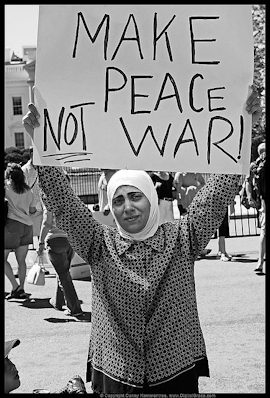
Make Peace. Photo: Danny Hammontree, flickr

What if they gave a war and nobody came?” is a popular slogan from the antiwar-movement. But nowadays, when USA with their allies go to war in Iraq and Afghanistan, people do come. Lots of people enlist in the military, even voluntarily, especially in the U.S. Why?

Anthropologist Sarah Salameh answers this question in her master’s thesis Courtesy Of The Red, White And Blue. A Midwest American Perspective on Troops, War and Nation.

She’s been on a six months’ fieldwork in a small town in the upper Midwest, a rather conservative and patriotic area that struggles with deindustrialization, low wages and unemployment. Salameh – an opponent of the U.S wars in Afghanistan and Iraq – describes the six months “as the most interesting and mind blowing time of my life.”

And it is indeed an interesting and well written thesis about “one of the most understudied groups”: white middle-class Americans.

She introduces us to a diverse group of military people:

The many settings the reader is introduced to includes an Army recruiting office, a public elementary school, Memorial Day celebrations, the motorcycle group the Patriot Guard Riders‟ missions, and the celebration of a National Guard unit returning home from Iraq. One gets to know people ranging from Army recruiters to the girls they helped enlisting at the age of 17, the concerned mother of a soldier, and a bunch of rather unconcerned 5th graders performing their patriotic duty decorating their town‟s cemetery with Star Spangled Banners.

One of her findings is the critical distance many soldiers have towards the government.

While in uniform, the anthropologist writes, soldiers are not allowed to speak negatively about the President. But in reality, as Robert, one of the soldiers, told her “The troops fight for the people, the American people, not the government. Neither the troops nor the people like the government.”

The official reason for waging a war is not always relevant for the soldiers. Looking at peoples‟ motives for joining the military, Salameh writes, “underlines the irrelevance of government and politics”.

Not one person she’s talked to (around 100) claimed to have joined the military because he or she thinks that this or that exact war is especially just or necessary as it is explained by politicians.

Robert is one of them. He did not believe the official explanation of the Iraq war (weapons of mass destructions). At times, Robert claimed the Iraq war is a quest for oil.

But he doesn’t care:

I am going for other reasons than oil. When I was in Iraq, I built schools, and handed out backpacks and paper to school children. I fixed dams so the people could have electricity. I spent two years totally committed to doing stuff like that.


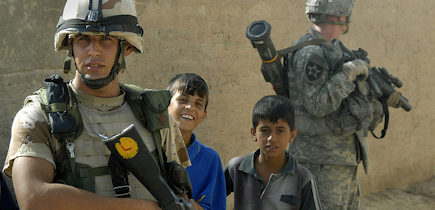
U.S. Army Soldiers in Iraq. Photo: Scott Taylor, U.S.Army, flickr

The research subjects explained and mostly legitimized the US military presence and their own participation, with a reference to themselves as Americans.

Robert places American politicians outside these “American people. He places himself, as a service member, on the side of and fighting for, the American people, not the government.

The anthropologist explains:

People and troops, the government and the people make up two societies that act according to two different value systems; the politicians according to a rather crooked one, initiating wars on unjust premises and ignoring the will of the American people; the American people according to what might perhaps be termed a more American one, expressed in Robert‟s account as focused on a wish to keep his own family and other Americans safe and free, and help Iraqis towards a better life.

Help Iraqis towards a better life? That’s in the eyes of the soldiers their responsibility as Americans. The USA is in their view a positive example for other countries, an example to follow. It seems to me they are on a kind of religious mission.

This religious dimension is interesting. Salameh discusses American nationalism as “civil religion”:

Much of the (…) USA and its military, can be understood within the context of civil religion, wherein the nation is the focus of belief, and its endeavours overseas is the spreading (missionary function) of the values inherent in the „national belief‟.

One of the dogmas of this “civil religion” is the idea that God has a special concern for America, putting Americans in the role of the chosen people, and America in the role of the promised land:

This is connected to the story of the American foundation, taking the form of myth, where today‟s American‟s ancestors came to this promised land and made a covenant with it, still binding today‟s Americans. The covenant has two aspects: to maintain the concept of promised land, basically to keep the USA free, as underlined by for example Robert, as well as to „export by example‟ the American version of freedom.

Indianapolis War Memorial Shrine Room.
Photo: Carl Van Rooy, flickr

She also describes the flag as totem, and blood sacrifice as an American group taboo.

At Memorial Day sacrifice was a central theme. “What soldiers in the Army do is to give up their life for others‟ freedom”, an army recruiter explained.

Tony‟s 5th graders stood up, faced the flag on the left side of the blackboard, put their right hand on the left side of their chest and said the Pledge simultaneously with the principal‟s voice. Everybody knew the Pledge by heart and said it out loud: I pledge allegiance to the flag of the United States of America and to the republic for which it stands: one nation under God, indivisible, with liberty and justice for all.

But do people in Iraq and Afghanistan really want their help? What about the widespread opposition towards the US wars?

This question is not very relevant for the research subjects. Even if the the people the USA tries to help reject the help, the USA‟s efforts are legitimate.

“It is as if the people on the receiving side of, what by the Americans is presented as „help‟, are not in a position to judge whether what the US presence offers is good or bad”, Salameh comments.

This remembers of what Edward Said describes as orientalism.

People in the Orient have frequently been portrayed as more passionate, more violent and barbaric, as well as culturally determined. This „savaging‟ of the Orientals has justified European and American imperialism throughout history, often presented as a civilizing project.
(…)
And in the very same act as „the West‟ thus diagnoses other countries as less developed, „the West‟ also categorizes them as passive (they are weak, ill), thus allowing for a paternal role.

For the research subjects, there are “good others” and “bad others” in Iraq and Afghanistan:

There is the „good Other‟ who takes the form of some sort of deprived, but possible, allied and member of the „free world‟; in the accounts above termed „innocents‟, „civilians‟, „the people‟ (of Afghanistan and Iraq), or simply „Afghanis‟ and „Iraqis‟. Opposed to this, exists a „bad Other‟ that cannot possibly be helped, thus only fought. This bad Other carries many different names, among them „terrorists‟, „insurgents‟, „extremists‟, „radicals‟, and to a varying degree also the Iraqi and Afghani „leaders‟ and „government‟ are included.

Although nationalism is important, she stresses that she does not claim it is the only, or the most central factor. There are many individual factors (escaping from smalltown life etc). Economic incentives are often central when people decide to join the military in the first place, and “a thesis could have been written on economy as incentive alone””.

Sarah Salameh is currently turning the thesis into a book where she will include on all those other factors as well.

The whole thesis is available online. (LINK UPDATED 4.4.2020)

SEE ALSO:

Thesis: That’s why there is peace

Secret rituals: Folklorist studied the military as an occupational folk group

Embedded anthropology? Anthropologist studies Canadian soldiers in the field

War in Iraq: Why are anthropologists so silent?

Military anthropologist starts blogging about his experiences

More and more anthropologists are recruited to service military operations

Make Peace. Photo: Danny Hammontree, flickr "What if they gave a war and nobody came?" is a popular slogan from the antiwar-movement. But nowadays, when USA with their allies go to war in Iraq and Afghanistan, people do…

Read more

The Best of Neuroanthropology (etc)

One of the – in my view – most interesting anthropology blogs, Neuroanthropology, has recently celebrated post #1000 and made a list over their Top 100 Posts – based on page views (there is also a list with their personal favorites).

At the same time, the blog has moved to http://blogs.plos.org/neuroanthropology/. They are now part of the new Public Library of Science: PLoS Blogs, “a serious and powerful voice for open-access scholarship and education”. Neuroanthropology bloggers Daniel Lende and Greg Downey hope to “act as a voice for anthropology in a scholarly and public forum built around science and medicine”.

Neuroanthropology is one of the rather few outward looking anthropology blogs – writing both for fellow researchers and the interested public. There are many in-depth magazine style posts – and not only about neuroanthropology – often regarded as one of the most exciting research fields.

One of the most recent posts deals with the question: How does language affect thought and perception? while others discuss The Pitfalls and Pratfalls of Criminals or The dog-human connection in evolution or the Neuroanthropology of Morality.

Public Anthropology is a popular topic, see for example On Reaching a Broader Public or Glory Days – Anthropologists as Journalists or Student Websites and the Classroom: Anthropology Online.

A lot to explore and learn!

One of the - in my view - most interesting anthropology blogs, Neuroanthropology, has recently celebrated post #1000 and made a list over their Top 100 Posts - based on page views (there is also a list with their personal…

Read more

“Globalisierung macht Hirtenkultur cool”

“Warum begeistern sich junge Städter neuerdings fürs Schwingen, für das Kräftemessen einer alte Hirtenkultur vom Land?” Dieser Frage nehmen sich mehrere Schweizer Zeitungen an.

In einem Interview mit a-z.ch bringt Walter Leimgruber, Professor am Seminar für Kulturwissenschaften und Europäische Ethnologie an der Universität Basel, den Schwing-Boom in Zusammenhang mit der Globalisierung:

Die Globalisierung hat uns mit kulturellen Formen und Traditionen der ganzen Welt vertraut gemacht. Wir können indianischen Zeremonien beiwohnen, asiatischen Kampfsportarten und der Musik der Südseebewohner. Das weckt auch die Neugier auf das, was es hierzulande gibt.

Zudem ist seit einigen Jahren “Swissness” angesagt. Es ist wieder cool, das Schweizerwappen zu tragen, sich mit Insignien des Schweizerischen zu schmücken. Nennen wir das Patriotismus light oder die Konsumvariante der Heimatliebe.

>> weiter bei a-z.ch

Schwingen; Oberländisches Schwingfest 2010 in Brienz-Hofstetten

Einen sehr interessanten Aufsatz zum Thema hat Christoph Fellmann im Tagesanzeiger geschrieben.

Er stellt die verbreitete Auffassung in Frage, der Boom der Volkskultur sei eine Reaktion auf “zu viel” Globalisierung. Es gehe nicht um das eine oder das andere:

Vielmehr haben die Menschen heute die Fähigkeit, das Unterschiedlichste locker miteinander zu verbinden. Gestern an die Street-Parade, heute ans Schwingfest.

Jedoch “erst als zeitgemässes Update konnte die alte Hirten- in die neue Eventkultur eingehen”.

Sie musste sich vom Muff befreien, das Volksmusiksendungen anhaftete. Diese vonpolitische Rechtsaussen Wysel Gyr im Fernsehen moderierte Sendungen hätten nämlich dazu “beigetragen, dass die Mehrheit bald lieber zu irischen Reels oder brasilianischem Salsa schwofte als zur uperisierten Ländlermusik”.

>> weiter im Tagesanzeiger

Schwingen ist auch bei Frauen beliebter geworden, vor allem als Publikum, erfahren wir. Doch es gibt auch einen Frauen-Schwingverband. Und zwar schon seit 1992. Viele der 80 Schwingerinnen kommen aus Schwingerfamilien.

SIEHE AUCH:

Neue Arbeit im Volltext: Mundartrap zwischen Lokalpatriotismus und Globalisierung

Volksmusik = Stadtmusik

Die missverstandende kulturelle Globalisierung

Ethnologe: “Deutscher WM-Patriotismus positiv”

Ainu in Japan: Cool to be indigenous

Headhunting as expression of indigenousness

"Warum begeistern sich junge Städter neuerdings fürs Schwingen, für das Kräftemessen einer alte Hirtenkultur vom Land?" Dieser Frage nehmen sich mehrere Schweizer Zeitungen an.

In einem Interview mit a-z.ch bringt Walter Leimgruber, Professor am Seminar für Kulturwissenschaften und Europäische…

Read more

“Rasenmähen am Sonntag = Kulturverlust”

“Rasenmähen am Sonntag halte ich für einen Ausdruck gewaltigen Kulturverlusts.“ Diese Aussage stammt nicht von einem konservativen Priester (oder Imam hätte ich beinahe geschrieben), sondern von einem Ethnologieprofessor – Werner Mezger von der Uni Freiburg im Breisgau.

Der Anlass: Der Südkurier diskutiert “den siebten Tag der Woche. Obwohl die Gesellschaft liberaler geworden ist, gelte immer noch das von der Bibel inspirierte Gebot der Sonntagsruhe.

“Man hängt vielleicht nicht gerade die Bettwäsche in den Garten – aber die kleine Wäsche auf dem Balkon stört niemanden mehr”, so das Blatt.

Selber bin ich sehr erstaunt darüber, dass die Tradition der Sonntagsruhe immer noch so lebendig ist, ich vermute mehr auf dem Land als in der Stadt, im Süden mehr als im Norden?

Der Artikel ist jedenfalls interessant und relevant für Diskussion über Religion und Kultur in Deutschland, die sich leider zu sehr über den Islam dreht.

Im Kommentarfeld erinnert “pezzi” an etwas Wichtiges: “Dass es am SOnntag vielen Menschen gut gehen kann, mit Müssiggang und süssem Nichtstun haben sie einer Handvoll schwer Arbeitender zu verdanken.”

>> weiter im Südkurier

SIEHE AUCH:

Ein Ethnologe aus Pakistan bei den Deutschen in Sauberteich

“Kuriose Osterbräuche in Bayern”

Selbstkreuzigung unter Christen: Wenn Religion zum “Theater” wird

“Ritualboom in Deutschland”

Deutschlandforschung: Wofür sich “ausländische” Ethnologen interessieren

"Rasenmähen am Sonntag halte ich für einen Ausdruck gewaltigen Kulturverlusts.“ Diese Aussage stammt nicht von einem konservativen Priester (oder Imam hätte ich beinahe geschrieben), sondern von einem Ethnologieprofessor - Werner Mezger von der Uni Freiburg im Breisgau.

Der Anlass: Der Südkurier…

Read more