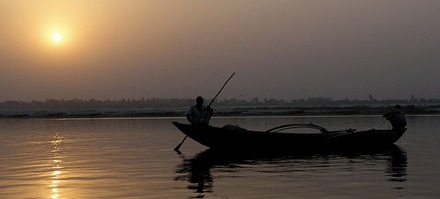
Caste, Occupation and Politics on the Ganges is the title of a new book by anthropologist Assa Doron that Tereza Kuldova reviews here for antropologi.info. It is a book about the life of a marginalized group of people in India – the boatmen at the river Ganges in Banaras (also called Varanasi).
The pictures are taken by juicyrai (1,2), flickmor, omblod and Alex Craig.
Doron, Assa. (2008). Caste, Occupation and Politics on the Ganges: Passages of Resistance. Ashgate 198 pages. ISBN 978-0-7546-7550-1. Price £55.00.
Review by Tereza Kuldova
This anthropological study takes us straight into the everyday world of the boatmen at the river Ganges, in Banaras. It pictures their lives, narratives and practices and it contextualizes these within a wider historical perspective and social forces which have impact on their daily lives.
It is a study of a group of people disadvantaged and marginalized in both traditional and modern terms. It is a study of power and resistance in its everyday forms. It provides both a historical account of the evolution of the caste of boatmen during the colonial and post-colonial times and a discussion of the current position of this community, which faces the social and economic changes in the modern India as well as the impact of globalization. It shows how the boatmen, even though a low-status and under-privileged group, manage to challenge and contest the upper-caste and state domination. The book is first and foremost a thorough discussion of the processes of domination, subordination and resistance.
This book is intended primarily for anthropologists, historians and other social scientists or any student interested in the contemporary India, the topics of religion, everyday politics and globalization. Because of its historical and analytical rather than literary approach to the subject it is particularly interesting for the professionals, but I believe, less so for occasional readers of ethnographic accounts.
The first chapter, The Criminal Type: Domesticating the Ganges Boatmen, deals with the encounter between the boatmen and the colonial state and the classification of the Mallah (boatmen) caste by the British. It provides us with a historical account of how this occupational caste became classified and relegated into a criminal caste category and thus gained a reputation of thieves and gangsters and how the colonial rule imposed restrictions on the occupation and movement of the boatmen in Benares, which resemble to a great degree the limitations imposed by the modern Indian state.
But Assa Doron does not present the boatmen as incapable victims of this imposed classification in which “one was recognized by the bureaucratic administration of the state only as a number and part of an aggregate caste group” and where “individual capabilities were measured through one`s extended ‘body’: caste” (p. 36). On the contrary, he explores also the ways in which boatmen tried to manipulate these classifications and thus resist the domination. One of such ways was for example the idea to improve their status by claiming a different name, the name Nishada. “This name had positive connotations for the group as it placed the caste among an honorable people who, according to the epic Ramayana, devotedly served and protected the godking Rama during his tribulations in exile” (p. 37).
This is just one among the many strategies boatmen employed to resist the dominant classification. But, “nevertheless, claims for higher status were not always effective. The Mallah`s criminal reputation with its exotic, unlawful and immoral behavior (…) formed the basis of colonial census classification” and “being categorized as low caste often meant exclusion from recruitment to military service, the police force or administrative jobs” (p.37).
The second chapter, ‘Step-sons of the State’: Marginalization and the Struggle for Recognition, is devoted to the discussion of the influence of the state policies and particularly the development scheme known as Ganga Action Plan on the Mallah community. This development scheme imposed restrictions on the on sand mining, fishing and cultivation of the land on the riverbeds, which were all traditional occupations and part of the traditional rights of the Mallah caste. “The result is that the occupational diversity of boatmen working on the riverscape has been reduced to that of ferrying passengers” (p. 72). This led not only to the further development of the ‘marginalized boatmen identity’ identified with poverty, oppression and exclusion, but also to the establishment of caste community associations, which try at the same time to resist the state domination and collaborate with the state.
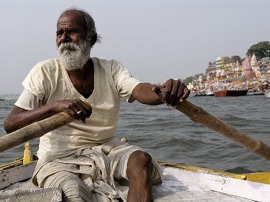
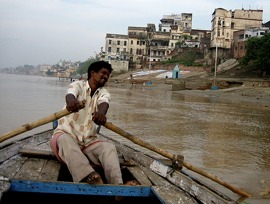
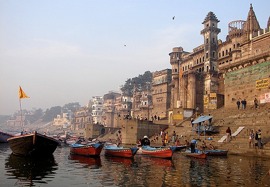
Using the dominant rhetoric and the politics of positive discrimination, the caste organizations actually try to subvert and resist the state domination by engaging in open political action and articulating their objections to the governmental policies.
The boatmen claim that “Ganga has been exploited by corrupt politicians, local officials and powerful Brahmins who siphon (‘eat’) money on the pretext of cleaning the river. In the process, it is the poor, ordinary citizens who suffer, through loss of customary rights, police harassment and caste prejudice” (p.77).
The relationship between boatmen and the state is thus ambivalent and filled with tension. On one side there is a need to cooperate and to negotiate; on the other there is a need to resist.
But what we clearly see from Assa Doron`s account is that “the way in which boatmen express their plight and act to fend off state domination, demonstrated that they understand and are well aware of the inner workings of liberal democracy, including ideas of citizenship, public accountability, rational legal authority and democratic rule” (p. 79).
The third chapter, The Moral Economy of Boating: Territorial Clashes and Internal Struggle, takes into spotlight the sophisticated socio-economic system which organizes the everyday work of the boatmen and can be said to work as a ‘moral economy’, in that it regulates the space, mitigates the conflict and provides “an economic safety net for the boatmen” and prevents “the modern state, local actors and commercial entrepreneurs from infringing on their livelihood” (p. 18).
The work system stands for rules the differentiately positioned boatmen must respect, these rules direct their work, divide the space on the riverfront within which the particular boatmen can operate and direct the mutual relations between the boatmen. Though numerous tensions exist within the boatmen community, the work system still provides measures to ensure subsistence for all the members of the community.
In this respect the notion of haq (right/property) is particularly interesting; “there is a moral expectation that they /the ghatwars – the wealthier members of the boatmen community/ let other members of the community have their share of the earnings derived from the river economy” (p. 111). At the same time the wealthier members are dependent on the support of the poorer members of the community in the matters of political action. But though this system of mutual obligations and reciprocity, this ‘moral economy’ is still important in the daily lives of the boatmen, it is at the same time challenged by the social and economic changes – be it for example the changing nature of the tourist industry, or the introduction of motorboats – which are all transforming the nature of the relationships between the boatmen and even lead to the fact that the boatmen tend to take up different types of unskilled jobs elsewhere, reducing thus the dependency on the river economy. But as already pointed out, “the work system remains an important ideological and economic institution for ensuring stability and security of the community” (p. 114).
The fourth chapter, River Crossings: Boatmen, Priests and the Ritual Economy of Banaras, focuses on the role of boatmen as ritual specialists within the ritual economy of Banaras and on their relationship with the river Ganga. Assa Doron concentrates here on how the boatmen invoke their caste identity, myth and other cultural symbols to contest the Brahmanical authority and to assert their rights to conduct rituals and maintain a certain control over ritual spaces around the Ganga.
The ritual serves here for the boatmen as a way of gaining respect and recognition for their role and work on the riverscape. They argue that they are granted the role as ritual specialists by the virtue of their caste and occupation. “By firmly establishing their position as ritual specialists on the riverscape, the boatmen register their claim over physical space that is valuable beyond the ritual context” (p. 124).
These claims and the identity of the boatmen are related to the story of the boatman Khevat from Ramayana, in which Khevat ferries lord Rama, Sita and Lakshmana across the river, at the end of trip Sita wants to pay the boatman a fee, with the only thing she has, her ring, but the Khevat rejects it saying to Rama: “we are of the same profession, you carry people across the river of life (samsara) to the far shore of liberation (moksha) and I carry people from this bank of the river to the other side. (…) Rama you are also a boatman (tum bhi Khevat), how can I charge you?” (p. 127). This encounter of Khevat with the lord Rama is perceived as a transformative event for the boatmen collective identity; this encounter is an evidence of the dignified roots and esteemed position of all boatmen within the Hindu social order.
The “boatmen creatively appropriate the myth to denote their dignified existence and elevate themselves in the caste hierarchy, inflecting it with their own aspirations, which eulogize the community and its morality” (p. 130). The myth thus serves as a justification to conduct particular rituals in the riverscape, which at the same time interrupt the priestly authority. “They may contest Brahmanical order and authority, yet at the same time imitate it and draw their strategic positioning from it” (p. 137). But “it is important to emphasize (…) that while such actions clearly subvert priestly authority, Banaras` ritual economy is still very much organized around the governing principles and values associated with orthodox religion” (p. 138).
The fifth chapter, The Romance of Banaras: Boatmen, Pilgrims and Tourists, discusses the asymmetrical powers relation between the boatmen and the pilgrims and tourists. Assa Doron focuses here particularly on how the boatmen deploy strategies to control and influence the pilgrims and tourists at the riverfront and on how the boatmen appropriate, manipulate and take advantage of the tourist discourse emerging in the First World and how they thus further their social and economic interests.
To illustrate this let us have a look at an example of such practice in relation between boatmen and pilgrims, “a practice where the subordinate (in the extreme case, beggars) bless and praise ‘their (potential) benefactors’ trapping them in ‘the cultural implication of their roles as superiors, that is, in the obligation to be generous’. It is important to note, however, that for the boatmen a position of subordination is assumed strategically. In their capacity as culture brokers boatmen also assume a position of authority when guiding pilgrims, selectively informing them about the city” (p. 147).
But not only do the boatmen get use of the traditional language, they also use the modern tourist discourse in their daily activities. Banaras as a tourist place is subject to commoditization whereby the tourists consume the local culture, which is – among others – mediated by the boatmen, who deploy this dominant tourist discourse. This discourse “emanating from Western countries, serves to produce a series of Orientalist tropes, largely produced and disseminated by the travel industry and media as well as travel talk” (p. 141). The boatmen thus help to reproduce the Orientalist India, which the foreign tourists search for, giving them what they want.
Though the book is in all convincing in its description of the everyday life of the boatmen community and its relations with the state and the dominant Brahmins, it has according to my opinion also several weaknesses.
Firstly, the discussion of the actual methodology of the research is almost completely missing. We get no clear idea about how the author went actually about gathering the data and what do the data consist of. And also throughout the book, we get almost no access to first-hand data – concrete cases are almost missing (with the exception of several cases in chapter 3 and 5). The book thus provides us with very descriptive and abstracted statements about what ‘boatmen think, do, feel’, but we rarely hear the actual voice of the boatmen, concrete illustration of their conduct or are presented with actual cases which would support the descriptive and analytical language of the author.
Secondly, the author is not really present in the book in any reflexive sense. The reflection on one`s own positioning is not elaborated in any detail. We for example get to know that the author had a Brahmin research assistant, but this fact is not commented upon any further. We thus do not get to know how this crucial relationship could have influenced or affected the data gathered, or for what kind of work the research assistant was used; what was the nature of his relationship with the boatmen, and how his being Brahmin could have affected the data, etc. But this is a general problem which I experienced reading this book – the lack of the discussion of the concrete interactional data.
Thirdly, the author is obviously influenced by the subaltern studies and at the same tries to get beyond their explanations, but he only suggests the direction of his approach. Therefore I believe that the theoretical discussion presented in the Introduction could have been more exhaustive. Towards the end of the study one tends to get an idea that the boatmen, constantly labeled as subaltern, marginalized and oppressed, are continually trying to resist the oppression of either the state, represented most often by the local police and administration or of the traditional authorities, represented by the Brahmins. And that is what they basically do in their everyday lives, that their lives basically consist of resistance itself or are resistance. Every single action of theirs tends to be viewed in the perspective of resistance. So for example fishing in the night (which is actually prohibited, so it cannot be done during the day), is perceived as a convert form of resistance against the state authorities. It may be – too, but not only.
And fourthly, though the author notes that he did not have any contact with the police or the local Brahmins, because of his close relationship with the boatmen, which may be understandable, the fact that we thus never get to know the same story as told from the perspective of those labeled as “dominant”, is certainly disappointing, particularly when the author tends to discuss the ‘inter-relationships’ and ‘mutual relationships’ between the boatmen and Brahmins and local representatives of the state.
This being said, there is still no doubt that the book is extremely valuable in its account of the lifeworld of the boatmen community in Banaras, which is first of its kind. I definitely recommend it to all interested.
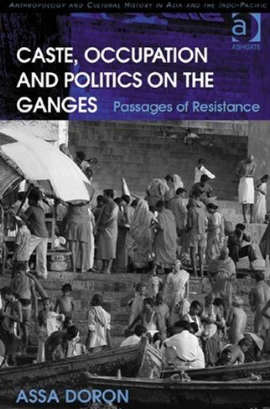
For more information about the book, see the presentation by Ashgate, where also the introduction can be downloaded (pdf)
Caste, Occupation and Politics on the Ganges is the title of a new book by anthropologist Assa Doron that Tereza Kuldova reviews here for antropologi.info. It is a book about the life of a marginalized group of people in India…