search expand

Financial crisis: Anthropologists lead mass demonstration against G20 summit

(Update: Chris Knight suspended over G20-activism) The G20 summit in London next month may be marked by one of the biggest demonstrations since a million people marched against war in Iraq in 2003. According to The Sunday Telegraph, the demonstrations are being organised by anthropologists Camilla Power and Chris Knight.

Under the slogan “Storm the Banks”, the two members of The Radical Anthropology Group are urging the public to vent its anger on the financiers and bank executives many blame for the global economic crisis. They think it is necessary to question or even overthrow capitalism – a taboo topic for the ruling elites.

Very interesting: The Telegraph writes that the two anthropologists work at the University of East London, which is based close to the headquarters of some of the world’s biggest banks. The University is “proud of its links with the City of London and multinational companies based in London”.

The paper quotes the university’ website who “boasts“:

“We are committed to do all we can to ensure that our expertise is made available to benefit business and society. Utilising the wealth of expertise, research capabilities and facilities at UEL our solutions help companies to become more profitable, more competitive and more sustainable.”

(Or take a look at the frontpage of the university and study the language: Is this a university or a oil company or even a bank??)

Anyway, Camilla Power thinks her role in organising the protests does not conflict with her position at UEL and says:

“What our university management thinks is good for students and academics does not always accord with what students and academics think is good for them.”

But maybe they don’t disagree at all? A spokeswoman for UEL said (diplomatically?):

“The University of east London includes a range of academic disciplines and individual academics who advocate a range of viewpoints. We are proud of our diversity, which fosters a spirit of critical inquiry, and we support freedom of debate. We are also proud of our active partnerships with business.”

As often the case when people take to the streets, the media are mostly interested in writing about violence and “the worst public disorder for a decade“. . Up to 3,000 police officers will be on the streets. Armed undercover officers will mingle in the crowds while police snipers will be stationed on rooftops.

>> read the whole story in The Sunday Telegraph

>> Protest website G20 Meltdown

SEE ALSO:

How anthropologists should react to the financial crisis

Anthropologist Explores Wall Street Culture

After the Tsunami: Maybe we’re not all just walking replicas of Homo Economicus

The Internet Gift Culture

“Anthropology needs to engage in an activist way”

(Update: Chris Knight suspended over G20-activism) The G20 summit in London next month may be marked by one of the biggest demonstrations since a million people marched against war in Iraq in 2003. According to The Sunday Telegraph, the demonstrations…

Read more

Her kan du studere "Norges adel"

(Lenker oppdatert 8.8.2020)Finanstoppene hevdet seg i birkebeinerrennet“, melder E24.no. Birkebeinerrennet ser ut til å være et godt sted for å studere den norske eliten.

“Velbeslåtte menn fra vestkanten er grovt overrepresentert” på Norges mest tradisjonsrike turrenn på ski fra Rena til Lillehammer, leser jeg i Klassekampen (kun på papir).

På “Birken” finner en “det nærmeste vi kommer en adel på norsk”, sier historiker Tor Bomann-Larsen til Klassekampen. Birkebeinermerket er dessuten “den beste attest du kan legge fram ved en ansettelsessøknad”:

– Birkebeinermerket vitner om at du har det rette verdigrunnlaget. Skisporten forener individualisme og sansen for natur og nasjonale verdier. Den symboliserer den ensomme vandrer i naturen, selv om dette ikke akkurat preger Birkebeinerløpet. Det er ikke tilfeldig at skøyter og ishockey står mye sterkere på østkanten og i arbeiderklassen.

– En kommer ikke til topps i det norske samfunnet uten å vite forskjell på plog og fiskebein. Bare se på de fullblods skiløperne Støre og Stoltenberg. Nikkersadelen er det nærmeste vi kommer en adel på norsk. De store skogeierne og næringslivslederne utgjorde en stor del av stammen i skiidrettens tidlige historie, og advokater og offiserer sto i fremste rekke.

Dette er miljøer med ekstremt konkurranseinnstilte mennesker, og skiløping passer dem perfekt, sier Bjørn Olav Nordahl, som før han tok sluttpakke i Dagens Næringsliv gikk treningstur med ei gruppe næringslivsfolk som kaller seg Overtoppen:

Mange herrer i det private næringslivet legger ekstremt mye i skitrening og renn. De leier inn toppfolk for å lære mer om teknikk og smøring, og sparer ikke på noe når det gjelder utstyret.
(…)
Disse gutta sokner for en stor del til Heming og Lyn, og de kom ikke sist til matfatet. Det blir en kostbar hobby for dem som skal ha høyeste kvalitet av alt. Før renn går det i sliping og struktur, rillejern og pulver. En boks cera for å få optimal gli koster fort en tusenlapp. Dette er glidemiddel for voksne mannfolk.

Tradisjonelt er det den økonomiske overklassen som har drevet friluftsliv, minner idrettssosiologen Arve Hjelseth på. Og det er noe som slår meg hver gang jeg er på fjellet og overnatter i en av DNTs hytter.

Mer om adelen på ski skriver Dagens Næringsliv i Derfor går vi Birken

SE OGSÅ:

– Lite forskning på elitene

Nyrike er annerledes

Skal ta mastergrad i luksus

“Kulturell overlegenhetsfølelse”: Antropolog forklarer fyllebråket i Hemsedal

Thomas Hylland Eriksen: Myten om påske-fjellet

(Lenker oppdatert 8.8.2020) "Finanstoppene hevdet seg i birkebeinerrennet", melder E24.no. Birkebeinerrennet ser ut til å være et godt sted for å studere den norske eliten.

"Velbeslåtte menn fra vestkanten er grovt overrepresentert" på Norges mest tradisjonsrike turrenn på ski fra…

Read more

Imponderabilia – new international anthropology student journal

screenshot

Wow! A new anthropology journal! Made by students worldwide. Imponderabilia is it called, and it is “the product of our love of, and frustration with, anthropology”:

The journal tries to overcome, erode, undermine and blur the boundaries between institutions and disciplines, between theory and practice and between undergraduates and postgraduates. We envision a space where students can share their research and exchange their views, criticisms and reflections on anthropology through articles, interviews, photography and other creative methods.

Imponderabilia draws on the thoughts and insights of students from universities across the world; it represents a genuine dialogue between authors, editors and peer reviewers many of whom have been in contact during the process of planning, writing, and rewriting. Authorship therefore transcends university degrees and field sites and we hope the journal can develop into a platform for the sharing of our common, yet unique experiences of studying and ‘doing’ anthropology.

The first issue (spring 2009) consists of several dozens articles – there are interviews about visual and activist anthropology, text about activists and police at a Climate Camp, the significance of gossip, learning and teaching anthropology, and much more including poetry.

And the journal, based in Cambridge University (UK), exists both in a pdf version (even print?) and an “extended online version” – open access for all of us.

Imponderabilia, by the way means “a series of phenomena of great importance which cannot possibly be recorded by questioning or computing documents, but have to be observed in their full actuality” ( Malinowski 1922)

>> visit Imponderabilia (updated Link with copy from Internet Archive, journal closed down)

On their website I found two other student journals I haven’t mentioned before (local ones though): Abantu (University of Cape Town, South Africa) and Problematics (Stanford University, USA)

screenshot

Wow! A new anthropology journal! Made by students worldwide. Imponderabilia is it called, and it is "the product of our love of, and frustration with, anthropology":
The journal tries to overcome, erode, undermine and blur the boundaries between institutions and disciplines,…

Read more

Book Review: How Indissoluble is Hindu Marriage?

Divorce does not belong to Hindu tradition, anthropologist Livia Holden was told when she started her research in India 14 years ago. But is this true? Tereza Kuldova reviews for antropologi.info Holden’s new book Hindu Divorce. A Legal Anthropology.

Anthropologist Livia Holden has been on 16 months of fieldwork over the course of 12 years in a village in Madhya Pradesh, India. With the help of the case studies of several women she challenges popular belief and earlier anthropological studies.

Here is the review:

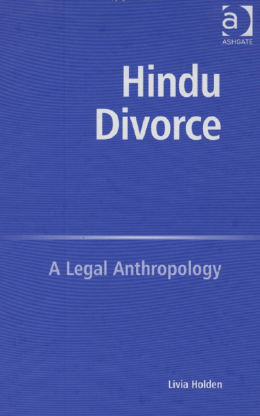
cover

Review: Holden, Livia. 2008. Hindu Divorce: A Legal Anthropology. Ashgate.

Tereza Kuldova

Livia Holden’s book Hindu Divorce presents an invaluable and to a certain degree also provocative re-examination of the praxis and legal status of Hindu divorce and remarriage, both in its past and present manifestations. Being an anthropologist, Livia Holden has the necessary first-hand experience with the actual practices of Hindu divorce and remarriage, at the same time as she connects these with the greater framework of the official law at the national level and even traces the implications of her findings transnationally.

Her examination of the divorce practices and remarriage is based on 16 months of fieldwork over the course of 12 years in a village in Madhya Pradesh, India. Over these years she had the opportunity to follow her informants, their stories and to develop deep relationships.

With the help of the case studies of several women (p. 69-124), which she has gathered over this period, she proves that contrary to the popular discourse in which Hindu marriage is considered indissoluble, and even contrary to the most legal and even anthropological studies, it is possible to find textual, historical and even contemporary evidence of customary provisions for divorce and remarriage.

The mainstream view of the Brahmans and other upper-caste Hindus, as it is codified in the Laws of Manu and other classical texts, which claims that marriage – solemnized according to the sacred rites prescribed by the ancient religious texts – is indissoluble, is contested on the basis of the customary law and practice.

It is also this view which served the British when developing the Anglo-Hindu personal law, as they gave priority to the religious texts and naturally also to the upper-caste views on law (p. 14). This codification led to even greater general consolidation of this idea, which is again what is reflected in most of the anthropological and law treatises.

In 1955 the Hindu Marriage Act was passed. This act guaranteed divorce for all Hindus and has saved customary practices of divorce. The emphasis on customary law and practices is important here, because, as Livia Holden points out, it would be a misconception to believe that most Hindu divorces take place through the juridical process in the civil courts, it is rather the customary law which prevails.

In addition “the inclusion of custom in the realm of the legal has the unique advantage of overcoming the fictional opposition between normative and non-normative behaviors, or between official and alternative normative orders that fix society within the limits of a privileged and totalizing cultural system” (p. 11). And it thus corresponds more to what her empirical data clearly show, i.e. that these customary provisions for divorce and remarriage function even among Brahmans and other high-caste Hindus, even though they are commonly perceived as practices of the lower castes.

She claims firmly that “dissolution of marriage did not only exist from ancient times; it was available to women and it was also widespread among the Hindu upper caste” (p. 5).

Being inspired by the feminist anthropology she also provides throughout her book an account of “how the mainstream Hindu discourse of gender imbalance shapes the legal discourse of law and how, in turn, the official legal discourse shapes Hindu society” (p. 19). Relating her empirical observations to the law discourse and theories on gender, she shows that customary law may actually provide more scope than the statutory personal law for the woman to negotiate successfully the conditions of her existence. She provides an analysis of the problem whether and if so how does the Hindu divorce and remarriage constitute a certain way out for women in the situations of matrimonial crisis.

In this context she presents several of her cases in which she also discusses such topics as arranged and child marriage, dowry, bigamy, domestic violence and interestingly also manipulations of custom and of official law. She further discusses the treatment of the Hindu divorce in the framework of national official law and its various relationships to the customary law and discusses the effects of the official law for the women.

She concludes that:

“in specific circumstances Hindu women can successfully negotiate the end of an unsuitable matrimonial tie and remarry to secure better lives for themselves and their children; but for an understanding of peculiar techniques, which are part of the women’s legal awareness, it is necessary to see beyond positive law, to where the non-state law can inform or even substitute for state-law a perspective of legal pluralism that is something more than plurality of law” (p.218).

This book is no doubt a great contribution both for anthropology and for the study of law in India. Connecting the different levels of analysis it provides a coherent picture of the state of affairs. The possible direction of future research in this area might lie in the focus on the Hindu divorce and remarriage in the urban areas, especially among middle classes.

As my own fieldwork experience suggests, divorce and remarriage among Hindus in villages, even among higher-caste Hindus was generally possible, precisely on the basis of the customary law as pointed out above. But in the urban areas on the other hand the higher-castes acted more conservatively and generally restricted women who left their husbands to remarry, and even women themselves felt that it would be inappropriate. Investigating these processes which go hand in hand with modernity and which to a certain degree can be considered as the products of modernity, might thus be a fruitful scenario fur further research.

But except for the undoubtedly remarkable contribution of rethinking of the Hindu divorce and remarriage in various areas, the book is also striking in its degree of self-reflexivity. The chapter 2 (p. 27-68) is devoted to the discussion of the theoretical and methodological insights and reflection over these. It is very instructive in its open discussion of the changing role of the anthropologist and her positioning in the field.

Livia Holden goes on to discuss such topics as what challenges doing research together with a husband brings and what possibilities it on the other hand also opens, or how she was perceived in the first period when she was childless and how the relationships changed and evolved when she came next time with a baby and how this changed situation opened up different arenas for her research. She reflects also on doing research in a village which was already previously studied by her professor J. L. Chambard and the negotiation of the relationships with the villagers on this subject. She reflects on her status as a woman who is concerned generally with mens matters, as she becomes a kind of honorary male, which allows her cross-gender behavior. She also discusses her ideas on authorship and the collaborative nature of her research.

Methodologically this book is also interesting as it combines different resources, even integrating the method of filming. The resulting ethnographic film from 2001 is called Runaway Wives and it was done in co-production with her husband Marius Holden who also wrote a chapter in this book (p. 60-8) that discusses and reflects the process of filming and the theoretical problems of visual anthropology.

This extensive self-reflection incorporated throughout the whole book makes it instructive and an interesting reading for every anthropology student and anthropologist. In addition the multidisciplinary approach to the research which draws from feminist and legal studies and social sciences will be of interest to any student or scholar of law, sociology and anthropology.


>> Information on the book by the publisher (Ashgate)

>> information on Tereza Kuldova (both anthropologist and artist)

SEE ALSO:

Thesis: How Indian women fight the stigma of divorce

Unmarried Women in Arab Countries: Status No Longer Dependent upon the Husband

China: Where women rule the world and don’t marry

On African Island: Only women are allowed to propose marriage

cover

Divorce does not belong to Hindu tradition, anthropologist Livia Holden was told when she started her research in India 14 years ago. But is this true? Tereza Kuldova reviews for antropologi.info Holden’s new book Hindu Divorce. A Legal Anthropology.

Anthropologist…

Read more

Werner Schiffauer: Wie gefährlich sind “Parallelgesellschaften”?

cover

Wie viel Zusammenhalt braucht eine Gesellschaft? Wie viel Segregation (v)erträgt sie? Bereits im letztem Jahr ist Werner Schiffauers Buch “Parallelgesellschaften” herausgekommen. Erst jetzt wurde es in einer Zeitung, dem Standard, besprochen.

In diesem Buch zeigt der Ethnologe dass das Beharren auf die Notwendigkeit gemeinsamer Werte das Zusammenleben mit Menschen aus anderen Ländern erschwert. Er weist nach, dass gesellschaftliche Solidarität auch entstehen kann, wenn es grosse kulturelle Unterschiede innerhalb einer Gesellschaft gibt. Notwendig ist ein Klima, das kulturellen Austausch fördert.

Die Besprechung im Standard ist allerdings allzu kurz. Bessere Arbeit hat Süleyman Gögercin auf socialnet.de geleistet. Der Pädagogik-Professor aus Villingen-Schwenningen geht das Buch Kapitel für Kapitel durch und stellt auch die drei Fallstudien, auf denen das Buch basiert, vor. “Ein Ehrdelikt – Zum Wertewandel bei türkischen Einwanderern”, “Die islamischen Gemeinden in der »Parallelgesellschaft«”, und “Großstädtische Identifikationen”.

Gögercin zufolge räumt Schiffauer mit vielen gängigen Vorstellungen auf, z.B. dass islamische Gemeinden Integration verhindern. Schiffauer zeigt auch, dass man sich nicht deutsch fühlen muss, um integriert zu sein. Auch wenn sich gewisse Nachkommen von Einwandern (“2. und 3. Generation der Migranten” – sind ja eigentlich keine Migranten) nur wenig mit Deutschland identifizieren, so bejahen sie die Stadt, in der sie leben. Sie identifizieren sich mehr mit der Stadt als mit der Nation. “Ich bin ein Berliner”, sagen sie stolz.

So abgeschlossen und “modernisierungsresistent” wie es mange glauben, seien Stadtteile mit hohem Migrantenanteil nicht. Es herrscht eine grosse Vielfalt, und “Parallelgesellschaften” stellten sie nicht dar.

Eine kulturell integrierte Gesellschaft, so Schiffauer, zeichnet sich nicht dadurch aus, dass alle Einwohner sich zu den gleichen Werten bekennen. Wichtiger sei, “dass es fließende Übergänge, Überkreuzungen und Überschneidungen”, also eine kulturelle Vernetzung, gäbe. Deshalb brauchen wir “eine kluge Politik der Differenz”.

“Eine Politik, der an gesellschaftlichem Zusammenhalt liegt, wird einen offenen Austausch mit allen Gruppierungen anstreben, die innerhalb der Gesetzesordnung agieren und sie darüber kommunikativ einbinden.” (S. 123) Diese “Politik der Einbindung nutzt das Potenzial von pluralen kulturellen Zugehörigkeiten und Loyalitäten bei der Gruppe der ‚anderen Deutschen’ und vermeidet Eindeutigkeitszwänge.” (S. 125)

Das Beharren auf die Notwendigkeit einer “Leitkultur” und das ewige Gerede über “Parallelgesellschaften” verringere die Chancen solidarischen Zusammenlebens:

“Gerade wenn man den Gedanken teilt, dass Kultur eine wichtige Rolle für den Integrationsprozess und für den gesellschaftlichen Zusammenhalt spielt, ist man gut beraten, den Gedanken der Leitkultur aufzugeben und ihn durch den Gedanken der kulturellen Vernetzung zu ersetzen, der in jeder Hinsicht einer offenen und freiheitlichen Gesellschaft angemessener ist.” (S. 138)

>> Besprechung im Standard

>> Besprechung auf socialnet.de

Der Transkript-Verlag hat eine informative Seite über das Buch erstellt (inkl Mini-Interview). Auf Schiffauers Uni-Webseite kann man sich eine Unmenge von Texten von ihm herunterladen.

Schiffauer scheint übrigens auf alle meine Fragen zu antworten, die ich in meinem Text über die Leitkulturdebatte “Wieviel Zusammenhalt braucht eine Gesellschaft?” stelle

SIEHE AUCH:

Schiffauer: “Man sollte ein Bekenntnis zum Grundwertekatalog verlangen”

Schiffauer: “Öffnung gegenüber dem Islam nicht der Terrorismusbekämpfung unterordnen”

Einwanderung, Stadtentwicklung und die Produktion von “Kulturkonflikten”

Schule, Integration und Kosmopolitismus

Buchbesprechung: Unser merkwürdiger Umgang mit “Fremdem”

What holds humanity together? Keith Hart and Thomas Hylland Eriksen: This is 21st century anthropology

cover

Wie viel Zusammenhalt braucht eine Gesellschaft? Wie viel Segregation (v)erträgt sie? Bereits im letztem Jahr ist Werner Schiffauers Buch "Parallelgesellschaften" herausgekommen. Erst jetzt wurde es in einer Zeitung, dem Standard, besprochen.

In diesem Buch zeigt der Ethnologe dass das Beharren…

Read more