Zerstört die Globalisierung unsere lokale Küche? Immer wieder kommt diese Frage auf. In einem Interview mit Spiegel Online erinnert Ethnologe Marin Trenk daran, dass die Globalisierung unserer Küche bereits vor mindestens 500 Jahren begonnen hat:
Kolumbus löste 1492 die erste von drei kulinarischen Globalisierungswellen aus, den zweiten Schub sehe ich in den kolonialen Begegnungen. Wir leben in der letzten Welle, die sehr intensiv und beschleunigt verläuft. Aber die Veränderung, die Kolumbus auslöste, war kulinarisch die größte Zäsur in der Weltgeschichte.
Die Anbaufrüchte der neuen Welt veränderten die regionalen Küchen der alten Welt vollständig: Was wäre Südostasien ohne Chili? Italien ohne Tomate, Ungarn ohne Paprika? Nach 1492 sah keine Küche der Welt mehr so aus wie davor. Nach Kolumbus haben sich etwa Kartoffel, Chili, Tomate oder Mais sehr erfolgreich durchgesetzt. Bemerkenswert ist aber, dass keine kompletten Gerichte gereist sind, sondern nur Rohprodukte.
Marin Trenk spricht auch von gegenwärtigen Trends in Deutschland. Japanisch ist in, ausserdem Fleisch “das nicht wie Fleisch schmeckt und auch nicht wie Fleisch aussieht”.
Er hat früher auch über das Verhältnis nordamerikanischer Indianer zum Alkohol geforscht. In einem Paper (pdf) erklärt er, dass Betrunkensein als eine Art ist, mit der Welt der Geister zu kommunizieren.
Globalisierung: Was wäre Italien ohne Tomaten? Foto: Darwin Bell, flickr
Zerstört die Globalisierung unsere lokale Küche? Immer wieder kommt diese Frage auf. In einem Interview mit Spiegel Online erinnert Ethnologe Marin Trenk daran, dass die Globalisierung unserer Küche bereits vor mindestens…
Here, Karen Brodkin, Sandra Morgen, and Janis Hutchinson show that there is still a racial bias in American anthropology. Their online survey among anthropologists of color in the US reveals that anthropology has “not done well when it comes to decolonizing their own practices around race”. A racial division of labor within departments, as well as a range of everyday practices recreate white public spaces. Works by minority scholars and their role in theory building are not reflected in the canon.
Inspired by her post, I downloaded and read the paper. Here we find several examples for that anthropologists of color (graduate students and faculty) often are treated as second class academics:
In sum, taken-for-granted practices of racially dividing labor mark anthropology departments as white institutional spaces. They include assigning diversity work to faculty of color, while giving it little value for tenure and promotion, and freeing white faculty from responsibility for it. Informal practices that train students of color for a paraprofessional track reinforce long traditions of treating members of subordinated communities as study subjects and native informants rather than as professional colleagues. The message is that minority anthropologists are not full professionals.
Here are some more quotes from the paper:
Several respondents experienced being actively sought after, only to discover that their most valued attribute was their appearance—so that their university or department could have the look of diversity. One who was so courted discovered that her appointment was tied “to a diversity-related administrative function with little budget or power.”
Those who are held institutionally responsible for the work of creating a more racially diverse faculty and student body are disproportionately minority faculty. As respondents described the amount of time they spent on this work and the consensus of their colleagues that it was their job, we came to think of it as “diversity duty.” –
A racial division of expectations also applies to teaching and advising. Departments often value faculty of color for their ability to teach students of color but not necessarily white students.
Students and faculty of color are often hypervisible as tokens of institutional political correctness but invisible as scholars in their work settings. More specific were reports of white faculty who treated students of color as research assistants and cultural brokers rather than scholars-in-training.
An important conceptual foundation of a secondary track for anthropologists of color is a common assumption that outsider status is the desired norm for anthropological research. This marks insider researchers negatively, most notably marking their knowledge as “folk” or “local” but not“scholarly . ”
Some respondents reported being “valued for my language and cultural insight, not for my intellect”. (…) Another [respondent] described a professor who “wished me to accompany him to Africa to be his go-between with the natives although this would have yielded no advantage to me and would greatly have delayed my ability to complete my program of study… . He wished to exploit me for his gain because of my minority ethnic status.”
(M)any respondents were told that the subject matter of their work, especially studies of U.S. communities of color and patterns of racism, do not belong in anthropology. Several were encouraged to leaveanthropology and move to ethnic studies.
Many departments remain attitudinally white in ownership and decision making about the discipline, undermining what Daryl Smith (2009) calls institutional “mattering and belonging . ” This happens through the continuing pattern of marginalizing the work and theoretical perspectives generated by scholars of color, as well as by seeing proper anthropology and ethnic studies as mutually exclusive. Both practices constitute anthropologists of color as less than full anthropologists. White ownership also happens when a predominantly white department collectively enacts mainstream U.S. forms of race avoidance in dealing with racial issues in departmental practice.
Respondents to our survey encountered resistance similar to that reported in 1973 to scholars of color actively shaping the directions of anthropological thought—and, notably , they mentioned hostility toward critical theoretical perspectives on taken-for-granted aspects of mainstream culture. One faculty respondent reflected, “Neither myself nor my grad school peers of color expected the extreme resistance for paradigm changes … we have all been pushed out of these colleges simply because of this resistance.”
Another [respondent] implicated class bias: “ Tenure requires having no life but [an] academic [one] and a class background that gives you a level of financial support to work.” (…) Class and race bias interact. Students of color are disproportionately from working-class backgrounds, and institutional blindness to the concomitants of class works against them.
Perhaps the biggest attitudinal barrier to ethnic diversification is a belief that being an anthropologist inoculates one against racism (as well as other varieties of social stereotyping). Many respondents urged developing a departmental discourse about race that includes reflexivity. Intersectional thinking is at the heart of reflexivity: for example, recognizing that not all minorities are male (or straight or working class) nor are all women white (or straight or middle class) opens up possibilities for making racial diversity the cutting edge of broader diversification. The lesson is to make critical discourses part of departmental discourse. (…) (D)epartments must hold white faculty equally responsible for improving racial diversity for it to be highly valued.
(T)he heart of our conclusion is embarrassingly obvious. It is this: the defamiliarizing insights and analyses generated from vantage points developed by anthropologists of color are better tools for diversifying departmental organization and culture (among other things) than hegemonic ones, and anthropology departments should embrace them instead of marginalizing them. Alternatively put, anthropology has made its mark on understanding cultures by taking seriously the points of view of those it studies. We suggest it needs to take seriously the points of view of those who are internal others to better understand and diversify itself as well as enhance its theoretical robustness.
Some of their findings are also reflected in an ethnography of American anthropology that I blogged about nearly two years ago: Reversed Gaze. An African Ethnography of American Anthropology by Mwenda Ntarangwi – see my post How racist is American anthropology?. I see now that I announced a second post about this book, but it never appeared, I hope I’ll have the opportunity to do that soon!
There has been some discussion on these issues (including the paper) in a post by Jason Antrosio at Savage Minds: Taking Anthropology, Introduction
In a blog post at AnthroNow, Manissa McCleave Maharawal draws our attention to an important article in the American Anthropologist that was already published in november 2011: Anthropology as White Public Space?
Here, Karen Brodkin, Sandra Morgen, and Janis Hutchinson show…
Antropologi.info is mainly about social anthropology. So, maybe now it’s time to get inspired by a paper from a neighbouring discipline – archaeology. Lukas Loeb has sent me this paper that he’d like to share with others: The Human Burial of the Abrigo Lagar Velho Child. An analysis of human burial and the understanding of social relations and ancient society.
Loeb is currently a student in the Social Science and Economy Department at the University of Agder, Norway. The paper was written as a part of an anthropology course he took at the University of British Columbia, Canada, in 2009/2010. The course, an Introduction to World Archaeology, provided a survey of world archeology from the emergence of humankind to the beginning of state societies.
What is your essay about, Lukas Loeb?
– My essay is about the human burial of the Abrigo Lagar Velho Child, and the introduction of modern humans in Europe. How we can use a single burial to discover ancient cultures and study their social life by the burial itself and the tools and vegetation surrounding it?
In your email to me, you wrote this is an important topic that you’d like to share with others. Why?
– Many say that the Neanderthals disappeared from Europe because the continent were overtaken by modern humans. My essay discusses the important topic of the modern humans and Neanderthals interacted and that there were some sort of gene flow between these two human species.
Is this discussion also relevant for cultural- and social anthropologists?
– I would say that this discussion is both important and relevant for both cultural- and social anthropologists, this essay discusses and analyzes the burial itself and how it reflects to the religion, social life, hierarchy and status that was present 24,500 BP.
As a bonus: Some links for those who want to know more about your topic?
Antropologi.info is mainly about social anthropology. So, maybe now it's time to get inspired by a paper from a neighbouring discipline - archaeology. Lukas Loeb has sent me this paper that he'd like to share with others: The Human…
The last entries in this blog will concern what probably ought to be the final part of any research project: getting the material out and beyond a blog like this and the narrow circles of colleagues and the odd conference.
The first media to pick up on my finished thesis its defence was an art and culture program on NRK P2, the Norwegian equivalent to BBC Radio 4 or France Culture (or perhaps somewhere between the latter and France Info, since Norway can never come up with anything as high brow, philosophical and educational as France Culture…). I liked that it was this particular radio channel, and that it was the literary and arts aspect of the work that caught their eye, not the sociological or political. They wanted me to cycle down to their studio and talk about my project, experience, scientific treatment and its conclusions. My very first radio interview went quite well. They even made me spontaneously recite the poem I had performed a couple of times at slam sessions in Paris. I still find it quite touching to do that. The clip starts with an extract of Enfant de la ville by Grand Corps Malade (read interview about the album in French here), which is very typical of the most famous French slam artist, and perhaps also of French slam in general, as it treats the artist’s relationship to the city. At the end of the clip, Grand Corps Malade appears again in A la recherche where he is featured by two grand old men in French rap, Kery James and Oxmo Puccini. This is not very typical of the genre, but I think the journalists thought it worked well on the radio.
The day afterwards, another of my favourite Norwegian media, Klassekampen, phoned for an interview. (It’s only accessible through logging in to something). The journalist is probably one of the most familiar with French literature and society here, and I appreciated her headline: “ Accuses the state from the stage”.
The last entries in this blog will concern what probably ought to be the final part of any research project: getting the material out and beyond a blog like this and the narrow circles of colleagues and the odd conference.…
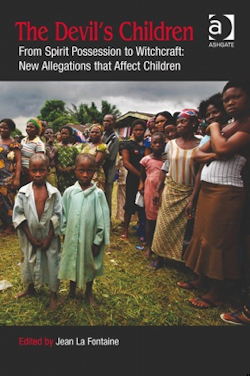
LaFontaine (Hg.) 2009: The Devil’s Children. From Spirit Possession to Witchcraft: New Allegations that affect Children. Farnham, Surrey: Ashgate Publishing Limited.
Von Felix Riedel, MA Ethnologie
Die Viktimisierung von Kindern durch Hexereianklagen hat in den letzten Jahren starkes Interesse der Öffentlichkeit erfahren. Ein Auslöser dafür war die britische Dokumentation des Senders Channel 4 mit dem Titel Saving Africa’s witch-children. Das Porträt eines nigerianischen Asyls für Kinder, die von ihren Eltern, Stiefeltern, Verwandten, Priestern oder Nachbarn der Hexerei beschuldigt und misshandelt wurden, stieß eine gesellschaftliche Debatte in Nigeria an. Die vergleichbare Situation in der Demokratischen Republik Kongo wurde in ähnlichen Dokumentarfilmen belegt.
Dispatches: Return to Africa's Witch Children (1 of 5)
In Diskrepanz zum journalistischen Interesse steht das Schweigen der Ethnologie. Lediglich Robert Brain (1970), Peter Geschiere (1980) und Filip DeBoeck (2003; 2004; 2005) haben bislang fundierte Daten gesammelt und diskutiert, zwei neuere Studien aus Ghana erschienen nach 2009. Eine Reihe von Arbeiten aus dem Umfeld humanitärer Organisationen rezitiert im Wesentlichen die journalistischen Quellen.
Der von Jean LaFontaine herausgelegte Sammelband betritt daher ein weitgehend brach liegendes Feld.
Die Publikation richtet sich in der Konsequenz nicht primär an ein wissenschaftliches Fachpublikum, sondern an soziale Arbeit, therapeutisches Personal, Polizisten und Kirchen. Zwei Drittel der Texte im Sammelband leisten ausschließlich Vorarbeit zu einem Verständnis von Geistbesessenheit in unterschiedlichen kulturellen Bezügen.
Eine hervorragende Zusammenfassung der psychiatrischen Problematik liefert Roland Littlewood. Seine Gegenüberstellung von Geistbesessenheit und suizidaler Überdosierung von Medikamenten eröffnet einen praktikablen Weg, das Verhältnis von agency und Symptom bei weiblichen Besessenheitskulten in aller gebotenen Unschärfe neu zu bestimmen:
„The distinction may be difficult to draw. As with overdoses, when do ‚symptoms’ become ‚strategies’?“ (33)
Littlewood fordert eine erhöhte Sensibilität der Therapeuten für kulturelle Belange sowie die partielle Integration von kulturspezifischen Laien-Therapeuten ein. Die psychiatrische Therapie will er durch diese Offenheit im Interesse des Patienten stärken und beibehalten.
Sherrill Mulhern evaluiert in einem weiteren exzellenten Text für den europäischen Kontext alternierende Schwankungen in den Körper-Geist-Konzeptionen.
Ausgangspunkt ist der Wandel von der hochmittelalterlichen Lehrmeinung über Hexereigeständnisse und Somnambulismus zu den fundamental differenten Anschauungen des 14ten Jahrhunderts. (38ff) Erst diese interpretierten halluzinierte Geständnisse als empirisches Zeugnis einer nächtlichen Reise und Teufelsbuhlschaft.
Diesen Wandel parallelisiert sie mit dem aktuellen charismatisch-christlichen Postulat, Geständnisse und Visionen seien empirische Manifestationen göttlicher Wahrheiten und ermöglichten spirituelle Ätiologien. Während die Exzesse der katholischen Kirche letztlich die Entwicklung von alternativen psychologischen Konzepten provoziert hätten, würde die charismatische Bewegung die Therapie aus der säkularen Psychotherapie in die Dämonologie der deliverance zurück überführen. (46)
In einer bisweilen zu glatten, rasanten Erzählung problematisiert sie die Wiederkehr des Geständnisproblems in der Psychotherapie der zweiten Hälfte des 20. Jahrhunderts: Unter dem Druck feministischer Positionen sei die analytische Annahme einer subjektiven, psychologischen Wahrheit für Inzestfälle in den Verdacht der Vertuschung von realen Verbrechen geraten.
Die bis heute andauernde Strömung fordert gegen das rechtsstaatliche Prinzip der Nachweisbarkeit und in Verleugnung der Möglichkeit der Konfabulation eine prüfungslose Anerkennung jeglicher Opfererzählungen. Als Resultat der Diskursschwankungen seien erstaunlich weit verbreitete Phantasien über satanistische Rituale bis hin zum Kannibalismus als glaubhafte kindliche Erinnerungen von Patienten und Therapeuten verteidigt worden. (54) Mulherns historische Analyse verweist in einer neuen Dringlichkeit auf die Komplexität und Reichweite des Problems der Nichtidentität von Geist und Körper.
Die Integration von emischen Perspektiven versucht der Band im dritten Teil. Christina Harringtons Beitrag idealisiert in einem kurzen Beitrag ihre Wicca-Initiation. Mercy Magbagbeolas Beschreibung ihrer christlichen Hexereivorstellungen sind als illustrative ethnographische Quelle wertvoll, werden in dieser Form aber unnötig aufgewertet.
Erst das letzte Drittel des Buches widmet sich explizit Kindern als Opfer von Hexereianklagen.
LaFontaine fasst die wenigen bestehenden ethnographischen Texte zusammen und leistet so die Vorarbeit zum einzigen ethnographischen Beitrag von Filip DeBoeck. Dieser liefert eine geringfügig aktualisierte Durchführung seiner älteren Texte, in denen er konzise die Verhältnisse in der DRC beschreibt und diskutiert.
Leider besteht er immer noch auf einer euphemistischen Definition der Heilung: Der mitunter wochenlange Exorzismus von Kindern in den Kirchen biete als therapeutic ‚healing’ space eine „alternative Lösung des Problems“ an. (131)
DeBoeck entgleitet hier die Sensibilität für die komplexere infantile Psychodynamik, schlüssig wird der therapeutische Aspekt nicht. Das Trauma des Exorzismus wird nicht weiter erörtert, die Reintegration ins verfolgende Kollektiv wird mit Heilung gleichgesetzt. Auch wiederholt er die populäre Hypothese, Hexereianklagen könnten als a posteriori birth control gelten: Kinder würden primär aus ökonomischen Gründen verstoßen.
Materialistische Ansätze dieser Art erklären nicht, warum die okkulte Rechtfertigung der ökonomischen vorgezogen wird.
Stichhaltiger ist seine Beobachtung über Neuformierungen der Kernfamilie gegen die erweiterte Verwandtschaft mit ihren Ansprüchen. Aber auch hier fehlt die Vermittlung durch die individuelle Psychodynamik und die Ideologieform, in der diese Abgrenzung als okkultes Ressentiment gewählt und ausformuliert wird.
In einer für das Forschungsfeld üblichen Umkehr werden die Verfolger von Kindern zu Opfern einer spirituellen Unsicherheit, einer Krise der Verwandtschaft. Die Krise der kindlichen Opfer von Hexereianklagen tritt dann nur noch als sekundärer Effekt einer anderen Krise in Erscheinung.
Das letzte Kapitel wird im Wesentlichen von Eleanor Stobart gerettet durch eine empirische Studie über Fälle von Kindesmisshandlung mit assoziierten Hexereianklagen in Großbritannien.
Die breite Zielgruppe des Bandes resultiert in einem Relativismus, der Kritik unterbindet. So behauptet Eileen Barker in der Einleitung:
„The social sciences have to recognise their limitations, however. They have no expertise, technologies or skills that allow them to judge theological or ethical claims.” (3)
Dieser Widerruf wissenschaftlicher Erkenntnis richtet sich gegen philosophische Betätigung als Vermittlung zwischen dem aktuellen Stand der Aufklärung und dem dahinter zurückfallenden gesellschaftlichen Bewusstein. Der den Sozialwissenschaften aufoktroyierte „wissenschaftliche Agnostizismus“ (3) tendiert dazu, analytische Kritik und interdisziplinäres Denken stillzulegen.
So richtig die Kritik am „nothing but“ der psychologistischen oder materialistischen Ansätze ist, so reduktionistisch ist die Aufgabe des Versuches der dialektischen Darstellung zugunsten einer urteilsfreien Beschreibung, die weder naturwissenschaftlichen noch philosophischen Ansprüchen gerecht wird.
Der Eindruck der Beliebigkeit wird komplett, wenn Barker wenig später das Urteil über spezifische Vorurteile doch wieder einführt: Als berechtigten Verweis auf „ignorance“ und „misinformation“ der westlichen Gesellschaften gegenüber den Vorstellungen der Minoritäten (4).
Die dialektische Spannung zwischen Materialismus und Psychologismus, Gesellschaft und Individuum kann der Band nicht aushalten. Er beinhaltet einige Aufsätze von hervorragender Qualität und leistet auch Pionierarbeit für die Praxis mit viktimisierten Kindern. So erfreulich dieser seltene praxisbezogene Ansatz ist, die Desiderate des Feldes „Kinder und Hexenjagden“ können die Beiträge leider nur partiell schließen.
Felix Riedel, MA Ethnologie Marburg, Deutschland Kontakt: Felix.Riedel.Uni (AT) googlemail.com
Als "Hexenkind" verfolgt und misshandelt (Kleine Zeitung, 16.1.2012)
Die Hexenkinder von Nigeria: Priester und Scharlatane bereiten Jungen und Mädchen die Hölle auf Erden (Die Welt, 11.9.2010)
Immer wieder macht das Thema "Hexenkinder" Schlagzeilen in den Medien. Doch was haben Ethnologen und Ethnologinnen…