
search expand

“Similar to the Third World debt crisis” – David Graeber on ‘Occupy Wall Street’

(UPDATE:) David Graeber: Occupy Wall Street rediscovers the radical imagination (Guardian 25.9.2011)

While the Guardian is sending an anthropologist on fieldwork among bankers to give us insight in the destructive culture of finance, thousands of people in New York are occupying the Wall Street, “the financial Gomorrah of America” and “greatest corrupter of our democracy”.

Inspired by the massive public protests in Cairo’s Tahrir Square and Madrid’s Puerta del Sol Square, hundreds have slept outside near Wall Street for the past three nights. The campaign “Occupy Wall Street” began on Saturday when thousands gathered in New York City’s Financial District.

As Egyptian researcher Maha Abdelrahman said a few months ago, we might be witness to a global revolutionary movement against neoliberalism.

Most protesters are under 30, and “over-educated and under-employed” according to the Guardian.

“We have a president who tells us to do the right thing, to go to school, to get a better life, but I’m not getting a better life. I am a new college graduate and I have $50,000 of college debt built up while studying business management at Berkeley. I can’t find a job to pay it off”, says one of them, 26 year old Romeo.

“Who is here? Young people and students with college debts. They want to talk to the people who took away their future”, explains anthropologist David Graeber who is one of the protesters.

Graeber has just a few weeks ago published his new book Debt: The First 5,000 Years where he highlights the exploitative nature of debts and “virtual credits”. According to a review in the Financial Times by anthropologist Gilian Tett:

Graeber insists that debt is intrinsically linked to power, since credit can be used to exploit or control people. And the power is doubly effective, he adds, because debt is so overlaid with moral context. There is no better way to justify unequal power relations than “by reframing them in the language of debt … because it immediately makes it seem that it’s the victim which is doing something wrong”

In an interview with Democracy Now Graeber compares the current economic crisis in Europe and the U.S. with the so-called Third World debt crisis.

The austerity regimes that are being imposed now on Europe and on America are remarkably similar to what happened—you know, what used to be called the Third World debt crisis. First you declare a financial debt—a financial crisis. You bring in these people who are supposedly neutral technocrats, who are in fact enforcing this extreme neoliberal ideology. You bypass all democratic accountability and impose things that no one ever possibly have agreed to. It’s the same thing.

And one reason it’s happening to us now is that there was really successful mobilization around the world against those policies. In a lot of ways, the global justice movement was successful. The IMF was kicked out of East Asia. It was kicked out of Latin America. And now it’s come home to us.

David Graeber on the Occupy Wall Street Protest & Forgiving Debt of the American Poor

After quick googling it seems that American mainstream media covers the protest mainly as a police story with focus on arrests, see New York Times or CBS or Business Week.

So we have to turn to Russia Today: Occupy Wall Street – America’s own Arab Spring? or the Guardian: Wall Street protesters: over-educated, under-employed and angry and The call to occupy Wall Street resonates around the world.

Or of course to alternative media and the official website of the campaign https://occupywallst.org/

For more information on Graebers new book see his essay Debt: The first five thousand years (Mute/Eurozine) or an interview with David graeber: Debt’s history, implications, and critical perspective (No Borders) and Debt Came Before Money: An Interview with Economic Anthropologist David Graeber (Naked Capitalism)

UPDATE: EGYPT SUPPORTS PLANNED US-PROTEST

“Egyptian activists are lending their support to a planned protest in Washington, DC, which US activists hope will become an open-ended sit in modeled on the Tahrir Square protests that helped bring down former President Hosni Mubarak”, according to the newpaper Al-Masry Al_Youm:

The demonstration, which is being organized under the banner “human needs not corporate greed,” will be held on 6 October, on the eve of the 10th anniversary of the start of the US occupation of Afghanistan and as the recently passed US budget takes effect.

Egyptian activists plan to hold a concurrent protest in Tahrir Square.

SEE ALSO:

Financial crisis: Anthropologists lead mass demonstration against G20 summit

UK Riots: Let's talk about class and oppressive states

From Tahrir to Israel: "Protest movements inspire greater human understanding"

How anthropologists should react to the financial crisis

Anthropologist uncovers how global elites undermine democracy

Saba Mahmood: Democracy is not enough – Anthropologists on the Arab revolution part II

Thesis: Neoliberal policies, urban segregation and the Egyptian revolution

– Use Anthropology to Build A Human Economy

(UPDATE:) David Graeber: Occupy Wall Street rediscovers the radical imagination (Guardian 25.9.2011)

While the Guardian is sending an anthropologist on fieldwork among bankers to give us insight in the destructive culture of finance, thousands of people in New York are…

Read more

Guardian sends anthropologist on fieldwork among bankers in London

Can you make a complex subject like the world of finance accessible to outsiders? What about sending an anthropologist into the world of bankers in London’s financial district and let him blog his findings?

That’s the new project of the Guardian. They have engaged Dutch anthropologist Joris Luyendijk who has also a background as a journalist (perfect combination) to start an anthropological banking blog.

It’s a project in the spirit of public anthropology and anthropology 2.0 – at least in theory.

The anthropologist explains in his introductory post:

When I started interviewing financial workers this summer, I knew as little as the average Guardian reader. So I plan to start at the beginning. Every interview will be posted on the web, with comment threads open to let other outsiders to ask questions and, who knows, to let insiders to elaborate on the material. Over time I hope to build an intellectual candy shop full of interesting stuff about the world of finance, stuff that will then help you as a reader make better sense of the news.

It is important for outsiders to learn more about this sector, he stresses:

Finance directly affects everyone’s interests, but many have a hard time maintaining their interest in it. But as the collapse of Lehman Brothers and the following three years have shown, the financial world is too important to leave to the bankers – in fact in some countries democracy is beginning to look like the system by which electorates decide which politician gets to implement what the markets dictate.

The people in this very powerful sector are worth learning more about. And the good news is, when you listen to them in their own words, that can actually be pretty entertaining. And humanising.

But how anthropological are portraits of bankers? And does “humanising” mean depoliticising or even legitimizing their actions? Do we get a better understanding of the political economy of finance?

So far he has posted around ten portraits of financial workers, no analysis so far. The project has just started.

What I find striking: The financial workers don’t reflect about the consequences of their work. They seem to be obsessed with pleasing their clients, in making their clients more successful and richer.

You’ll find critical reflections in the comment sections only – like here

..and to generate wealth you have to generate poverty. Success?

It might sound as if anthropological studies of bankers are something extraordinary. No longer. There has been surprisingly much interest among anthropologists for the world of finance. Karen Ho for example has been on fieldwork in the Wall Street: Anthropologist Explores Wall Street Culture. Another anthropologist, Gillian Tett, who works in the Financial Times, explained three years ago that she used anthropology to predict the financial crisis and that it’s important to understand the tribal nature of banking culture.

See also How anthropologists should react to the financial crisis and – Use Anthropology to Build A Human Economy. Check also David Graeber’s comments on the current Occupy Wall Street Protests

Can you make a complex subject like the world of finance accessible to outsiders? What about sending an anthropologist into the world of bankers in London’s financial district and let him blog his findings?

That’s the new project of the Guardian.…

Read more

Museum der Kulturen Basel: Weg von der Schaustellung von Ethnien

Vor zwei Wochen feierte das grösste ethnologische Museum der Schweiz seine Neueröffnung. Die zweijährigen Umbauarbeiten scheinen dem Museum der Kulturen in Basel gut getan zu haben. Nicht nur architektonisch, sondern auch fachlich.

Die Ausstellungen bewegen sich nämlich laut Pressemeldung:

weg von der vermeintlich all umfassenden Schaustellung einzelner Ethnien, Territorien, Religionen, etc. hin zu thematisch ausgerichteten, kultur- und länderübergreifenden Ausstellungen, mit dem handelnden Menschen im Mittelpunkt und immer mit Bezug zum Hier und Jetzt.

Eine der drei neuen Ausstellungen heisst übrigens “EigenSinn – Inspirierende Aspekte der Ethnologie”.

Es ist offenbar nicht mehr ein Museum, in dem Besuchende ihr Bedürfnis nach “Exotik” befriedigen können. Wenige Objekte, wenige Beschreibungen, dafür viel Raum – auch für eigene Reflektionen. Daniel Wiener schreibt in der Basler Zeitung, Basel habe ein neues Kunstmuseum erhalten.


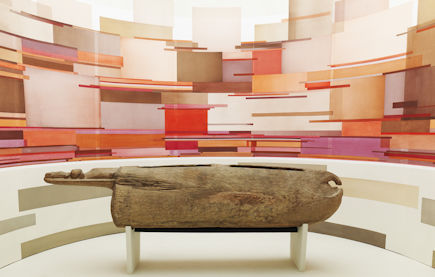
So stellt das Basler Museum der Kulturen Schlitztrommeln aus Papua Neuguinea aus (Pressebild)

Er schreibt ganz begeistert, doch im Kommentarfelt hagelt es Kritik.

“Befremdend ist es, dass von riesigen Sammlung indigener Kult- und Kunstgegenstände so gut wie nichts mehr zu sehen ist”, schreibt z.B. Klicki.

Samba, “jung, kulturinteressiert”, entgegnet:

Für mich ist dies eines der ersten ethnologischen Museen, dass ich gesehen habe, das endlich aufwacht! Der Gegenstand der Ethnologie ist der Mensch. Wer glaubt, dass sich Subjekte kategorisieren lassen, in regionale Gruppen, in Sprachgruppen oder sonst irgendwelche eurozentrische Typen, der verhält sich gegenüber dem Gegenstand der Ethnologie, der eben kein Gegenstand im eigentlichen Sinne ist, nichts als unaufrichtig.
(…)
Bitte, stolze Basler, nehmt Abschied von Euren Erwartungen an Räume mit 40 Speeren und Lendenschürzen, die kein Mensch der Welt mehr braucht oder trägt, und lasst es zu, dass Eure wunderbaren Sammlungen, Eure Schätze, endlich einen neuen Weg gehen dürfen und in einem anderen Licht gezeigt werden können.

In einem ausführlichen Bericht auf Onlinereports.ch schreibt Aurel Schmidt:

Was hier als Konzept erarbeitet wurde und vorliegt, ist insofern neu, als bis ungefähr um 1980 jedes Objekt nur in seinem sozialen, religiösen, rituellen Kontext gesehen werden durfte. Das Funktionelle herrschte vor, etwas anderes war verpönt. Jetzt steht mit einem Mal das Objekt mit seinem Eigensinn (wieder?) im Mittelpunkt, als ästhetisches Objekt, von dem die Verführung ausgeht, wie Jean Baudrillard gesagt hat.
(…)
Gesucht wird dabei immer eine transversale Bedeutung, das heisst, dass der Sinn erweitert wird und im Idealfall am Ende zu einer verbesserten Erkenntnis führt. “Verständnis für die Menschheit”, drückt es Richard Kunz, der Kurator der Ausstellung, mit seinem eigenen Eigensinn aus.

Siehe auch Berichte in der Badischen Zeitung von Volker Baumeister über die Neugestaltung des Museums und über die Ausstellung “Eigensinn”

Das Museum hat auch eine ansprechende Webseite, wo sich auch sämtliche Ausstellungsbroschüren runterladen lassen.

Ähnliche Diskussionen wurden auch geführt während der Neugestaltung des Ethnologischen Museums in Berlin-Dahlem, siehe
Der Tagesspiegel zum "Dilemma ethnologischer Museen" und in Paris: Indigenous? Non-Western Arts? Primitive? The Paris Museum Controversy

Vor zwei Wochen feierte das grösste ethnologische Museum der Schweiz seine Neueröffnung. Die zweijährigen Umbauarbeiten scheinen dem Museum der Kulturen in Basel gut getan zu haben. Nicht nur architektonisch, sondern auch fachlich.

Die Ausstellungen bewegen sich nämlich laut Pressemeldung:

Read more

Når integrering betyr undertrykkelse

Sannsynligvis synes de fleste at integrering er noe positivt og at innvandrere skal integreres i det norske samfunnet. Men mange migranter har føtter og røtter i mange land. For dem kan en integrering, slik norske myndigheter krever, virke undertrykkende.

Dette sier Jana Sverdljuk i et intervju med Kilden. Hun er stipendiat ved Institutt for tverrfaglige kulturstudier, ved NTNU i Trondheim og forsker på russiske kvinner i Norge.

Dersom det ikke er mulig å ha en transnasjonal identitet, har vi et system som undertrykker den transnasjonale migranten, mener Sverdljuk og forklarer:

– Hvis du ser på introduksjonslovene i de nordiske landene, så finnes det i dem en ide om at det er migranten som skal integreres i det systemet som er i Norden fra før. Dette skaper en sterk kobling mellom systemet og migranten, der det blir en likhet mellom det å være borger og det å være nordisk. Jeg ville forsøke å utfordre denne koblingen, og i stedet sette fokus på det å være en global verdensborger, der identiteten hører til flere steder samtidig.

Saken er allerede 4 uker gammel, men forskeren tar opp et noe viktig som man sjeldent hører i integreringsdebatten.

Jana Sverdljuk har tidligere i sommer skrevet en veldig god slakt av den statlige Brochmannrapporten som beskrev visse typer innvandring som en byrde for den norske velferdsstaten: Velferd – et sensitivt anliggende :

Et alternativ til spørsmålet ”hvordan gjøre norsk velferd mindre attraktivt for utlendinger?” kan være å spørre ”hvordan er det mulig å tilrettelegge velferdstilbud i en verden som er kjennetegnet av globalisering?”
(…)
Forskningskonklusjoner som er laget med utgangspunkt i et skille mellom ”oss” og ”dem” – mellom aktive nordmenn og passive innvandrere – inviterer til diskriminerende tenkning snarere enn å motvirke slike holdninger.

SE OGSÅ:

Antropologer: – Legg til rette for sirkulær migrasjon!

Avdekker store mangler i migrasjonsforskningen

Thomas Hylland Eriksen: Myndighetene hemmer migrasjonsforskningen

Doktoravhandling: Jobb ikke nøkkel til integrering

Antropolog: Slutt å bruke ordet "innvandrer"!

Les bygdebøker!

How to challenge Us-and-Them thinking? Interview with Thomas Hylland Eriksen

Sannsynligvis synes de fleste at integrering er noe positivt og at innvandrere skal integreres i det norske samfunnet. Men mange migranter har føtter og røtter i mange land. For dem kan en integrering, slik norske myndigheter krever, virke undertrykkende.

Dette…

Read more

Islamhatere drapstruer forskere

Akademikere opplever ubehageligheter og trues jevnlig etter at de har vært ute i media med sin forskning. Flere har fått drapstrusler. Konsekvensen er at noe forskning aldri når ut til offentligheten. Dette melder På Høyden.

Som det kommer fram i teksten er det først og fremst forskere innen feltene islam, multikulturalisme, minoriteter, kjønnsforskning eller klima som er utsatt for trusler. Det har vært mye fokus på voldelige islamhatere. Men også klimaforskere får henvendelser fra personer som er aggressive og hevder at klimaforskningen får store økonomiske konsekvenser for deres virksomhet.

Etter hendelsene 22. juli vil Universitetet i Bergen ta trusler mer alvorlig, sier personaldirektør Line Rye i en oppfølgingssak.

Samtidig frykter Unni Wikan at fagfolk etter 22/7 “har blitt merkbart mer forsiktige med hva de sier” fordi “det er mange som gjør alt man sier til et argument for islamofobi”, hevder hun i et NRK-intervju. “Det kan gå på bekostning av åpenhet hvis folk legger bånd på seg i debatten.”

Tidligere hadde antropologene Sindre Bangstad og Thomas Hylland Eriksen sammen med samfunnsdebattant og skribent Bushra Ishaq og filosof Arne Johan Vetlesen skrevet at visse hatefulle ytringer er ut ifra juridiske og moralske vurderinger ikke akseptable. Etter en del kritikk fulgte de opp med en ny kronikk i Aftenposten: Straffer ikke det straffbare.

Sjekk også intervjuet med Thomas Hylland Eriksen og Runar Døving i Morgenbladet: Forsøk på en oppklaring.

I Morgenbladet har det samtidig vært en debatt om fellestrekk mellom islamofobi og antisemittisme.

SE OGSÅ:

Trengte politibeskyttelse for å forsvare doktoravhandlingen sin om muslimske friskoler

Slik bør Oslo-terroren endre forskningen

Når antropologer utfordrer tattforgittheter får de kjeft

Thomas Hylland Eriksen: Myndighetene hemmer migrasjonsforskningen

"Sovjet-liknende produksjonskvoter truer forskningsfriheten"

Kommersialisering av forskning: Artikkel om aidssyke barn uønsket

Engaged research = Terrorism: Germany arrests social scientists

Blogging and Public Anthropology: When free speech costs a career

Akademikere opplever ubehageligheter og trues jevnlig etter at de har vært ute i media med sin forskning. Flere har fått drapstrusler. Konsekvensen er at noe forskning aldri når ut til offentligheten. Dette melder På Høyden.

Som det kommer fram i teksten…

Read more