search expand

Visual ethnography and Kurdish anthropology by Kameel Ahmady

(LINKS UPDATED 21.9.2020) The first part of the paper Media consumption, conformity and resistance: a visual ethnography of youth culture in Iranian Kurdistan by anthropologist Kameel Ahmady has been published on KurdishMedia. Ahmady wanted to examine the factors which shape a sense of belonging among young people in Mahabad, a town on the north-west periphery of Iran.

His methodological approach is interesting:

I used reflexive visual methods, asking them [the young people] to take their own photographic pieces dealing with themes they saw as relevant to local current events and their place within these processes. The works they produced were then placed in a week long public exhibition in Mahabad, where further data was gathered in a Guest Book of reactions to the event, as well as participant observation notes taken at the time.

Kameel Ahmady has an interesting website with an image gallery and we also can read some of his articles and papers, mostly dealing with Middle East issues.

UPDATE (15.10.06): Part II of his paper Media consumption, conformity and resistance: A visual ethnography of youth culture in Iranian Kurdistan is out

(LINKS UPDATED 21.9.2020) The first part of the paper Media consumption, conformity and resistance: a visual ethnography of youth culture in Iranian Kurdistan by anthropologist Kameel Ahmady has been published on KurdishMedia. Ahmady wanted to examine the factors which…

Read more

Neuroanthropology: “Different cultures produce different brains”

It might sound deterministic (and essentialising – maybe one should replace “cultures” with “societies”), but Juan Dominguez, a PhD student at the University of Melbourne, believes “different cultures” produce “different brains” and that cultural differences reflect different neurological functioning. He discussed the effects of ‘enculturation’ on the human brain at a recent anthropology conference in Cairns, according to ABC Australia. He said:

In certain societies and cultures there are certain patterns of behaviour, people may make certain evaluations, have certain opinions, there are certain tasks that are culturally specific. We should be able to find that … the brain would have some sort of bias acquired through exposure to culture.

Douglas Lewis, a senior lecturer at anthropology who is supervising the work, acknowledges this is a controversial area. He explains that the emerging science of neuroanthropology suggests that brains within a group can be ‘wired’ by common experience, just as individual brains become ‘wired’ by individual experiences. “What we’re looking for are correlates in the brain that anthropologists have in the past thought of as being cultural or culturally mediated,” he says.

>> read the whole story in ABC

>> coverage in the Neorophilosopher’s weblog

John Walter, a Ph.D. candidate in the Department of English at Saint Louis University comments:

This kind of work makes some of us in the liberal arts really nervous, but that’s because we don’t understand cognitive studies and neuroscience well enough. (…)

My sense is that there’s a fear that if we accept or find that difference is part of our neurological wiring we’ll be taking a step back to past racist practices of essentializing and differentiating groups. This fear is, I think, rooted in the assumption that there’s some kind of culture-biology duality, that if something is wired into us it is unchangeable, because (…) wiring doesn’t change. Those familiar with cognitive science, however, know that brains are adaptive.

>> read the whole comment in Machina Memorialis

SEE ALSO:

Social Neuroscience – Psychologists neuroscientists and anthropologists together

It might sound deterministic (and essentialising - maybe one should replace "cultures" with "societies"), but Juan Dominguez, a PhD student at the University of Melbourne, believes "different cultures" produce "different brains" and that cultural differences reflect different neurological functioning.…

Read more

Media: High school sports more popular than academics

A local news story that might say something more general about why anthropology isn’t more present in the news? The results of University research between April 1 and June 30 show high school athletes often get 4 to 8 times the media coverage of an academic all-star, Minnesota Daily reports.

“We’re not ignoring good stories; we’re not being told good stories,” Maureen McCarthy, Star Tribune education leader, said. “It’s unrealistic to expect two reporters to know what is going on in all area high schools.”

>> read the whole story in the Minnesota Daily

SEE ALSO:

“Discuss politics!” – How anthropologists in Indonesia engage with the public

More and more anthropologists, but they’re absent from public debates – “Engaging Anthropology” by Thomas Hylland Eriksen (1)

Why anthropology fails to arouse interest among the public – Engaging Anthropology (2)

A local news story that might say something more general about why anthropology isn't more present in the news? The results of University research between April 1 and June 30 show high school athletes often get 4 to 8 times…

Read more

Saturday food market


See more photos from the local food market here.

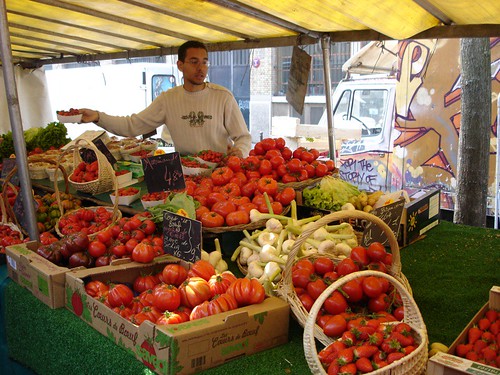
It’s around midday a sunny Saturday in October. The terrace of my regular café-cum-office is still in the shadow, so I decided to take a stroll up the food market which is situated in the middle part of the boulevard. I’ve probably written about these foodmarkets before, but I’ll do it again – this time coming straight from Eastern Oslo and I find their abundance even more striking.
[teaserbreak]
The stretch of boulevard (de Charonne, de Ménilmontant, de Belleville and de la Villette) going all the way from Place de la Nation until Canal St. Martin, houses three food markets, each organised 2 times a week. In addition, there are of course other local food markets all over the place. And we are talking a quite hard core East End, popular area here, and it’s that I find so fascinating. Oslo has the same social fracture between east and west as Paris (and London as well), with the East end being far poorer and far more disadvantaged. According to a newspaper article I read some years ago, the fracture in Oslo in fact mounts to a difference in expected age of no less than 10 years between East and West! I’ve heard surprisingly little talk about it, and I don’t know if the truth can be really that extreme. However, I keep on thinking about the eating habits of the traditional eastenders in Oslo and how different they must be from what they eat here. The food markets here are bourgeoning with fresh fruits and vegetables from all over, with an unimabinable variety of olives, nuts, beans all that, with fresh fish and shellfish of a variety I’ve rarely seen, meat, flowers… everything, and very appetising indeed.

The east end in Oslo has of course changed a lot after the arrival of the immigrants and their fresh fruit and veg shops. And even these shops has spread far into the west end and surroundings now, it’s still a small phenomenon compared to the large outdoor markets here. But I really wonder how my life in Oslo would have been without these shops…

See more photos from the local food market here.

It’s around midday a sunny Saturday in October. The terrace of my regular café-cum-office is still in the shadow, so I decided to take a stroll up the food market which is…

Read more

Indigènes

I’ve just been to see the film Indigènes. I don’t cry very often at the cinema, but I must admit that I had problems stopping weeping during the last part. I, and probably the rest of the audience, knew just too well how the film would end and how the story it self would go on for decades afterwards. I saw it on a cinema nearby, with pensioners (white) and local lycéens (of all colours). It shows on 31 cinemas in Paris, with 4-8 screenings each + two in the weekends.
[teaserbreak]
Indigene is the shameful juridical assignation used for Muslims in French North Africa. Muslims, being indigenes and not citizens like the Christians and Jews, didn’t enjoy equal rights until 1945. It’s incredible, isn’t it, in the country priding itself with the slogan libérté, égalité, fraternité? The entire story of the combatants from the colonies is an incredible account of the failure of this beautiful idea… – Just for instance, this example of France in a nutshell: the soldiers get to view a classical ballet show at the casern, while teaching them to read and write, however, is not a concern.

The film starts with recruitment of soldiers in North Africa. A mother doesn’t want her son to go, as his father had died in the First World War, – for France, probably, and we later learn that the family has been left in misery). But he leaves to fight for La mère Patrie, together with fellow villagers as they shout Vive la France. (I probably got a tear in my eye already at this point, as one is to understand the disappointments that are to come…).

All the four protagonists represent various versions of the failure of France the idea: the petty criminal recollects with his brother how the village was killed by the French, to “pacify” them.

The handsome one falling in love with a white girl at the liberation of Marseille never gets her letters – nor she his – as they are being “censured”. As she is about to unbutton his shirt someone enters the room and he jumps up, in North Africa they’re not allowed to have anything to do with French women. But it’s different here in the mother country, at least for the men coming to liberate her…?

The last disappointment – or treason – is the saddest of them all, and it echoes somehow the disillusionment of all the non-whites with “non-French” surnames in the banlieues who have taken an education as the French dream says, but still see very little of the égalité they’ve been promised: The intelligent, but hèlas so naïve colonel decides to continue on an impossible mission into Alsace, because then, finally, “we will get what we merit” – as they over and over of course not has got until then. His troop gets killed. Another French regiment who enters when the German battalion has been beaten gets all the glory (except from a few of the villagers who thank the only surviving Tunisian), and then we jump 60 years in time and the film ends with the never-more-than-a-colonel sitting on the bed in his little, sparsely furnished room; living-conditions which most French probably recognise from TV reportages on the ancient combatants and migrant workers…

The captain also represents an interesting angle: He passes as a pied noir (a French born in Algeria), but we learn that he is in fact an Arab. That’s an aspect of his identity he keeps close to heart – literally, as a photo of his North African mother he keeps in his breast pocket, and as a secret, that would have kept him from advancing in the army hierarchy had it been known.

Last week, when the film opened, President Chirac decided that the pensions of the ancient combatants finally should be equal to that of the French veterans. Since 1959 their pensions have been “frozen”, as some kind of revenge for the independence…

The four protagonists, Sami Bouajila, Roschdy Zem, Samy Naceri and Jamel Debbouze are all French descendants of North Africans. At Cannes this year the four of them won the prize for the best male protagonist.

The film is not only important it is also very good, and as it concerns the liberation of the whole of Europe from Nazism, I suppose it will be screened in Norway as well. I wasn’t really aware of the important contribution of the soldiers form the colonies before I saw The English Patient, which perhaps not coincidentally, is written by a Sri Lankan author.

The film has created a discussion of course (read some of it in English in The Guardian) – for instance with L’Express devoting their frontpage to the headlines “Should we be ashamed of being French?”

I’ve just been to see the film Indigènes. I don’t cry very often at the cinema, but I must admit that I had problems stopping weeping during the last part. I, and probably the rest of the audience, knew just…

Read more