search expand

Back in the field

Yesterday brought me no less than two très belles coïncidences. First – as I told yesterday – the issue of Le Monde I got on the Air France flight had assigned a whole page to my research object, the very reason for which I was coming down to France again this week; the French slam scene. (Today it’s Libération’s turn). The second coincidence was almost as belle; as I strolled around in my beloved Belleville/Ménilmontant neighbourhood I spotted a poster in a window announcing that the historian Pascal Blanchard, coeditor of La fracture coloniale, was having at talk at the local library 2 hours later. La fracture coloniale was in fact the very book I decided at the last moment not to bring with me here, as I would have little time for reading, – but which I’ll have to read as soon as I get back, since I’m writing an essay on the current struggle over history going on here.
[teaserbreak]
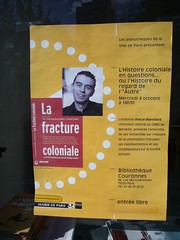
So, before I took the metro down to The Seine and the junk (i.e. boat), La Guinguette Pirate, for the weekly Wednesday slam session there, I went over to Bibliothèque Couronnes to listen to Blanchard. It was in fact the fourth time in 12 months that I heard him. It was however the first time that he came to a community library right in the neighbourhood where I carry out my fieldwork.

(At La Guinguette, by the way, one of the slammers managed to convince me that the Le Monde article I just had thought was quite well, was quite bad. “It just tells the same old story, and doesn’t even mention all the regular soirées going on, just the star appearance this week. It’s hardly based on any research other than reading the Internet. Your study, on the other hand…” It indeed pleased me to hear that my research is taken seriously, especially since my French obviously not yet is up to the whole complexity of the slam performance repertoire…)

Yesterday was thus packed with significant happenings, and it reminded me of how overwhelming this field often felt when I stayed here last time. In the local neighbourhood, the news, politics on all levels, and in the arts world: everywhere in France these days issues of the colonial past and the cosmopolitan (or lack of cosmopolitan) present are discussed, fought over, – and lived out.

When I come back for my last 8 months of fieldwork from December onwards, I think I have to shield myself from all this noise constantly diverting my attention, and keep the focus narrowly on my specific topic of research. It suits me well that the main topic – the (Parisian) slam poetry scene – almost exclusively is situated in popular neighbourhoods in the vicinity of my favourite boulevard where I’ve spent quite a lot of time studying the social geography, as well as out in two popular suburbs. (Then I can even do a tiny little bit of research in the infamous les banlieues, the gate-keeping concept (à la Arjun Appadurai) par excellence for this kind of research in France…).

Yesterday brought me no less than two très belles coïncidences. First – as I told yesterday – the issue of Le Monde I got on the Air France flight had assigned a whole page to my research object, the very…

Read more

Ethnologie und Volkskunde/Europäische Ethnologie – Ein spannungsreiches Verhältnis?

EVIFA – Die virtuelle Fachbibliothek Ethnologie (und einer der wichtigsten Ethnologie-Seiten im Netz) hat eine Diskussion gestartet zum Verhaeltnis Ethnologie und Volkskunde:

Wer sich in diesem Portal mal umgeschaut hat, der wird wissen, dass wir in unseren Angeboten die Volks- und Völkerkunde auch nicht sauber auseinander halten. ;-) Dafür sind wir gescholten, aber auch gelobt worden. Sowohl Vertreter der Ethnologie als auch der Europäischen Ethnologie haben uns schon vorhgehalten, doch wohl stärker das jeweils andere Fach zu vertreten. Daran läßt sich erkennen, wie sehr nach wie vor aus der Perspektive ‘die’ und ‘wir’ gedacht wird. Für ein Portal, dass NutzerInnen von beiden Seiten für sich gewinnen will, ist das eine durchaus schwierige Situation.

(…)

Sei es aufgrund von Veränderungen in den von uns empirisch untersuchten Lebenswelten, Verschiebungen im fachidentitären Selbstverständnis oder institutionellem Druck im Zuge universitärer Umstrukturierungen – an Gründen für rekapitulierende und doch zukunftsorientierte Blicke auf Gemeinsamkeiten und Unterschiede der Fächer mangelt es nicht.

Vier Texte werden zur Diskussion gestellt (zuvor veröffentlicht in den Mitteilungen der “Deutschen Gesellschaft für Völkerkunde” Mai 2006, Nr. 36), ein Forum ist eingerichtet (das leider jetzt schon mit Spam zugeschuettet wurde, ein bekanntes Problem aller Forenbetreiber)

>> Zur Diskussion bei EVIFA

SIEHE AUCH:

Umbenenung: “Institut für populäre Kulturen” statt “Volkskundliches Seminar” (Ethnologie statt Voelkerkunde. Sozial-/Kulturanthropologie statt Ethnologie. Namensaenderungen widerspiegeln Aenderungen im Fach)

Diskusssion: Ethnologie vs Kulturanthropologie

EVIFA - Die virtuelle Fachbibliothek Ethnologie (und einer der wichtigsten Ethnologie-Seiten im Netz) hat eine Diskussion gestartet zum Verhaeltnis Ethnologie und Volkskunde:

Wer sich in diesem Portal mal umgeschaut hat, der wird wissen, dass wir in unseren Angeboten die Volks- und…

Read more

If you want to post announcements / call for papers etc…

Sometimes, readers send call for papers or job announcements to me. Therefore, I’ve now “relaunched” the forum. After registering, you may post there your announcements if you want.

>> visit the antropologi.info-forum

Now, there are two new posts:

PhD scholarship at the Department of Organization and Industrial Sociology, Copenhagen Business School

Call for entries: European Documentary and Anthropological Film Festival Budapest, Hungary, April 2007

Sometimes, readers send call for papers or job announcements to me. Therefore, I've now "relaunched" the forum. After registering, you may post there your announcements if you want.

>> visit the antropologi.info-forum

Now, there are two new posts:

PhD scholarship at the…

Read more

How Islamic cassette sermons challenge the moral and political landscape of the Middle East

The New York Times called it “Bin Laden’s Low-Tech Weapon”: Islamic cassette sermons are often associated with terrorism. They are rather a medium for democratic activism and ethical selv-improvement, anthropologist Charles Hirschkind argues in his new book “The Ethical Soundscape. Cassette Sermons and Islamic Counterpublics”.

There is an book excerpt on the website of Columbia University Press. Hirschkind writes:

To read the cassette sermon primarily as a technology of fundamentalism and militancy reduces the enormous complexity of the lifeworld enabled by this medium, forcing it to fit into the narrow confines of a language of threat, fear, rejection, and irrationality.

On the contrary, cassette sermons frequently articulate a fierce critique of the nationalist project, with its attendant lack of democracy and accountability among the ruling elites of the Muslim world. The form of public discourse within which this critique takes place, however, is not oriented toward militant political action or the overthrow of the state. Rather, such political commentary gives direction to a normative ethical project centered upon questions of social responsibility, pious comportment, and devotional practice.

(…)

For those who participate in the movement, the moral and political direction of contemporary Muslim societies cannot be left to politicians, religious scholars, or militant activists but must be decided upon and enacted collectively by ordinary Muslims in the course of their normal daily activities.

These sermons are a key element in the technological scaffolding of what is called the Islamic Revival (al-Sahwa al-Islamiyya), he writes. The cassette sermon has become an omnipresent background of daily urban life in most Middle Eastern cities:

In Cairo, where I spent a year and a half exploring this common media practice, cassette-recorded sermons of popular Muslim preachers, or khutaba’ (sing. khatib), have become a ubiquitous part of the contemporary social landscape. The sermons of well-known orators spill into the street from loudspeakers in cafes, the shops of tailors and butchers, the workshops of mechanics and TV repairmen; they accompany passengers in taxis, mini-buses, and most forms of public transportation; they resonate from behind the walls of apartment complexes, where men and women listen alone in the privacy of their homes after returning home from the factory, while doing housework, or together with acquaintances from school or office, invited to hear the latest sermon from a favorite preacher.

During his stay in Egypt, he spent much of his time meeting both with the khutaba’ who produced sermon tapes and with young people who listened to them on a regular basis.

One of the central arguments of his book is, he writes, “that the affects and sensibilities honed through popular media practices such as listening to cassette sermons are as infrastructural to politics and public reason as are markets, associations, formal institutions, and information networks.”

>> read the whole book excerpt

SEE ALSO:

Charles Hirschkind and Saba Mahmood: Feminism, the Taliban and the Politics of Counterinsurgency

Charles Hirschkind: What is Political Islam? (Middle East Report)

Charles Hirschkind: The Betrayal of Lebanon (tabsir, 1.8.06)

The New York Times called it "Bin Laden's Low-Tech Weapon": Islamic cassette sermons are often associated with terrorism. They are rather a medium for democratic activism and ethical selv-improvement, anthropologist Charles Hirschkind argues in his new book "The Ethical Soundscape.…

Read more

This is conference blogging!

Why haven’t there been such blog posts about the recent EASA-conference (European Association of Social Anthropologists)? Anthropologist Grant McCracken has presented a paper at the EPIC-conference (Ethnographic Praxis in Industry Conference) and written three blog posts, among others about his presentation (and the usefulness of ethnography):

In my presentation on Monday at EPIC 2006, I proposed that we might want to take advantage of the “extra data” effect. Ethnography is often most useful when we don’t know what we need to know. The method is good at casting the net wide. We ask lots of questions. Collect lots of data. Apply lots of theory and interpretation. Eventually, we begin to see what it is we need to see. At the end of this process we find ourselves in possession of a lot of data we cannot use. This “extra data” is an opportunity.

>> read his whole post

Read also part II and part III

SEE ALSO:

Anthropology and the World: What has happened at the EASA conference?

Conference blogging at EPIC 2005

Why haven't there been such blog posts about the recent EASA-conference (European Association of Social Anthropologists)? Anthropologist Grant McCracken has presented a paper at the EPIC-conference (Ethnographic Praxis in Industry Conference) and written three blog posts, among others about …

Read more