search expand

“Liberté, Égalité, tes papiers!”

Blonde and blue-eyed as I am, I’m not treated as an immigrant here. I often think of my privileged position and how much better I’m treated than many of the locals. While the kids in Clichy-sous-Bois, and elsewhere, are asked for identity papers up to four times daily, I’ve never ever been asked for mine. That’s really lucky, because it’s actually obligatory to carry an id card here, and I always forget mine…
[teaserbreak]
Last night I got reminded of the sheer sickening injustice of this once more. I found myself in the awkward situation of being on a bus… with a bike instead of a valid ticket, and as usual, without identity papers. But, as I’m not a black woman – which was the unfortunate case for another passenger – I didn’t have to first cry as the nazi looking brute of a ticket controller loudly threatened to bring her to the commissariat since she didn’t have her papers on her, and then, put up forced giggles as the brute found it suitable to use his powerful position to try to chat her up instead of bringing her in. No, that was not what happened to me. I gave the brute a ticket from earlier in the evening and hoped for the best. Apparently everything was all right. Then he asked whose bike it was, and after a little back and forth (lasting maybe 30 sec) he said; “I’m just telling you it’s not allowed with bikes here”.

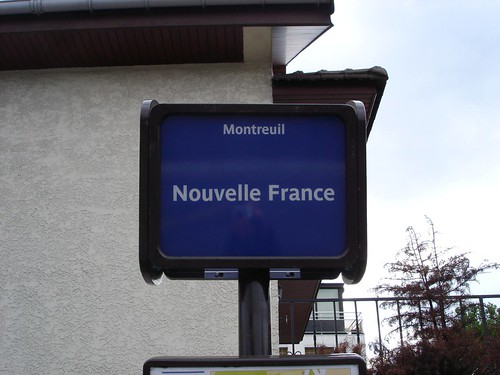
My company all had their season tickets, which however was not valid for the zone we were. But as they were neither female, nor black, there wasn’t any need to fine and harass them… For all the other passengers in the bus it must have seemed like the four of us had valid tickets, which wasn’t the case with none of us. The incident with the black lady dragged on for the better part of the quite long bus ride, and on our way we passed a stop named “Nouvelle France”. We found that very, very symbolic indeed, and one of them suggested that I write a blog post on what had happened with the title “New France”. I replied that I for months had planned to write about this subject, as this was not the first time I experienced such things.

Blonde and blue-eyed as I am, I’m not treated as an immigrant here. I often think of my privileged position and how much better I’m treated than many of the locals. While the kids in Clichy-sous-Bois, and elsewhere, are asked…

Read more

“Play on sterotypical understandings of Africa” – Anthropologist analyses Nigerian scam emails

Email scams constitute the third largest industry in Nigeria, after oil and drugs. These email-scammers succeed because they play on stereotypical understandings of Africa, anthropologist Elina Hartikainen concludes in paper, that she presented at a conference few weeks ago.

Most of us have received emails from African chiefs and businessmen, or relatives of them, with pleas for assistance in retrieving large sums of money that for some reason is inaccessible for them. As compensation we are promised a sizeable percentage of it. In 2001 alone, “Nigerian scammers” have earned around 500 million dollar from victims all over the world.

The spam filters at Hartikainens university are not that good, so she received lots of these scam-emails and started collecting them. There is no thing on earth that cannot be of interest for an anthropologist! When she finally read through one of the emails, she was totally fascinated by the ways in which it played on stereotypical understandings of Africa.

She writes:

The power of these e-mails to engage their recipients in further interaction is centrally founded on the senders’ artful calibration of both the content and form of the e-mails to Western stereotypes of Africa and African cultural practices. It is by representing themselves as embedded in webs of corruption, oil wealth, religious piety and traditional inheritance customs that the senders of the requests for assistance construct themselves as imaginable characters to their Western audience.

She provides this example. “Mrs.Princess Mawa” writes to her, telling about the death of her father, a wealthy businessman:

Following his death, his family members insisted that I am not entitled to his property (Assets and money) since I am a woman and my offspring is all girl as I do not have a male child for my late husband claiming that it is what our tradition entails. Well, because of this barbaric traditional law here in COTE D’IVOIRE which doesn’t permit a woman to inherit her Husbands property incase of death if she has no male child, the relatives of my late Husband are expected by tradition to take over the management of his business and other properties including myself who automatically becomes a wife to one of his immediate brothers.

Hartikainen comments:

This description of Princess Mawa’s situation in terms of traditional, barbaric kin and inheritance customs plays a dual role in enticing the recipient of the request into responding to it. On the one hand it serves to reinforce stereotypical understandings of African tradition that circulate in the popular media. (…) On the other hand, Princess Mawa’s condemnation of her own society’s “barbaric traditions” and particularly her claim to invest her share of her money in her daughter’s education (…) create the possibility for the recipient of the letter to claim that in the final run their decision to cooperate in the scheme is not motivated by financial profits alone, but it is also morally justified.

One can expect that no one takes these mails seriously. But those who do, respond on the basis of impressions of the senders’ intellectual inferiority, Hartikainen supposes. Many of the victims, she writes, consider themselves to be scamming the scammers only to realize that it was not they who were playing the scammer for the fool, but the opposite.

>> read her entry: Writing on Nigerian Scams

The paper is not yet available online. But she has an interesting blog called becoming an anthropologist – about me and my life somewhere between bahia, chicago and helsinki where she will publish the paper when she has “cleaned up the paper”, since it is “still in more of a presentation format”.

Email scams constitute the third largest industry in Nigeria, after oil and drugs. These email-scammers succeed because they play on stereotypical understandings of Africa, anthropologist Elina Hartikainen concludes in paper, that she presented at a conference few weeks ago.

Most of…

Read more

Politics in the banlieues… encore

I couldn’t believe my ears when I head a sociologist saying on a seminar a while ago that the car burning and riot delinquency going on regularly in this country is apolitical. According to him, these riots had neither symbols nor slogans. I can agree that “fuck Sarko” isn’t the most creative slogan you can come up with, but it’s still sort of a slogan. And if the CRS riot police is not a symbol of a certain securitarian policy, well, then, what is? The same goes for the republican schools that were set fire to in the autumn. (I shall agree that it’s not that easy to find the symbolic content in the act of burning your neighbour’s car).
[teaserbreak]
And here we go again, in Montfermeil and neighbouring Clichy-sous-Bois. What exactly led to the riots this time is contested. The rightwing major claims it’s revenge against him testifying against a violent delinquent. On the other hand, many local youth and leftwing politicians put it down to a brutal police action (teargas and police custody) against a mother of a 14-year-old supposed thief. “She was even barefoot…,” as a local young man explained.

Montfermeil and it’s major made it to the headlines about a month ago, when he tried to put into action a legislation forbidding all 15-18 year olds to be together more than three in public spaces, in order to fight gang delinquency… The judiciary system stopped the major’s attempt, but it clearly says something about the political climate in this area.

Today the news on France 3 has documented the massive police presence at the moment in Montfermeil. There were helicopters lightening up the streets and the towerblocks, and there were loads and loads of CRS police. And Sarkozy has been there, as always surrounded by loads of tv cameras, which, as always, disseminates all over France how he gets into heated debates with the locals… (The last I heard is that the hottest socialist presidential candidate has jumped on the securitarian bandwagon, as well…).

To add to the complexity of the case: the severely burnt, but only surviving victim from the (presumed) police chase to the power transformer in Clichy-sous-Bois October last year, Muhittin Altun, was arrested during the riots yesterday, for having – according to the police – thrown a stone at the CRS. His lawyer denies this accusation and says the police only want to discredit the 18-year old, as it is today the reconstruction of the possible police chase in Clichy-sous-Bois should take place. Television news reminded us that they only a few weeks ago broadcasted an interview with Muhittin, where he once again expressed how utterly fed up he was with the constant stop-and-search and identity papers routine carried out by the police in the area.

Finally, I should add that most sociologists I’ve listened to do not depoliticise what’s happening in the banlieues in this way. The opposite is rather the case. (Only a few days ago Loïc Wacquant went (something like); the riots last autumn was in fact a bonne nouvelle for the French society, as it was a sign of refusal of a normalisation of insecurity…). Sociologists, and even some politicians (e.g. an interview I recently heard from the 80s with Mitterand talking about discrimination and all that…) have for 25 years had a very clear vision of what’s going on. However, it’s not this particular understanding of events that gains ground here, rather the opposite, it seems to me. There seems to be a real political battle going on, but unfortunately, I’m afraid that it’s not the scientifically informed interpretation that’s winning. Enough for now, the whole thing makes me a bit fed up…

I couldn’t believe my ears when I head a sociologist saying on a seminar a while ago that the car burning and riot delinquency going on regularly in this country is apolitical. According to him, these riots had neither symbols…

Read more

Urfolk ønsker patent på kultur

Patent på samisk joik, på maori design og didgeridoo musikk? Kulturell opphavsrett er blitt en del av utkastet til FNs erklæring om urfolksrettigheter. Må vi putte urfolk i samme bås som Microsoft som ikke vil dele kunnskap som andre? Hvordan kan det ha seg at urfolk ønsker den samme beskyttelse som store kommersielle selskaper?

Dette er spørsmål som antropolog Gro Ween, stipendiat ved Sosialantropologisk institutt ved Universitetet i Oslo, tok opp under en debatt på årskonferansen i Norsk antropologisk forening i Trondheim. Eksempler på urfolksdesign i kommersiell er ifølge antropologen didjeridoo i plastikk på gata i Sydney, sørsamiske perlebroderier i gjør-det-selv-pakker på Panduro, og urfolksmusikk som for eksempel- Samiid Ædnan som norsk bidrag i Melodi Grand Prix i 1980.

Hvorfor engasjerer seg urfolkene for dette? Mange urfolkaktivister er blitt lei av at urfolkskultur blir kommersielt utnyttet, tilegnet (“approprierte”) av folk utenfra – det er en type kolonisiering, mener Ween:

Urfolk opplever at de i lang tid har blitt tappet for ressurser. Når store farmasøytiske selskaper tar patent på urfolkskunnskap, når plateselskaper tjener fett på opptak fra den brasilianske regnskogen som selges som chill out musikk for clubbere, eller når hvem som helst kan selge lavvoer, didjeridooer eller drømmefangere, understreker dette for urfolk at de fremdeles er sett som en naturressurs – en kulturell allemannsrett, som vesten fritt kan benytte seg av.

Appropriering er en del av et større fenomen – som innebærer alt fra å plassere hodeskallen til Mons Somby som ble hugget hodet av etter Kautokeino opprøret (1857), på museum i Oslo, til å kopiere Maori krigerdesign på engelsk porselen. Historiske beskrivelser av slik appropriering er ofte sentrale i nåtidens urfolksdiskurser, og sentrale for urfolks identitet. En slik forståelse av opphavsrettens problemområde viser lange historiske linjer, og understreker at mange urfolk fremdeles ser kolonisering som en pågående prosess, om enn i endret form.

Men skaper ikke bruk av opphavsrett fremmedgjøring, fryser kulturelle objekter og fjerner dem fra kontinuitet med fortid og fremtid? Blir ikke kultur rikere ved at den blir delt? Har ikke kultur alltid blitt kopiert (se greske akantusranker i norsk rosemaling etc) Er ikke derfor kulturelle uttrykk et felles produkt? Skal ikke kunnskap være fri? Og – som Thomas Hylland Eriksen sa – er det ikke bedre å bli utnyttet enn å bli ignorert?

Gro Ween er ikke enig i dette. Kulturell eiendomsrett er et svar på den pågående koloniseringen og kan ikke ses løsrevet fra dette:

Finnes ikke urfolksforfatteren? Kunstneren? Klart han og hun gjør. Skal ikke urfolk få ta i bruk vestlige juridiske strukturer for å beskytte seg mot bruk av deres kultur og kunnskap uten å bli anklaget for å bli inautentiske? Jo, selvfølgelig. Det mer interessante i denne diskusjonen er i min mening hvordan opphavsretten selv blir appropriert og gitt et urfolksuttrykk.
(…)
Et fokus på urfolks approprieringer av vestlige juridiske strukturer vil understreke hvordan urfolk former opphavsretten i sitt bilde (uten at noen anklager den for å bli mindre autentisk av den grunn), og hvordan urfolk gjennom lovverk, og som forsvar mot kommersielle interesser, forsøker å skape en struktur som beskytter deres kulturelle uttrykk, og gir dem rom til å utvikle seg, også med det utgangspunkt at kultur kan være grunnlag for økonomisk overlevelse og gevinst.

Oppdatering: Hele innlegget er nå lagt ut på hjemmesiden til Norsk antropologisk forening.

Saken er kompleks og omdiskutert. Antropolog Sabina Magliocco har tidligere kritisert slik patentering. Hun skriver først og fremst om bruken av urfolkskunnskap i New Age sammenheng:

The idea that the right to spiritual practice is determined by blood violates everything we know about the constructed nature of race, ethnicity and culture. As anthropologists, we cannot turn our backs on our most fundamental assumptions, even to protect indigenous groups whose spiritual traditions have been fetishized. Taken to its logical extreme, it leads directly to essentialization and racism.

>> les hele saken: Indigenousness and the Politics of Spirituality

For mer informasjon se også Who owns native culture – A book with an excellent website

OPPDATERING: Se også kommentaren på tiram.org og linken til Bling Ladens innlegg “Det er for få samer i Norge”

Patent på samisk joik, på maori design og didgeridoo musikk? Kulturell opphavsrett er blitt en del av utkastet til FNs erklæring om urfolksrettigheter. Må vi putte urfolk i samme bås som Microsoft som ikke vil dele kunnskap som andre?…

Read more

Tilbake til steinalderen: Ingen forskningsformidling på nett

Underlige nyheter fra forskningens verden. Forskere og institutter som formidler forskning på nett skal ikke belønnes for innsatsen sin. Dette foreslår et utvalg som skal foreslå indikatorer for å belønne formidling i finansieringen av universitet og høyskoler, melder UiBs nettmagasin På Høyden. Grunnen er at “det vil være for store utfordringer hva gjelder kvalitetssikring og dokumentasjon, til å kunne ta det med som en indikator.”

Som UiBs formidlingsdirektør, Torny Aarbakke sier, så er internett “nåtidens og fremtidens hovedkanal for allmennrettet formidling”, så hun er nok ikke den eneste som rister hodet over beslutningen av byråkratene i Utdannings- og forskningsdepartementet.

>> les hele saken i På Høyden

Forskningsfinanseringen har møtt mye kritikk i det siste, se derfor også Opprop: Forskningsfinanseringen en trussel mot vitenskapen og demokratiet

Underlige nyheter fra forskningens verden. Forskere og institutter som formidler forskning på nett skal ikke belønnes for innsatsen sin. Dette foreslår et utvalg som skal foreslå indikatorer for å belønne formidling i finansieringen av universitet og høyskoler, melder UiBs nettmagasin…

Read more