search expand

Guest bloggers at antropologi.info

Savage Minds has recently done an excellent job in hosting guest bloggers. During the following weeks and months, you might also read entries from guest bloggers here on antropologi.info. My main objective is to to broaden the anthropological community / blogosphere by recruiting anthropologists that have never blogged before, but you might also find texts by other bloggers on specific topics.

PS: While both anthropology.net and Savage Minds follow the American 4-field-approach, the focus here on antropologi.info is rather on the British tradition of social anthropology (or lesser known traditions).

UPDATE:
First Guest Blogger: Denise Carter. Her first post: The Birth of a Cyberethnographer: The MU5 is to Blame

Savage Minds has recently done an excellent job in hosting guest bloggers. During the following weeks and months, you might also read entries from guest bloggers here on antropologi.info. My main objective is to to broaden the anthropological community /…

Read more

Norwegian anthropology conferences are different

Back from the annual conference of the Norwegian Anthropological Association, I must say that I prefer Norwegian conferences to British ones – at least regarding the way papers are presented. While papers in Britian are read – in a formal (and mostly boring) way, papers in Norway are presented in an more oral way. The audience expectes you to make them smile or (even better) laugh – otherwise you aren’t regarded as a good paper-giver. “I could have listened to him for several hours”, many participants said after the presentation by Edvar Hviding about fishermen on the Solomon Islands (many brilliant pictures!). Many great presentations!

Maybe culture can explain something here? Norwegian society is quite egalitarian compared to other countries and academics are frequently present in mainstream media. You are expected to be “folkelig” – meaning “like normal people” and tear down the walls between academia and the people outside.

SEE ALSO:

What’s the point of anthropology conferences?

How To Present A Paper – or Can Anthropologists Talk?

PS: By the way, Antropyton announced that she’s going to share her thoughts about the conference with us (I’ll be blogging in Norwegian only).

Back from the annual conference of the Norwegian Anthropological Association, I must say that I prefer Norwegian conferences to British ones - at least regarding the way papers are presented. While papers in Britian are read - in a formal…

Read more

Savage Minds starts “Anthro Classics Online”

Kerim Friedman at Savage Minds recently announced a new series about classical works in anthropology which are available online. The idea, he writes, is to “both encourage newbies to read some classical anthropological texts as well as allow those with Ph.D.s in the discipline to debate the contemporary value of these works”.

The first entry: Laura Bohannon: “Shakespeare in the Bush” – the essay that turned Kerim on to anthropology:

It explores how difficult it is to translate Shakespeare’s Hamlet into the cultural idiom of the Tiv in West Africa (the Tiv are mostly located in Nigeria). While the article takes on a straw-man argument (the idea that there is something universal about Shakespeare’s plays overlooks just how hard it is for even American school kids to learn to appreciate Hamlet), it is a well written article which I believe holds up to the test of time.

>> read the whole post at Savage Minds

Kerim Friedman at Savage Minds recently announced a new series about classical works in anthropology which are available online. The idea, he writes, is to "both encourage newbies to read some classical anthropological texts as well as allow those with…

Read more

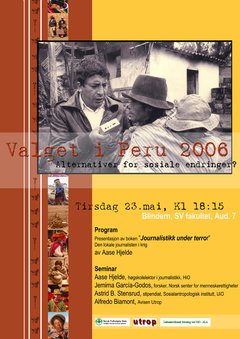
Peru: – Grasrotorganisering gir håp

valget i peru Folk vil ha mer medbestemmelse, mindre nyliberalisme på USAs premisser. Valget i Peru kan gjøre Latin-Amerika enda rødere. Men uansett om Alan García (sosialdemokrat) eller Ollanta Humala (litt lenger ute på venstresida) vinner valget – det er grasrota som som har nøkkelen til framtiden: – Det er grasrotas organisering som gir håp, sa sosialantropolog Astrid Bredholt Stensrud på arrangementet Valget i Peru 2006: Alternativer for sosial endring? ved Universitetet i Oslo ikveld (arrangert av
Latinamerikansk Forening og avisa Utrop).

Antropologen har skrevet hovedoppgaven om fattige kvinners kamp for bedre levekår i Cusco, Peru og skal snart igjen reise til Peru i samband med sin doktoravhandling. Hun ble imponert over kvinnenes arbeid.

– Det er på grunn av organiseringa på grasrota at jeg er optimistisk når det gjelder Perus framtid. Utfordringen er å samle de mange organisasjonen på samme måte som i Bolivia, sa hun.

I hovedoppgaven konkluderer hun:

Mange barn lærer å arbeide av sine foreldre, og på denne måten reproduseres klasse og kjønnsroller. Likevel er det stadig flere unge som fullfører videregående skole. Flere og flere kvinner ser med nye øyne på kjønnsroller og arbeidsdeling, og stadig flere fattige setter spørsmålstegn ved den sosiale hierarkiske orden. I kvinnenes kollektive kamp for overlevelse kan man se spirer til politisk handling og sosial endring.

>> last ned hele oppgaven (pdf)

Nesten hele panelet delte optimismen hennes. For Alfredo Biamont fra avisa Utrop og tidsskriftet La Ventana var det viktig at både hæren og terror-organisasjonen Den lysende sti har mistet mye av sin tidligere makt:

– For 15 år siden var jeg bekymret for at Peru er på vei til å bli en totalitær stat. Nå er jeg ikke lenger bekymret.

For en løpende oppdatering: LAG (Latin-Amerikagruppene i Norge) følger presidentvalget i Peru 2006

(PS: En fordel med å arrangere en slik debatt i en by der 20% av innbyggere har innvandrerbakgrunn er at det sitter mange eksperter blant publikum fra de berørte områdene! Også mange nordmenn med tilknytning til Peru. Mye mer spennende av den grunn!)

OPPDATERING (24.5.06): Per Aage Pleym Christensen har lagt ut sin kommentar på sin blogg med overskriften Sært om Peru på antropologibloggen

LESESTOFF:

Astrid Stensrud: Valget i Peru: Ny brikke til det røde kontinentet?

Astrid Stensrud: Salir Adelante. Fattige kvinners kamp for bedre levekår i Cusco, Peru (pdf)

Astrid Stensrud: Regional etnografi Peru

Nær 70.000 drept i Peru i årene 1980-2000 (Dagsavisen, 28.9.03)

Peru dreier venstre om (Dagsavisen, 5.5.06)

Indianer søker makten i Peru (Dagsavisen, 7.4.06)

Rødt Sør-Amerika bekymrer USA (VG, 16.1.06)

Den venstreorienterte nasjonalisten Ollanta Humala er tilbake i ledelsen (Klassekampen, 20.3.06)

Presidentkandidat Ollanta Humala vil befri peruanerne fra «amerikanske neo-kolonisme» (VG, 10.4.06)

Mapuchefolket bildar oväntade allianser – oberoende av etnicitet

Chronicles Women’s Social Movements in India: “The small groups of rural women in India fighting for change is something the rest of the world needs to take note of”

Verdens sosiale forum – Globalisering nedenfra

valget i peru

Folk vil ha mer medbestemmelse, mindre nyliberalisme på USAs premisser. Valget i Peru kan gjøre Latin-Amerika enda rødere. Men uansett om Alan García (sosialdemokrat) eller Ollanta Humala (litt lenger ute på venstresida) vinner valget - det er grasrota som som…

Read more

From La Sorbonne to Université de Saint-Denis

For those who read French, I can recommend Le Bondy Blog. A couple of journalists from the Swiss magazine L’Hebdo settled in the banlieue Bondy during the November revolts, and stayed there for more than 4 months. Before they left, 8 local youth got training in journalism and took over the blog after the professionals. Every post they write – be it miniskirts or soldiers from the colonies helping out France during the war – initiates a lively debate. I had just read Hanane Kaddour’s very instructive post on how geography determines which university you can apply for when I had the opportunity to have a closer look at 4 different university locales in the Paris area in just a few days.
[teaserbreak]
I didn’t know about this sectorisation of the universities before I read this post, and I have to say that that knowledge gave an extra edge to my trip from La Sorbonne to Université de Saint-Denis. I suspect the amphitheatre I visited at Sorbonne must have been one of the more prestigious ones, because prestigious it was indeed. I don’t think the Royal Palace in Oslo have a hall that could match this amphitheatre. Along the walls the French greatnesses were lined up; Molière, Descartes, Racine… In the ceiling, there was a painting of a man reading a huge book amidst antiquity ruins, and over his head the Muses, presumably, and some angels were playing. There were red carpets on the floor and the desks were made of dark, visibly old and worn, wood.

I would never dream of mocking such a presence of history. Far from it. One of the few, or probably only, collective identities I’ve ever felt any affiliation with is that I’m almost a little bit proud of having been a pupil at Norway’s oldest school. We were impregnated with such an identity from the moment we started there. It’s almost a thousand years old and it’s connected to a cathedral (too grand for it’s city ☺ ). On the walls of the cathedral, a pupil three-four hundred years ago has made a tag (in Latin of course) about a gay teacher, which our (gay) teacher showed us. (Here I’ll not fall into the trap of more nostalgia).

The day after we were at Sorbonne the seminar I attended moved to the old Faculté de Médecin, which is in another grandiose building in the Latin Quarter. High ceilings, broad marble stairs, busts, statues, a memorial for medicine students and teachers lost in the First World War, tapestries and Greek myths… It was all very nice. And then I cycled home and took the metro to its final destination, in Saint-Denis.

The people seemed very nice. There was an “Intercultural festival” going on when I was there, so in the vestibule they sold food – French and North African – and played North African music. But I was quite surprised of how dilapidated and worn out the buildings seemed. And there were security guards walking around, and a huge security post right in the entrance hall. The women’s toilet didn’t have a sign – I don’t know if that was intentional – and the walls in the booths were full of holes filled with toilet paper. And the amphitheatre was full of graffiti! I almost had to laugh because the contrast from the central Parisian etablissements I had just left was so great. I didn’t take any photos because that would feel, I don’t know, strange… but I hope to go back, as I said, there seemed to be interesting things going on there. (And the Wikipendia entry on the Paris 8 university shows that it’s been a hotbed for radicalism since it was established far away from the city by de Gaulle after 1968 :D – they even say “tu” to eachother…)

The fourth and last teaching establishment I’ve been to the last week was not a university like Sorbonne and Saint-Denis, but a Grande Ecole, which is supposed to be more elitist (but I don’t know the ranging of La Sorbonne (Pantheon) within this). It was the EHESS – Ecole de hautes études en science sociale – which I’ve mentioned here before. This building is 1950-60s style and in the centre of Paris, but not in the Latin Quarter. Funnily, EHESS was full of graffiti as well. It was occupied long time ago during the protests against the CPE and there were photos available on the internet showing the vandalism, or what to call it, right after the squatters were thrown out. But that is months ago, and the harsh juridical repression in various CPE law cases have already been going on for a long time. But for some reason they haven’t yet removed the scribble, not even what’s written with chalk. I wonder why.

I understand Bondy Blog’s Hanane Kaddour’s concern about being geographically limited to Saint-Denis or some other banlieue university. Especially since which university, or rather Grande Ecole, you go to, have everything to say when you try to get a job afterwards. But at the same time I like the other France as well (and Saint-Denis’ Philosophy department is founded by Michel Foucault!). So why can’t the two of them – the old and historical and the new and vibrant – just come a little closer together?

I’ve left the digression to the end this time: When I was checking a word on Britannica.com I learnt that it’s Malcolm X’ birthday today (1925-1965). His autobiography (written by Alex Haley) is a very, very good book about identity politics, as well as history, jazz and other things, and I can strongly recommend it. When I was writing now, one particular scene from the book, as well as the film (by Spike Lee) came to mind. Malcolm was the best pupil in class, and for a while neither he nor the others seemed to take much notice that he was the only black boy there. However, the teacher did. So, one day he asked his brightest and perhaps favourite pupil what he wanted to do when he grew up, and the young boy answered “lawyer”. But the teacher thought, perhaps rightly, that that could never happen in a segregated America, so he suggested that Malcolm opted for carpentry instead. A suggestion that, as far as I remember, terminated Malcolm’s formal schooling.

For those who read French, I can recommend Le Bondy Blog. A couple of journalists from the Swiss magazine L’Hebdo settled in the banlieue Bondy during the November revolts, and stayed there for more than 4 months. Before they left,…

Read more