search expand

Instituts-Webseiten: Immer noch keinen Dialog mit der Öffentlichkeit

In den letzten zwölf Jahren hat sich nicht viel verändert. Die Webseiten von Ethnologie- und Sozialanthropologie-Instituten sind heute grösstenteils genauso langweilig wie 2004.
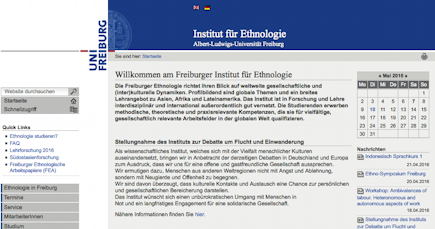

Nicht besonders attraktiv, doch beinhaltet zumindestens eine Stellungsnahme zur Flucht- und Migrationsdebatte: Die Webseite des Freiburger Instituts für Ethnologie.

Damals kam eine Untersuchung des Ethnologischen Institutes der Uni Trier zum Schluss, dass “sich die Inhalte der deutschsprachigen Internetauftritte ethnologischer Universitätsinstitute in erster Linie an den Bedürfnissen der internen Studentenschaft, schon seltener an denen eines kundigen Publikums außerhalb des eigenen Instituts und nur in Ausnahmefällen an denen der Öffentlichkeit orientieren”.

Als ich mir kürzlich sämtliche Webseiten deutschsprachiger Ethnologie- und Sozialanthropologie-Institute (mehr als 30) anschaute, musste ich feststellen, dass sich in den letzten 12 Jahren nicht viel getan hat. Ein Dialog mit der Öffentlichkeit findet immer noch nicht statt. Die Webseiten sind weiterhin nur an eigene Studierende und Forschende sowie Forschungsbürokraten und Sponsoren gerichtet.

Die deutsche Ethnologin, die ich letztes Jahr in Oslo auf einer Konferenz in Oslo traf, hatte recht. Sie war beeindruckt darüber, dass mich die Uni Oslo dafür bezahlt, für die Uniwebseiten mehrere Artikel über eine Konferenz zu schreiben.”So einen Service kenne ich leider überhaupt nicht in Deutschland”, sagte sie. “Für administrative Dinge ist sehr wenig Geld da, die Websites werden häufig von den Sekretärinnen bestückt, die ständig am Rand ihrer Belastbarkeit sind.” (Siehe auch früherer Beitrag zum Thema: Weder Zeit noch Geld für Medienarbeit)

An Unis in Norwegen ist Kommunikation mit der Öffentlichkeit mittels journalistisch aufgearbeiteter Forschungsnachrichen inzwischen Standard geworden – nachdem Thomas Hylland Eriksen in der Anfangszeit ziemlich lange allein auf weiter Flur war mit seinen Bemühungen, Brücken zwischen Forschung und Öffentlichkeit zu bauen.

Die letzten zehn Jahre hab ich mich deshalb so einigermassen mit Forschungsjournalismus in Oslo übers Wasser halten können. Ich habe sämtliche Teilnehmerinnen und Teilnehmer mehrerer Forschungsprojekte interviewt, Studenten während ihrer Feldforschung auf vier Kontinenten angerufen und nach ihren Erfahrungen befragt, Master- und Doktorabhandlungen und neue Bücher vorgestellt – und natürlich viele Zusammenfassungen von Seminaren und Konferenzen geschrieben (siehe u.a. hier).

Die besten Webseiten

Platz 1

Aber es gibt Ausnahmen im deutschsprachigem Raum. Wenn ich eine Rangliste über die besten Institutswebseiten aufstellen müsste, dann hätte ich einen eindeutigen Gewinner – es ist die Webseite des Max-Planck-Instituts für ethnologische Forschung in Halle, also kein universitäres Institut.
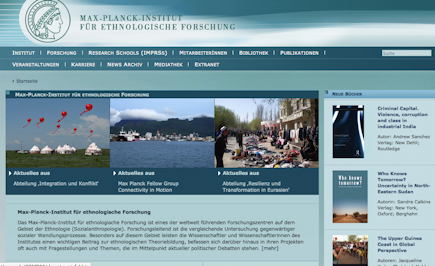

Klare Nummer 1: Die Webseite des Max Planck-Instituts für ethnologische Forschung in Halle.

Kein anderes Institut im deutschsprachigen Raum präsentiert seine Forschung so ansprechend der Aussenwelt. Zwar ist das News-Archive etwas bürokratisch gehalten und die Beschreibungen der Forschungsprojekte etwas trocken. Doch in der Mediathek gibt es jede Menge Bilder aus der Forschung sowie neun Dokumentarfilme.

Eines der Forschungsprojekte hat einen eigenen Blog, den REALEURASIA Blog, mit imponierend vielen Beiträgen. Das Institut hat auch zwei Beiträge zum Thema Terrorismus beigesteuert: Wie Terroristen gemacht werden (von Günther Schlee) und „Wir tappen immer noch im Dunkeln“ (Interview mit Carolin Görzig)

Eine grosse Anzahl von Working Papers gibt es auch.

Platz 2

Platz zwei würde ich dem Institut für Ethnologie in München vergeben.

Auf den ersten Blick schaut die Münchner Seite so gähnend langweilig wie alle anderen Institutsseiten aus. Eine neue Welt tut sich denjenigen auf, die auf den unscheinbaren Menüpunkt “Schmankerl” klicken. Hier gibt es ansprechend aufgearbeitete Einblicke in die Forschung des Instituts. Es gibt Studentische Filme zu sehen, Ausstellungen sowie Feldforschungsberichte, u.a. über Ökotourismus-Projekte in Mexiko oder Civil Society in Pakistan oder Remoteness & Connectivity – Highland Asia in the World – und zwar mit Bildern und Videos.

Platz 3

Platz 3 würde ich an das Institut für Kultur- und Sozialanthropologie an der Uni Wien vergeben. Internes dominiert auch hier, doch in der Sektion News gibt es teilweise auch Lesestoff für die interessierte Öffentlichkeit. Es wird auf Interviews mit Forschern hingewiesen (“Migration als Chance, über uns nachzudenken”) und auf Videos über ein Fieldworkslam und einen Berufsinformationsfilm. Ausserdem hat das Institut eine Webseite erstellt zum Thema: ‘Mehr Als Flucht. Initiativen und Hintergründe aus Kultur- und Sozialanthropologischer Perspektive’ (Hier finde ich allerdings die Idee besser als die Durchführung).

Platz 4

Ein guter Kandidat für den vierten Platz sind die Webseiten des Lehrstuhls für Ethnologie und Kulturanthropologie an der Uni Konstanz. Denn dieses Institut hat seit drei Jahren seinen eigenen Blog, wo zu aktuellen Ereignissen Stellung genommen wird, z.B. zu Der Fluch der ‚Kariben‘ – Zu Disneys Darstellung anthropophagischer Ureinwohner in Piraten der Karibik 2 oder wo Forscherinnen selbst von ihrer Forschung berichten wie z.B. Sarah Fuchs in ihrem Beitrag Armut, Kultur oder Menschenhandel? Die „Biographie des Bettelns“ in Senegals Koranschulen.

Platz 5

Zu guter Letzt auf Platz 5 die Facheinheit Ethnologie an der Uni Bayreuth. Gleich auf der Startseite werden wir auf drei studentische Videos hingewiesen, die im Seminar “Schreiben und Mediales Präsentieren: Picturing Anthropology” (SS 2015) von Valerie Hänsch entstanden sind. Herauszuheben ist die umfangreiche Photogalerie mit Bildern von Feldforschung in diversen afrikanischen Ländern.

Habe ich gute Seiten übersehen?

SIEHE AUCH:

Halle, Bern und Basel vorn – Webseiten von Ethnologie-Instituten untersucht (1.9.2004)

Weder Zeit noch Geld für Medienarbeit (17.5.2010)

Nancy Scheper-Hughes: Public anthropology through collaboration with journalists (7.8.2009)

Michael Schönhuth: Mehr Interesse für eine öffentliche Ethnologie? (15.11.2009)

In den letzten zwölf Jahren hat sich nicht viel verändert. Die Webseiten von Ethnologie- und Sozialanthropologie-Instituten sind heute grösstenteils genauso langweilig wie 2004.

Nicht besonders attraktiv, doch beinhaltet zumindestens eine Stellungsnahme zur Flucht- und Migrationsdebatte: Die Webseite des Freiburger Instituts für…
Read more

Terror in France and ISIS’ Revolution: Anthropologists try to see the whole picture

(draft, post in progress) More surveillance, more bombs, more border controls, less democracy, less freedom: Europe is reacting hysterically after the deadly terror attacks in Paris one week ago. How to make sense of what is happening?

The deadly terror attack in France has brought, as anthropologist Jeremy Trombley at Struggle forever writes, “the violence that people around the world experience on a daily basis back into our own sheltered and secured lives. They remind us not only that the world is a violent place, but that, perhaps, our lives are peaceful because there is violence elsewhere.”

People in Europe have during the recent days got the chance to get an inside view into the struggles of people in less priviledged countries that are regularily bombed by the West.

In theory there is a slight possibility for some kind of solidarity or cosmpolitanism to develop out of this, and a critique of Western policies.

The common discourse in mainstream media is – unsurprisingly – a totally different one.

Heather E. Young-Leslie was right when she two days after the attack wrote:

Sadly, l’horreur of Paris 13 Nov. 2015 will, probably, lead to greater political support for the hawks: the anti-Muslim, anti-immigrant, anti-refugee, pro-militaristic, pro-fascist and neo-Nazi elements in France and other parts of the EU. We will hear that it is necessary to relinquish freedoms in order to protect liberté, and solidarité will be purchased with rhetorics of anti-immigration and victim-blaming.

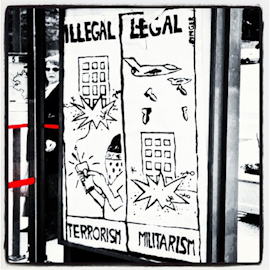
Double standards. Photo: ugocuesta, flickr

This natio-chauvinist “we” against “them” rethoric tends to silence cautious attempts to discuss the wider context of the terrorist attack, including the role of the West in creating terrorism, and the possibility that the operations by Western powers can be viewed as terrorism as well.

“Them”, in the official discourse, not only refers to the Daesh/ISIS attackers but increasingly to all muslims and “non-western” refugees (like those who are escaping the madness i Syria) and immigrants and those who speak Arabic.

Anthropologists react

Several anthropologists, in their immmidiate reactions to the terror attack, insisted to focus on the wider global context of the terror attacks where the Western powers do bear some responsibilities.

Keith Hart, is writing from Paris, in his open letter to his daughter, first published on Facebook:

The fact is that the French killed 1 mn people in the Algerian war of independence, the second genocide they got away with (the other being Vichy). They have now made themselves the US’ closest ally in bombing North Africa and the Middle East, invading Mali, Central African Republic etc. In radio discussions here no-one ever questions their right to do this.

Thomas Hylland Eriksen is reacting in a similar way. “The Syrian conflict, the rise of IS/Daesh, the flows of people out of the country and the reactions with which they are being met in Europe, the feeling of disenfranchisement and marginalisation prevalent among youths of North African origin in France, and the Western countries’ active destabilisation of Iraq, Afghanistan and Libya cannot be seen independently of each other”, he stresses:

[T]he value of human lives varies depending on where you live and who you are. This may be stating the obvious, but there is rarely if ever a major outrage in the rich countries when a drone attack or a missile targeting a terrorist leader instead ends up killing dozens of innocents, including children. Yet this happens routinely and frequently. Not everybody agrees that it is acceptable that the rich countries murder civilians in poor countries, and the Paris terrorist attack can thus be understood as an act of retribution.

Viewed from an subversive anthropological perspective, the distinction between good and bad guys, between terrorists and victims is not as clear as mainstream politicians suggest.

Terrorists or revolutionaries?

Maybe the term terrorist is not a very helpful one at all. Maybe we can get a better understanding of IS/Daesh when we call them – as anthropologist and terror researcher Scott Atram does – for revolutionaries.

In the Guardian he writes that treating Isis as a form of “terrorism” or “violent extremism” would mask the menace. Instead, he describes Isis as being part of a “dynamic, revolutionary countercultural movement of world historic proportions, with the largest and most diverse volunteer fighting force since the second world war”.

In a fascinating interview om Russia Today, he explains the revolutionary aspects and even draws lines back to Hitler.

Sophie Shevardnadze, the interviewer,wonders how it can be possible that ISIS’s horror brings them even more supporters. “Basically”, she says, “what I am asking, is ISIS appealing to sick and disturbed people more than normal people?”. The anthropologists answers:

No, it appeals to people in span of normal distribution. I mean, it’s like any revolutionary movement, that’s why I think even calling it terrorism or just extremism is beyond the pale. (..) It’s very much like the French revolution, or even the Bolshevik revolution or even the National Socialist revolution… I mean, look at the French revolution, they were eating one another just like Al-Nusra and ISIS and other groups are eating one another like bloodied sharks, and they were invaded by a coalition of the Great Powers, and yet not only they survived, but they endured, and they introduced the notion of terror itself, as an “extreme measure” as they called it, “for the preservation of democracy”, and every revolution since then, every real revolution has done pretty much the same thing, pretty much successfully, so ISIS is no exception.

(…) In any kind of truly revolutionary movement there’s a feeling of invincibility once you’ve fused with your comrades in your cause. The idea is their history is on their side. So, even if they take battlefield losses, they’re not going to consider that a loss at all.

ISIS sings the same tune Hitler did, promising Utopia in the end, the anthropologist says:

Look, George Orwell in his review of Adolf Hitler’s “Mein Kampf” back in 1939 have described the essence of the problem. He said: “Mr. Hitler has discovered that human beings don’t only want peace and security and comfort and free from want. They want adventure, glory and self-sacrifice, and Mr. Hitler’s appealed to that – and while the Oxford student union at that time vowed to never fight again, Mr. Hitler has 80 million people fall down to his feet, in one of the most advanced countries in the world.” How did that happen? Again, ISIS is appealing to the same sort of sentiments, that have been appealed to throughout human history… and no, I don’t think we’ve learned much from history about that.

ISIS consists of young poeple, people in transition. ISIS, the interviewer suggests, might be seen as a form of teen rebellion then? The anthropologist agrees. It is – as most revolutionary movements, driven by young – and educated people, he says. But, the interviewer wonders, we’re used to think that young people want freedom, but ISIS is forbidding this?

The anthropologist answers:

I got a call from head of Medical School telling me that her best students have just left to set up field hospital for ISIS in Syria, and she was asking me why would they do this; and I said, “because it’s a glorious and adventurous mission, where they are creating a Brand New World, and they do it under constraints.” I mean, people want to be creative under constraints. A lot of young people just don’t want the kind of absolute freedom you’re talking about. The choices are too great, there’s too much ambiguity and ambivalence. There are too many degrees of freedom and so one can’t chart a life path that’s at all meaningful, and so these young people are in search of significance, and ISIS is trying to show them a way towards significance.

Again, we have to take it very seriously, that’s why I think it’s the most dynamic counter-cultural movement since WWII, and it’s something I don’t think people are taking seriously, just dismissing them as psychopaths and criminals and… this, of course, is something that we have to destroy. I think, we’re on the wrong path in terms of the way we’re going to destroy it.

So what is they way out of this? The first step is in Atran’s view to understand this movement. Current counter-radicalisation approaches lack in his view the mainly positive, empowering appeal and sweep of Isis’s story of the world, and the personalised and intimate approach to individuals across the world. What inspires the ISIS-fighters is not so much the Qur’an but “a thrilling cause that promises glory and esteem”.

There are not many anthropologists who are conducting fieldwork among extremists like ISIS/Daesh. It’s not just because it’s dangerous, Atran says in an interview with Scientific American:

It’s because human subjects reviews at universities and especially the [US] defence department won’t let this work be done. It’s not because it puts the researcher in danger, but because human subjects [research ethics] criteria have been set up to defend middle class university students. What are you going do with these kind of protocols when you talk to jihadis? Get them to sign it saying, “I appreciate that the Defense Department has funded this work,” and by the way if you have any complaints, call the human subjects secretary? This sounds ridiculous and nothing gets done, literally.
(…)
Then you have crazy things [required by US funding bodies] like host country authorization. Suppose you want to do work in Israel and Palestine. So you go to the Israelis, say, “We want to do studies, just like we do in American universities” and say, “We need host country authorization from some government.” They say, “Are you crazy?” And in many countries that are in chaos, who’s going to give you permission?

PS: Maybe it might be fruiful to take a look at “On Suicide Bombing” by Talal Asad where he – among others – writes:

It seems to me that there is no moral difference between the horror inflicted by state armies (especially if those armies belong to powerful states that are unaccountable to international law) and the horror inflicted by its insurgents. In the case of powerful states, the cruelty is not random but part of an attempt to discipline unruly populations. Today, cruelty is an indispensable technique for maintaining a particular kind of international order, an order in which the lives of some peoples are less valuable than the lives of others and therefore their deaths less disturbing.

SEE ALSO:

Terror in Oslo: Who cares about Christian right wing extremism?

Mahmood Mamdani: “Western concern for Darfur = Neocolonialism”

How can anthropology help us understand Swat and Taliban?

Anthropologists: “It’s time to kill the Osama bin Laden myths”

Militarisation of Research: Meet the Centre for Studies in Islamism and Radicalisation

Protests against British research council: “Recruits anthropologists for spying on muslims”

Engaged research = Terrorism: Germany arrests social scientists

Bush, “war of terror” and the erosion of free academic speech: Challenges for anthropology

(draft, post in progress) More surveillance, more bombs, more border controls, less democracy, less freedom: Europe is reacting hysterically after the deadly terror attacks in Paris one week ago. How to make sense of what is happening?

The deadly terror…

Read more

Egypt: Open access to online scientific journals, ebooks and encyclopedias for everybody in the whole country

It does not happen often that there a good news from Egypt where I am still living. This news here, although nearly too good to be true, is at least interesting. In January, Egypt is going to launch the Egyptian Knowledge Bank. Anybody with an Egyptian IP-address will be able to get free access to academic journals, ebooks and other publications that normally only would be available to a small circle of individuals that are affiliated with well-funded universities.

Agreements with 26 international publishing houses have already been signed. According to an official statement by the president’s media office the Egyptian Knowledge Bank project would be “the largest digital library in the world”.

“Our goal is to provide all Egyptians with access to world-class publications, like Nature and Encyclopedia Britannica. By providing these materials free of charge, the knowledge bank ensures that all Egyptians, no matter what their economic circumstances, will have the tools they need to excel in their education and research”, Tarek Shawki, chair of the Presidential Specialized Council for Education and Scientific Research, says.

Gaining access to research materials from private journals and other for-profit online publications has long been difficult in Egyptian academic circles, according to the news site Mada Masr. While the American University in Cairo is able to pay for online journals and databases, public universities like the University of Cairo aren’t able to do the same.

The agreement with publisher Elsevier, for example, “provides access to ScienceDirect, Elsevier’s full-text platform for research literature and abstract and citation database Scopus. They also include Elsevier’s clinical search engine ClinicalKey, and engineering reference platforms Knoveland Engineering Village. The partnership also gives Egypt’s policymakers access to SciVal, meaning they will be able assess the impact of these tools, and make informed decisions on how and where to invest in research”, according Elsevier.

This state-funded initiative is an interesting variation of the open access debate. So far, the efforts have been focused on making the journals itself free to access – a nearly impossible task so far, at least regarding the more prestigious journals. The growth in open access journals, at least within anthropology – is, it seems, rather caused by the establishment of new journals like HAU, Altérités or Vibrant than established ones becoming open for anybody.

Read more about the Knowledge Bank:

Egyptian Knowledge Bank to give free access to online journals, but will it fulfill its promise? (Mada Masr, 16.11.15)

Egypt signs national agreement to expand access to scientific information (Elsevier, 17.11.15)

Dean Shawki: Egyptian Knowledge Bank to Widen Research, Education Opportunities (American University in Cairo, AUC, 11.11.15)

Al-Sisi orders establishment of ?Bank of Knowledge? (Daily News Egypt, 15.11.15)

It does not happen often that there a good news from Egypt where I am still living. This news here, although nearly too good to be true, is at least interesting. In January, Egypt is going to launch the Egyptian…

Read more

Antropologi på nett – er det i Danmark det skjer?

Nøyaktig tre år har gått siden jeg sist har skrevet noe her i antropologi.infos nordiske hjørne. På tide med en titt på det som har skjedd siden den gang: Har det oppstått noen nye initiativer innen antropologien på nett? Spennende nye blogger og nettsteder?

Jeg har kikket litt og funnet en del. Men siden jeg ikke har fulgt med så nøye den siste tida, så har jeg sikkert ikke fått med meg alt.

Det finnes fortsatt bare få antropologer som blogger på norsk, dansk eller svensk. De fleste nordiske antropologer gjør som Thomas Hylland Eriksen og blogger først og fremst på engelsk. Hvis de skriver noe på et nordisk språk, så er det avisinnlegg.

Et unntak er Trond Waage, sosialantropolog ved Universitetet i Tromsø. På nettsiden forskning.no blogger han direkte fra feltarbeidet sitt i Kamerun. Nærbilder fra langt borte – Kamerun under press heter bloggen. Siste innlegget heter Når nomadene må flykte og handler om noen av konsekvensene av borgerkrig og terror for moborororene, en nomadegruppe: “Historiene de forteller oss er voldsomme. Men stemningen dem i mellom er smilende og lett.”

Så fant jeg også bloggen rteworld, en blogg som – til tross for undertittelen “sannsynligvis norges nest morsomste blogg” faktisk er morsom. Bloggeren er en masterstudent fra NTNU Trondheim som ser etter informanter for masteroppgaven sin om, ja, blogging! Her er det saker om mange andre temaer, bl.a. en avslørende sak om verdien av utsagn som “Vi leter etter en afrikansk-utseende mann…” og en antropologisk betraktning av endringer i frisørbransjen.

De som skriver på nordisk på nett har gjerne kommersielle interesserer. De er antropologer som selger tjenester. Antropologerne.com er en slik side eller antropolog.no og Antropologisk.dk.

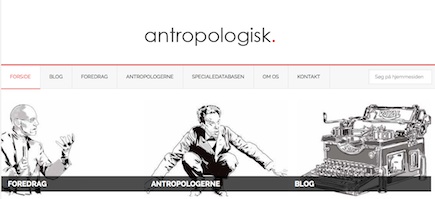
Sistnevnte er den mest interessante siden av de tre etter min mening, meningen med siden er mindre selvpromotering, men rett og slett antropologi. I tillegg til en blogg med innlegg som Du er ekspert – også selvom du er nyuddannet! og Israel/Palæstina-konflikten – fortællinger der forhindrer forsoning, så finner vi også en utmerket Specialedatabase med avhandlinger i fulltekst! En veldig bra side!

Antropologisk.dk er, skriver de, “et stærkt fagligt netværk af antropologer, der formidler foredrag, konsulent- og oplysningsarbejde af høj kvalitet” og blir drevet av Andreas Kambskard, Mark Buskbjerg og Line Hendriksen. Projektet ble lansert den 1. november 2012.

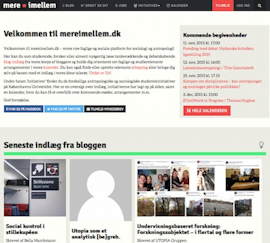
mere i mellem er et annet lovende prosjekt. Københavns Universitet står bak denne nettsiden og beskriver den som det “nye faglige og sociale platform for sociologi og antropologi”.

Her er det både blogg, kalender, oppslagstavle og mere. Kalenderen virker oppdatert, siste blogg-innlegg er skrevet for bare tre dager siden, men dessverre etter en pause på ni måneder uten oppdateringer. Skulle ønsket at siden var litt mer utadvendt og ikke bare rettet til regionen København.

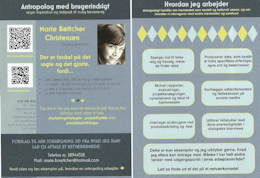
Udkantstanker er en annen dansk blogg som blir drevet av en antropolog som selger antropologisk kunnskap. “Om hvordan antropologi kan bidrage med viden og vækst i det såkaldte Udkantsdanmark” er undertittelen. Antropologen heter Marie Bøttcher Christensen og har nettopp startet opp. I innlegget Branding og lidt om os/dem forteller hun hvordan hun prøver å “selge seg selv” på en karrieremesse og har lagt ut en “atypisk CV” (se bildet til høyre) som sikkert flere kan bli inspirert av. En gode ide, må jeg si til tross for jeg er motstander av konsepetet om “å selge seg selv”…

Til slutt to blogger som ikke har vært særlig aktive i det siste. På https://charlots.wordpress.com/ blogger den danske antropologen Charlotte Jensen om helse og velferd. Hun har vært på 1½ års feltarbeid blant langtidssyke. Siste innlegg handler om trakassering av mindre privilegerte mennesker.

Antropolog Christian Groes blogger på nettstedet videnskab.dk om kjønn og seksualitet. En sejr for verdens sexarbejdere er tittelen av hans siste sak som handler om Amnesty Internationals (ai) anbefaling om å avkriminalisere prostitusjon og sexarbeid. Amnestys posisjon har ikke vært særlig populær i Norden.

Jeg fant ikke noe nytt i Sverige merkelig nok, de fleste initiativene var danske. Er det nå i Danmark det skjer? Vet du noen andre nordiske antropologisider?

Jeg har lagt til de fleste bloggene til denne nye antropologi-avisa som viser de nyeste innleggene av mer enn hundre antropologiblogger på engelsk, tysk og nordisk – se her

Jeg skal prøve å bli finkere med å skrive om nordisk antropologi framover!

Nøyaktig tre år har gått siden jeg sist har skrevet noe her i antropologi.infos nordiske hjørne. På tide med en titt på det som har skjedd siden den gang: Har det oppstått noen nye initiativer innen antropologien på nett? Spennende…

Read more

The new antropologi.info Anthropology Newspaper and News Ticker

screenshot

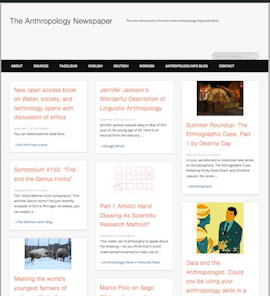
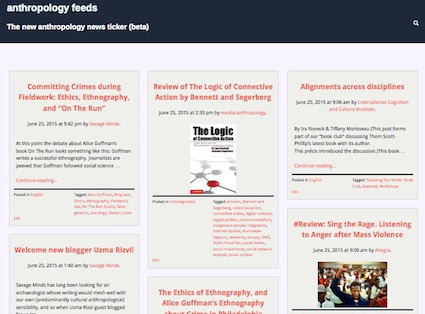
Would you like to get an overview over the most recent anthropology blog posts? The old newsticker did no longer work reliably, so I’ve created a new one. It is still work in progress, but so far it seems to work well. I tried to make it look more attractive, with a newspaper look, images and short excerpts with responsive design that also looks good on mobile devices. It also provides a tagcloud from all the categories that the blog authors assigned to their posts, a probably useful tool for exploring previous posts.

The feeds are updated every two hours. Have a look at the new Anthropology Newspaper here http://www.antropologi.info/feeds/

So far, 100 70 blogs are included, so far only English and German ones. I might add more languages later. Please let me know if there are other blogs that I should add or if things are not working as expected, either here in the comment field or via the contact page.

As mentioned, I’m still working on it, there is a lot more that can be done with the current set up. It was not easy to find a good solution. I was about to go for a commercial solution but then I was so happy to find the free and opensource feed aggregator FeedWordPress by “web developer, student of Philosophy, and sometime political activist” Charles Johnson. The more I more I’ve used the more fascinated I became by this plugin. I am also very thankful for the smart template Ocomedrev that web developer Antonio Sánchez created. I only modified it slightly.

screenshot

Would you like to get an overview over the most recent anthropology blog posts? The old newsticker did no longer work reliably, so I've created a new one. It is still work in progress, but so far it seems to…

Read more