
search expand

Why the head of IT should be an anthropologist

(via Bits and Bytes) The true value of IT will come not from information or technology per se but from the social side. Therefore anthropologists and other social scientists will become more important to Information Technology (IT) Departments than IT itself, says IT analyst Tom Austin in an interview by Fast Company.

The interview does not deal with user centered design but with shaping a climate of creativity in the workplace in the Web 2.0 era with Facebook, Twitter, blogs, wikis and other online social network tools:

A new species of Information Technologist is emerging from the primordial ooze of Web 2.0 — social scientists and humanists who focus on human behavior more than software code. (…) As computer systems become ever more automated and transparent, attention will shift to how to use these tools as social lubricants in the workplace.

MySpace or Facebook will become models for business interaction, Austin thinks:

Look at teenagers today. They’re teamagers. They work on projects as a group and think nothing of doing it that way. I expect to see that kind of thing percolate through the enterprise as an unstoppable force over the next two decades.

Austin tells about companies that are using websites like Facebook to help reinforce or build a social network inside the company to enhance collaboration and productivity:

They use a variety of tools where employees are encouraged to create a personal page where they share not only name, rank, and serial number but also information about prior jobs, interests, hobbies, other skills they may have, projects they’ve worked on, and so forth. That becomes a dynamic and important tool for navigating through the network of people inside the company to find others who may be able to help you.

In this world of the “ad hocracy” that we live in, where people get thrown into project after project, it helps to look at information and figure out, these three people I’m meeting with tomorrow who I’ve never met before. What are they like? Is there something we share in common — a hobby, a background, education, a boss we hated — that you can use to strike up a conversation?

(…)

The problem with IT today is there are too many engineers and not enough social scientists. Look at the numbers of features and controls we put on how things are done. That’s an engineer’s approach, versus some of the free form approach of Enterprise 2.0 and social networking.

>> read the whole interview at FastCompany.com

There is another business anthropology story in the news: In the article Can the Cellphone Help End Global Poverty?, New York Times author Sara Corbett writes about the work done by Nokia-researcher Jan Chipchase, a “human-behavior researcher” and “user-anthropologist” (but with a degree in design, not anthropology):

His mission, broadly defined, is to peer into the lives of other people, accumulating as much knowledge as possible about human behavior so that he can feed helpful bits of information back to the company — to the squads of designers and technologists and marketing people who may never have set foot in a Vietnamese barbershop but who would appreciate it greatly if that barber someday were to buy a Nokia.

He works in a similar way as many design anthropologists:

Rather than sending someone like Chipchase to Vietnam or India as an emissary for the company — loaded with products and pitch lines, as a marketer might be — the idea is to reverse it, to have Chipchase, a patently good listener, act as an emissary for people like the barber or the shoe-shop owner’s wife, enlightening the company through written reports and PowerPoint presentations on how they live and what they’re likely to need from a cellphone, allowing that to inform its design.

The whole article in The New York Times is interesting but quite long. For a summary including comments see the post over at Neuroanthropology Cellphones Save The World. For more information, see Jan Chipchase’s blog

For an earlier entry on Jan Chipchase, see Capitalism and the problems of “High speed ethnographies”

UPDATE (14.4.08) Anthropologists are part of a research team that wants to find out how mobile phones might be used to allow people to share content with each other >> more information at The Engineer

SEE ALSO:

Microsoft anthropologist: Let people be online at work or risk losing stuff!

Plans to study anthropological online communities and Open Access movement

Office Culture – good overview about corporate anthropology in FinancialTimes

Timo Veikkola – The Anthropologist as Future Specialist at Nokia

Popular IT-anthropologists: Observe families until they go to bed

“The science of ethnography is an ideal tool to designing mobile phones”

(via Bits and Bytes) The true value of IT will come not from information or technology per se but from the social side. Therefore anthropologists and other social scientists will become more important to Information Technology (IT) Departments than IT…

Read more

Interviews about moral cosmopolitanism, India-Pakistan, faith, populism, minoritiy-issues

Recently, several of my interviews with researchers of the interdisciplinary research program Cultural Complexity of the New Norway (Culcom) have been translated into English. Here are the most recent ones:

Does the answer exist in human nature?
What is justice? Can research on infants give us new insight into global moral questions? Yes, according to Culcom’s Ph.D. fellow Odin Lysaker. Drawing on theory from psychology, sociology, and biology, the philosopher will try to find out what unites people on this earth with regard to moral questions

Taking the India-Pakistan-conflict to Norway?
A million and a half people were killed under the Partition of British-India into India and Pakistan. How has this conflict affected the relationship between Norwegian-Pakistanis and Norwegian-Indians and their integration into Norway? Lavleen Kaur is going to interview three generations of Indians and Pakistanis in Norway, Pakistan, and India.

– A symptom of large societal changes
It is important to understand the growth of these parties in connection with an elitist and normative judgment of populist parties, says Culcom Master’s student, Tor Espen Simonsen. In his Master’s thesis, the historian studied right-wing populism in Denmark and Norway.

– Focus on minority background undermines the principle of equality
Students who end up in the “minority language speakers” category risk receiving an inferior education. All students should receive an individually adapted education. But this principle does not seem to apply to everyone according to Nina Lewin.

Going their own way without breaking away from the family
The parents are concerned with status, relations with their home country, and job possibilities. Even though obedience and respect for the parents is important, the girls are concerned with choosing an education that they are interested in. This is shown in Culcom Master’s student Vibeke Hoem’s thesis.

Different life histories lead to different faiths
“Through studies of individual faith we can gain a better understanding of a religion,” says Culcom’s Master’s student Marie Toreskås Asheim. For her Master’s thesis she studied young Muslims’ personal relationship to Allah.

Forced to be a victim?
In doing research, start out with people’s experiences, not theory! Sociologist Helga Eggebø has put Dorothy Smith’s theories into practice. With the help of Smith’s “institutional ethnography” she shows how the victim discourse can help reproduce stereotypes and create a divide between “us” and “them”.

>> all interviews

Recently, several of my interviews with researchers of the interdisciplinary research program Cultural Complexity of the New Norway (Culcom) have been translated into English. Here are the most recent ones:

Does the answer exist in human nature?
What is justice? Can research…

Read more

Anthropologist: “Decriminalize prostitution! It’s part of our culture”

cover

After her fieldwork in a brothel in Mexico, anthropologist Patty Kelly is convinced: Legalizing and regulating prostitution has its problems. But criminalization is worse. It’s time to decriminalize prostitution, she writes in The Los Angeles Times.

One reason: Prostitution is not terribly uncommon. It’s a part of “our” culture, and it’s not going away any time soon, she explains. I’m not sure if she means “American culture” or “human culture”. Her statistics are related to America: More than one in every 10 American adult males have paid for sex at some point in their lives. In 2005, about 84,000 people were arrested across the USA for prostitution-related offenses.

But it was during her one year fieldwork in a legal, state-regulated brothel in Mexico where she learned why legalizing is the way the way to go. She spent days and nights in close contact with the women who sold sexual services, with their clients and with government bureaucrats who ran the brothel. In Mexico, commercial sex is common, visible and, in one-third of the states, legal.

Saying that all sex workers are victims and all clients are demons is the easy way out, she writes:

Here’s what I learned: Most of the workers made some rational choice to be there, sometimes after a divorce, a bad breakup or an economic crisis, acute or chronic. Of the 140 women who worked at the Galactic Zone, as the brothel was called, only five had a pimp (and in each of those cases, they insisted the man was their boyfriend).

The women made their own hours, set their own rates and decided for themselves what sex acts they would perform. Some were happy with the job. (As Gabriela once told me: “You should have seen me before I started working here. I was so depressed.”) Others would’ve preferred to be doing other work, though the employment available to these women in Mexico (servants, factory workers) pays far less for longer hours.

At the Galactic Zone, good-looking clients were appreciated and sometimes resulted in boyfriends; the cheap, miserly and miserable ones were avoided, if possible.

To be sure, the brothel had its dangers: Sexually transmitted diseases and violence were occasionally a part of the picture. But overall, it was safer than the streets, due in part to police protection and condom distribution by government authorities.

Sweden’s 1998 criminalization of commercial sex has according to Kelly not protected the women at all. Prostitution continued, prices for sexual services dropped, clients were fewer but more often violent.

Kelly prefers New Zealand’s 2003 Prostitution Reform Act. The act, she writes, not only decriminalizes the practice but seeks to “safeguard the human rights of sex workers and protects them from exploitation, promotes the welfare and occupational health and safety of sex workers, is conducive to public health, [and] prohibits the use in prostitution of persons under 18 years of age.”

>> read the whole article in The Los Angeles Times

Patty Kelly is also the author of the book Lydia’s Open Door: Inside Mexico’s Most Modern Brothel

SEE ALSO:

An anthropologist on sex, love, AIDS and prostitution in a university campus in South Africa

cover

After her fieldwork in a brothel in Mexico, anthropologist Patty Kelly is convinced: Legalizing and regulating prostitution has its problems. But criminalization is worse. It's time to decriminalize prostitution, she writes in The Los Angeles Times.

One reason: Prostitution is…

Read more

Transforming the Anthropology of Childhood – Anthropology News April

Has Anthropology News gone open-access? 14 articles of the new issue are online. Anthropology News examines new ways of thinking about childhood and children’s roles and experiences. Methodological challenges of anthropological work with and of children are addressed as well.

We can read articles on children and climate change and disasters, on a successful antipoverty program for working poor adults and their children where anthropologists were involved, children as anthropologists, on children’s rights and much more.

>> overview over all articles

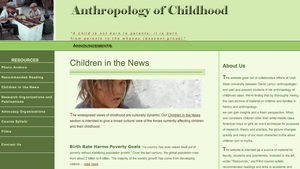
screenshot

In this issue, we also are informed about the existence of a website called Anthropology of Childhood that grew out of collaborative efforts at Utah State University between anthropologist David Lancy and past and present students in his anthropology of childhood class.

SEE ALSO:

“We want children to be their own ethnographers”

Ethnographic study: Why the education system fails white working-class children

Anthropologist calls for a greater appreciation of child labor

Technologies of the Childhood Imagination- new text by anthropologist Mizuko Ito

Play as research method – new Anthropology Matters is out

screenshot

Has Anthropology News gone open-access? 14 articles of the new issue are online. Anthropology News examines new ways of thinking about childhood and children's roles and experiences. Methodological challenges of anthropological work with and of children are addressed as well.

We…

Read more

Discovered the first-ever linguistic link between Siberia and Canada

While studying an ancient language now spoken by only a few hundred people in a remote corner of Siberia, linguist Edward Vajda has found the first-ever linguistic link between the Old World and any First Nation in Canada, the Ottawa Citizen reports. “This is a big breakthrough to be able to link these”, anthropologist Jack Ives said on Wednesday.

Vajda found that the speakers of the Ket language in Russia’s Yenisei River region, and the Athapaskan-speaking native people in Canada and the U.S. (including the Dene, Gwich’in, Navaho and Apache) use almost identical words for canoe and such component parts as prow and cross-piece.

Mr. Vajda’s claim of a Dene-Yeniseic-connection was endorsed last month at an conference in Alaska attended by linguists and anthropologists. Vajdas discovery is being compared with the 18th-century “Indo-European” revolution that ultimately classified English, French and other modern languages with ancient Sanskrit.

>> read the whole story in The Ottawa Citizen

For more information see a posts on this issue over at anthropology.net: More on Vajda’s Siberian-Na-Dene Language Link where also points of controversy are discussed.

SEE ALSO:

New website helps save Kenai Peoples language (Alaska)

Book review: Empires of the Word: A Language History of the World

While studying an ancient language now spoken by only a few hundred people in a remote corner of Siberia, linguist Edward Vajda has found the first-ever linguistic link between the Old World and any First Nation in Canada, the…

Read more