It happened already around 200 years ago: Aboriginal Australians marry Indians. Afghan cameleers open up the interior of Australia for transport and development. Indian seamen fight for Indonesian independence. And long before Australia was colonised by white settlers in 1788, Aboriginees have had longstanding relations with the Indonesian archipelago.
A few weeks ago I met Devleena Ghosh. She is conducting interesting research about the movements of people and ideas in the Indian ocean. We often link transnationalism to today’s world, but Ghosh shows that people have lived globalised lives already several hundred years ago. Australias history consists of more than white settler history.
– It is important to highlight the connections between people, she told me. It is important to challenge the popular belief that migration is something new, that people lived seperated from each other, hating each other. Because that’s not true.
I totally agree with her.
Relationships between South Asians and Australians during the colonial period and earlier have been little investigated. The same can be said of Norwegian history. It was not more than seven years ago, that the first history of immigration was written.
Because of this lack of transnational history writing, the incorrect view of the world as consisting of isolated and self-sustaining societies has been able to dominate the public and scientific discourse. This view has been a fruitful breeding ground for ethnic chauvinism, racism and – in social science – methodological nationalism (pdf).
Devleena Ghosh and her colleagues have published some open access papers:
It happened already around 200 years ago: Aboriginal Australians marry Indians. Afghan cameleers open up the interior of Australia for transport and development. Indian seamen fight for Indonesian independence. And long before Australia was colonised by white settlers in 1788,…
”The Eurovision Song Contest is torture to my ears”, was one of my recent Facebook status messages. But as I learnt, the mega event is not primarily about music, it’s a ritual, a transnational social event that connects people and that – according to a recent paper “produces a new form of unity among people in Europe”.
In the most recent issue of the European Review of History, anthropologist Marijana Mitrovic analyses some of the recent Serbian contributions (2004-2008) to the Eurovision Song Contest (ESC).
In her view, the ESC is a good place to discuss potentials for creating a critical, post-national and cosmopolitan European public sphere that challenges the governing paradigms of identity and belonging.
She writes:
My thesis is that both the ESC and the strategies of Serbia’s participation in this event present attempts to move on from bipolarisation (East/West on the geopolitical map of Europe and First Serbia/Second Serbia in Serbia), respectively, to turn bipolarisation to multiplicity – and through that, paradoxically or not, to produce a new form of unity.
The Western, more ironic stance towards the competition can be seen as opposed to a more strategic attitude of the Eastern European participants, she writes. Similar observations were made by Onnik Krikorian at Global Voices. “While some media reported lagging interest in the 54-year-old competition”, he writes, “countries such as those in the former Eastern bloc continue to take it seriously.”
Popular culture events such as the ESC have according to Marijana Mitrovic “the power and ability to reshape the geopolitical map of Europe and are also used in this way by the new and aspiring member states of the European Union”:
Those are mostly countries that are undergoing a post-socialist transition. Participation in the ESC and a potential victory are a chance for them to invert the social and economic order, on a symbolic level. But paradoxically or not, with that inversion, they also integrate into Europe and inscribe themselves into its symbolic map. Thus rite de passage becomes a transition ritual indeed.
The contributers used the ESC to transform the image of the Balkan/Serbian from a militant and non-cultivated savage, into someone civil, emotional, yet archaic – while at the same time promoting a ”certain level of (Balkan?) universality”. The “new face of Serbia” is “pacified and friendly” and “meets both European and local values”. This new Serbia “is a ‘country in the Balkans, a country of peasants’, but peasants who recognise European values.”
An example is the performance of Zeljko Joksimovic (2004)
Serbia and Montenegro - Eurovision 2004 - Lane moje (LIVE)
❤❤❤ Zeljko Joksimovic and Ad Hoc orchestra - Lane moje - The song came on the 2nd place after a great competition with Ukraine. Only a difference of 17 points !... About Zeljko - he plays 11 musical instruments!!! Istanbul 15 May 2004.">
The anthropologist comments:
Visual identity, crucial for the whole construction, is almost entirely recycled form the ‘memories’ of medieval Serbia. The members of his ad hoc orchestra are dressed in quasi medieval garments, while Joksimovic’s suit is modern, white and minimalist, but with an impressive ‘ethno’ accessory – modification of the belt typical of Serbian costume with an attached golden needle. He has a perfect haircut, his beard is tidy, he is sophisticated, reserved, unobtrusive and somewhat apart from the scene.
By means of a minimalist and modernised wardrobe, accessories and make-up which strongly referred to the medieval tradition of Serbia, the Balkans, but also the Byzantine Empire (not the Ottoman, although the Balkans are often associated with the Ottoman legacy), the Serbian team tried to transform the image of the Balkan/Serbian male, and people for that matter, from a militant and non-cultivated savage, or brute, always ready to fight, into someone civil, emotional, yet archaic
The recipe, she writes, was followed by the Croatians in 2005 and 2006, the Bosnians in 2006 and 2007, and peaked in the winning solution in Serbia’s 2007 winning song Molitva.
Many different groups, including socially marginalized groups, ethnic and sexual minorities invest their expectations and cultural preferences in this spectacle. Gay organisations are among the greatest fans of the event. They see this event as a symbolic representation of differences that guarantees the possibility of their social visibility according to Marijana Mitrovic:
Although some have derogatively proclaimed Marija Serifovic’s performance as an overtly lesbian one, that did not prevent their countrymen from awarding her a maximum 12 points. (…)
Preparing her ESC performance, her creative team reached the solution intentionally offered to be read as gay (with five female backing vocalists dressed in male suits the same as that of the lead singer, one of them locking hands with Marija to connect two halves of the heart tattooed on their hands). The symbolic value of her victory gained special weight through the association of her performance with lesbians and her origin with Roma communities in Serbia. It was argued that this was a victory for Serbian minorities as well.
But the problem with the new politics of Serbian identity is according to the researcher that the last revision of the past has erased all recent past, more than half a century of the region’s history:
Instead of continuity, ‘a time hole’ is opened up. This was reflected in the performances chosen to represent the state. For the turbulent sociocultural Serbian history, identity constructions based on the recycling of different memories turn out to be some of the main mechanisms for the construction of potential ‘new’ identities. Music themes and the way they are performed, as part of the representational and signifying system, manage to evoke and embody the nostalgia for the memory of the past in rational and affective ways; nonetheless, they also shape and direct the process of building and performing the national identity in the present and for the future.
”The Eurovision Song Contest is torture to my ears”, was one of my recent Facebook status messages. But as I learnt, the mega event is not primarily about music, it’s a ritual, a transnational social event that connects people and…
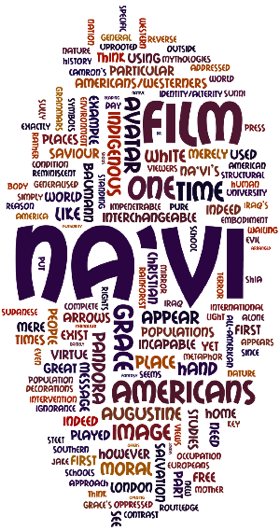
It is no traditional journal. ARDAC was developed from within a social network site (Ning) and its aim is to incorporate web 2.0 technologies, photography, video, internet‐based content as well as traditional text (not in the first issue, though). In addition to traditional abstracts, the articles have their own “word clouds” (see example on the right – from the review of the film Avatar).
The journal is innovative in another way as well: It is more inclusive towards anthropologists outside of the English speaking world: Non‐English speakers are allowed to express themselves in the kind of English that they feel familiar with rather than the kind of edited English that is standard in publications. The journal takes submissions in other languages as well. Work from individuals at early stages of their academic career are welcome as well as more senior academics and inclusive of the academic community at large.
Here a short overview over this issue from Àngels Trias i Valls’ editorial:
– (T)he first contributor, Veronica Barassi, send us an article that ethnographically narrated understandings of dissent and cultural politics through the analyses of discursive technologies and political action.
– Nick White looked at the pertinent issue of ‘copy’ and the issues of legality and illegality in music filesharing on the Internet.
– Hagai van der Host produced a fascinating review of the film Avatar, mirroring some of the ways in which film mythologies correspond to political realities, and how the levels of allegory and projection spoke for discursive discussion on orientalism, the morality of counterfeit and cultural imperialism in the American / Iraqui conflict.
– I was thankful of the opinion articles, from Clare Perkins and Stavroula Pipyrou, because they made distinctive points about the possibility of ‘re‐ directing the ethnographic lense’ (in Clare’s case of using anthropology to think about genetically modified products) and re‐telling the social appropriation of violence (in Stavroula’s Calabrian Mafia) in a way in which both articles convinced me of the possibility of using anthropology to re‐ position ourselves theoretically and in research practice in larger communities of knowledge.
– At the closing of this number Maria Paulina de Assis and Maria Elizabeth Bianconcini de Almeida brought an article that looked at the relationship between education and digital exclusion from an educational perspective and on the possibilities of multi‐ educational strategies for global educational contexts that have now consolidated through the Internet.
Is this one of the first real web2.0-journals in anthropology? A new Open Access journal was launched: Anthropology Reviews: Dissent and Cultural Politics (ARDAC)
It is no traditional journal. ARDAC was developed from within a social network site (Ning) and…
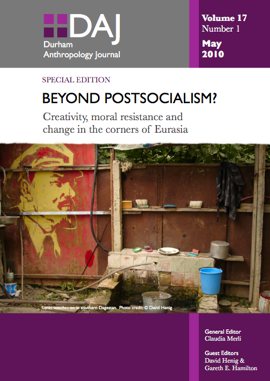
The authors want to give us alternative views on so called postsocialist societies.
Postsocialist studies, David Henig explains in his editorial, have been dominated by Western perspectives (the East as the “Other”) and also by discourses of capitalist “triumphalism” (from socialism or dictatorship to liberal democracy, from plan to market economy).
The reality is different. Anthropologists have found important continuities between socialist and post-socialist eras.
Míriam Torrens has been on fieldwork in rural Romania. Instead of postsocialism or new capitalism”, she writes, “what we find in these communities is the prevailing picture of a traditional peasanthood with some ‘innovations’”:
(B)oth socialist and liberal economists (…) have failed in taking into account the strength – and the reasons for this strength – of social institutions such as the family and the community, their customary law and the broad impact of communal and cooperative action.
Durham Anthropology Journal is an open access journal
"Beyond postsocialism? Creativity, moral resistance and change in the corners of Eurasia" is the title of the new issue of Durham Anthropology Journal.
The authors want to give us alternative views on so called postsocialist societies.
For some reason this journal has hardly been mentioned on anthropology blogs. But Anthropology Notebooks is actually one of the few serious traditional anthropology journals with free access to all articles for everybody (from 2005). And it is an expanding journal: While promising recent open access initiatives like After Culture have shut down, Anthropology Notebooks has started publishing three issues instead of one issue per year.
The journal has an international editorial board, it is peer reviewed, and it is abstracted and indexed in international bibliographic databases. All articles are in English.
For some reason this journal has hardly been mentioned on anthropology blogs. But Anthropology Notebooks is actually one of the few serious traditional anthropology journals with free access to all articles for everybody (from 2005). And it is an expanding…