search expand

Transforming the Anthropology of Childhood – Anthropology News April

Has Anthropology News gone open-access? 14 articles of the new issue are online. Anthropology News examines new ways of thinking about childhood and children’s roles and experiences. Methodological challenges of anthropological work with and of children are addressed as well.

We can read articles on children and climate change and disasters, on a successful antipoverty program for working poor adults and their children where anthropologists were involved, children as anthropologists, on children’s rights and much more.

>> overview over all articles

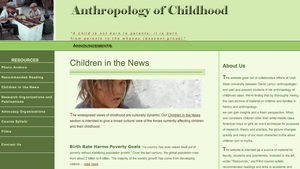
screenshot

In this issue, we also are informed about the existence of a website called Anthropology of Childhood that grew out of collaborative efforts at Utah State University between anthropologist David Lancy and past and present students in his anthropology of childhood class.

SEE ALSO:

“We want children to be their own ethnographers”

Ethnographic study: Why the education system fails white working-class children

Anthropologist calls for a greater appreciation of child labor

Technologies of the Childhood Imagination- new text by anthropologist Mizuko Ito

Play as research method – new Anthropology Matters is out

screenshot

Has Anthropology News gone open-access? 14 articles of the new issue are online. Anthropology News examines new ways of thinking about childhood and children's roles and experiences. Methodological challenges of anthropological work with and of children are addressed as well.

We…

Read more

Discovered the first-ever linguistic link between Siberia and Canada

While studying an ancient language now spoken by only a few hundred people in a remote corner of Siberia, linguist Edward Vajda has found the first-ever linguistic link between the Old World and any First Nation in Canada, the Ottawa Citizen reports. “This is a big breakthrough to be able to link these”, anthropologist Jack Ives said on Wednesday.

Vajda found that the speakers of the Ket language in Russia’s Yenisei River region, and the Athapaskan-speaking native people in Canada and the U.S. (including the Dene, Gwich’in, Navaho and Apache) use almost identical words for canoe and such component parts as prow and cross-piece.

Mr. Vajda’s claim of a Dene-Yeniseic-connection was endorsed last month at an conference in Alaska attended by linguists and anthropologists. Vajdas discovery is being compared with the 18th-century “Indo-European” revolution that ultimately classified English, French and other modern languages with ancient Sanskrit.

>> read the whole story in The Ottawa Citizen

For more information see a posts on this issue over at anthropology.net: More on Vajda’s Siberian-Na-Dene Language Link where also points of controversy are discussed.

SEE ALSO:

New website helps save Kenai Peoples language (Alaska)

Book review: Empires of the Word: A Language History of the World

While studying an ancient language now spoken by only a few hundred people in a remote corner of Siberia, linguist Edward Vajda has found the first-ever linguistic link between the Old World and any First Nation in Canada, the…

Read more

25th of April and 30th of May

We meet the last Friday in April and May.

Friday 25th of April
Cicilie F. will make a 15 minutes presentation of a paper called either “Postcolonial reappropriation of French history” or “The concept of minority and the inclusion in national memory in France” or something else in that vein. (The paper will be sent to those interested at the 20th of April, but the presentation should also be accessible for those who have not read the paper).

She will also propose to read an article related to the topic, thus something on history and anthropology.

Friday 30th of May
We read Thinking through things (Amazon.co.uk )

We meet the last Friday in April and May.

Friday 25th of April
Cicilie F. will make a 15 minutes presentation of a paper called either "Postcolonial reappropriation of French history" or "The concept of minority and the inclusion in national…

Read more

Die virtuelle Fachbibliothek Südasien (Savifa)

logo

In der Ethnologie haben wir Evifa, fuer Suedasien speziell gibt es Savifa – eine virtuelle Fachbibliothek, ein Wegweiser durch die fachlich relevanten Ressurcen im Internet. Savifa ist interdisziplinaer und wird von der Uni Heidelberg betrieben(Südasien-Institut – UB Heidelberg).

Wie suedasien.info meldet, ist soeben das erste Themenportal fertig geworden und im Netz. Es heisst Varanasi Displayed und präsentiert (An-)sichten der Stadt Varansi am Ganges, die auch Benares oder Kashi genannt wird. Das Themenportal beinhaltet eine virtuelle Fotogalerie mit Bildern des Fotografen Thomas Effinger, zwei historische Reisebeschreibungen und eine Bibliographie , die aus dem Varanasi Research Project am Südasien-Institut der Universität Heidelberg hervorgegangen ist.

logo

In der Ethnologie haben wir Evifa, fuer Suedasien speziell gibt es Savifa - eine virtuelle Fachbibliothek, ein Wegweiser durch die fachlich relevanten Ressurcen im Internet. Savifa ist interdisziplinaer und wird von der Uni Heidelberg betrieben(Südasien-Institut - UB Heidelberg). …

Read more

Examples of engaging anthropology – New issue of “Anthropology Matters”

logo

How can anthropology contribute to understanding and fighting inequality? The new issue of Anthropology Matters brings together articles from the first British postgraduate MA in Applied Anthropology and Community and Youth Work. Most of the students are experienced youth workers, working with underprivileged, marginalised youth in the UK.

As Alpa Shah writes in her editorial:

All the papers are in some form interested in the lessons from and for anthropological theory and analysis in its engagement with applied action. The articles focus on youth, encourage youth workers to be critically aware of the policy discourses with which they operate, the structural inequalities which they veil, and promote a more reflexive praxis of working with youth in order to create spaces of critical thinking between them.

One example is Saffron Burley’s analysis of the growing trend among young people in urban areas in the UK to own fighting dog breeds such as bull terriers, and the resultant “moral panic” that this has caused among dominant groups. Burley employed participant observation by taking a young Pit Bull Terrier called “Biscuit” out for walks in the area, in order to understand these young people better.

The result, Alpa Shah writes, is “an insightful ethnographic account which explores the subtle potentials that exist in the union of the young person and the dog”:

Burley’s work not only contributes to our understanding of inequality, marginalisation and animal-human relations, but concludes with some lessons for community and youth workers – rather than seeing the dogs as “problems”, as external to the young person, the dog needs to be drawn into the centre of understandings of the dilemmas and tensions faced by youth.

The issue is dedicated to an engaging anthropologist and participant of the MA course at Goldsmith who was killed in a bicycle accident in January: Paul Hendrich. In his phd-project on “Charting a new course for Deptford Town Hall”, Hendrich examines his own institutional context at Goldsmiths College and the debates surrounding the history of the racism of the British slave trade that is embedded in Deptford’s former Town Hall:

As I was putting the finishing touches to this editorial, Paul Hendrich’s wife, Sasha, called with the devastating news that Paul had been run over on his bicycle by a lorry. Paul was 36 years old and had a one year old daughter, Agatha. His death is a deep loss to all of us. Paul was a very special person with some extremely rare qualities. His life was committed to engaging an everyday struggle against racism. He held a passion and belief that anthropology could and should be used for and rethought through this struggle against racism and it is this that guided his engagement with academia.

>> read the whole editorial

>> read Charting a new course for Deptford Town Hall by Paul Hendrich

>> overview over all articles in Anthropology Matters Journal, 2008, Vol 10 (1) Engaging Anthropology

logo

How can anthropology contribute to understanding and fighting inequality? The new issue of Anthropology Matters brings together articles from the first British postgraduate MA in Applied Anthropology and Community and Youth Work. Most of the students are experienced youth…

Read more