search expand

Rundt 50 nye antropologi-oppgaver på nett!

Hittil har jeg hatt ambisjonen å omtale hver eneste hoved- eller masteroppgave som blir lagt ut på nett. Det var en enkel oppgave i begynnelsen siden antropologer publiserte langt mindre på nett enn forskere i andre disipliner. Slik er det ikke lenger. Tar du en titt på DUO – det digitale arkivet ved Universitetet i Oslo vil du legge merke til at de fleste har valgt å gjøre oppgavene sine tilgjengelig også for folk utenfor akademia.

Rundt 50 nye antropologi-oppgaver er nå lagt ut på DUO i løpet av de siste dagene, det er umulig å nevne alle men jeg skal plukke ut noen etterhvert. For en første oversikt se min oversikt over de engelskspråklige oppgavene When Norwegians do business in Brazil, Lowrider Culture and 9 more anthropology theses (part 1) eller ta en titt på DUO selv.

Hittil har jeg hatt ambisjonen å omtale hver eneste hoved- eller masteroppgave som blir lagt ut på nett. Det var en enkel oppgave i begynnelsen siden antropologer publiserte langt mindre på nett enn forskere i andre disipliner. Slik er det…

Read more

When Norwegians do business in Brazil, Lowrider Culture and 9 more anthropology theses (part 1)

(LINKS UPDATED 29.10.22) Norwegian anthropologists no longer hide their master theses in distant libraries. Most theses are now available online in digital archives. Last week, more than 20 new theses (among them 11 in English) have been put online at DUO, the digital library of the University of Oslo.

On this rainy Sunday, I’ll pick out two studies:

Doing busness in Brazil. An anthropological study of the interaction between Norwegian and Brazilian business people is the title of the theses by Anita Wold. She conducted fieldwork in a Brazilian family company that recently was acquired by a Norwegian company. Furthermore, she interviewed Norwegians working in Brazil and Brazilians working in Norwegian companies.

Her point of departure: The increase in international business has created a demand for books about cultural differences in business that are easy to grasp. But books and teaching material within the field called intercultural communication is dominated by quantitative studies. “I believe anthropological theory can provide a more fruitful analytical framework for understanding communication between people with different backgrounds and knowledge”, she writes.

She shows among other things that the dominating figures within the field of intercultural communication use a problematic perspective on cultural difference. For Hofstede (2001), Trompenaars and Hampden-Turner (1997) national identity is an imprint of values and a collective “software” in peoples’ minds that produces a distinctive national behavioural pattern. Through quantitative studies these researchers have found a small set of value-based continuums of interpretation such as individuality-collectivist, masculinity-femininity, power distance etc. (see for example Hofstede’s country profiles):

I found that most of the Norwegian managers find “the Norwegian leadership style” the best way of practicing leadership. The Brazilian leadership style is considered to be more authoritarian than the Norwegian, and few of the Norwegian managers seemed to be willing to adjust their own practice.

The Norwegians, as owners and managers, are in a position where they can define the use of management techniques and practices in the companies where they are in command. However, whenever Norwegians engage with customers in Brazil, they are not in a position to define the situation and therefore have to adapt to local practices and demands in order to sell their products.

In exploring the interaction between people with different backgrounds, I have argued against the perception of culture as it is postulated by Hofstede (2001), Trompenaars and Hampden-Turner (1997). In the present study I have argued that business practices are embedded in the local context.

Thus, in order to understand the differences encountered by the Norwegian and Brazilian business people I have demonstrated the importance of placing the practices in a cultural, historic and economic context.Thus, quantitative studies and universalistic assumptions of cultural differences fail to achieve a fruitful understanding of the contextual variations.

>> download the thesis

lowrider

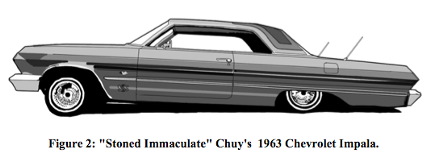
Martin Høyem has written the thesis I want my car to look like a whore. Lowriding and poetics of outlaw aesthetics. It as an extremely well written thesis and even fun to read. He captures the reader already on the first pages when he describes his first days in the field, looking for potential lowriders:

I never saw any lowrider cars in the streets, and this surprised me, since I had an impression—gathered from the material I studied before I left for the field—that the streets of LA would be packed with lowriders. I suddenly realized that my plan A of simply walking up to somebody with a lowrider asking to talk to them rested on a missing premise. I also realized I had no plan B.

At one of the first meetings with his informants, they asked him some questions:

“One thing first: Do you like Abba or Led Zeppelin?”
Chuy had presented me to everybody, in plenum, and asked that I talked a little about myself. (…) It was immediately clear to me what the right answer would be. “These guys aren’t Abba fans,” I thought to myself. And as Bourdieu points out: “Nothing more clearly affirms one’s ‘class’, nothing more infallibly classifies, than tastes in music.” (Bourdieu, 1984:18) (…) “I like Zeppelin,” I said. They all nodded and mumbled approvingly. “That was easy,” I thought.
(…)
Then one guy asked “What kind of car do you have?”
Not missing a beat—since I felt I was doing so well building credibility—I told them: “It’s a 1989 Cadillac Eldorado Biarritz. Two doors.” They didn’t like that. “Well at least it has two doors,” somebody mumbled.

For Martin Høyem it was important to contribute with new perspectives in the study of the lowrider culture:

As a result of the tendency in social studies within USA to threat themes in the light of ethnicity and gender, a major part of ethnographical studies portray the population groups they write about as exotic and describes them as physically and culturally isolated—as subcultures opposed to main-stream American culture. The same goes for descriptions of the lowrider culture, both in academic literature and in diverse types of popular culture.
(…)
The lowrider cars are traditionally described as products heavily influenced by the owner’s Mexican heritage. While there is obviously much to be said for these accounts, they often fall short of considering the class aspects in the judgment of aesthetical taste. I have pointed to data which illustrate how class background might be just as important, if not more, in an effort to analyze the cars and their owners place in the American consciousness.

Additionally, the outlaw mystique which clings to the cars and their owners is a social problem for the lowriders. (…) Perhaps the outlaw aesthetic in the lowriders play the same role as folklore did for the rise of the European romantic nationalism. Just like the scholars of that time gathered histories to demonstrate “connections with the cultural glories of supposed common ancestry” (Herzfeld 1996) the histories that are told through the outlaw aesthetic are stories seeking to establish an abstract common background.
(..)
Although the imagery tells stories of violent conflict solving, loose sexual morals, liberal use of recreational drugs and a strong focus on material values, the everyday reality for the majority of the people who parade this imagery is much more mundane; theirs is a life lived within a framework in agreement with the moral code of society.

>> download the thesis: I want my car to look like a whore. Lowriding and poetics of outlaw aesthetics

And here are the other nine new anthropology theses:

Anne Gry Venås: “School is for the lazy ones”. Local interpretations of children`s rights to education in a rural community in Guatemala

Matthew Whiting: Men & motors. Myth-making and the emulation of a past elite class

Brigt Hope: The function of the internet in the Moroccan public sphere

Marit Aune Bergstrøm: Struggling for respect and dignity. Strategies for shaping meaningful lives among persons with disability and their families in a community on the Mexican south-pacific coast

Hilde Johanne Bjugn Foss: The Hmong in the Twin Cities. Generational and gender differences in the perception of kinship, marriage and prestige

Katri Elina Matikainen: Transformative substances, knowledge and power. Affecting the course of events in a Gambian Mandinka village

Jonas Ursin-Holm Lea: Streets, skollies and coons in district six. On narratives and identity related to an area of forced removal in Cape Town, South Africa

Lene Cecilie Hellum: The face of the cowboy. Perspectives on myths and identities among Texan cowboys

Janne Waagbø: “Dancehall! – a serious thing!” Performing gender in Jamaican dancehall

UPDATE 1/10 Even more new theses in English! More in a later post.

lowrider

(LINKS UPDATED 29.10.22) Norwegian anthropologists no longer hide their master theses in distant libraries. Most theses are now available online in digital archives. Last week, more than 20 new theses (among them 11 in English) have been put online at…

Read more

Nun auch Live-Blogging vom der Tagung der Deutschen Gesellschaft für Völkerkunde

Nach dem Live-Blogging bei der Volkskunde-Tagung Bilder Bücher Bytes wird es nun auch Live-Blogging bei der Ethnologen-Tagung geben. Die Volkskundler haben innerhalb nur weniger Tage eine imponierende Sammlung an Texten, Podcasts und Bildern zusammengestellt.

Am morgigen Montag startet die…

Read more

Conflict Resolution and Anthropology: Why more scholarship on violence than on peace?

Is it because the academe rewards critique rather than advocacy? Conflict resolution studies, Mark Davidheiser and Inga E Treitler write in Anthropology News September, are “not widely acknowledged within our discipline” and are “rarely published in mainstream anthropological journals”.

Is it because these studies are often written to be intelligible to a broad audience, they wonder:

Addressing an interdisciplinary readership makes it impractical to philosophize on the finer points of specialized topics like agency and employ the latest anthropological jargon. A prominent case in point is the bestselling Getting to Yes, coauthored by anthropologist William Ury. Getting To Yes did not foreground anthropological themes, and while it has been read by many public health practitioners and management professionals, it has received scant attention within anthropology.

One may justifiably wonder why anthropology has not engaged conflict resolution in a more sustained manner. As Leslie Sponsel and Thomas Gregor emphasize in The Anthropology of Peace and Nonviolence, there has been much more scholarship on violence than on peace. The fact that their book has long been out of print only underlines their point.

>> read the whole article “Conflict Resolution and Anthropology: An Analytic Introduction and a Call for Interdisciplinary Engagement” (link updated)

In his historical overview of anthropology and Conflict Resolution, Kevin Avruch writes that most of anthropologists’s early involvement was dedicated to the problem of getting the field to take the idea of culture seriously. They faced two main hurdles. First, the political scientists and international relations folk took power to be the only “variable” that counted. Second, the psychologists assumed that given the biogenetic unity of the human brain, we must all think and reason in the same way, and so, say, decision-making (as in negotiation) must look the same everywhere.

>> read the whole article: A Historical Overview of Anthropology and Conflict Resolution (link updated)

Günther Schlee stresses that an important finding of anthropological research is related to causes of conflicts:

Ethnicity is not the cause of so-called ethnic conflicts. The corresponding thesis about religion is that religion is not the cause of religious conflicts. We continue to talk about ethnic or religious conflicts, because there is much about such conflicts that is indeed ethnic or religious—just not their causes. Frequently, ethnic or religious polarization only starts to emerge in the course of a conflict, and that is certainly the wrong time to be looking for a cause.

>> read the whole article “The Halle Approach to Integration and Conflict” (link updated)

As Mark Davidheiser and Inga E Treitler writes, there are anthropologists who argue that conflict resolution can be seen as an ideology that subverts access to “justice”. One of them is Laura Nader.

In her article in Anthropology News, she writes:

Conflict, adversarialness, dissent, confrontativeness are tools used in asymmetrical situations to right a real or perceived wrong—the collision of force with opposing force. In the absence of such opposing force there is acquiescence, subordination, passivity, apathy—features associated with Brave New World or 1984 societies.
(…)
Looking back on our study of consumer justice makes me realize that conflict, confrontativeness, adversarial law would have produced much more benefit for our society than the harmony and reconciliation industry, in terms of improved products, citizen participation (rather than apathy), and an investment in our judicial system appropriate to a country that espouses democratic rule.
(…)
The search for justice is both fundamental and universal in human culture and society. Thus, as long as there is power asymmetry one can expect conflict.

>> read the whole text “What’s Good About Conflict?” (link updated)

Leslie E. Sponsel is one of several anthropologists who contribute to the website Peaceful Societies. Alternatives to Violence and War

SEE ALSO:

Applied anthropology – A wedding ceremony in support of peace in West Timor

Book review: An Anthropological Challenge to Assumptions about War and Violence

Mahmood Mamdani: “Peace cannot be built on humanitarian intervention”

Challenges of Providing Anthropological Expertise: On the conflict in Sudan

Anthropologists on the Israel-Lebanon conflict

Anthropology in a Time of Crisis. A Note from Nepal

Cameroon: “Ethnic conflicts are social conflicts”

Do anthropologists have anything relevant to say about human rights?

Is it because the academe rewards critique rather than advocacy? Conflict resolution studies, Mark Davidheiser and Inga E Treitler write in Anthropology News September, are "not widely acknowledged within our discipline" and are "rarely published in mainstream anthropological journals".

Is…

Read more

Ethnobotany in Britain: Anthropologists study social networks around plants

Ethnobotany in not only about “exotic” plants in the rain forest: “The ethnobotany of British home gardens: diversity, knowledge and exchange” is the title of a new research project at the Department of Anthropology at the University of Kent. Among other things the anthropologists will look at the the social networks along which plants and knowledge are exchanged.

“We hope to be able to demonstrate scientifically the wider value of home gardens beyond the material worth of the land that they occupy”, Simon Platten explains. “We wish to learn how people learn to become good home gardeners. Whilst biological diversity in itself is important, so are the skills and knowledge that maintain it”, project director Roy Ellen says.

Despite high rates of participation in gardening there is according to him relatively little work on the basic social, cultural and ethnobotanical dimensions of home gardening.

>> read the whole story at Scenta

>> more information about the research project

SEE ALSO:

New Research Study about Traditional Folk Knowledge related to Plants in Albania

Lowly weeds may hold promise for curing host of common health woes

Journal of Ethnobiology and Ethnomedicine – New Open Acces Journal with RSS feed

Ethnobotany in not only about "exotic" plants in the rain forest: "The ethnobotany of British home gardens: diversity, knowledge and exchange" is the title of a new research project at the Department of Anthropology at the University of Kent. Among…

Read more