search expand

Ethnography under colonialism: what did Evans-Pritchard think of it all?

“When the Government of the Anglo-Egyptian Sudan asked me to make a study of the Nuer I accepted after hesitation and with misgivings” (Evans-Pritchard 1940: 7).

“A Government force surrounded our camp one morning at sunrise, searched for two prophets who had been leaders in a recent revolt, took hostages, and threatened to take many more if the prophets were not handed over. … It would at any time have been difficult to do research among the Nuer, and at the period of my visit they were unusually hostile, for their recent defeat by Government forces and the measures taken to ensure their final submission had occasioned deep resentment. Nuer had often remarked to me, ‘You raid us, yet you say we cannot raid the Dinka’; ‘you overcame us with firearms and we had only spears. If we had had firearms we could have routed you’; and so forth. When I entered a cattle camp it was not only as a stranger but as an enemy, and they seldom tried to conceal their disgust at my presence, refusing to answer my greetings and even turning away when I addressed them” (ibid. p. 11).

There is no other anthropologist I’ve read so extensively and thoroughly as Evans-Pritchard. I love how he makes reference to his arguments over witchcraft with members of the Azande community. His ethnographic descriptions of situations and even individuals in Witchcraft, Oracles, and Magic among the Azande are so “thick”, that you are allowed judge by yourself whether you agree with his theoretical analysis or not. When I reread The Nuer a couple of weeks ago, my hero disappointed me.

The book is nothing but generalisations – there isn’t one event, one situation, one individual mentioned after the short introductory chapter. Not even his one “constant companion in Nuerland” Nhial (p.10), who must have been indispensable in acquiring knowledge of the fierce and hostile Nuers appears in the text proper. He leaves us with an image of Nuer society as a seamless, timeless whole* devoid of real human beings. But as we know from his own introduction, Nuerland is in full anti-colonial revolt at the moment of writing. And in Evans-Pritchard’s own tent, young and proud Nuer men “endlessly visit”, talking about nothing but cattle and girls (which “led inevitably to that of cattle” :D ) and asking for tobacco without bothering to answer his questions.

Like anyone who’s been through a graduate course in social anthropology, I was of course familiar with the critique. However, my recent interest in colonial encounters gives an extra edge to reading 70 years old ethnographic descriptions by a white Brit in East Africa (Bourdieu among the Kabyle has certainly moved up on my reading list).

“I … never succeeded in training informants capable of dictating texts and giving detailed descriptions and commentaries. This failure was compensated for by the intimacy I was compelled to establish with the Nuer. As I could not use the easier and shorter method of working through regular informants I had to fall back on direct observation of, and participation in, the everyday life of the people. … Information was thus gathered in particles, each Nuer I met being used as a source of knowledge, and not, as it where, in chunks supplied by selected and trained informants. … Azande would not allow me to live as one of themselves ; Nuer would not allow me to live otherwise. … Azande treated me as a superior ; Nuer as an equal” (Ibid. p. 15).

Between the lines of this cold and “objective” ethnography, I read a lot of respect for the Nuers. But how on earth could this brilliantly alert and bright anthropologist not reflect on his own position as employed by the colonial – and so obviously repressive and violent – government. And equally puzzling: how can he treat the fact that he moves around with black servants (not Nuers, of course!) as such a matter of course? From the previous quote it even sounds like he usually treated his informants as servants… (This classical photo from Monica’s blog apparently gives a good indication of his relationship with the Azande).

A student alerted me to the fact that Evans-Pritchard lead African troops against the Italians in Eastern Africa during the WWII (Wikipedia). After seeing the French film Indigènes (see earlier blog post) on how the French colonial troops were treated during the war, I cannot but wonder how my predecessor treated his own soldiers.

*) This seamless whole is in fact what he wanted, as he writes that he wanted to write a new kind of monograph where the development of theory isn’t drowned in ethnographic detail.

“When the Government of the Anglo-Egyptian Sudan asked me to make a study of the Nuer I accepted after hesitation and with misgivings” (Evans-Pritchard 1940: 7).

“A Government force surrounded our camp one morning at sunrise, searched for two prophets who…
Read more

Existence! Resistence! …eh back in Oslo


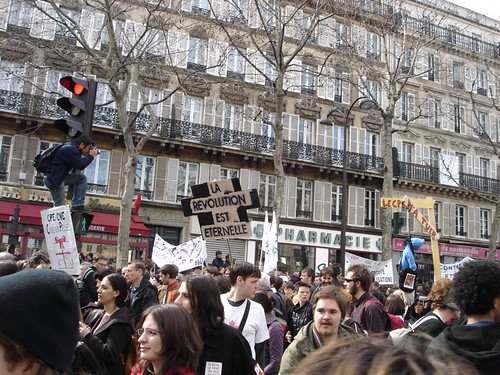
4th of April 2006, from one of the many demonstrations against the new labour law

It’s almost two months since I left Paris and time is overdue to get going with the second phase of this blog. One thing is certain; one will always have Paris, but for the time being it will be a long-distance relationship, slowly withering into a mythical landscape which hopefully will help me making some anthropological sense of it. (A landscape I hope will be fuller of poetry and revolt, than social organisation, cultural artefacts and postcolonial theory :-) ).
[teaserbreak]
As some squandered drops of water unfortunately landed on my thereafter defunct laptop, the unfinished blog post from my last day in Belleville is no longer accessible. I’m now unable to get back to how I felt having my last croissant beurre and coffee at Zorba, my last walk through the street market at the boulevard and the narrow, winding streets of the hill above, my extravagant last lunch (almost raw grilled tuna [never, ever complain that something is too raw in France, if you want to keep up apparences being at least partly cultivated despite some obvious traits of the noble savage from up North]) at the local Asian/fusion restaurant. Luckily, the highlights from the conversation with the Moroccan taxi-driver on the way to the airport are still safe in my little cahier. While drinking my glass of white wine at the restaurant, I remember thinking about the expression “a heavy heart”. I was feeling it physically. Not sorrow or sadness. Just a heavy feeling in my chest.

This evening I revived some of the sentiment of being in Paris, when I saw Je suis né d’une cigogne by Tony Gatlif (Eng. wikipedia) at the cinematheque. The film is from 1998, but the themes appear to be ever-present in France the last 20 or even 30 years. The first scene in the film was a demonstration, with people carrying huge banners proclaiming Existence! Résistance! while shouting tous ensemble tous ensemble (“everybody together”) just like they did during my fieldwork. In the banlieues life was drab and the flats crammed. The unemployed protagonist was selling L’Itineraire (a local version of The Big Issue, or =Oslo), an Arab immigrants felt pas chez nous (not at home), while another replaced his son’s name Ali with Michel (“because everyone here’s called that”) while eating pork with his family (the director’s real name is Michel, and he is of Algerian Andalusian Roma origin), and an old lady guarded her last Luis XVI chair from the insensitive bailiff while claiming she knew [the socialist] Jaurès, [the anarchist and communard] Louise Michel and fought for the commune and the intellectual little Ali, after having torched his father’s car, read La société du spectacle and listened to anarchists on Radio Libertaire talking about Algeria. The characters were angry and a little bit crazy and it was all recognisable and quite French to me.

This anarchic atmosphere, the anger and revolt, is the first aspect of Paris I’ll try to describe. In the four weeks, I’ll have ready a paper for a seminar with the – oh! gosh – so romantic title “Revolutionary Paris”. But before that brief return to Paris (to intellectual – and bourgeoise – rive gauche this time, except for a guided visit to Le mur de fédérés where the last communards got shot) for the seminar, I’ll get through the final stage of the local election campaign, half a ton of monographs and anthropological literature for the seminars I teach, colder autumn days (cyclists are already wearing gloves in the morning) and perhaps some more blog posts.

4th of April 2006, from one of the many demonstrations against the new labour law

It’s almost two months since I left Paris and time is overdue to get going with the second phase of this blog. One thing is certain;…

Read more

Why were they doing this work just to give it away for free? Thesis on Ubuntu Linux hackers

thesis-cover

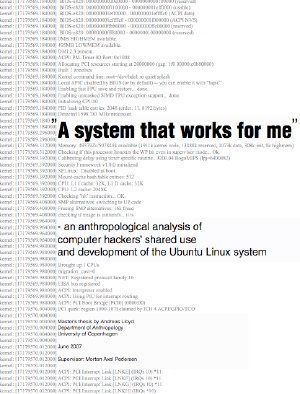
It all started when anthropologist Andreas Lloyd (University of Copenhagen) was browsing on the Internet looking for a new laptop computer and ended up installing the free Windows alternative Linux. Two years later, he finished his master thesis “A system that works for me” – an anthropological analysis of computer hackers’ shared use and development of the Ubuntu Linux system.

The thesis is a study of the Internet Gift Economy. Linux is developped by computer geeks saround the world, collaborating over the Internet, building a computer operating system in their spare time, which can be downloaded, installed, used and modified completely for free. It is among the biggest and most complex engineering projects ever conceived and built:

Based on more than 2 years of daily use of the Ubuntu Linux system and 6 months of online and in-person fieldwork among the developers working to develop and maintain it, this thesis examines the individual and collaborative day-to-day practices of these developers as they relate to the computer operating system that is the result of their labour.
(…)
A group of Spanish computer scientists measured the size of a Linux system similar to Ubuntu, and found that it contained around 230 million lines of source code. When they translated this into the effort spent on writing this code using a standard software industry cost estimate model, they found that it would correspond to almost 60.000 man-years of work (Amor-Iglesias et. al. 2005). By comparison, it took an estimated 3.500 man-years to build the Empire State Building in New York, and 10.000 man-years to build the Panama Canal. This immense effort makes modern operating systems such as Ubuntu among the biggest and most complex engineering projects ever conceived and built.

So the anthropologist was curious to learn more about how the hackers collaborate to build such an intricate system, and to learn why they were doing all of this work just to give it away for free.

How do you do fieldwork among hackers around the world? He explains:

I joined the Ubuntu on-line community on the same terms as the Ubuntu hackers, contributing to and using the same system, sharing their experiences with the system, and meeting them in-person on the same terms as they do at the conferences at which they gather, experiencing the same social and technical means and limitations through which they develop the system.
(…)
In order to do participant observation in this on-line space, I began contributing to the system by writing the system help and documentation, rather than the system itself due to my lack of technical understanding. In this way, I could take part in shaping Ubuntu alongside other community members while slowly developing a feel for the everyday exchanges and work in the community.

His thesis is by the way neither dedicated to any girl friend nor his parents:

In the true digital spirit of this work, I dedicate this thesis to Rosinante, the laptop on which I first experienced the Ubuntu system, and which was my faithful companion during my fieldwork and the writing of this thesis, only to bow out a week before tsafe for so long.

>> download the thesis

(Links updated 11.1.17)

SEE ALSO:

The Internet Gift Culture

Open source movement is like things anthropologists have studied for a long time

Open Source Fieldwork! Show how you work!

Gift economies and open source software: Anthropological reflections

Why you always get a present you don’t want – Social Sciences and Gift-Giving

Mobile phone company Vodafone gets inspired by traditional Kula exchange system

Open Source Anthropology : Are anthropologists serious about sharing knowledge?

2006 – The Year of Open Access Anthropology?

thesis-cover

It all started when anthropologist Andreas Lloyd (University of Copenhagen) was browsing on the Internet looking for a new laptop computer and ended up installing the free Windows alternative Linux. Two years later, he finished his master thesis "A…

Read more

“Anthropology = Smarter Counterinsurgency”

Another article about military anthropologists: The Christian Science Monitor writes about anthropologist “Tracy” who helps the US Army in their war against Afghanistan. Tracy “can give only her first name” to the journalist:

Evidence of how far the US Army’s counterinsurgency strategy has evolved can be found in the work of a uniformed anthropologist toting a gun in the mountains of eastern Afghanistan. Part of a Human Terrain Team (HHT) – the first ever deployed – she speaks to hundreds of Afghan men and women to learn how they think and what they need.
(…)
Finding ways to challenge that fear – and learn what makes Afghans choose to support the government or its enemies – is the job of the HTT. The key ingredient is a “senior cultural analyst,” in this case, Tracy, the anthropologist in uniform.

She has interviewed hundreds of Afghan women and men, sometimes for hours on end, hearing how most are “so tired of war.” In nine months, Tracy has gained deep knowledge, she says, aimed at helping “fill the vacuum that the Taliban and other nefarious actors want to fill.”

Tracy tells Afghans that she wants to “enhance the military’s understanding of the culture so we don’t make mistakes like in Iraq.” But the bar is high, and this village with the medical clinic shows signs of militant influence, such as being “coached.”

Still, Tracy says that she sees real progress, “one Afghan at a time.” And the US military’s views are evolving accordingly, away from firepower to a smarter counterinsurgency.

“It may be one less trigger that has to be pulled here,” Tracy says of the result. “It’s how we gain ground, not tangible ground, but cognitive ground. Small things can have a big impact.

>> read the whole story in the Christian Science Monitor

SEE ALSO:

The dangerous militarisation of anthropology

“Tribal Iraq Society” – Anthropologists engaged for US war in Iraq

Military – social science roundtable: Anthropologists help mold counterinsurgency policy

Protests against British research council: “Recruits anthropologists for spying on muslims”

More and more anthropologists are recruited to service military operations

Military anthropologist starts blogging about his experiences

San Jose: American Anthropologists Stand Up Against Torture and the Occupation of Iraq and AAA Press Release: Anthropologists weigh in on Iraq, torture at annual meeting

“War on terror”: CIA sponsers anthropologists to gather sensitive information / see also debate on this on Savage Minds

Another article about military anthropologists: The Christian Science Monitor writes about anthropologist "Tracy" who helps the US Army in their war against Afghanistan. Tracy "can give only her first name" to the journalist:

Evidence of how far the US Army's…

Read more

Ny bok: Hvorfor skyter de?

bok-cover

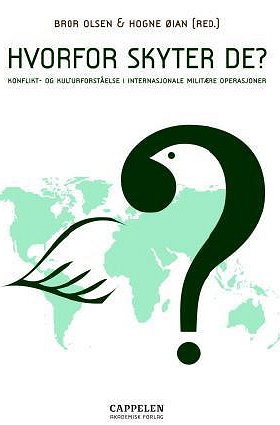
“Boka er såpass god og viktig at den ønskes inn som pensum både på Befalskolen og Krigsskolen”, melder Forsvarsnett. Antropologene Bror Olsen og Hogne Øian har nettopp gitt ut boka Hvorfor skyter de? der ni soldater skriver om selvopplevde konflikter i Afghanistan, Libanon, Bosnia og Kosovo.

En av offiserene, Svein Kyrre Ludviksen fortalte at de fikk andre syn på konfliktene de hadde vært med på etter skriveprosessen, og beskriver boka som et nyttig verktøy i kulturforståelse og forståelse for et ganske nytt handlemønster, “four block war”.

>> les hele saken i Forsvarnett

>> offisiell info om boka (UiT)

SE OGSÅ:

I Sverige: Antropologer utdanner soldater

Fredrik Barth underviste Hæren om Afghanistan

Månedens antropolog: Tone Danielsen – rådgiver for Forsvaret

Antropress: Forsvaret sponser undervisning – antropologi og rasisme

“War on terror”: CIA sponsers anthropologists to gather sensitive information

Embedded anthropology? Anthropologist studies Canadian soldiers in the field

The dangerous militarisation of anthropology

bok-cover

"Boka er såpass god og viktig at den ønskes inn som pensum både på Befalskolen og Krigsskolen", melder Forsvarsnett. Antropologene Bror Olsen og Hogne Øian har nettopp gitt ut boka Hvorfor skyter de? der ni soldater skriver om selvopplevde konflikter…

Read more