search expand

Kommersialisering av forskning: Artikkel om aidssyke barn uønsket

Ikke bare dagsaviser er populistiske: En artikkel om afrikanske barn som har blitt foreldreløse som følge av aidsepidemien, ble avvist av et internasjonalt tidsskrift – ikke på grunn av forskningskvaliteten, men fordi leserstatistikk viste at tematikk knyttet til avgrensede afrikanske områder ikke var interessant, melder På Høyden. Tidsskriftet heter Journal of Children and Poverty.

Psykologiprofessor Gro Therese Lie leder en tverrfaglig utviklingsrelatert forskningsgruppe som samarbeider med afrikanske universitet om utfordringer knyttet til hiv/aids-problematikk og fattigdom. Hun peker på at studier fra fattigere deler av verden og studier som omhandler marginaliserte grupper ofte blir sett på som uinteressante av vestlige referee-baserte tidsskrift. Hun sier til På Høyden:

– Mange ganger er forskningskvaliteten vurdert som god, men temaene blir ikke funnet ”verdige”. Når markedsstyrte leserundersøkelser brukes som begrunnelse for å la være å ta inn tematisk relevante artikler fra Afrika er det ganske provoserende.
(…)
Både midler og prestisje avhenger i stor grad av at vi får publisert i meritterende tidsskrift.

I artikkelen som ble avvist, hadde forskerne sett på vilkårene for foreldreløse i østafrikanske områder. Utgangspunktet har vært å studere hva som kan styrke mestringsevnen, kompetansen og den psykososiale helsen hos barna og hvordan man kan støtte deres omsorgspersoner og nærmiljø.

10 prosent av helseforskningen i verden retter seg mot sykdommer som først og fremst rammer marginaliserte befolkninger i lav- og mellominntektsland. 5 prosent av helseforskningen i Norge retter seg mot de helseproblemene som utgjør 90 prosent av sykdomsbyrden globalt.

>> les hele saken i På Høyden

Antropolog og medieviter Anders Johansen har samtidig skrevet en essay i UiBs nettmagasin Vox Publica. Norske myndighetenes mål på kvalitet er salgbarhet:

Formidling er, i [Formidlings-]utredningen, mer eller mindre det samme som salg. Første punkt på listen over det som skal påskjønnes, er ”eksterne inntekter fra salg av tjenester og publikasjoner.” Mens nettet åpner nye muligheter for effektiv, gratis spredning av kunnskapene, skal vi nå altså oppmuntres til å behandle dem som handelsvarer, og begrense tilgangen deretter. (…)

Men det er ideen om ”formidling i dialog med brukerne” som er det sentrale budskap i denne utredningen. Med det menes kort og godt kommersialisering. Det er dét man nå ”i særlig grad vil stimulere til”. Å sørge for at kunnskapen kommer til nytte for folk som kan betale for det, er å drive ”brukerrettet formidling”.

(…)
Det står ingen ting i denne utredningen om ansvar for en levende offentlighet, ingen ting om sivilsamfunnet. ”Samhandling med næringslivet” vies mye oppmerksomhet – og det kan være viktig nok – men ikke engasjement i frivillige organisasjoner.

Aksjeposter teller med, men – uttrykkelig – ikke debatt: Utvalget gjør regning med at forskere også kan være forretningsdrivende, men ikke intellektuelle eller aktivister. Den gamle begrunnelsen for samfunnskontakt – forpliktelsen til demokratiet – er fullstendig fraværende.

>> les hele saken i Vox Puplica (takk til infodesign.no for linken)

SE OGSÅ:

Børs og bibliotek: Det er bonanza i kunnskapsmarkedet

Formidling på blindspor (Nå vil Kunnskapsdepartementet styrke formidlingsinnsatsen – med et system som vil bidra til kommersialisering – Aftenposten, 20.10.06)

På vei til akademisk apartheid? (: Hvis en norsk forsker publiserer resultatene om fattigdomsbekjempelse på et forlag i Kenya for å gjøre dem tilgjengelig for lokalbefolkningen, blir han straffet – egen tekst, 4.6.06)

Tellekantsystemet: “Forskningsfinanseringen en trussel mot vitenskapen og demokratiet”

Å gjenoppfinne samfunnsvitenskapen fra et afrikansk perspektiv

Farvel til gaveøkonomien? Hylland Eriksen varsler døden for den frie kunnskapsutvikling

Spesial: Open Access Anthropology

Ikke bare dagsaviser er populistiske: En artikkel om afrikanske barn som har blitt foreldreløse som følge av aidsepidemien, ble avvist av et internasjonalt tidsskrift - ikke på grunn av forskningskvaliteten, men fordi leserstatistikk viste at tematikk knyttet til avgrensede afrikanske…
Read more

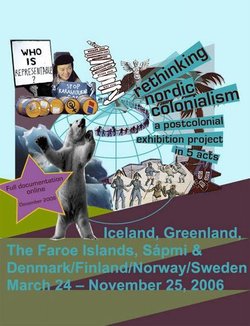
Rethinking Nordic Colonialism – Website Sheds Light Over Forgotten Past

plakat 56 artists, theorists, politicians, and grassroots activists from all over the world participated in the project that took place in Iceland, The Faroe Islands, Sapmi, Norway, Sweden and Finland. They exchanged colonial and postcolonial experiences and strategies, examined why this past has been forgotten and how it continues to reproduce itself as waves of intolerance, xenophobia, and nationalism.

A week ago the (impressive!) website of this project (which has also been published on DVD) has been launched in Oslo. You can spend hours and days, reading the papers, watching videos and movies, looking at exhibitions, listening to presentations.

In the introduction Frederikke Hansen and Tone Olaf Nielsen explain:

The colonial history of the Nordic region is a dark chapter that seems to have slipped the memory of many of the Nordic populations. Although it continues to make itself very much felt in the region’s former colonies, this history is alarmingly absent in the collective memory of the once-colonizing Nordic countries.

With Rethinking Nordic Colonialism: A Postcolonial Exhibition Project in Five Acts, we aim to shed light over this history. Not only do we hope to explain why this past has been forgotten in some parts of the region. We also want to show how this history continues to structure the Nordic societies today, and how our contemporary problems of intolerance, xenophobia, and nationalism have their roots in this past.

I’ll come back with more blog posts about this website

>> visit Rethinking Nordic Colonialism

SEE ALSO:

An exhibition and a movie: The French, colonialism and the construction of “the other”

Anthropology and Colonial Violence in West Papua

“A postcolonial urban apartheid”: Two anthropologists on the riots in France

The Five Major Challenges for Anthropology

plakat

56 artists, theorists, politicians, and grassroots activists from all over the world participated in the project that took place in Iceland, The Faroe Islands, Sapmi, Norway, Sweden and Finland. They exchanged colonial and postcolonial experiences and strategies, examined why this…

Read more

“Don’t transfer all copyrights to the publisher”

Is it okay to publish your own journal articles on your website? Won’t you violate any copyright? No problem! Publishers are quite flexible if you let them know you are just going to include a copy of your article on your own website or on your institution’s website, according to the most recent entry in the Open Access Anthropology Blog.

But important: Many publishers ask the author to transfer all copyrights in the work to the publisher. Don’t give them all copyrights! They quote Peter Hirtle who in his article Author Addenda: An Examination of Five Alternatives proposes an author’s addendum — “a little bit of legalese that you add to the agreement with your publisher and sign that lets you save the rights you need in order to make your work open access”.

>> read the whole entry: Author’s right agreements: how to make them work for you

For example when I published the (rather short) article Cosmopolitanism and anthropology/ in Anthropology Today, it was no problem to delete the second part of this part of the copy right agreement:

In consideration of the publication of the Article in the above Journal, I hereby warrant and undertake:
a. that this Article is an original work, has not been published before and is not being considered for publication elsewhere in its final form either in printed or electronic form.

SEE ALSO:

antropologi.info Open Access Anthropology Special

Is it okay to publish your own journal articles on your website? Won't you violate any copyright? No problem! Publishers are quite flexible if you let them know you are just going to include a copy of your article on…

Read more

For free migration: Open the borders!

Given the continuing massive disparities in wealth between Europe and Africa, immigration is unlikely to stop anytime soon. Remittances sent by migrants are the second most important income source for many countries in the south. Border control is expensive and ineffective. So why not open the borders? Free migration for all?

In his blog On distance, Anthropologist and journalist Joshua Craze discusses some arguments for free migration – to be published in Cafe Babel.

One of the most prominent lobbies to back the idea of opening up all our frontiers is the free-market right:

Free marketeers point out that in 2005 over a third of Europe’s regions were facing a declining labour force. Immigration, they argue, fills this need, and it also fills skills shortages (in both low and high skilled jobs) that will allow our economy to grow.
(…)
Such proposals may seem like a further extension of the dominion of the market: it would be businesses who effectively control the borders they have long since bypassed. However, in another sense such proposals are essentially a vanguard action; they preserve existing notions of citizenship, and immigration follows the model of the German guest worker, or gastarbeiter. (…) They priveledge capital’s need for labour and do not address the humanitarian problems of immigration. As Max Frisch noted of the Turkish gastarbeiter: ‘We called for a workforce, but we got humans.’

The political left forms the other part of the open borders movement:

Raffaele Marchetti argues that we shouldn’t think about open borders in terms of how it can benefit us, but in terms of the universal right to free movement. Why should Europeans be allowed to holiday wherever they want while Africans cannot even come to Europe to work?

Such a proposal has a number of humanitarian advantages. You stop people trafficking and the attendant loss of life and human rights violations, as people would be able to enter the country legitimately. Then there is the massive financial cost of maintaining Fortress Europe which would be saved. A recent report by the International Organisation of Migration shows that five OECD countries spent two-thirds as much on border controls as they did in official development assistance. Removing this boundaries would also mean removing the massive humane cost of people trying to scale the wall and cross the sea to get to Europe.

>> read the whole text by Joshua Craze

Strangely enough, I’ve written a piece about the same topic at the same time (in Norwegian), inspired by an article about a new book by political scientist Jonathon Moses (Norwegian University of Science and Technology). In International Migration: Globalization’s Last Frontier he argues for free mobility.

He adds an economic and historic perspective and shows that free migration helps fighting poverty in a much more effective way than free trade (and development aid).

On his website you can download – among others:

Exit, vote and sovereignty: migration, states and globalization
Increased mobility is shown to improve the responsiveness of governments to citizen demands. In a world characterized by relatively free mobility for other factors of production (and their owners), labor/voters appear to be handicapped by being prisoners of territory.

The Economic Costs to International Labor Restrictions: Revisiting the Empirical Discussion

Two (Short) Moral Arguments for Free Migration

For a good summary for see also Kevin H. O’Rourke (2003): The Era of Free Migration: Lessons for Today

Both Kevin H. O’Rourke and Jonathon Moses remind us of the fact that borders are a relatively new phenomenon and therefore claims for open borders are not unrealistic. According to the book Norsk innvandringshistorie (Norwegian immigration history), the Norwegian government decided in 1870 that borders are outdated, something that belong to despotic regimes.

But O’Rourke stresses in The Era of Free Migration: Lessons for Today the important role of the national state. Labour market regulation (e.g. minimum working ages, the prohibition of night work, limits on the working day or factory inspections) and social insurance (e.g. accident compensation; or unemployment, sickness or old age insurance) are neccessary, otherwise native workers’ living standards would inevitably be eroded by mass immigration (wage dumping / social dumping)

SEE ALSO:

Research: How migration fights poverty

Migration and development – a report from Tonga

Raffaele Marchetti: Migration needs global regulation based on the principles of free movement and universal justice

Liza Schuser: Keeping alive the possibility of a free migration, “open borders” policy is an investment in everyone’s future

Chukwu-Emeka Chikezie: Africans’ initiative, symbolised by diaspora remittance flows, is the key to liberation (part of a larger debate at Opendemocracy.net)

More Global Apartheid? (The South African system came to an end just as the rest of the world was reinventing it in new forms.)

Why borders don’t help – An engaged anthropology of the US-Mexican border

“Anthropologists Should Participate in the Current Immigration Debate”

See also more articles by Joshua Craze in Cafe Babel and SaudiDebate

Given the continuing massive disparities in wealth between Europe and Africa, immigration is unlikely to stop anytime soon. Remittances sent by migrants are the second most important income source for many countries in the south. Border control is expensive and…

Read more

Oxford to Host First Conference on Visual Anthropology of Iran

The first Interdisciplinary Conference on the Visual Anthropology of Iran entitled “Images of Culture, Culture of Images” is to be held in Oxford University in September 2007, according to a press release.

The two-day conference on the Visual Anthropology of Iran, organized by the Society for Iranian Anthropology (SIRA), is the very first of its kind. The participants will investigate on different issues such as nomadism, rituals and ceremonies, war, gender, aesthetics and language in Iran and its relationship with the other countries.

The SIRA says in its announcement:

Since the 1990s, there has been a growing interest in Iranian cinema which is now internationally recognized as one of the most original and prolific cinemas of all times and whose aesthetics and culture have in the twenty-first century increasingly appealed to a mass audience. The study of visual anthropology is motivated by the belief that one can understand the culture of some people by looking at visual symbols such as gestures, rituals, ceremonies and works of art.

>> call for papers “Images of Culture- Culture of Images”

SEE ALSO:

Photography as research tool: More engaged Kurdish anthropology

Anthropologist: Iranian Nomads Constitute Cultural Treasure

Photos and songs from fieldwork in Siberia, reflections on ethnographic photographing

Anthropological Films online

The first Interdisciplinary Conference on the Visual Anthropology of Iran entitled “Images of Culture, Culture of Images” is to be held in Oxford University in September 2007, according to a press release.

The two-day conference on the Visual Anthropology of Iran,…

Read more