
search expand

What’s the point of anthropology conferences?

panel

I’m back from the conference Anthropology and Cosmopolitanism at Keele University (1h from Manchester, UK). As I’ve learned from entries on Savage Minds, job hunting and networking are a main point of anthropology conferences arranged by the AAA (American Anthropological Association). Luckily, this wasn’t the case with the conference I’ve attended last week: The main purpose seemed to be socialising – without ulterior motives: The participants were very friendly and open people. It seemed to be that I’ve talked at least to the half of all participants.

The topic – cosmopolitanism – seemed to have attracted a certain kind of people. “There are nearly no Americans here”, one delegate wondered. Usually, lots of Americans attended conferences arranged by the Association of Social Anthropologists of the UK and Commonwealth. What I found most striking: The largest part of all delegates were migrants!

Nearly none of them is working at a University in the country they were born. I met an anthropologist from Sri Lanka who’s working in the USA, another anthropologist working in Canada, originally from Turkey but – as she said – “a product from Norway”. There were quite a lot of German anthropology migrants living in the UK, and from Switzerland and Italy. A woman wore a badge with “Aberdeen University” on it. Of course, she told me that she’s from Malta!

colson

Many participants appreciated the social events. In contrast to other conferences, nobody left the venue after the day’s final lecture. There was nowhere to go as the University of Keele is a kind of academic ghetto, located far away from the nearest village. And the lectures actually lasted until 11 o’clock at night! I especially enjoyed these less formal after-dinner lectures – held by Elizabeth Colson (see picture to the right), by Andre Beteille and a debate on Robert Hayden’s ‘Shared Shrines, Syncretism and Tolerance’ in the old library (see image below), published in Current Anthropology.
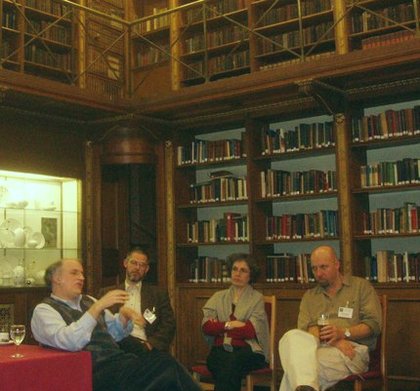
old library

But concerning the topic of the conference, I wonder if I might have learned more if I had stayed at home and read the papers on my own. There were many very weak presentations: Most paper-givers read their papers monotonously and went over time. There was never enough time for discussion. Furthermore, generally three or four papers were read one after another without any breaks in between! It reminded me of the worst seminars during my first year at university.

Several participants left these panels before they ended. After a short walk in the sun, I met a young PhD-student. He was as frustrated as me: “It’s my first and probably my last conference”, he told me.

I wondered: Is the main purpose of a conference to deliver a paper in order to get it listed on one’s CV as John McCreery supposes while we discussed the topic How To Present A Paper?

“If you want to be considered a serious academic you have to read your paper. That’s standard and just the way it is”, one of the elder anthropologists informed me.

Some papers haven’t even had much to do with the topic of the conference (a few paper-givers admitted it openly!).

On the last day of the conference, Keith Hart said (maybe too harshly?): “Anthropologists don’t care for cosmopolitanism. It’s just an excuse to come together. We’re not engaging in the world. We don’t talk about Iraq and Iran. Our detached discourse lacks wider relevance.”

As I’ve found out afterwards, Keith Hart had said something that many delegates agreed with. The organisers had asked great questions about cosmopolitanism, but we haven’t heard many concrete answers. I missed debates about moral and ethical issues: Recently, several magazines and newspapers have discussed cosmopolitanism as an answer to the growing polarisation between socalled Western values and the socalled Islamic world. After the controversy around the Mohammed-cartoons, mainstream-media loved talking about culture and religion wars and Huntingtons clash of civilisation. But maybe we should have talked more about cosmopolitanism? Is this correct? Is cosmopolitanism a better alternative than multiculturalism? If yes, how could anthropologists contribute to a more peaceful, just, cosmopolitan world?

Nobody addressed these questions. Rather, extreme relativism prevailed. French anthropologist Benoît de L’Estoile for example, argued, we shouldn’t define the term cosmopolitanism by its moral qualities (openness to the world, empathy etc). graeber It is in his view problematic to define some people as good (cosmopolitans) or bad (non-cosmopolitans).
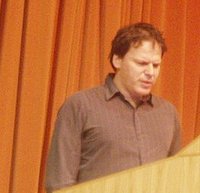
Nevertheless, there were many interesting papers (among others by David Graeber, see image to the left). I’ll have a look at them during the following days and weeks, (I hope) and will try to summarize some of the discussions.

See also my earlier post For an Anthropology of Cosmopolitanism.

UPDATE 2: A heavily edited version of this text was published in Anthropology Today august 2006. You can read the text here on my personal homepage

UPDATES

Summary of David Graeber: There never was a West! Democracy as Interstitial Cosmopolitanism

Owen Sichone: Poor African migrants no less cosmopolitan than anthropologists

Thomas Hylland Eriksen: Cosmopolitanism is like respecting the ban on smoking in the public

panel

I'm back from the conference Anthropology and Cosmopolitanism at Keele University (1h from Manchester, UK). As I've learned from entries on Savage Minds, job hunting and networking are a main point of anthropology conferences arranged by the AAA (American Anthropological…
Read more

“Ethnography as the inscription of participatory experience”

After an oh so long time in the field, I’ve finally got around to make a summary of some good advice I’ve returned to from time to time during my stay. They’re rather commonsensical knowledge for any graduate in anthropology, but it’s surprising how quickly I get accustomed to the details of everyday life, and thus stop paying attention… (from Writing ethnographic fieldnotes (Emerson, Fretz and Shaw, 1995)).
[teaserbreak]
On focus: – how to look in-order-to write (p.26)
*) on a scene: take notice of initial impressions available to the senses
*) give priority to processes (rather than causes etc); what is occurring (rather than why)
*) look for practical concern of actors; – conditions and constraints

On description (p. 32-):
*) write down the details of key components of observed scenes and interaction
*) avoid generalising characterisations – be concrete!
*) concrete sensory details of the scenes, settings, objects, people, action and talk
*) concrete details of everyday life which show (rather than tell)
*) how are emotions expressed (careful with generalisations…)
*) sensory (rather than analytic) adjectives
*) verbatim (rather than summarised) dialogue
+ the accompanying gestures, facial expressions, movements, postures…
*) sensory imagery (rather than evaluative labels)
*) immediate details showing agency and process in situations, auditory and kinetic details – evoke all senses which recall the moment of the experience (p. 72)
*) specify the conditions under which people invoke and apply terms (p. 139)

On reflection:
*) self-consciously recognise my own fundamental orientations (p. 62).
*) avoid evaluative wording; – but when using an evaluative term describe what led to the judgement
*) highlight the process of determining meaning
*) how are my accounts products of my (implicit) decisions about participation and description?
*) how do social events come to be perceived and written up as data? → reflect on the interplay/dialectic relation between theory/analysis and the creation of data. (Data are products of prior interpretative and conceptual decisions (p. 167).
*) which incidents/experiences toughed off particular attention and interests?
*) “see how our own renderings of others’ … worlds can never be descriptions from outside that world … understand our own enterprise in much the same terms that we understand those we study” (p. 216)

On writing:
*) remember the interplay of concrete exemplification and discursive commentary (p.174): – remain sensitive to how analytic reframing of ethnography might distort (local) meaning
*) when giving ethnographic examples; present the negotiated, processual quality of interaction (p. 175).
*) remember when presenting: the text about people’s way of life creates that world as a phenomenon for the reader (p. 214).
*) the reader should be able to assume the producer (i.e. me), the research process and the product (the text) as a coherent whole → (what I learnt occurred on spesific occations and was shaped by methods and modes of participation) (215).

After an oh so long time in the field, I’ve finally got around to make a summary of some good advice I’ve returned to from time to time during my stay. They’re rather commonsensical knowledge for any graduate in anthropology,…

Read more

Space, time and revolt: – My blog, my project and I, part 2

The working title of my project has been Communities in the making: Identity and belonging in postcolonial Paris and London. Initially, the idea was to do a similar project to the one I had done for my master thesis. However, after I came to Paris I quickly learnt that the situation here is quite different from the one in London 6 years ago. The first thing I realised was that it was no wonder my first fieldwork went pretty well, but – hélas – I yet don’t see any reasons for this one to follow suit…
[teaserbreak]
In London 1999, I stumbled right upon the climax in the creation of a home-grown British Asian identity. And what chance, because that kind of identity politics was exactly what I had prepared for. Before I crossed the North Sea to arrive in London I had read Paul Gilroy’s brilliant There ain’t no black in the Union Jack almost to pieces, and what I found amongst the second generation British Asians was a situation quite similar to the one Gilroy described amongst black Britons 10-15 years earlier. (Gilroy shows how a way of being black and British had been created through political struggles, a process where music and social/political movements played an important role. The British Asian identity politics I found going on in London in the second half of the 1990s was formulating a strategic, or political identity, as a response to stigmatisation (for a large part).

And then I went happy go lucky to Paris to find a French, republican equivalent…

Perhaps the Marche pour l’Egalité in 1983 (also called “march for the Beurs (French Arabs)”) can be compared to the identity political process I witnessed in London, but there are so many differences that perhaps it would be a too gross simplification to equate the two phenomena. To the extent that there are or have been identity political movements here in France, I think they would take a very different shape.

These different shapes are of course exactly what I’m here to look at, but until now I have had problems finding a nice little comparable and “studiable” phenomenon. Instead of something small, manageable and significant, I’ve become utterly overwhelmed by noteworthy phenomena and processes going on, and – of course – by an accelerating amount of academic literature on whatever imaginable and relevant subject. For instance, it’s been written books on the situation of French Arabs and the situation in the banlieues at least since 1983… And every month there are new publications coming – I have lost track of books and journals already published on the November 2005 riots; Banlieue, lendemains de révolte, La République brûle-t-elle?… (I’ve got four of them but there are many more).

So, after I had become aware of – through the confrontation with the French context – how focused and pertinent my previous field study had been, I understood that I needed a sharper and more locally adapted focus for my approach here. My first idea was to look at interaction in, and appropriation of, space. The first two months of my fieldwork I lived next to the neighbourhood of Belleville, and every day I crossed through a field of ethnic, cultural and social diversity with is perhaps one of the most complex on earth: Relatively recently arrived East Asians establishing new enterprises, recently arrived West Africans and equally recently arriving bobos (bohemian bourgeoisie artists and professionals – predominantly, but not exclusively white (and quite a few of them seem to live in ethnically mixed couples)), the long-staying North African Muslims and North African (Tunisian) Jews and the old white artisan and working class, apparently all together… (Apropos the working class element; funnily, at an exhibition at the Town Hall recently, I heard an interview with the photographer Willy Ronis who recounted that he had lived next to Belleville 70-80 years ago, but had been prohibited to go there from his middleclass father, presumably because of it’s working-class shabbiness. Luckily, for those of us who appreciate good photos from Paris he started hanging around there as an adult).

In addition to a research focus on the appropriation of space, I was also thinking of looking at the re-appropriation of history, which was also a phenomenon that quickly grabbed my attention. Before I came here I had just read the anthropological classic Europe and the people without history by Eric Wolf (which as brilliant as Gilroy’s book, here my favourites turn up, one after the other…). And the funny thing was that while only a few of my informants in London said, to quote Asian Dub Foundation; “we’re only here ‘cause you were there”, the theme of France’s dependence on it’s colonies, the atrocious history of slavery, the work the (former) colonial subjects have done and still do here reverberates everywhere – from rap songs to what the local cornershop owner easily will chat to you about… So yes, the re-appropriation of the history of France seemed like a relevant approach.

My contemplation had come about this far when the banlieues seemed to explode last autumn. Whatever I’d been thinking concerning focus for my research until then just drowned in an overload of information. The angry kids outside Paris didn’t seem directly relevant in my comparative study (just as the riots in Bradford, Burnley and Ilford hadn’t made much impact on my findings in London), however the bearings the November riots have had on the media as well as the politics is worth a research project in itself…

(As I write this, on one of the numerous talk-shows which goes on for hours and hours into the night, I can hear them mentioning the autumn’s revolt as they’re discussing the CPE (“All that for that”, as they somewhat self-ironically have dubbed the discussion)… Right now, Alain Finkielkraut – with messy, half long hair, round glasses and a broad stripy tie, a French intellectual, obviously… – seems to be suggesting that the French youth is malleable and easy to seduce; – the president of the student organisation is shaking his head, the porte-parole of the ruling party is looking almost bored… I’m about to lose track of the task of finishing this, absorbed as I easily become of these French discussions… I ought to study one of them anthropologically, as a ritual. If they don’t talk all at once sooner or later, the event has not been very successful). The law on “equal opportunities” (l’égalité de chances) where the CPE has been part and which has been messing up the whole country for more than a month, is meant to be an answer to the problem of the banlieues. The response is rejected by a majority of the French population, including quite a few of the banliusards themselves.

Maybe the law obliging schools to teach the positive sides of colonisation would have been scraped sooner or later anyway, and maybe the silent non-celebration of the centenary of the law on laïcité (separation of state and church) and the bicentenary of Napoleon’s victory at Austerlitz would as well have been subdued anyway, but my impression is that the sensitivity to colonial/historical issues is nothing but gaining in importance at the moment.

So, yes, a focus on a re-appropriation of history could be a well-founded choice for this fieldwork. It fits well in with the larger, comparative object of my research project as well, as this new scrutiny of the history of France also can be seen as a next step in identity politics: British Asians (e.g.) made it possible to be British in new ways – they widened the boundaries of “Britishness” – through reversing and removing the stigmas that for a long time had been attached to their South Asian origins and which had excluded them from being British. The critique that is being lanced against French national history – devoirs de mémoire, “the duty to remember” – can be interpreted as a challenge to the omissions and forgetfulness incorporated into the national history of former colonial powers (as well as other nations). To be French is not what one thinks it is… And by what right can one exclude the descendants of slavery, descendants of soldiers fighting for France in numerous wars, the migrant workers participating in the glorious growth of the post-Second World War period and so on from being citizens of this nation/republic? The empirical phenomenon almost fits too well with my new infatuation for Eric Wolf’s perspective, as well.

For a while much of my attention has been on this re-appropriation of first space, and then more and more of time. But then suddenly, France erupts again. A friend of mine reminded me that all these demonstrations and revolts fit perfectly with my research focus on communities in the making… Yes, she’s right. And I start to reflect on all the anger, revolt and political commitment I have come across here. In fact it’s been so much of it that I’m considering revising the working title of my project to Revolt and belonging in postcolonial Paris: community in the making.

The working title of my project has been Communities in the making: Identity and belonging in postcolonial Paris and London. Initially, the idea was to do a similar project to the one I had done for my master thesis. However,…

Read more

Do anthropologists have anything relevant to say about human rights?

Anthropology News April focuses on the topic anthropology and human rights. Both anthropologists and non-anthropologists have been asked to answer the question: Do anthropologists have anything useful or relevant to say about human rights?

In Gerald F Hyman’s view (Director, USAID Office of Democracy and Governance), anthropologists contribute little to the development of human rights themselves or a human rights regime because anthropologists are skeptical of normative claims.

Sheila Dauer from amnesty international makes a similar point, criticizing the idea that human rights are a Western idea and than introducing them might even be a neocolonial act:

When anthropologists support the idea that the changes the changes people are working for on the ground that are based on human rights standards are “Western” or “neocolonial,” they are using the same argument used by governments and others in power to repress less powerful sectors of society—ethnic and racial minorities, women and other groups. Within the human rights movement, conceptualizing human rights standards as universal is now thought of as bringing local meanings into dialogue with human rights standards to mutually reinterpret them and to find ways they can apply locally—a kind of cultural negotiation.

(related see Democracy Isn’t ‘Western’ by Amartya Sen that also was debated on Savage Minds)

Victoria Sanford calls for “activist scholarship”:

It is not uncommon within the academy for lived experience to be dismissed as unscientific or not relevant to real, objective scholarship. This is completely backwards because it is the academy that needs to be relevant to the reality of lived experience.

Advocacy and activism do not diminish one’s scholarly research. On the contrary, activist scholarship reminds us that all research is inherently political—even, and perhaps especially, that scholarship presented under the guise of “objectivity” is often little more than a veiled defense of the status quo. Anthropologists can do better than that. We can and should use our expertise to support rights claims in the communities where we work.

She has a nice homepage with lots of pictures and several articles about her conflict and peace research in Guatemala and Colombia.

Veena Das is sceptical. Institutional transformations in the universities in the US and elsewhere are threatening the kind of free inquiry on which critical understanding rests:

I see a far greater threat to anthropology’s capabilities for engaging politically difficult questions based upon good evidence from everyday practices that govern research in universities than from direct censorship.

>> read the whole article in Anthropology News (removed, no longer available)

UPDATE (9.10.06):
The October 06 issue of Anthropology News asks the question Do Anthropologists Have an Ethical Obligation to Promote Human Rights? (removed)

SEE ALSO:

Declaration on Anthropology and Human Rights Committee for Human Rights by the American Anthropological Association

“We have a huge responsibility to give back to the places we study from”

Annelise Riles: Anthropology, Human Rights, and Legal Knowledge: Culture in the Iron Cage

Sally Engle Merry: Human Rights Law and the Demonization of Culture (And Anthropology Along the Way)

Links updated 12.5.2018

Anthropology News April focuses on the topic anthropology and human rights. Both anthropologists and non-anthropologists have been asked to answer the question: Do anthropologists have anything useful or relevant to say about human rights?

In Gerald F Hyman's view (Director,…

Read more

Conference blogging: “Quit using the word ‘culture’ wherever possible”

On the recent conference by the Society for Applied Anthropology, Mary Odell Butler from Battelle suggested that anthropologists ought to quit using the word ‘culture’ wherever possible, according to Judd Antin at Technotaste who writes:

“The larger and more interesting point she made, is that talking about culture instead of more specific perceptions or processes, is a scapegoat. It relieves us of the burden of talking about specific ideas, habits, and histories. She gave an example that I remember well. Contrast these two statements:

Many African-American women have developed a culturally-based perception that they will be disrespected in community healthcare clinics.

vs.

Many African-American women have learned through their experience and that of their friends and family that they will be disrespected in community healthcare clinics.

Culture, in other words, is too often a gloss for actual perception and practice. Why not call a rose a rose?”

>> read the whole post on TechnoTaste

Judd Antin has written two more posts about the conference: Wednesday Morning at SfAA and SfAA 2006: To Start. There was no press coverage (no surprise). Jen Cardew at anthroblogs did some conference blogging, but the notes aren’t especially reader-friendly.

Jen made an interesting remark about getting in touch with people at conferences. It’s an advantage to be a smoker:

I would like to note that the only people who have approached me, or that I have approached at the conference thus far have been smokers outside on a smoke break. I am actually thankful that I am a smoker right now, what a wonderful social tool! I’m kind of shy, so it is not too often that I approach people to chat.

Jen has also written about Smokers as a Subculture

SEE ALSO:

Emphasis on ‘culture’ in psychology fuels stereotypes, scholar says

The Culture Struggle: How cultures are instruments of social power

Thomas Hylland Eriksen, Savage Minds: An old warhorse revisited: Do we need another book about culture?

Thomas Hylland Eriksen: Why culture should be brought back in

The Secret Society of Anthropologists

On the recent conference by the Society for Applied Anthropology, Mary Odell Butler from Battelle suggested that anthropologists ought to quit using the word ‘culture’ wherever possible, according to Judd Antin at Technotaste who writes:

"The larger and more interesting point…

Read more