search expand

”Eurovision produces a new form of unity”

The Eurovision Song Contest is torture to my ears”, was one of my recent Facebook status messages. But as I learnt, the mega event is not primarily about music, it’s a ritual, a transnational social event that connects people and that – according to a recent paper “produces a new form of unity among people in Europe”.

In the most recent issue of the European Review of History, anthropologist Marijana Mitrovic analyses some of the recent Serbian contributions (2004-2008) to the Eurovision Song Contest (ESC).

In her view, the ESC is a good place to discuss potentials for creating a critical, post-national and cosmopolitan European public sphere that challenges the governing paradigms of identity and belonging.

She writes:

My thesis is that both the ESC and the strategies of Serbia’s participation in this event present attempts to move on from bipolarisation (East/West on the geopolitical map of Europe and First Serbia/Second Serbia in Serbia), respectively, to turn bipolarisation to multiplicity – and through that, paradoxically or not, to produce a new form of unity.

The Western, more ironic stance towards the competition can be seen as opposed to a more strategic attitude of the Eastern European participants, she writes. Similar observations were made by Onnik Krikorian at Global Voices. “While some media reported lagging interest in the 54-year-old competition”, he writes, “countries such as those in the former Eastern bloc continue to take it seriously.”

Popular culture events such as the ESC have according to Marijana Mitrovic “the power and ability to reshape the geopolitical map of Europe and are also used in this way by the new and aspiring member states of the European Union”:

Those are mostly countries that are undergoing a post-socialist transition. Participation in the ESC and a potential victory are a chance for them to invert the social and economic order, on a symbolic level. But paradoxically or not, with that inversion, they also integrate into Europe and inscribe themselves into its symbolic map. Thus rite de passage becomes a transition ritual indeed.

The contributers used the ESC to transform the image of the Balkan/Serbian from a militant and non-cultivated savage, into someone civil, emotional, yet archaic – while at the same time promoting a ”certain level of (Balkan?) universality”. The “new face of Serbia” is “pacified and friendly” and “meets both European and local values”. This new Serbia “is a ‘country in the Balkans, a country of peasants’, but peasants who recognise European values.”

An example is the performance of Zeljko Joksimovic (2004)

Serbia and Montenegro - Eurovision 2004 - Lane moje (LIVE)
❤❤❤ Zeljko Joksimovic and Ad Hoc orchestra - Lane moje - The song came on the 2nd place after a great competition with Ukraine. Only a difference of 17 points !... About Zeljko - he plays 11 musical instruments!!! Istanbul 15 May 2004.">

The anthropologist comments:

Visual identity, crucial for the whole construction, is almost entirely recycled form the ‘memories’ of medieval Serbia. The members of his ad hoc orchestra are dressed in quasi medieval garments, while Joksimovic’s suit is modern, white and minimalist, but with an impressive ‘ethno’ accessory – modification of the belt typical of Serbian costume with an attached golden needle. He has a perfect haircut, his beard is tidy, he is sophisticated, reserved, unobtrusive and somewhat apart from the scene.

By means of a minimalist and modernised wardrobe, accessories and make-up which strongly referred to the medieval tradition of Serbia, the Balkans, but also the Byzantine Empire (not the Ottoman, although the Balkans are often associated with the Ottoman legacy), the Serbian team tried to transform the image of the Balkan/Serbian male, and people for that matter, from a militant and non-cultivated savage, or brute, always ready to fight, into someone civil, emotional, yet archaic

The recipe, she writes, was followed by the Croatians in 2005 and 2006, the Bosnians in 2006 and 2007, and peaked in the winning solution in Serbia’s 2007 winning song Molitva.

Many different groups, including socially marginalized groups, ethnic and sexual minorities invest their expectations and cultural preferences in this spectacle. Gay organisations are among the greatest fans of the event. They see this event as a symbolic representation of differences that guarantees the possibility of their social visibility according to Marijana Mitrovic:

Although some have derogatively proclaimed Marija Serifovic’s performance as an overtly lesbian one, that did not prevent their countrymen from awarding her a maximum 12 points. (…)

Preparing her ESC performance, her creative team reached the solution intentionally offered to be read as gay (with five female backing vocalists dressed in male suits the same as that of the lead singer, one of them locking hands with Marija to connect two halves of the heart tattooed on their hands). The symbolic value of her victory gained special weight through the association of her performance with lesbians and her origin with Roma communities in Serbia. It was argued that this was a victory for Serbian minorities as well.

But the problem with the new politics of Serbian identity is according to the researcher that the last revision of the past has erased all recent past, more than half a century of the region’s history:

Instead of continuity, ‘a time hole’ is opened up. This was reflected in the performances chosen to represent the state. For the turbulent sociocultural Serbian history, identity constructions based on the recycling of different memories turn out to be some of the main mechanisms for the construction of potential ‘new’ identities. Music themes and the way they are performed, as part of the representational and signifying system, manage to evoke and embody the nostalgia for the memory of the past in rational and affective ways; nonetheless, they also shape and direct the process of building and performing the national identity in the present and for the future.

I just picked some parts of her paper that is only available for subscribers.

On her webpage you can read a related paper about music and the “new face of Serbia”: Serbia – from Miki and Kupinovo to Europe: Public Performance and the Social Role of Celebrity (pdf).

Marijana Mitrovic is by the way member of the Eurovision Research Network.

Check also the overview over the ESC 2010 by anthropologist Erkan Saka

Links updated 23.5.2014

SEE ALSO:

Earth Hour – The first globalized ritual?

“Pop culture is a powerful tool to promote national integration”

Durham Anthropology Journal: How “post-socialist” is Eastern Europe?
How anthropology in Eastern Europe is changing

For an Anthropology of Cosmopolitanism

”The Eurovision Song Contest is torture to my ears”, was one of my recent Facebook status messages. But as I learnt, the mega event is not primarily about music, it’s a ritual, a transnational social event that connects people and…

Read more

New Open Access Journal: Anthropology Reviews: Dissent and Cultural Politics (ARDAC)

Is this one of the first real web2.0-journals in anthropology? A new Open Access journal was launched: Anthropology Reviews: Dissent and Cultural Politics (ARDAC)

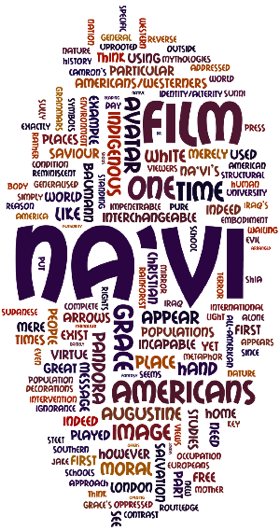
It is no traditional journal. ARDAC was developed from within a social network site (Ning) and its aim is to incorporate web 2.0 technologies, photography, video, internet‐based content as well as traditional text (not in the first issue, though). In addition to traditional abstracts, the articles have their own “word clouds” (see example on the right – from the review of the film Avatar).

Interesting: The journal was inspired by our first Open Access Anthropology Day in 2009 and “is released this month to commemorate the young history of open access anthropology and to join the many new publications under the practice of open access”, as editor Àngels Trias i Valls writes in her editorial Open Access Anthropology 2.0 as a type of altermodern experimentation.

The journal is innovative in another way as well: It is more inclusive towards anthropologists outside of the English speaking world: Non‐English speakers are allowed to express themselves in the kind of English that they feel familiar with rather than the kind of edited English that is standard in publications. The journal takes submissions in other languages as well. Work from individuals at early stages of their academic career are welcome as well as more senior academics and inclusive of the academic community at large.

Here a short overview over this issue from Àngels Trias i Valls’ editorial:

– (T)he first contributor, Veronica Barassi, send us an article that ethnographically narrated understandings of dissent and cultural politics through the analyses of discursive technologies and political action.

– Nick White looked at the pertinent issue of ‘copy’ and the issues of legality and illegality in music filesharing on the Internet.

– Hagai van der Host produced a fascinating review of the film Avatar, mirroring some of the ways in which film mythologies correspond to political realities, and how the levels of allegory and projection spoke for discursive discussion on orientalism, the morality of counterfeit and cultural imperialism in the American / Iraqui conflict.

– I was thankful of the opinion articles, from Clare Perkins and Stavroula Pipyrou, because they made distinctive points about the possibility of ‘re‐ directing the ethnographic lense’ (in Clare’s case of using anthropology to think about genetically modified products) and re‐telling the social appropriation of violence (in Stavroula’s Calabrian Mafia) in a way in which both articles convinced me of the possibility of using anthropology to re‐ position ourselves theoretically and in research practice in larger communities of knowledge.

– At the closing of this number Maria Paulina de Assis and Maria Elizabeth Bianconcini de Almeida brought an article that looked at the relationship between education and digital exclusion from an educational perspective and on the possibilities of multi‐ educational strategies for global educational contexts that have now consolidated through the Internet.

>> overview over the first issue

>> overview over Anthropology Open Access Journals

Is this one of the first real web2.0-journals in anthropology? A new Open Access journal was launched: Anthropology Reviews: Dissent and Cultural Politics (ARDAC)

It is no traditional journal. ARDAC was developed from within a social network site (Ning) and…

Read more

Leipziger Ethnologiestudierende starten “Ethnoradio”

Seit letztem Jahr protestieren sie für bessere Studienbedingungen. Nun ist die Idee entstanden, produktiv mit der Situation umzugehen und den Protesten einen ethnologischen Blick zu verleihen – mittels eines Ethnoradios, meldet die flaschenpost, der ethnologische Blog der Uni Leipzig.

Auf http://weltempfaenger.wordpress.com/ lassen sich die Beitrage anhören zu Themen wie Griots – Dichter und Sänger Westafrikas oder Waskati – Selbstmordattentäter in Afghanistan.

Es gibt auch einen interessanten selbstkritischen Beitrag Warum Ethnologie im Radio. “Wir” ziehen in die Welt und schreiben ueber “die anderen”: Besteht da nicht die Gefahr des Ethnozentrismus?

Eine Berufskrankheit von Ethnologinnen ist das Exotisieren anderer Menschen, ausserdem das Ueberbetonen von “Kultur” und “Religion”, wie auch im Beitrag über Selbstmordbomber in Afghanistan deutlich wird. In den Erklärungen, die uns da geboten werden, ist kaum etwas vom Krieg in Afghanistan und der Rolle der USA zu hören, dafür viel über Ehre und Religion, traditionelle Konfliktlösung etc. Diese kulturalistischen Perspektiven hat Ethnologe Talal Asad in seinem Buch On suicide bombing kritisiert. Als Hörer frage ich mich ausserdem: Was sind die Quellen des Beitrages?

Andere (deutschsprachige) Radio-Projekte / Podcasts: ethnowelle und talking anthropology

SIEHE AUCH:

Ethnologen, raus aus der Kulturfalle!

Vermitteln Ethnozentrismus und ein ueberholtes Bild von der Ethnologie?

Ethnologie-Einführungen und die Sonderstellung der deutschen Ethnologie

Ethnologie und Oeffentlichkeit II: Das ambitioese Projekt der Muenchner Ethnologiestudierenden

Michael Schönhuth: Mehr Interesse für eine öffentliche Ethnologie?

Seit letztem Jahr protestieren sie für bessere Studienbedingungen. Nun ist die Idee entstanden, produktiv mit der Situation umzugehen und den Protesten einen ethnologischen Blick zu verleihen - mittels eines Ethnoradios, meldet die flaschenpost, der ethnologische Blog der Uni Leipzig.

Auf…

Read more

"Bisarre skikker kjennetegner norske kvinners dagligliv"

(LENKER OPPDATERT 2.4.2020) Å eksotisere det (antatt) kjente er alltid en nyttig øvelse. Også den hvite majoritetsbefolkningen holder på med mye rart som er en analyse verdt. I et nytt innlegg tar masterstudent i sosialantropologi Rannveig Svendby for seg norske kvinners “bisarre skikker”.

Vi leser om diverse kroppsritualer på badet, om mystiske masker og om medisinmenn som former “kroppen etter den kulturelle oppskriften på skjønnhet”. Om hvithet som “må eksponeres med måte” at “uheldig bleke kvinner” som derfor benytter seg av et av de mange stekerommene landet over.”

>> les hele saken på Rannveig Svendbys Aftenposten-blogg

SE OGSÅ:

Integrering: “Snakk mer om norsk kultur!”

Moralpoliti et innvandrerproblem?

Hjemme bra, men borte best? – Fagkritisk dag om feltarbeid “i eget samfunn”

Da danske kvinner gikk med burka og radikale norske kvinner med skaut

Hvor er antropologene når Bygde-Norge går på jakt?

Fieldwork in Papua New Guinea: Who are the exotic others?

La oss studere normaliteten!

Marianne Gullestad – majoritetsforsker og annerledesantropolog

(LENKER OPPDATERT 2.4.2020) Å eksotisere det (antatt) kjente er alltid en nyttig øvelse. Også den hvite majoritetsbefolkningen holder på med mye rart som er en analyse verdt. I et nytt innlegg tar masterstudent i sosialantropologi Rannveig Svendby for seg norske…

Read more

Indianere: Drit og prostitusjon istedenfor pil og bue

– Vi må slutte med det romantiserende bildet av indianere som løper rundt med pil og bue i skogen. Mange lever av tigging, og det er mye dritt og prostitusjon, sier antropolog Christian Sørhaug i et intervju med Apollon.

Han forteller om et ganske spesielt feltarbeid hos Waraoindianerne i Venezuela. I to uker har han vært på en “enorm og stinkende søppelhaug”, som ”i flere tiår har vært et viktig kulturelt møtested mellom den vestlige kulturen og landets 25 000 waraoindianere.” Dit drar indianerne for å finne klær, samle spiker, metaller, kokekar og økser. En uke bruker de for å padle dit. Turene gir prestige.

Sørhaug var der i to uker for å se på flyten av materialer fra søppelplassen til landsbyen i elvedeltaet. “Jeg har studert hvordan den hverdagslige kulturen har endret seg i en landsby når globaliseringsprosesser tvinger seg på. Det er feil å si at de mister kulturen. De finner nye, kreative måter å være i verden på og har gjenoppfunnet seg selv på nye måter”, påpeker han.

>> les hele saken i Apollon

SE OGSÅ:

Primitive indianere eller primitive journalister?

Bolivia: Where shamans understand colonialism as sickness

Why was anthropologist Miguel Ángel Gutiérrez Ávila beaten to death?

Indianernes kamp om vannet: “Film er det beste mediet”

“But We Are Still Native People” – Tad McIlwraith’s dissertation is online

– Vi må slutte med det romantiserende bildet av indianere som løper rundt med pil og bue i skogen. Mange lever av tigging, og det er mye dritt og prostitusjon, sier antropolog Christian Sørhaug i et intervju med Apollon.

Han forteller…

Read more